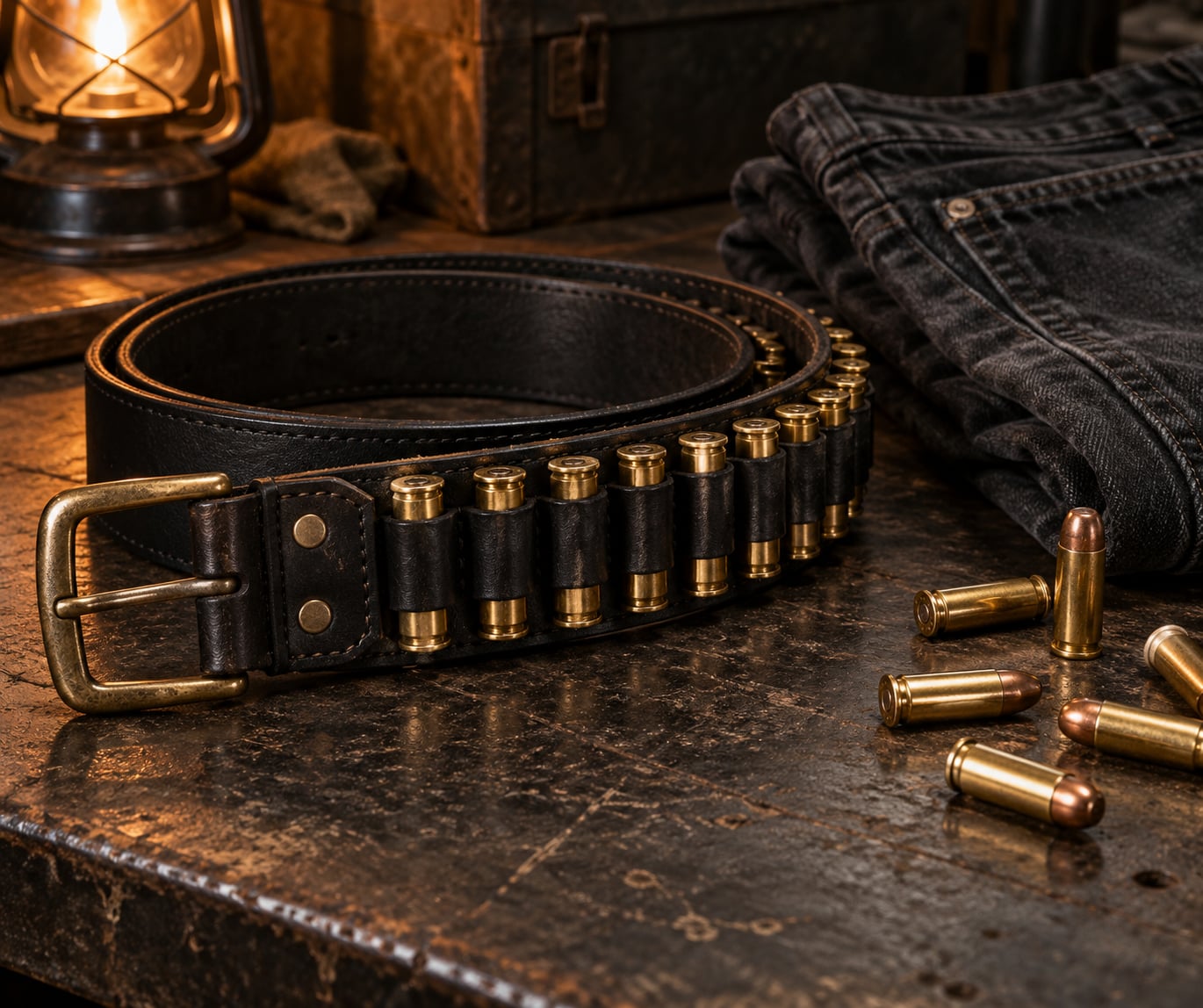
A bullet belt is a leather strap fitted with ammunition, empty brass cartridge casings, or replicas of them, worn across the waist or chest as an accessory. The history of the bullet belt in metal fashion runs from sixteenth-century military bandoliers through 1950s motorcycle culture and 1970s punk into the 1980s metal uniform, where it became shorthand for toughness and rebellion.
Today it sits somewhere between a stage prop, a subcultural badge and a genuine piece of hardware, worn by metalheads, goths, punks and anyone who likes the way a row of brass catches the light.
Table of Contents
- Where Did Bullet Belts Come From?
- How the belt moved from biker gear to stage wear
- Early Metal Stages and the Rise of the Bullet Belt
- How Bullet Belts Became a Symbol of Metal
- Bullet Belts Across Metal Subgenres
- Materials, Design, and Changing Styles
- How to Wear a Bullet Belt Today
- Frequently Asked Questions
- What are bullet belts called?
- What is the difference between a bullet belt and an ammunition belt?
- Who popularised the bullet belt in metal fashion?
- How can you tell real brass from a fake bullet belt?
- Are bullet belts still in fashion?
- Is it legal to wear a bullet belt in public?
- Conclusion
Where Did Bullet Belts Come From?
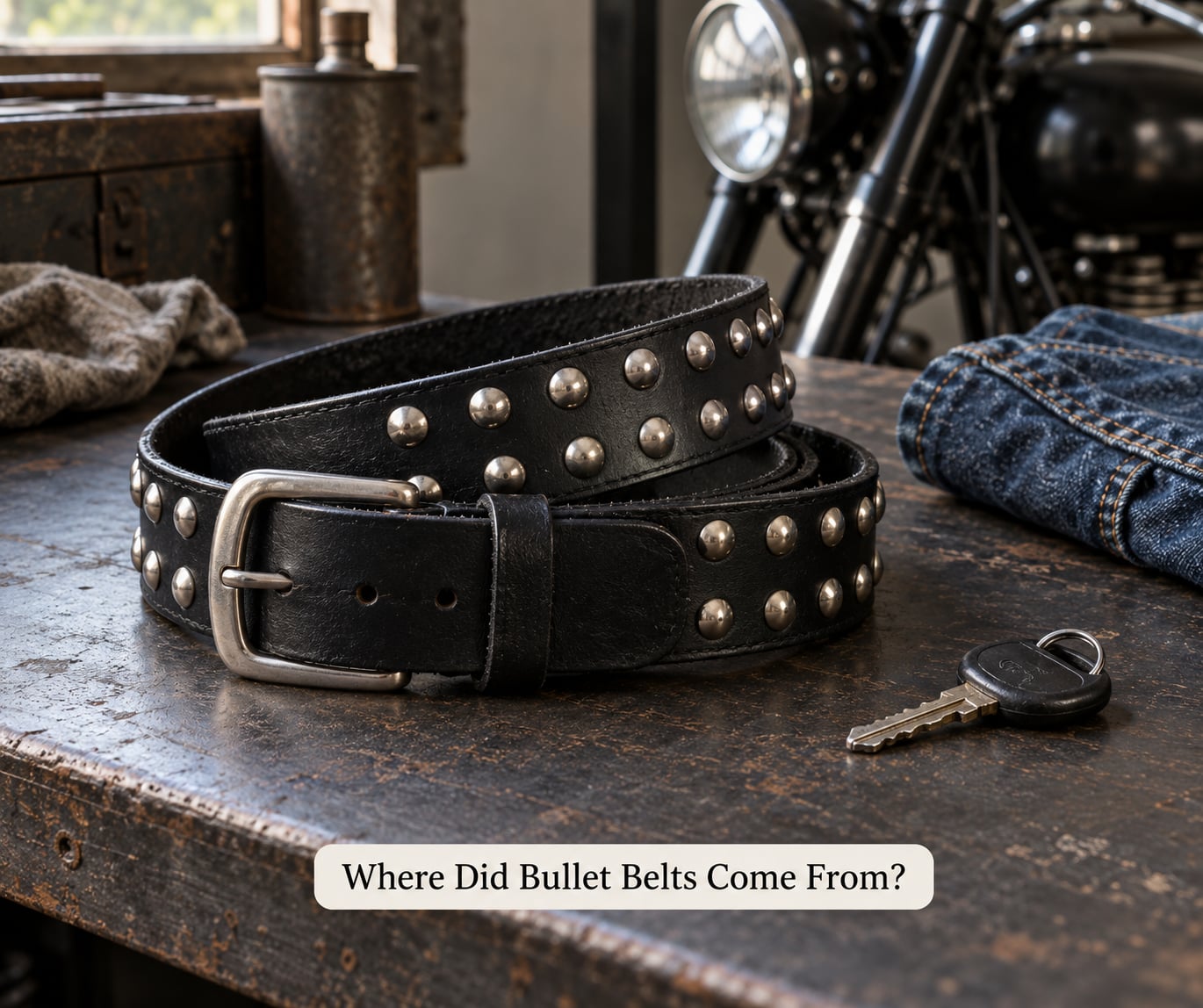
It helps to separate the accessory from the two things people usually mix it up with. A cartridge belt, ammo belt or bandolier is a piece of military equipment that actually holds ammunition and feeds it to a weapon. A studded belt has metal spikes riveted to plain leather for the punk and club look. A bullet belt does neither job; it simply displays the shape of ammunition.
The military ancestor is the bandolier. From the sixteenth century onward, soldiers carried musket and arquebus charges in wooden or leather boxes, boxes of charges, slung across the chest on a strap so a soldier could reload on the move. When paper cartridges replaced loose powder and ball in the late eighteenth century, the box gave way to a flat leather or canvas carrier holding a row of paper tubes, the first item that visually resembles the belt worn today.
The change that matters for fashion history came in the nineteenth century, when metallic cartridges arrived and the shoulder strap gave way to a waist belt carrying individual brass rounds in loops. By the First and Second World Wars the waist cartridge belt was standard infantry kit in several armies. One documented pattern from the Second World War saw resistance units in the Balkans wear the belt double: one set for feeding the weapon, a second across the chest purely because ammunition was scarce and every belt was worth carrying.
Civilian clothing absorbed military detail long before metal did. Motorcycle clubs made the cartridge belt legible as a toughness symbol in the 1950s, where a row of brass across the waist read as mechanical knowledge and road time rather than a costume. Punk picked it up through film, surplus shops and army-surplus stores in the late 1970s, and by the early 1980s it had moved into club clothing and stagewear.
How the belt moved from biker gear to stage wear
The route ran through surplus. Post-war military gear flooded second-hand markets, and surplus cartridge belts were cheap, heavy and unmistakably rugged. Rockabilly musicians bought them for the same reason bikers did: they made a black outfit look like it had a history. Once bands started wearing them under guitars on low stages, the camera started photographing them.
Early Metal Stages and the Rise of the Bullet Belt
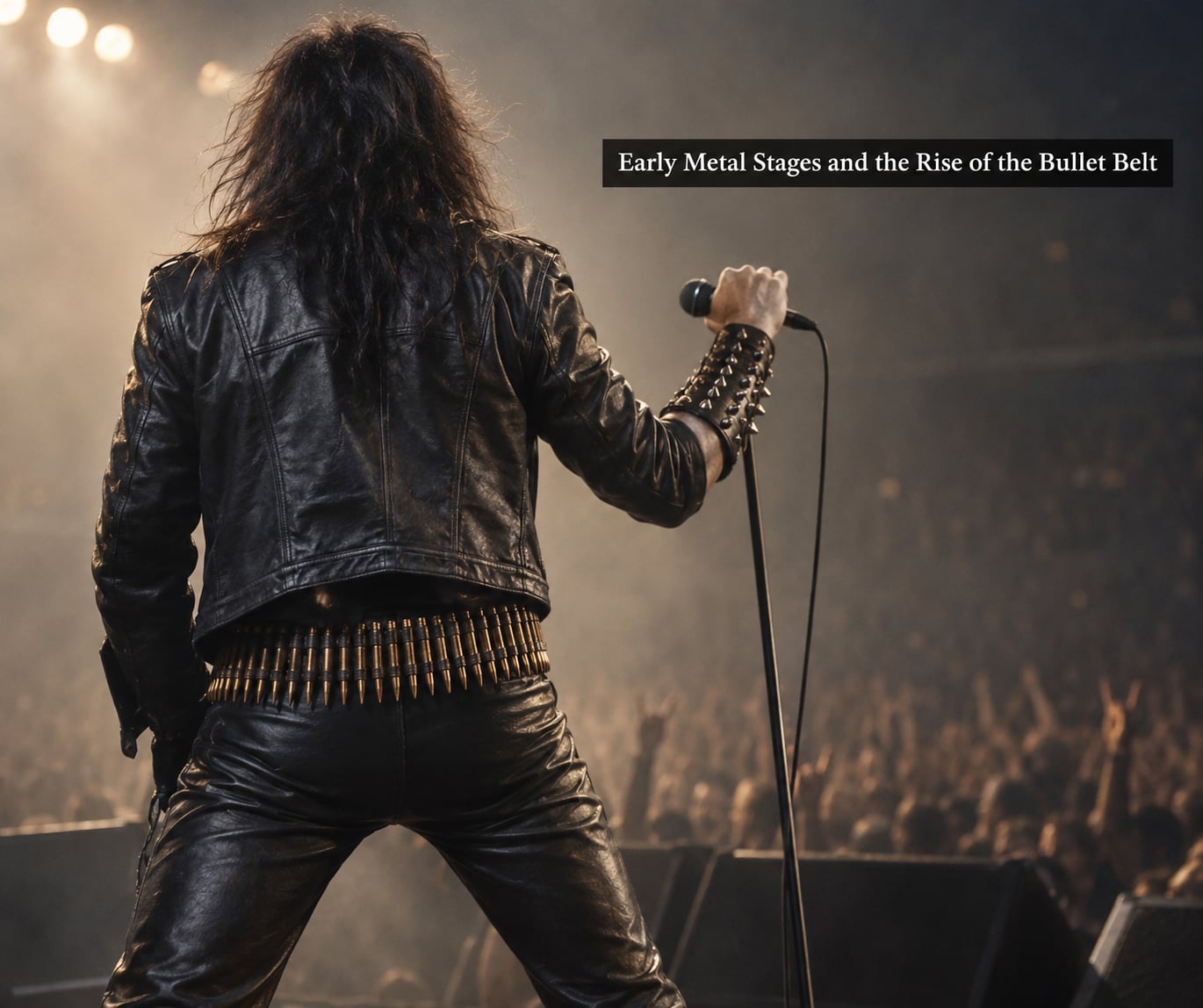
The heavy metal stage of the late 1970s and early 1980s borrowed wholesale from biker and punk imagery because that imagery already looked like defiance. Leather, tight denim, spiked hair, war paint and a cartridge belt formed a coherent costume: the band is hard, the audience is hard, and the music is loud enough to justify it.
The most frequently repeated answer to who popularised the belt in metal is Lemmy of Motörhead. The stage persona built around a battered hat, a bass guitar and combat boots normalised the military-surplus silhouette for metal audiences, and cartridge belts were part of that silhouette even where the exact belt varied from show to show.
In the United States the accessory is most closely associated with the Big Four thrash bands of the mid-1980s. Metallica, Anthrax, Slayer and Megadeth dressed in a near-uniform of black, studs, chains and ammunition, and magazine photography and music videos spread that look far beyond the clubs where it started.
Be careful with origin stories here. Almost every claim of a single inventor that circulates online fails on inspection, because the belt has no inventor: it is a strip of leather with metal on it, and several scenes arrived at the same object at the same time. What is documented is who wore it on stage, in photographs and on records, and the 1980s metal press is unusually well documented on that front.
How Bullet Belts Became a Symbol of Metal
The belt became a symbol because it was cheap to read. A photograph of a musician in a plain black outfit tells you very little; the same photograph with a brass belt across the waist reads instantly as danger. That instant legibility is what a costume piece is for, and it is why the accessory survived where more complicated stage props did not.
Bullet Belts Across Metal Subgenres
There is no rule book here. Subgenre styling is taste and habit, not doctrine, and the same belt gets worn in very different ways by people in the same band. Broad patterns still show up.
In NWOBHM and the British heavy metal scene, the belt usually appears with jeans, a denim or leather jacket and boots, often under a longer coat. The effect is working-class and road-worn rather than theatrical.
In US thrash the belt tends to be wider and more decorative, paired with a studded wristband and a back patch, because the mid-1980s stage look borrowed from biker rallies as much as from punk.
Speed metal leans on a cleaner silhouette. A single brass belt over plain black clothing reads as military and precise, which fits the imagery the music borrows from sword and sorcery art. Glam metal tends to use fewer, shinier metal elements across the whole outfit rather than concentrating them at the waist.
Death metal and black metal are the two where the accessory appears least often on stage, because corpse paint and corpse imagery already carry the shock value. Doom and stoner scenes lean on it more casually, since the belt reads as workshop and motorcycle equipment as much as a stage prop. Modern metal and metalcore bands mostly use the studded belt rather than the cartridge belt, because the hardware trend drifted toward spikes and industrial fastenings.
Collectors of vintage metal fashion and worn battle jackets, or kutten, tend to treat the belt as part of a matched set rather than a standalone piece.
Materials, Design, and Changing Styles
Construction is the part most first-time buyers get wrong, and it is the single most asked question on metal forums: is this belt real? Four builds show up.
A belt with live rounds is a working ammunition carrier. Metalheads mostly avoid it, and for good reason beyond symbolism: live ammunition in public is restricted in many places, and it invites attention from people who are paid to give it.
A belt of empty brass casings is the classic build. Fired cases are looped through slots or riveted onto thick leather, usually cowhide. These are heavy, they rattle, and they wear the leather shiny over time in a way nobody replicates deliberately.
Hollow or resin replicas imitate the same silhouette in zinc alloy or cast resin. They are lighter, uniform in colour and cheap enough to be the mass-market version, which is exactly why metal forums complain about them. Buyers have reported ordering one and finding it is resin within days of arrival, a problem bad enough that honest labelling matters more than any styling tip.
One-of-a-kind custom work tends to use mixed materials: real brass, aluminium, chain, leather offcuts and whatever the maker had in the drawer. These are the pieces that look like nothing else at a show.
Weight is the practical factor most buyers underestimate. A full-width cowhide belt with brass casings adds real kilos around the waist, which is fine for two hours standing at a barrier and unpleasant for a full festival day. Wider straps spread the load better than narrow ones, and single-loop designs wear lighter than double-loop ones.
Fastening varies. Snap buckles are the most common and adjust easily, but they work loose under stage movement. Buckle-and-strap fittings hold better and suit heavier belts. Leather needs occasional conditioning to stay supple, and brass needs a dry cloth to keep from dulling in humidity. Never machine-wash any of it.
How to Wear a Bullet Belt Today
The belt is no longer a metal-exclusive accessory. Goth, punk, industrial and festival crowds wear it constantly, so styling it now is a matter of matching a strong piece to a quiet outfit. That is the whole trick.
Let the belt be the only metal on the outfit. A cartridge belt over plain black jeans, a plain tee and boots reads deliberate. The same belt with a studded jacket, chain and spiked wristband reads as a costume taken straight off a 1985 tour photo.
Wear it where you want the eye. Across the waist works for most body types and reads cleanly. Over one shoulder or across the chest is the biker and Lemmy placement, and it works better with heavier clothing like a leather jacket or a flannel shirt worn open.
Match the finish to the rest of the outfit rather than chasing the brightest brass. Tarnished brass suits distressed denim, vintage leather and workshop clothing. Polished brass suits sharper, more tailored clothes and photographs. A hollow replica with a uniform factory shine next to a genuine worn belt is the comparison other people will notice first.
For musicians, the belt is a costume and should be built like one: secure, comfortable for the set, and broken in before a tour date. What feels like a novelty on a Tuesday afternoon in a bedroom can pull at a shirt and sit badly after an hour of jumping around a stage.
Two practical points. Never wear live ammunition in public, at a school, on a plane or across a border, and check local rules on replica weapons if your build includes anything that looks functional. And be honest about materials, because the fastest way to lose someone’s trust is selling a resin copy as solid brass.
Frequently Asked Questions
What are bullet belts called?
The common names are bullet belt, ammo belt, cartridge belt and bullet bandolier. In metal fashion, bullet belt is the usual term. Cartridge belt and ammo belt also describe real military equipment that holds ammunition, so if you mean the fashion accessory, bullet belt is the clearest word to search and to ask a seller about.
What is the difference between a bullet belt and an ammunition belt?
An ammunition belt is functional military or sporting equipment. It holds cartridges and feeds them to a weapon, and it is built to a specific calibre and pattern. A bullet belt is decorative: it displays rounds or casings across the waist or chest without feeding anything anywhere. They look similar because the accessory was copied from the equipment.
Who popularised the bullet belt in metal fashion?
The answer usually given is Lemmy of Motörhead, whose military-surplus stage look made the cartridge belt part of heavy metal’s visual language. In the US the Big Four thrash bands of the mid-1980s carried it into magazine photography and music videos. No single inventor exists; several scenes arrived at the accessory at the same time.
How can you tell real brass from a fake bullet belt?
Weight is the fastest check. Solid brass casings are noticeably heavy and will usually have a duller, uneven finish from firing or handling. Resin and zinc copies feel lighter, sound different when you tap them, and often show a perfectly uniform colour across every piece. The honest test is still to ask the seller what the metal is before you buy.
Are bullet belts still in fashion?
Yes, though the styling has broadened. Bullet belts remain standard stage wear in metal, and they now appear across goth, punk and industrial clothing as part of a wider interest in hardware and fasteners. What has faded is the idea that the accessory belongs only to metal. Most current wearers treat it as an accessory, not a uniform.
Is it legal to wear a bullet belt in public?
Empty casings and replica hardware are ordinary accessories in most places. Live ammunition is different: carrying loaded rounds can be restricted or illegal depending on your country, state and local rules, and it attracts police attention regardless of the law. Venues, schools and transport operators often ban studded and cartridge-style belts inside. Check your local rules and ask the venue first.
Conclusion
The bullet belt has no inventor and no single origin story. It descends from military bandoliers, got picked up by motorcycle clubs and rockabilly musicians, passed through punk, and landed on the heavy metal stage in the late 1970s and 1980s, where photography turned it into a symbol you could recognise in half a second.
What has changed since is the audience. It now belongs to goths, punks, festival crowds and hardware-fashion fans as much as to metal bands. If you want to start, pick a comfortable width, decide honestly between casings and replicas, and wear it once before you commit to a show.