Protecting your hearing at concerts comes down to three things: wear earplugs that actually seal, put real distance between you and the speaker stack, and take quiet breaks on a schedule rather than when your ears force you. Get those right and you can stand in the pit all night and still hear everything the band is playing.
The catch is that no earplug makes a dangerously loud show safe. Protection cuts the dose you absorb, it does not erase it. Fans who treat earplugs as a reason to stand closer, or to skip the breaks, undo most of the work.
This is the routine I use before a loud show, written for metal and hard-rock nights where the pit is genuinely punishing. It takes about ten minutes of prep and about ten seconds of habit once you are inside.
Table of Contents
- What You Need
- Step-by-Step: How to Protect Your Hearing at Concerts
- Choose the right ear protection
- Protect your ears before the show
- Insert earplugs correctly and confirm the seal
- Use volume and distance as extra safeguards
- Plan your recovery after the concert
- Common Mistakes
- Treating earplugs as permission to stand closer
- Skipping the seal check
- Using one cheap pair for everything
- Trusting a phone decibel app too much
- Leaving at the end and forgetting the recovery window
- Assuming protection means you never need to check your hearing
- Frequently Asked Questions
- Do concert earplugs make the music impossible to hear?
- Can one loud concert permanently damage my hearing?
- Which type of earplugs work best for concerts?
- How far should I stand from the speakers at a metal show?
- How long should I wait before attending another loud concert?
- When should ringing in my ears after a concert see a doctor?
- Conclusion
What You Need
You need four things, and only the first one is really about equipment.
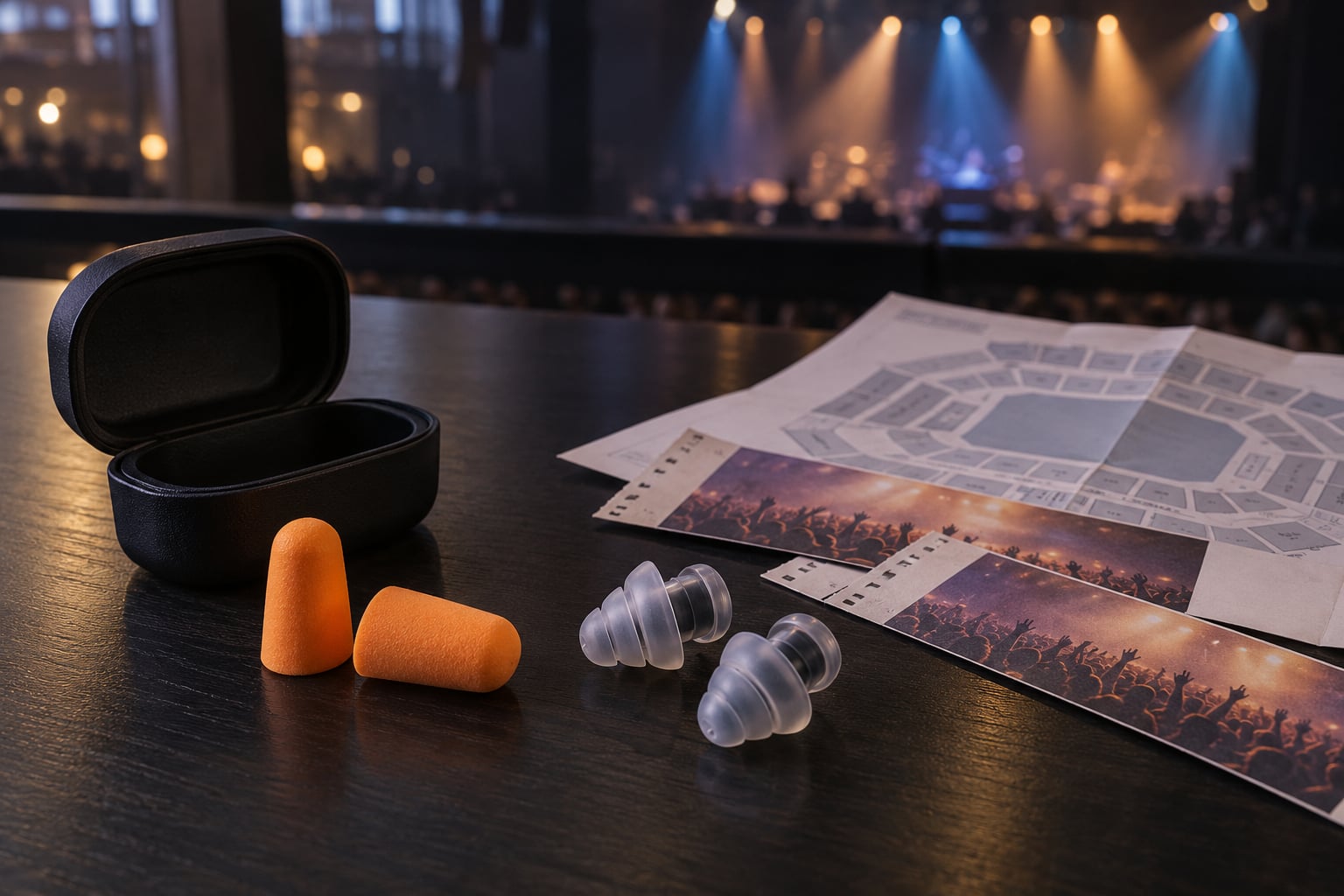
- Earplugs that fit your canal. The single most important item. Foam is cheap and disposable, silicone is reusable, filtered and musician-style plugs keep the mix clearer.
- A small case. A tip jar in a backpack works. Losing one plug in a dark venue at 1am is how people end up with one ear unprotected.
- A phone reminder for breaks. Set it for every hour. You will not remember otherwise.
- A backup pair. One sealed pair plus one spare. Earbuds that fall out mid-set are not protection.
One honest limit before we go further: nothing on this list makes standing in front of a 110 dB stack for two hours harmless. It lowers the dose reaching your cochlea. Both things are true at once.
Step-by-Step: How to Protect Your Hearing at Concerts
Choose the right ear protection
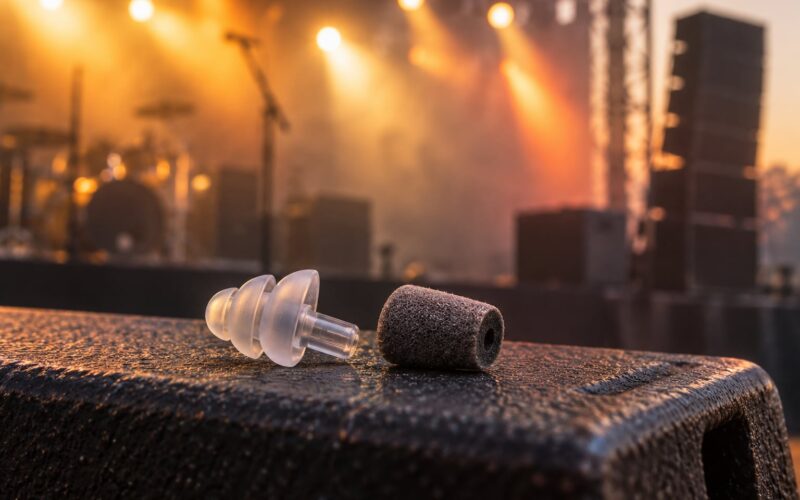
High-fidelity filtered earplugs are the best general answer for a rock or metal show. They use a filter that reduces volume roughly evenly across frequencies, so cymbals still sound like cymbals and you can still hear the mix the way the engineer built it. A flat filter is the whole point.
Foam plugs work differently. They block high frequencies first, which is where most of the damaging energy sits, but that also means the music goes muffled and thin. Plenty of fans decide on that basis alone that earplugs make a show unwatchable, and then wear nothing. On talkbass and drumforum, players who switched to ER-15 and ER-20 style musician plugs report the opposite once they got through the first few shows.
Silicone reusable plugs sit in between: better than foam for clarity, worse than a good filter, and much easier to lose. Custom-molded plugs, the kind made from an impression of your canal, are the best sound quality available and the most expensive, which is why they skew professional. The gearspace crowd mostly talks about custom molds as the only option that sounds normal, just quieter.
Success check: after you insert a pair, you should still be able to hear the kick drum and the vocal clearly, just at a lower level. If the music sounds like it is coming through a blanket, you have foam, and you may need to give filtered plugs a fair trial before you decide earplugs are not for you.
Protect your ears before the show
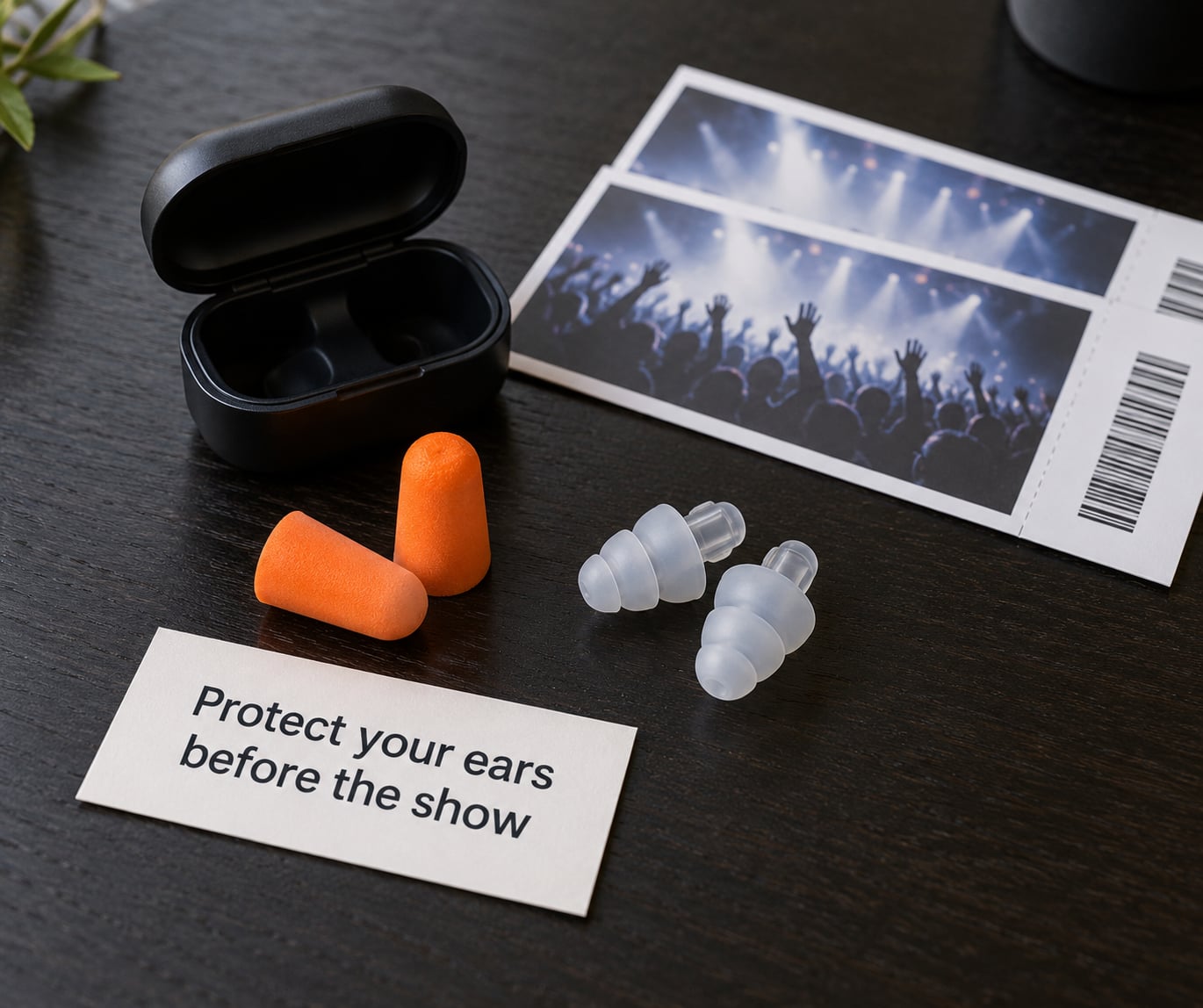
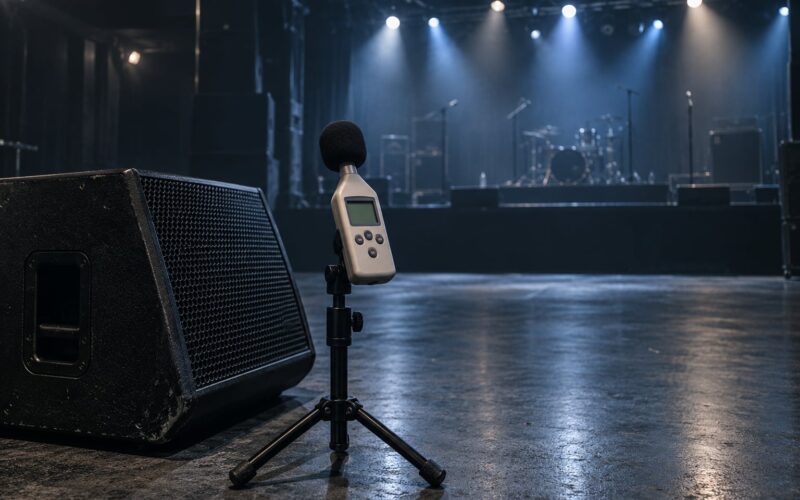
Arriving early is the cheapest protection available. Walk the floor while the room is still filling and stand where you plan to stand, then pull out your phone and run a decibel app. Apps are not lab instruments, but they are good enough to compare the front rail against the back of the floor or the bar, and that comparison is the useful part.
Look for a spot beside the speaker stack rather than in front of it, and further out than feels necessary. Sound pressure falls sharply with distance, and in a room it also bounces off walls and floors, so a barrier position near the side wall often reads quieter than the middle of the floor. Outdoors is better than indoors for the same reason: no reflective surfaces stacking pressure back at you.
If your ears were already tired before you walked in, head noise, a long flight, a night of loud music, you are starting the show with a partially fatigued ear, and the same dose does more work. That is a good evening to wear protection and skip the pit, not a good evening to push through.
Here is roughly what different rooms run at, from the range reported by clinic and audiology sources rather than from one specific show:
| Where you are standing | Rough level | What it means for you |
|---|---|---|
| Back of a small club, 200-cap | Up to about 105 dB at the front | Protection is not optional here |
| Front of house at a small club | Around 107.5 dB measured in one European study | Minutes, not hours, at this level |
| Arena floor, mid-field | About 100 to 105 dB | Filtered plugs plus breaks |
| Front-row pit at a festival stage | 105 to 110 dB | Do not stand there unhelped |
| Outdoor festival, back of field | About 90 to 100 dB | Earplugs still worth wearing |
| Camping near the stage or a generator | Low-level exposure around the clock | The dose adds up across three days |
Success check: your plugs are clean, seated in the case, and you can reach them without unpacking your whole bag. A pair in a jacket pocket beats a perfect pair in a rucksack at the bottom.
Insert earplugs correctly and confirm the seal
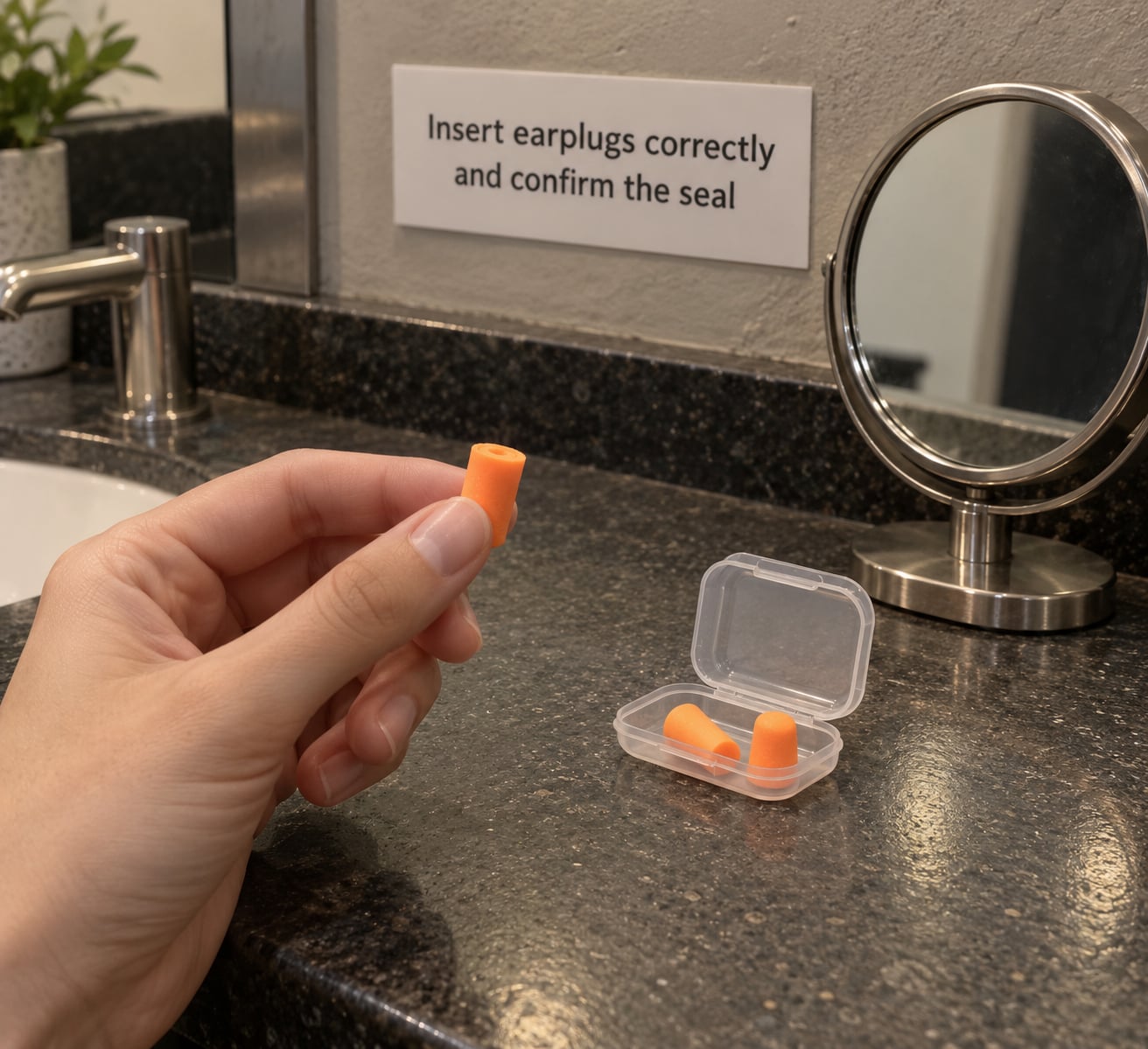
This is the step nearly everyone skips, and a failed seal throws away most of the attenuation the product promised. A plug sitting loosely in the canal is closer to decoration.
For foam: roll it between your thumb and forefinger into a thin cylinder, pull the top of your ear upward with the other hand, insert the rolled end and hold it there for a count of twenty, then let go and let it expand against the canal wall. It should feel slightly pressure-like, not painful. For silicone or filtered plugs, pull the ear up, press the plug in past the narrowest point, then gently pull down on it until it seats with no gap.
Two ways to check the seal. Say something out loud, then stop talking: with a good seal your own voice drops noticeably, and in a quiet room you will barely hear it. Then, once the music starts, take one plug out for two seconds and put it back. If the volume jump is dramatic, the seal is real. If it barely changes, you have a gap.
Nobody on talkbass or drumforum thinks the adjustment period is fun. The first show in filters sounds flat and slightly strange, and the honest fix is to go to two shows in a row before you judge it. That is also what musicians report: accustomed, they say their ears simply stop ringing after a gig.
If a plug goes loose, wet, or uncomfortable, replace it immediately rather than pushing through the set. Post-show users on tinnitustalk are blunt about this, wearing 33 dB plugs and still getting a tinnitus spike. Protection reduces risk, it does not remove it, and a plug that fell out at song four is the same as no plug at all.
Success check: the music is quieter and still clear, there is no pressure pain, and the plug has not shifted when you move your jaw.
Use volume and distance as extra safeguards
NIOSH and CDC guidance uses 85 dB over eight hours as the recommended exposure limit, with allowable time halving for every 3 dB added. Here is what that means in practice, and what a good filtering earplug buys you at the bottom:
| Level at your ear | Approximate safe time | With 20 dB of protection | With 30 dB of protection |
|---|---|---|---|
| 85 dB | 8 hours | About 80 hours | Over 300 hours |
| 95 dB | 53 minutes | About 7 hours | About 28 hours |
| 100 dB | 15 minutes | About 2 hours | About 8 hours |
| 105 dB | 4 minutes | About 32 minutes | About 2 hours |
| 110 dB | 1 minute | About 8 minutes | About 30 minutes |
That right-hand column is the part most guides skip. A 20 dB filter does not just make things quieter, it converts a 100 dB pit into something you can stand in for a couple of hours. A 30 dB filter turns the same spot into roughly a full evening.
Nobody should promise that distance or breaks prevent all damage. They work on the same dose arithmetic as earplugs, just through a different input. Practically, that means stepping off to the side of the stage rather than the front, using the venue’s quieter rooms and corridors between sets, walking the perimeter during the biggest tracks, and taking a real break every 30 to 60 minutes instead of pushing to the encore. The 5 to 10 minutes outside each hour that audiology sources keep repeating is a floor, not a target.
Skip alcohol where you can. Clinic guidance flags it because it affects how the auditory cortex processes sound, increases blood flow in the inner ear, and reliably makes tinnitus worse in people who already have it. Nobody wants to hear that at the bar, but the same people who would research a festival lineup have never looked this up.
Noise-cancelling headphones are not a substitute. They were built to cancel steady low-frequency hum, not the wide, changing, 105 dB wall of a live PA, and at a show you would be adding a second source of sound. Over-ear defenders work, but they are hot and awkward in a crowd. If someone told you to protect your hearing at concerts with noise-cancelling earbuds, they have the mechanism wrong.
Success check: at some point during the set you were outside the densest part of the crowd, and you did not lose the song doing it.
Plan your recovery after the concert
Removing plugs is gentler than most people make it. Reach up and back, take them out slowly, and do not dig. Drop them straight into the case, because a plug that spends a night on a sticky venue table will not seal when you need it.
Then give your ears a quiet evening. Skip high-volume earbuds on the walk home, keep the room calm, and get decent sleep. Silence does not reverse noise-induced hearing loss, but rest periods are when temporary threshold shift settles, and staying loud through the recovery window stacks more dose onto a tired ear.
Most temporary ringing after a show settles within a day or two. Keep a note of when it started and whether one ear is worse, because that answer is the first thing an audiologist will ask you.
Go and see someone, rather than waiting it out, if the ringing lasts more than a few days, if hearing feels muffled or blocked, if you get dizzy, or if one ear is clearly worse than the other. Sudden hearing loss in one ear after a show is treated as urgent. Do not wait on it, and do not assume it is just the noise.
Success check: your plugs are clean and back in the case, and you know what your ears sound like in a quiet room before you go to sleep.
Common Mistakes
Treating earplugs as permission to stand closer
This is the most common one, and the logic is backwards. Protection buys time, it does not buy immunity, so the same move that would have hurt you unprotected is now happening at a lower level rather than not happening. Keep the distance you would have kept without plugs, and take the extra range plugs give you as a longer night rather than a closer spot. Extra tip: decide your spot before you get there, not in the surge when the good places fill.
Skipping the seal check
A loose plug feels almost identical to a sealed one for the first minute, so people never notice the gap. Do the voice test and the remove-and-reinsert test at the start of every set until sealing becomes automatic. Extra tip: if you have narrow canals or a habit of clenching your jaw, filtered plugs with a moulded stem are more forgiving than a plain cylinder.
Using one cheap pair for everything
Foam for the pit, then the same foam for the third festival day, then a club show the next week. The dose is cumulative, and the venue with the least protection is the one where you are also tired. Extra tip: keep a dedicated pair that never gets used for chores or travel, so they stay clean and paired.
Trusting a phone decibel app too much
Phones are uncalibrated, they clip at high levels, and a lot of them read low because the microphone is clipping. Use the app to compare two spots in the same room, not to certify that you are under 85 dB. Extra tip: measure with the plugs out, then again with them in. The difference between those two readings tells you more about your seal than either number alone.
Leaving at the end and forgetting the recovery window
People protect the show and then spend the drive home with earbuds in at half volume, or sleep next to a phone speaker all night. The ear is still recovering, and the extra exposure lands on the most fragile tissue. Extra tip: leave one recovery night between two loud shows when you can, especially in a festival run.
Assuming protection means you never need to check your hearing
Long-time festival people report tinnitus spikes while wearing 33 dB plugs, and bass players on talkbass describe tinnitus escalating to the point where they considered leaving music. Nothing is guaranteed by a pair of plugs. Extra tip: get a baseline hearing test in your twenties and repeat it every few years, so a change is measured against your own norm rather than guessed at.
Frequently Asked Questions
Do concert earplugs make the music impossible to hear?
No, not with the right type. Foam plugs block high frequencies first, which sounds muffled and thin. Filtered high-fidelity plugs and musician-style plugs reduce volume more evenly across frequencies, so drums, guitars and vocals stay recognisable, just quieter. Give filtered plugs two shows before judging them; the first night in any new pair sounds flat because your ear is recalibrating.
Can one loud concert permanently damage my hearing?
One show is unlikely to leave permanent damage, but it can cause a temporary threshold shift, which shows up as muffled hearing or ringing that fades over a day or two. Permanent noise-induced hearing loss is a cumulative problem built from repeated exposure. That is the reason to treat every loud show as part of a long total rather than a one-off risk.
Which type of earplugs work best for concerts?
For most rock and metal shows, high-fidelity filtered earplugs with a noise reduction rating in the 15 to 33 dB range are the strongest all-round choice, because they lower volume evenly and keep the mix readable. Foam is louder on paper and cheaper, but the muffled result is why many fans give up on protection. Custom-molded plugs give the best sound quality and cost the most.
How far should I stand from the speakers at a metal show?
As far as you can while still seeing the band, and never directly in front of the main stack. Sound pressure falls sharply with distance, and a position beside the stack or along a side barrier usually reads quieter than the centre of the floor. Check with a decibel app on arrival, and if the front rail reads near 105 dB, treat that spot as a couple of songs, not a set.
How long should I wait before attending another loud concert?
Give your ears at least one quiet day between two loud shows, and more if ringing is still present from the last one. Temporary threshold shift can take a day or two to fully settle, and stacking a new dose onto a recovering ear is how a rough night becomes a rough week. During a multi-day festival, protect every day, including the day you think you feel fine.
When should ringing in my ears after a concert see a doctor?
Book an appointment with an audiologist or hearing specialist if ringing lasts more than a few days, if hearing stays muffled, or if one ear is clearly worse. Treat sudden hearing loss in a single ear as urgent and get it checked the same day rather than waiting to see whether it settles. Note the date it started, because that is the first question you will be asked.
Conclusion
Start before the doors open. Pick a pair of earplugs you can hear music through, confirm the seal with the voice test, put them in the door, and only then walk into the venue. After that it is distance from the stack, a real break every 30 to 60 minutes, and a quiet evening once you get home.
If your ears are already ringing, get a baseline hearing test and treat anything that lasts more than a few days as a reason to see an audiologist. The shows you remember in twenty years are not the ones where you could hear every cymbal. They are the ones where you were still able to hear them then.