The New Wave of British Heavy Metal was a nationwide British metal movement that began in the mid-1970s, gathered into clubs and DIY cassette circuits around 1976 to 1979, got its name from a single 1979 review in Sounds magazine, and broke into the mainstream between 1980 and 1985. Iron Maiden and Def Leppard carried it as far as stadiums.
Most metal fans meet it backwards. You hear a Diamond Head riff you recognise from Metallica, or an Angel Witch tune in a compilation, and go looking for the source. This guide puts it in order: the conditions that made it possible, the bands that defined it, the moment it went public, and the route in for a first listen.
Table of Contents
- How the New Wave of British Heavy Metal Started
- What musical and cultural conditions created NWOBHM?
- The punk inheritance, then the punk hangover
- Neal Kay and the Heavy Metal Soundhouse
- Tapes, fanzines and shops
- Dissatisfaction with the music of the day
- Who were the first important NWOBHM bands?
- How the New Wave of British Heavy Metal started in Britain
- How did NWOBHM sound different from punk and earlier metal?
- The twin-guitar attack
- Vocals and lyrics
- Production, or lack of it
- The look
- What did Metal for Muthas do for the movement?
- The Metal Revolution tour
- Which albums defined the first wave of NWOBHM?
- How did NWOBHM influence heavy metal worldwide?
- Speed, thrash and black metal
- Power metal and Europe
- The scene’s own effect on its audience
- Why did NWOBHM fade from the mainstream but remain influential?
- How can modern listeners explore the movement?
- What to listen for
- Frequently Asked Questions
- When did the New Wave of British Heavy Metal start?
- What does New Wave of British Heavy Metal mean?
- Was NWOBHM a reaction to punk or a continuation of British heavy metal?
- What is the best NWOBHM album for a beginner?
- Why was Metal Massacre important to NWOBHM?
- Did Iron Maiden start the New Wave of British Heavy Metal?
- Conclusion: Start with the music that changed British metal
How the New Wave of British Heavy Metal Started
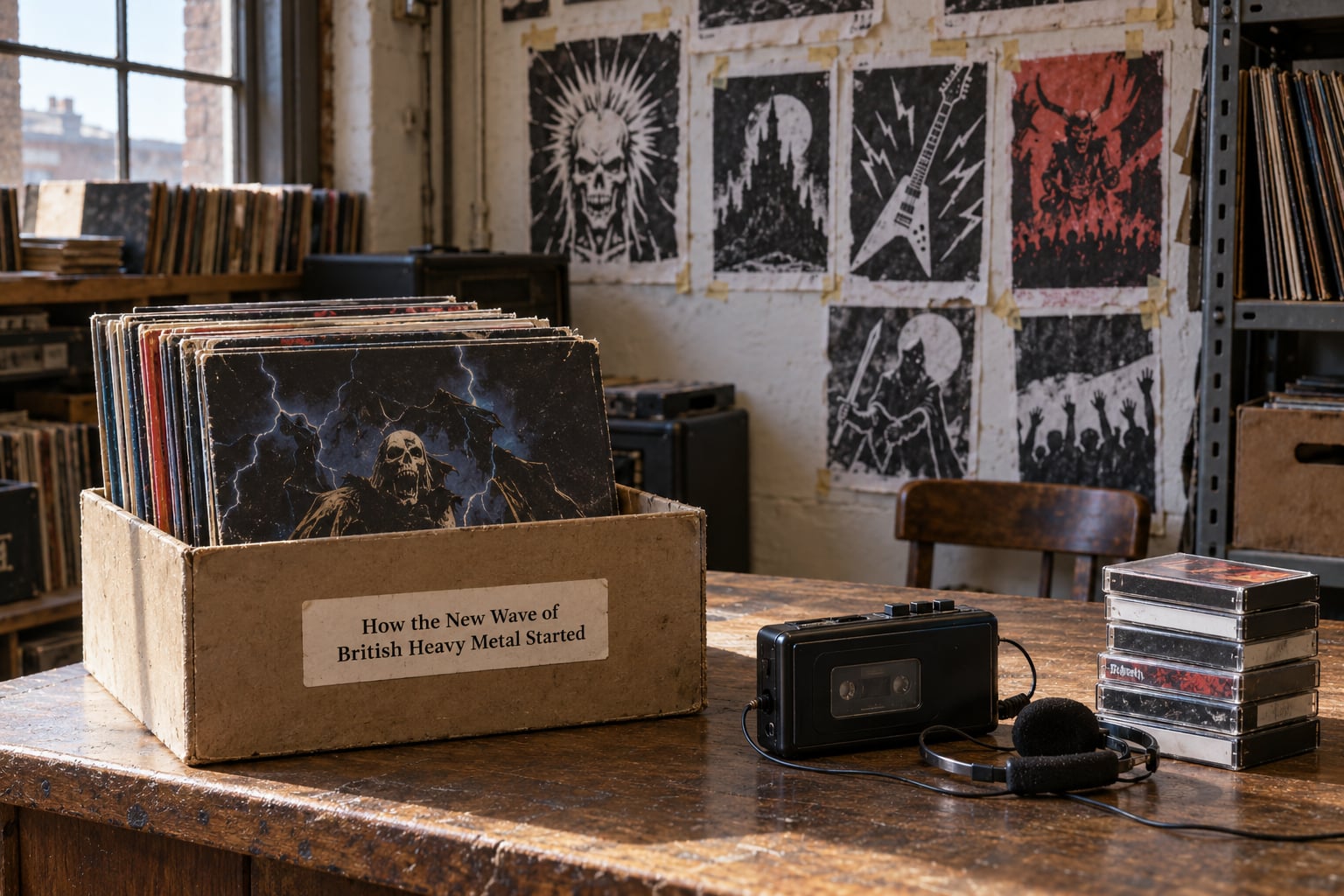
The name came first, the movement followed. On 8 May 1979, the music paper Sounds ran a review of a bill called the Metal Crusade, played at the Music Machine in London. Journalist Geoff Barton wrote it up, and the phrase “new wave of British heavy metal” appeared in the piece, on the suggestion of a colleague, Alan Lewis.
What Barton and Lewis were describing was not a genre with a manifesto. It was a set of small bands who had been playing for two, three, four years in clubs nobody had written about, releasing records nobody stocked, and trading tapes in the post. The label stuck because it was catchy and vague enough to cover all of them.
Not everyone accepted it. Bruce Dickinson, who fronted Samson at the time and joined Iron Maiden a year later, later called the term “a fiction, really, an invention of Geoff Barton and Sounds”. The counter-argument has some force: the bands themselves never claimed a shared identity, and the scenes that produced them had more in common with each other than with any national project. But the label stuck anyway, and historians use it as a fixed point for a movement that genuinely existed.
So how the New Wave of British Heavy Metal started, in short form: bands formed in regional clubs during the mid-1970s, built a distribution network of demos, fanzines and mail-order independents, got labelled by the press in 1979, and were handed a national identity by a record label and a tour in 1980.
What musical and cultural conditions created NWOBHM?
Britain in the mid-1970s was in a bad way, and that shaped the music more than most people realise. The 1973 to 1975 recession and the collapse of manufacturing industries put whole towns on the dole. Stourbridge, Sheffield, Newcastle, Barnsley, Edinburgh and Liverpool all had a large working-class audience with limited options and a lot of free time.
You had three conditions a scene needs: somewhere cheap to play, an audience, and a way to get records to the audience without anyone’s permission.
The punk inheritance, then the punk hangover
Punk had already solved the third problem. By 1977 anyone with a four-track, a friend who could cut tape inserts, and a photocopier had a release. When the punk scene fragmented in 1978 and 1979 into indie pop, post-punk and the indie chart, a lot of musicians were left with the tools and none of the songs.
NWOBHM took the DIY method and swapped the tempo. It also inherited punk’s suspicion of the music industry, which is why so much of the scene ran on independent labels: Neat Records in the north-east, Happy Face Records in London, Ebony and Heavy Metal Records elsewhere.
Neal Kay and the Heavy Metal Soundhouse
The single most important piece of infrastructure was a club night. DJ Neal Kay started The Heavy Metal Soundhouse at the Electric Ballroom in Camden in 1975, moved it through venues including the Venue in London and the Globe in Stockton, and ran a weekly Top 100 chart voted on by the audience. Metal Hammer later called Kay the godfather of British metal.
The chart mattered more than the bands on it. It turned a dozen disconnected towns into a ranked national scene, and it meant a band in Newcastle could know it was beating a band in London. Venom, from Newcastle, credited that chart with everything.
Tapes, fanzines and shops
Most of the movement’s records never reached a chart. They moved through cassette trading, classified ads, fan-run fanzines like Iron Maiden’s own The Running Wild, and mail-order independents pressing 500 or 1,000 copies at a time. Record shop counters in Birmingham and parts of the north still had metal sections that outsiders did not.
Dissatisfaction with the music of the day
The fourth condition is simpler: a lot of young British musicians thought mainstream rock was bloated and lazy, and thought the heavy music they grew up on had gone soft. That reaction is what makes NWOBHM a “new wave” of anything, and it is why the movement’s sound is defined by what it refuses as much as what it does.
Who were the first important NWOBHM bands?
Several hundred bands were part of this thing, most of them gone after three or four releases. The ones that get argued over are the ones whose records survived.
- Iron Maiden — formed in Leytonstone, London in 1975, self-released the Soundhouse EP in 1979, and went from the NWOBHM underground to the biggest British band alive by 1984.
- Diamond Head — Stourbridge, formed 1976, and the most consistently cited source of Metallica’s early riffs. Their 1980 debut is the scene’s most argued-over record.
- Saxon — Barnsley, formed 1976, and the band that actually had the longest staying power on the scene’s own terms.
- Def Leppard — Sheffield, formed 1977, and the group that moved furthest from the underground into MTV and stadium rock.
- Angel Witch — From a spiritualist background, and one of the heaviest and most Gothic bands in the first wave.
- Venom — Newcastle, and the band that pushed speed, satanic imagery and the term black metal further than anyone else at the time.
- Raven — Newcastle again, and the only early band to break through in America on its own merits.
- British Lion — Sheffield, a short-lived band whose single reached the top 40 in 1980.
- Samson — A familiar name on the first wave, and the band that introduced Bruce Dickinson on the stage.
- Tygers of Pan Tang — Newcastle, and part of the same Neat Records orbit as Venom.
- Girlschool — A London all-female band who toured with Motörhead and packed halls doing it.
Two names cause permanent arguments and both are older than the movement. Judas Priest, with 1977’s Sin After Sin, are usually called first wave of British heavy metal rather than NWOBHM, and Rob Halford later said the band blazed the trail for everyone. Motörhead came out of the same underground with a slower, dirtier sound and are treated as a precursor rather than a member. People argue about it still.
How the New Wave of British Heavy Metal started in Britain
The honest answer is that it did not start anywhere in particular, and that is the point. There was no founding date, no manifesto, and no single city. By 1976 you could find a garage band in almost any industrial town in England, and a fair few in Scotland.
What made it a movement was the network. Bands played Neal Kay’s club, got an entry in his weekly chart, appeared on a record shop wall or in a classified ad, and sold a few hundred cassettes to people who had seen them and wanted the tape.
By 1978 the network was dense enough that a Newcastle band knew what a Sheffield band sounded like, and that fans in different cities used the same vocabulary to describe it. Geoff Barton and Alan Lewis found that network, described it, and gave it a label that sounded like a genre. It was not, quite. But a name was the last thing it needed.
Around 1979 and 1980 three things turned a collection of local scenes into something national: the Sounds review that named it, the release of Metal for Muthas, and the Metal Revolution tour that took the bands out on the road together. Before those, nobody outside the tape-trading network had heard most of them. Afterwards, they had a name, a release schedule and an audience that had been waiting for them.
How did NWOBHM sound different from punk and earlier metal?
The cleanest comparison is with Black Sabbath. Sabbath invented the heavy riff, but by the late 1970s they were writing slower, more spacey material, and bands like Led Zeppelin and Deep Purple had become enormous and unwieldy. NWOBHM went the other way: up-tempo, tight, and short.
The twin-guitar attack
The defining texture is two guitars playing in the low register together, usually on power chords, one holding down while the other moves. It is rhythmically simple and it sounds enormous on a small PA, which is exactly why it worked in rooms like the Electric Ballroom or the Venue.
On top of that came the gallop: a driving eighth-note figure borrowed from Motörhead, and later perfected by Iron Maiden, that turns a static riff into forward motion. Fast song changes, almost no ballads, and solos played at speed rather than at length.
Vocals and lyrics
Front men sang higher than their predecessors and with more range, but still shouted rather than crooned. Lyrics moved away from the druggy mysticism of the early 1970s towards myth and fantasy, medieval battle, horror, science fiction and the occult. A lyric about a wizard fighting a dragon was no joke; it was the scene’s central image.
Production, or lack of it
This is the part people miss. Early NWOBHM records are not clean. They were recorded quickly, mixed fast, often with unfamiliar engineers, and pressed small. The thinness of the drums and the edge on the guitars are not flaws to apologise for, they are the sound of a movement that did not wait for anyone’s budget.
The look
Denim jackets with hand-drawn patches, long hair, leather, boots and no interest in looking fashionable. It was a uniform designed to be recognised from the back of a room and to distinguish a metal audience from the punk one. Eddie, the Iron Maiden mask, turned stage dressing into an icon that is still merchandising 40 years later.
What did Metal for Muthas do for the movement?
Metal for Muthas was a compilation released by Music for Nations in 1980, and it is usually treated as the moment the scene became a movement people could buy rather than a set of local scenes they lived near.
It collected eleven bands, including Venom, Raven, Angel Witch, Tygers of Pan Tang and Sam Fox as Steel Mill, Iron Maiden’s first recording, and Diamond Head. Most of them had never had a record in a national shop. After it, they had a national shop.
The follow-up volume kept the run going. Both records are still the most reliable way to hear the movement’s first wave in one place, which is why they have been reissued repeatedly and why the phrase “muthas” is still shorthand for the scene.
The Metal Revolution tour
Metal Revolution, the package tour of 1980, put many of those same bands on real stage time together, and the awkwardness of sharing a bill with bands who had only ever seen each other on a compilation is part of the memory of it. Venom on the bill in front of a crowd that had bought the record a week earlier is the image that sells the whole thing.
Together, the compilation and the tour answered the last objection: there was a scene, it was happening now, and you could see it.
Which albums defined the first wave of NWOBHM?
This is not exhaustive, because it cannot be. Pick six albums and you have left out another six people will insist you should have included. These are the ones that come up in arguments most often.
| Album | Year | Label | Why it matters |
|---|---|---|---|
| Diamond Head, Lightning to the Nations | 1980 | Happy Face | The purest statement of the scene’s sound; five of its seven songs later covered by Metallica |
| Iron Maiden, The Piper at the Gates of Evil | 1982 | EMI | The moment the movement reached a mainstream audience without abandoning the underground |
| Venom, Welcome to Hell | 1981 | Neat | Satanic imagery and speed pushed further than anyone else had gone |
| Angel Witch, We Have Raised the Devil | 1982 | Neat | The heaviest and most Gothic record of the first wave |
| Saxon, Saxon | 1979 | Neat | Straightforward, catchy early metal from a band that kept going |
| Raven, Rock Until You Drop | 1981 | Neat | The early band that broke through in the United States |
| Tygers of Pan Tang, Deceivers | 1980 | Neat | The Newcastle sound with the sharpest songs and the strongest lineup |
Two names are usually argued into this list and just as usually left off. Motörhead belong to the movement’s parents rather than its children. Judas Priest, whose British Steel from 1980 is the more polished, more important record, are treated by most fans as the band NWOBHM defined itself against.
How did NWOBHM influence heavy metal worldwide?
The influence ran mainly through record collectors. Lars Ulrich was a Danish kid buying British imports, and by the time he was in Metallica he was rereading Diamond Head and Venom tapes. The band covered five Diamond Head songs on Garage Inc., which put the scene in front of an audience two orders of magnitude larger than its own.
Other routes out were just as important. NWOBHM ’79 Revisited, the compilation Metallica’s Lars Ulrich assembled and released in 1990 with performances by the surviving scene bands, remains the standard gateway for anyone who wants to hear many bands at once.
Speed, thrash and black metal
Venom’s galloping bass lines and lyrics about Satan fed the American thrash and black metal scenes directly, and the term black metal itself was being used as a genre name before Bathory and before anyone outside Britain had heard the word used that way. Angel Witch and Tygers of Pan Tang supplied the tempo that a later generation of guitarists used as a floor.
Power metal and Europe
Where the movement influenced British mainstream metal was more direct. Every second-guitar player in every power metal band of the mid-1980s learned something from Iron Maiden’s twin-guitar lines, and Iron Maiden’s stage presentation with a recurring Eddie figure was copied across the industry. Continental European power metal took the twin-guitar sound and ran it in a more classical key.
The scene’s own effect on its audience
The more underrated legacy is behavioural. NWOBHM is the movement that proved a heavy metal band could exist without a major label, without a manager with a plan, and without permission. That idea is the reason the underground metal of the following decades is shaped the way it is.
Why did NWOBHM fade from the mainstream but remain influential?
Almost all of the movement’s bands disappeared. Not because they were bad, but because the economics of being small in a scene that suddenly had competition for attention were brutal, and because a lot of the founders wanted ordinary things like regular pay and stable lineups.
The mainstream moved on too. MTV launched in 1981, and Def Leppard’s Pyromania in 1983 was engineered for it, with shorter songs, cleaner production and videos built for a format that had no room for a two-minute guitar solo. The look went glam, the riffs went radio-friendly, and the bands that had defined the movement’s underground were now competing with its own success.
What was left was a catalogue. Iron Maiden, Saxon, Diamond Head, Venom and a few dozen others kept releasing, kept reuniting and kept being reissued. They became the most durable cult in metal, with reunion shows, anniversary tours and a collector’s market built on 500-copy independent pressings that now cost more than the records did when they came out.
How can modern listeners explore the movement?
Do not start with the albums everyone recommends. Start with the compilations, then go deeper in this order.
- Metal for Muthas (1980) — the whole movement in 11 tracks. Put it on and note which band you come back to.
- Diamond Head, Lightning to the Nations (1980) — if you only listen to one album, this is the one most people mean.
- Venom, Welcome to Hell (1981) — the rawest thing here and the clearest link to everything that followed.
- Saxon, Saxon (1979) — the accessible one. Catchy, tight, short.
- Angel Witch, We Have Raised the Devil (1982) — heavier and darker, and easier to appreciate once the ear has adjusted.
- Iron Maiden, The Piper at the Gates of Evil (1982) — the polished end of the spectrum, and the one to play last so it does not spoil everything else.
What to listen for
On the guitars, listen for the two-guitar low register and how it moves when one part stops and the other takes over. On the drums, listen for how much of the drive is double kick rather than a backbeat. On the production, do not judge it by 1982 standards, and note how little room the drums have.
On the lyrics, read a few. The medieval and fantasy imagery is doing more work than the usual folk-metal treatment gives it credit for, and Venom’s Satan material is a hoot, whatever the detractors say. Finally, listen for the small venues. Almost every record on this list was mixed for a room, not for a stadium.
Frequently Asked Questions
When did the New Wave of British Heavy Metal start?
It has no single start date, and that is part of the confusion. Bands in the movement formed from around 1975, and the underground network was running by 1976 to 1978 through Neal Kay’s club chart, demos and fanzines. The name itself arrived on 8 May 1979, in a Sounds review by Geoff Barton and Alan Lewis, and the movement broke into the mainstream between 1980 and 1985.
What does New Wave of British Heavy Metal mean?
It is the name the music press gave to a nationwide British metal movement that ran from the mid-1970s to the mid-1980s. It covers bands playing fast, guitar-heavy, DIY heavy metal in clubs and on independent labels, with Iron Maiden, Diamond Head, Saxon, Def Leppard, Venom and Raven as the names most people mean.
Was NWOBHM a reaction to punk or a continuation of British heavy metal?
Both, and the argument is still running. The movement took punk’s DIY methods, independent presses and cassette trading, then used them for heavier music once punk fragmented around 1978. It also continued a British heavy metal line from Black Sabbath and Judas Priest, mainly by reacting to how slow and soft that music had become. Most fans accept both descriptions.
What is the best NWOBHM album for a beginner?
Diamond Head’s Lightning to the Nations from 1980 is the usual answer, and it is a good one: short songs, twin guitars, almost no filler. If you want a sampler rather than a commitment, start with the 1980 Metal for Muthas compilation, which introduces eleven bands in one sitting. Save Iron Maiden’s The Piper at the Gates of Evil for last, because it is the most polished of them.
Why was Metal Massacre important to NWOBHM?
Two compilations carried the movement to new listeners. Metal for Muthas, released in the UK in 1980, put eleven underground bands onto a national label at once, and the 1980 Metal Revolution tour put many of the same bands on stage together. Metal Massacre, the 1982 US follow-up on Metal Blade, covered a similar spread of bands and gave American fans their first real taste of the scene.
Did Iron Maiden start the New Wave of British Heavy Metal?
Iron Maiden were one of the most important bands in it, formed in London in 1975 and part of the underground from the start. They did not start it, though. Venom, Diamond Head, Raven, Angel Witch and others were already recording and releasing when Iron Maiden put out their Soundhouse EP in 1979, and Iron Maiden became the movement’s biggest success rather than its origin.
Conclusion: Start with the music that changed British metal
The New Wave of British Heavy Metal started as a reaction to a soft decade, ran on infrastructure most bands built themselves, and became a movement because a magazine gave it a name and a record label gave it a release. Its lasting lesson is that heavy metal works best when the people making it control the means of release.
If you want the raw thing, start with Diamond Head’s Lightning to the Nations or Venom’s Welcome to Hell. If you want the version that became an industry, go to Iron Maiden’s The Piper at the Gates of Evil and work backwards. The records still sound like nothing else, and a new listener still has about forty years of digging to do.