Quick note before we start: this is about heavy metal music, not ore. If you landed here looking for metal provinces or mineral trade, this page is not for you. Heavy metal spread to South America through four overlapping channels — imported vinyl bought in record shops or by mail order, radio and later music television, a cassette and fanzine underground that moved music between bands across borders, and international tours — and by the 1990s those channels had produced national scenes that no longer needed Europe or North America to validate them. Sepultura, formed in Belo Horizonte in 1984, is the most famous heavy metal band from Brazil and the single name most listeners outside the continent recognise.
Table of Contents
- Why Did Heavy Metal Become Popular in South America?
- How Metal Spread to South America Through Records and Radio
- The Early Pathways: How Metal Spread from British, American, and European Records
- How National Scenes Developed Across the Continent
- Brazil: The Largest Heavy Metal Market
- Argentina: Speed, Power, and the Thrash Era
- Chile: A Distinctive National Progression
- Colombia, Venezuela, and the Andes
- Peru, Bolivia, Ecuador, and Paraguay
- Uruguay and the Southern Cone Connections
- How Touring Bands and Live Venues Changed Metal
- Why Metal Festivals Accelerated the Continental Scene
- How Metal Adapted Into South American Subgenres
- The Role of Tapes, Shows, Magazines, and Independent Labels
- How the Internet Changed Metal’s Reach
- What Makes the Story of South American Metal Unique?
- Frequently Asked Questions
- Which country did heavy metal reach first in South America?
- How did metal get into South America before the internet?
- Was heavy metal bigger in Brazil or Argentina?
- Why did South America develop so many extreme-metal bands?
- What are the best South American metal bands for new listeners?
- Who are the fathers of black metal?
- Conclusion
Why Did Heavy Metal Become Popular in South America?
Popularity is a distribution problem before it is a taste problem. Metal arrived in South America the way most imported music arrived: slowly, unevenly and mostly through individual fans with enough money and patience to order a pressing from abroad or wait for a tour.
Five things made that process work once it started. Imported records were a growing business from the late 1960s, so pressing plants, import shops and mail-order services already existed. Radio programming in most countries still carried album rock and later hard rock, which meant an imported record could reach tens of thousands of listeners without anyone choosing it for them. Music television arrived in Brazil in 1981 and widened the funnel enormously.
Underneath the majors sat the real engine: cheap instruments and local rehearsal spaces. Guitars, drums and amplifiers from Brazilian and Argentine manufacturers were accessible to teenagers, and a rehearsal room rented by three or four musicians cost little more than a night out.
The last piece is the one outsiders usually miss. Long before festival stages, South American metal ran on hand-numbered fanzines, photocopied flyers, demo cassettes passed between bands and postal trades with Europe, and small record labels pressing a few hundred copies. That infrastructure is why the story of how metal spread to south america is really a story about people copying tapes.
How Metal Spread to South America Through Records and Radio
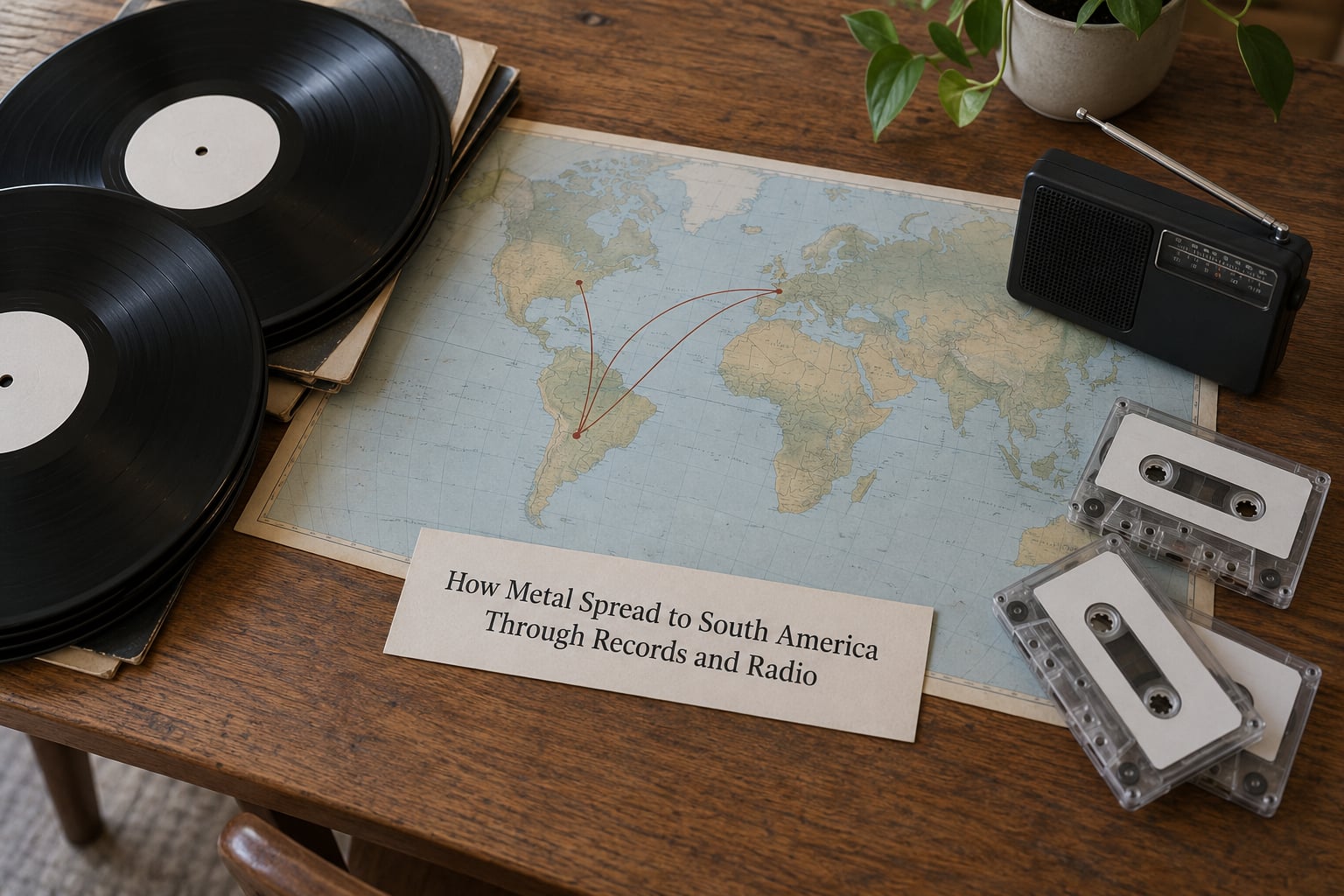
The route metal actually took ran through shops, not charts. A teenager in São Paulo, Santiago or Buenos Aires in the mid-1970s had three realistic ways to hear a British pressing: buy it at an import counter, order it from a mail-order ad in a magazine, or wait for a local band to play it back louder at a party.
The Early Pathways: How Metal Spread from British, American, and European Records
The first wave was British. Black Sabbath’s 1970 debut and its first few follow-ups supplied the heaviest and slowest blueprint, and the band toured Brazil and Argentina more than once in the 1970s. Judas Priest and then the new wave of British heavy metal supplied the riffs and the twin-guitar attack. Venom supplied the speed, the satanic imagery and the underground tone that a generation of South American bands would copy directly.
The American channel arrived differently. Kiss, Aerosmith and later the thrash explosion of the mid-1980s came largely through television and imported tapes, and that channel produced the fast, aggressive guitar bands rather than the heavy, mystical ones.
Radio did the quiet work. Weekly album-rock shows in the 1970s and 1980s turned records into repeated exposure, and the practice of announcing a record by giving its country of origin made foreign pressings sound like events. Where a radio show took listener requests from a scene-specific letter column, an entire country’s taste could be steered by a single show host.
Brazil had one advantage its neighbours lacked: a working domestic music industry. Records by Brazilian acts were pressed, distributed and advertised at home, which meant a local heavy metal record could actually reach a national audience. That is why the Brazilian scene consolidated first and hardest.
How National Scenes Developed Across the Continent
The continent did not receive metal evenly, and treating it as one market distorts the record. Each country had its own rock infrastructure, its own cities, its own first bands and its own moment when a scene became self-sustaining.
| Decade | Brazil | Argentina | Chile | Venezuela, Colombia, Peru and neighbours |
|---|---|---|---|---|
| 1970s | Sabbath and Priest via import shops and radio; domestic hard rock grows alongside Jovem Guarda and 1970s progressive rock | Hard rock and new wave of British heavy metal arrive through records, clubs and early radio play | Imported metal filtered through local punk and hard rock crossover | Rock imported through radio and imported media; local urban rock scenes form in Caracas and Bogotá |
| 1980s | Three hubs consolidate: Belo Horizonte, São Paulo and Rio de Janeiro. Korzus, Sarcófago, Overdose, Dorsal Atlântica, Viper, Mutilator, Chakal and Vulcano; Sarcófago’s I.N.R.I. in 1987 | Thrash scene consolidates; punk heritage and hard rock feed a fast, loud national style | National bands form around Santiago; punk and metal cross-pollinate | Metal subcultures grow in capital-city venues; Colombia develops extreme metal; Peru’s scene stays smaller and more regional |
| 1990s | Sepultura’s crossover era with Chaos A.D. in 1993; Angra and Krisiun carry the melodic and extreme sides abroad | Power, heavy and death metal develop alongside thrash; Masacre becomes an international name | Extreme metal circulates through tape trading and compilations; Asesino is the country’s most-cited export | Venezuela’s scene grows; Cultura Tres later describes how little sludge and doom existed there before the 1990s |
| 2000s | Scene fragments and renews; Massacration’s satire of the scene itself becomes a talking point | Underground metal consolidates through festivals and small labels | Broader festival circuit brings international bands to Santiago | Colombia, Venezuela and Peru connect more tightly through cross-border shows |
| 2010s to now | Festival-era international touring; Angra, Krisiun and newer bands hold strong European and US tours | Buenos Aires becomes a regional stop for international extreme-metal tours | International festival bookings and a steadier local touring circuit | Regional identity firms up; national scenes now discuss a South American circuit rather than only Europe and the US |
Brazil: The Largest Heavy Metal Market
Brazil’s metal scene is usually dated to the mid-1980s and organised around three cities: Belo Horizonte, São Paulo and Rio de Janeiro. Belo Horizonte produced Sepultura and later Sarcófago, whose 1987 album I.N.R.I. is the release most often cited as a Brazilian black metal record that predated most of Europe’s second wave. São Paulo supplied the punk and underground infrastructure — Ratos de Porão and Cólera among the better known — plus a record retail trade that could sell an imported pressing across a country of its own.
Rio de Janeiro added Korzus, Overdose and Dorsal Atlântica, the thrash and crossover wave that later split into faster and heavier directions. Viper, Mutilator and Chakal moved heavy metal toward power metal and speed metal, while Angra carried Brazilian melodic metal to stadiums and festivals abroad. Krisiun, founded by brothers from Belo Horizonte, put Brazilian death metal on international stages.
Two national conditions helped. Rock in Rio and later large festivals gave major acts stages without a label’s permission. And the country’s size meant internal travel was itself a distribution network, with bands moving between the three hubs on tour buses rather than on planes.
Argentina: Speed, Power, and the Thrash Era
Argentina’s route ran through hard rock and punk before it ran through metal. That background shows in the national scene’s sound and in its DIY habits. The 1980s produced a prominent thrash movement with national reach, and the 1990s broadened into power metal, heavy metal and death metal, supported by labels and clubs in Buenos Aires and other large cities.
Buenos Aires also became a regional stop rather than an isolated scene. International extreme-metal tours that played Chile or Brazil often added Argentina on the same run, which is how local bands grew accustomed to seeing their peers live in a neighbouring country.
Chile: A Distinctive National Progression
Chilean metal followed a different sequence because punk arrived early and mattered. Chilean punk and hard rock overlapped heavily with the first metal bands, which produced a faster, more abrasive national line than the neighbouring scenes and gave the country a distinct identity rather than a copy.
From the 1990s onward, Chilean extreme metal circulated the way South American extreme metal always did: demo tapes, split releases and compilations reaching Europe, then a slow trickle of European and North American interest. Asesino is the name that comes up most often when Chilean extreme metal is discussed abroad. Santiago’s festival circuit later gave Chilean bands regular contact with international touring acts.
Colombia, Venezuela, and the Andes
These scenes share one trait early: they were built on imported media rather than a domestic heavy pressing industry. In Colombia, radio and imported records fed a strong urban rock network in Bogotá, from which a genuinely distinct extreme metal and later gothic and nu-metal current grew. Colombia’s size and its internal migration between Bogotá, Medellín and the coast fed that growth, and Colombian bands increasingly toured regionally rather than only to Europe.
Venezuela’s metal history is well documented by the bands themselves. Cultura Tres, in a widely cited interview, described how little sludge and doom existed in Venezuela until the 1990s, how music television pushed national metal toward hardcore, death and thrash sounds, and how the country’s bands only later fused into something recognisably South American. The same interview puts the first South American Sludge festival in Buenos Aires at more than 1,200 attendees, a useful measure of how far the regional underground had come.
Migration matters here too. Venezuelan and Colombian musicians moving between countries carried scenes with them, which is part of why regional bands now tour each other’s home markets instead of only chasing European dates.
Peru, Bolivia, Ecuador, and Paraguay
These countries have smaller, more fragile metal communities, and honesty beats exaggeration. Peru has a Lima-centred scene with a long-standing heavy and death metal current and a growing festival audience, but its bands have had less international touring infrastructure than their Brazilian or Argentine neighbours. Bolivia and Ecuador have active local scenes organised around clubs, small labels and a few internationally circulated releases.
Paraguay’s metal community is smaller again and mostly sustains itself through local shows and online circulation. In all four countries the practical reality is the same: a handful of venues, a few persistent labels, and fans who trade records across borders because the local catalogue is thin.
Uruguay and the Southern Cone Connections
Uruguay sits inside the same cultural circuit as Argentina and southern Brazil, with a metal scene that grew alongside both. Uruguayan bands share audiences, promoters and record distributors with Buenos Aires, and Uruguayan fans were among the earliest to travel to South American festivals in Brazil and Argentina.
That shared axis — Montevideo, Buenos Aires, Porto Alegre, São Paulo — is why the Southern Cone often reads as one scene in travel reports, even though each country keeps its own bands, labels and press. The Southern Cone’s metal is now the most reliably cross-border music in Latin America.
How Touring Bands and Live Venues Changed Metal
A concert changes a scene faster than a record does. Seeing a band play makes people start a band, and a room with a regular Thursday metal night gives a scene a place to be visible.
The milestone most South American metal histories cite is Venom with Exciter in São Paulo on 10 December 1986, an eyewitness recollection rather than a press release. Shows like it mattered less for the crowd than for the effect on musicians in the room: a Venom song performed live proved that the underground had a live circuit and needed somewhere to put it.
By the 1990s, clubs in São Paulo, Belo Horizonte, Rio de Janeiro, Buenos Aires, Santiago and Bogotá were running regular metal nights, and permanent venues replaced rented halls. That is the point at which enthusiasm became infrastructure.
Why Metal Festivals Accelerated the Continental Scene
Festivals solved a problem no club could: they put a band’s audience in front of other bands, and they did it in a weekend.
Once major festivals began booking metal acts in Brazil and later across the region, touring packages made sense. A band from Lima or Bogotá could open for a European act in Chile and then play Argentina on the same run, which is how regional audiences stopped being separate audiences.
Smaller underground festivals did the same job at the extreme end. The first South American Sludge festival, held in Buenos Aires and remembered by Cultura Tres as drawing more than 1,200 people, is the kind of event that proves an extreme subgenre had moved from cassette to crowd. Fans also organised themselves into networks around these events, spreading recordings, contacts and booking advice at the same time.
How Metal Adapted Into South American Subgenres
Importing a genre is the easy part. What South American musicians did with it produced styles that do not map neatly onto the European or American originals.
Brazilian thrash and the crossover that grew from it were faster and more rhythm-driven than their influences, and the leap from that into death metal happened earlier in Brazil than in most European countries. Sarcófago’s I.N.R.I. is the clearest case: a 1987 release with satanic imagery and raw production that arrived before the European second wave most bands were later compared to. Angra took the opposite route, building a progressive, melodic power metal with clean production that filled large venues across Europe.
Argentine and Chilean thrash ran faster and grittier, with punk roots that kept showing in the vocals and the stage energy. Andean and Venezuelan scenes contributed doom, gothic and, later, nu-metal and crossover directions. And in the 2010s, sludge, doom and stoner became the one area where South American bands stopped responding to the scene and started setting it — the Cultura Tres interview is essentially an argument for that.
Language sharpened the difference. Brazilian and Spanish-language metal sings in Portuguese and Spanish, which kept it out of anglophone search, charts and recommendation systems, and pushed bands toward imagery, themes and wordplay their audiences actually read.
The Role of Tapes, Shows, Magazines, and Independent Labels
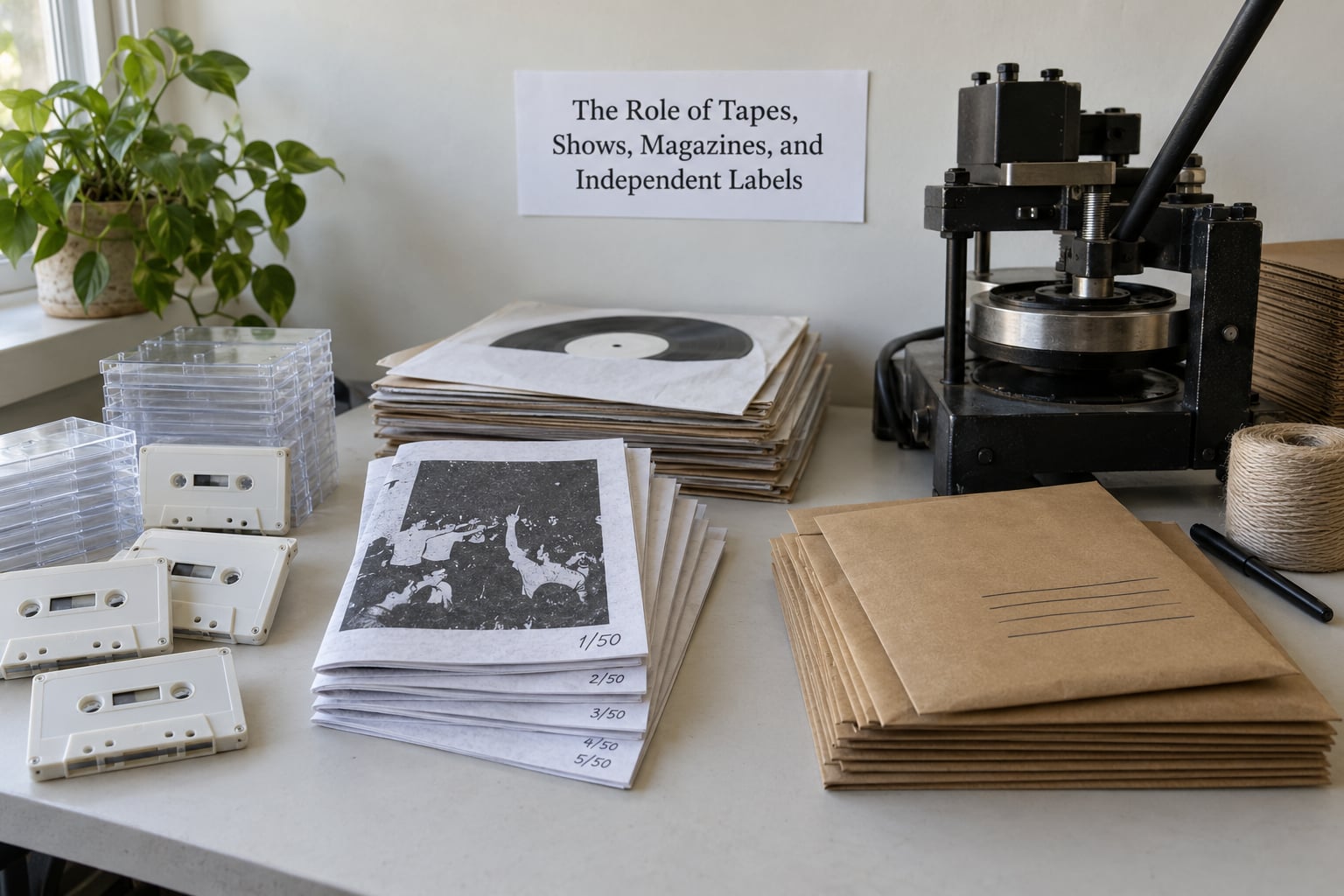
If you want to understand how metal spread to south america, the honest answer is photocopiers and cassette recorders.
A demo tape was the cheapest possible way to move music. One player copied a tape and passed it on; the copy reached a town with no metal shop and no radio play. Bands mailed tapes to fanzine editors, who reviewed them and passed them to other bands, which is how a rehearsal-room recording from Belo Horizonte ended up being heard in Bogotá or Lima.
Fanzines did the paperwork. Hand-stapled, photocopied and numbered, they carried gig dates, tape-trading addresses, record shop stock, interviews with foreign bands, and translations of foreign lyrics for readers who could not follow them. Where the local rock press ignored metal, the fanzine was the press.
Small labels did the pressing. Independent operations in Brazil, Argentina, Chile and Venezuela released demos, splits and early albums in runs that disappeared within weeks, and the scarcity itself drove demand — a tape you had to trade for was worth more than one you could buy. Mail order then turned those tiny runs into an international market.
This whole chain depended on live rooms. The gig is where a fanzine gets filled, a tape gets traded and a band finds out whether its songs work in front of people.
How the Internet Changed Metal’s Reach
The internet solved discovery, not belonging. Forum threads, YouTube uploads, streaming playlists and digital sales gave a listener in Europe or North America the same access to a São Paulo demo that a Buenos Aires fan had in 1991 — except the Brazilian fan got it months later.
It also rewired scene communication. Bands now book tours across the continent off a few messages, fans organise festival travel in group chats, and label catalogues stay available after a pressing sells out. Reddit threads such as those on r/asklatinamerica have become the modern equivalent of the fanzine’s discovery function, with English-speaking listeners asking directly for Latin American bands that their usual algorithms never surface.
What did not change is that live rooms still start bands. The internet widened the audience; the club still does the recruiting.
What Makes the Story of South American Metal Unique?
The first thing to correct is the idea that metal spread to the continent in one direction from one place. It did not. Fans on both sides traded records, and local musicians wrote in their own languages about their own problems. If anything, some South American bands were more extreme earlier than their European peers — I.N.R.I. is the standard example.
The second is scale. A country the size of Brazil with an internal rock industry could sustain a mass metal market; a country the size of Uruguay could sustain a scene, not a market. Distance between South American cities is measured in flight hours, and long internal distances shaped how scenes grew slowly and unevenly.
The third is language and scholarship. Because most South American metal is sung in Spanish or Portuguese, it sits outside anglophone discovery systems, which is why so much of the regional story is documented only in interviews, book chapters and forum threads. Two sources are worth starting with: Ricardo Rowe’s edited volume Heavy Metal Music in Latin America: Perspectives from the Distorted South (2021), and Norma Varas-Díaz’s article on decolonial reflections in Latin American metal music in Theologi (2018), which reads the music against the region’s colonial legacy. The “Distorted South” framing argues that metal here is not an imported copy but a local form that happens to sound like somewhere else.
The fourth is timing. The strongest national scenes formed in the 1980s, the crossover moment was the 1990s, and the 2000s brought fragmentation before the festival era pulled the region back together. Each country hit those moments at a different speed.
Frequently Asked Questions
Which country did heavy metal reach first in South America?
Brazil and Argentina both hosted British heavy metal tours during the 1970s, so neither was entirely first. Brazil is usually credited with the first consolidated scene, because its domestic record industry could press, distribute and advertise local heavy metal releases nationally. Argentina built its circuit through clubs and hard rock venues instead. By the mid-1980s both had distinct national movements, with Brazil’s divided between Belo Horizonte, Sao Paulo and Rio de Janeiro.
How did metal get into South America before the internet?
Through four channels: imported vinyl bought in import record shops or ordered by mail, radio album-rock programming, cassettes copied and mailed between fans and bands, and live shows. International touring supplied the spark, with Venom opening for Exciter in Sao Paulo on 10 December 1986 widely cited as an early landmark. Fanzines listing tape-trading addresses tied the whole chain together.
Was heavy metal bigger in Brazil or Argentina?
Brazil, by a wide margin. It had the largest domestic market, a working record industry able to press and distribute local metal nationally, and festival infrastructure that Argentine scenes relied on less. Argentina had a comparably loud thrash and underground scene and remains one of the continent’s strongest live audiences, but its metal never reached Brazil’s commercial scale inside the country.
Why did South America develop so many extreme-metal bands?
Two reasons. Bands here moved faster than their influences, so thrash became death metal earlier in some cities than in Europe, and Sarcofago’s 1987 album I.N.R.I. arrived before most of Europe’s second wave. Second, cheap instruments, rented rehearsal rooms and small pressing runs meant an extreme band could record, tour and release without permission from a label.
What are the best South American metal bands for new listeners?
Start with three that cover the range. Sepultura is the most famous Brazilian band and the crossover entry point. Angra is Brazilian melodic power metal and plays large venues across Europe. Krisiun is Brazilian death metal with no fat on it. Outside Brazil, Argentinian thrash and Chilean extreme metal are the next stop, and Cultura Tres from Venezuela represents the regional sludge and doom end.
Who are the fathers of black metal?
Black metal as a genre is usually traced to Europe, particularly the early 1980s Bathory and Celtic Frost wave and the early 1990s Norwegian scene around Mayhem. The South American line runs separately: Sarcofago’s I.N.R.I. came out in Brazil in 1987, years before that second wave, and the country’s extreme scene kept developing in parallel rather than in response to it.
Conclusion
Metal did not sweep into South America as a single invasion. It arrived through import counters, radio hours, mailed cassettes, photocopied fanzines and a handful of tours, and it landed on rock and punk scenes that already existed in every major city. Brazil and the Southern Cone — Buenos Aires, Montevideo, Santiago and southern Brazil — became the largest centres, but by the 2010s the network itself was continental, with bands touring neighbouring countries instead of only chasing European dates.
Start with three records and the rest of the region opens up: Sarcófago’s I.N.R.I. for the 1987 extreme-metal milestone, Sepultura’s Chaos A.D. for the 1990s crossover, and Angra’s output for the melodic side. Then pick a country you have never heard and read its scene history properly — the tapes are still out there, and the network still runs.