Doom metal slowed metal down by treating tempo as architecture rather than athletics. Instead of playing riffs faster to build intensity, it played them slower, lower and longer, so the low end could actually develop and the listener had room to feel the weight. That idea came from Black Sabbath in 1970, got codified by Candlemass, Saint Vitus and Trouble in the mid-1980s, and then split into funeral doom, death-doom, sludge, stoner and drone branches that all still exist today.
It also gave heavy metal a second reason to be heavy. Speed was one. Weight was the other. Once listeners had a scene built around tempo in the 60s, no band could go fast again without it sounding like a choice instead of a default.
Table of Contents
- What Does It Mean to Say Doom Metal Slowed Metal Down?
- How Doom Metal Developed From Early Metal
- Why Doom Metal Uses Slower Tempos and Heavier Riffs
- Negative space and decay do the compositional work
- Drumming at 70 BPM is harder than it looks
- Bass stopped being a backup instrument
- How Doom Metal Changed the Heavy Metal Underground
- Which Bands Helped Shape Doom Metal?
- How Doom Metal Influenced Sludge, Stoner, and Extreme Music
- How Doom Metal Slowed Metal Down Without Making It Boring
- How to Recognize Doom Metal’s Sound Today
- Frequently Asked Questions
- What is the slowest metal genre?
- What tempo is doom metal in?
- Did Black Sabbath invent doom metal?
- What tuning is doom metal in?
- What is the difference between doom metal and sludge metal?
- What three bands make up the Unholy Trinity of heavy metal?
- Conclusion
What Does It Mean to Say Doom Metal Slowed Metal Down?
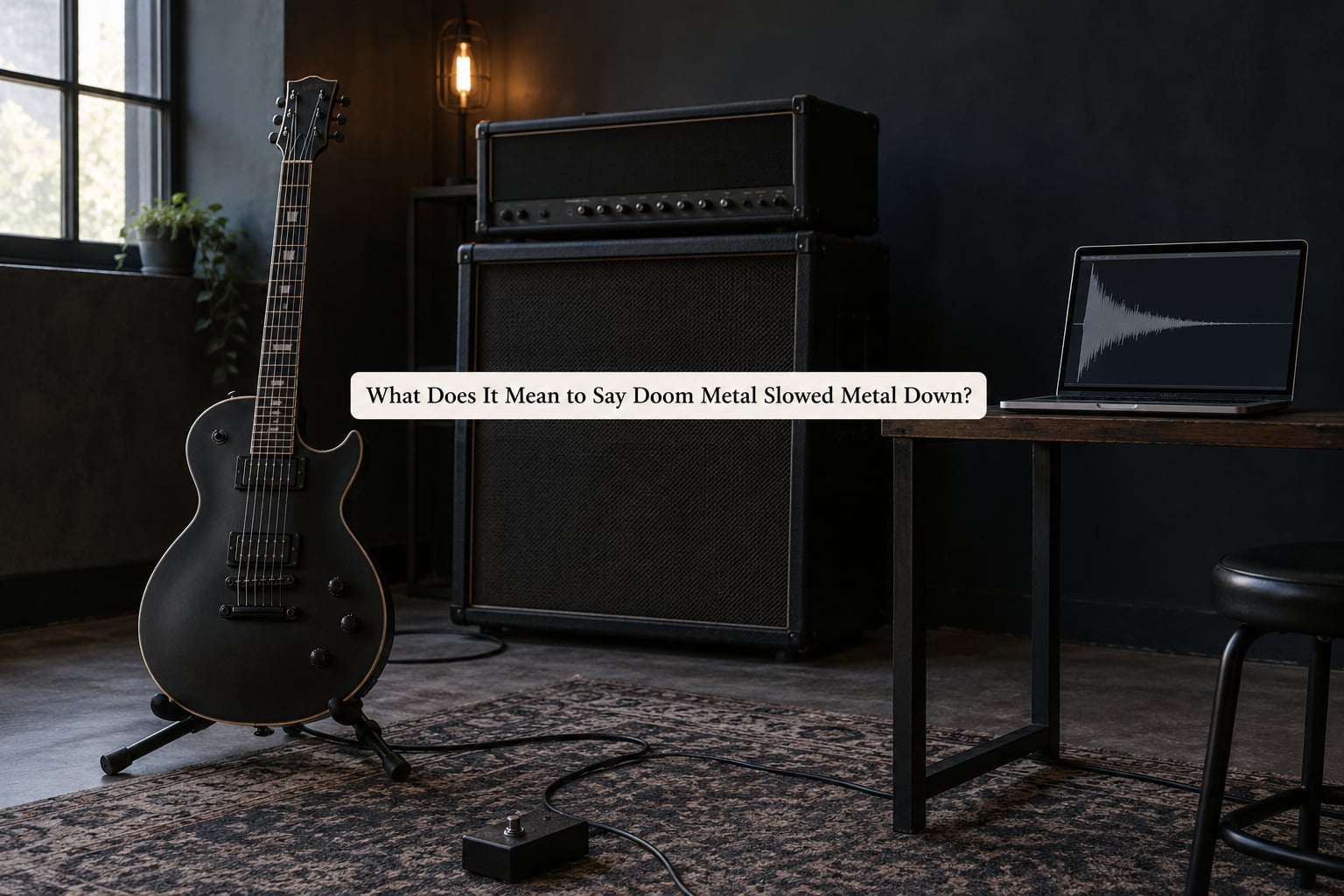
When people say doom metal slowed metal down, they mean two specific things happened at once: the tempo range of heavy music dropped, and the criteria for judging heaviness changed.
Before 1970, blues rock and psychedelic rock already played slow, but they played slow for different reasons. A slow Led Zeppelin track was still a groove record. Slow in doom metal is structural. The riff is not a rhythm to sit behind the vocals; it is the song.
The second shift matters more. Doom metal claimed that a song could be at 70 beats per minute and still feel more physically demanding than one at 240. That argument is what slowed metal down, and it is still the reason doom bands get compared to architecture instead of sports.
How Doom Metal Developed From Early Metal
Doom metal grew out of the loudest, dirtiest rock in Birmingham in the late 1960s. Black Sabbath took blues riffs, dropped the guitars lower, thickened the bass and left air around the notes. Their 1970 debut and Paranoid that same year did not announce a genre. They just made a record that was heavier and darker than anything else anyone was playing.
Tony Iommi had cut the tips off two fingers on the factory job he worked before the band formed, and he turned down the guitar a fourth to make fretting easier on the wounds. That accident is the hinge of the whole story: the flattest, thickest sound in early metal came from a limitation, not a concept.
Two things then happened in parallel. Sabbath’s influence spread through the underground, and in 1978 bands started writing songs explicitly in that mode. Pagan Altar, Saint Vitus and Trouble all came out of the same small US underground in that window. Pentagram and Witchfinder General took the Sabbath blueprint somewhere darker and more occult. These were the first bands that treated slowness as an identity rather than an accident of style.
Why Doom Metal Uses Slower Tempos and Heavier Riffs
The mechanics are simple once you understand what a speaker has to do. Low frequencies need time to move air. Play a low note for half a second and the speaker barely leaves its rest position. Play it for eight seconds and it moves enough to be felt in your ribs.
| Style | Typical tempo | What the extra time buys |
|---|---|---|
| Thrash and speed metal | 180-250 BPM | Relentless forward motion, technique on display |
| Traditional doom | 60-90 BPM | Long riffs, room for one note to decay fully |
| Epic doom | 60-80 BPM | Cathedral-scale arrangements, long solo sections |
| Funeral doom | 30-60 BPM | Near-ritual pacing, minimal movement |
| Stoner and sludge | 70-120 BPM | Heavier groove with more mid-tempo swing |
Drop the tuning and the fundamental gets lower. Low frequencies are perceived as slower than high ones even at identical tempos, so a down-tuned riff sounds heavier without any change to the drum track. Everything else follows from that.
Negative space and decay do the compositional work
Fast metal hides mistakes inside density. Slow metal exposes everything, which means silence becomes an instrument. A doom riff often has a held chord, a long fade, and a drum fill that arrives late. Those gaps are where the song breathes, and they are why a three-note doom riff can hold attention longer than a fifty-note thrash riff.
Drumming at 70 BPM is harder than it looks
Slow drumming is a precision problem. Kick and snare placement become obvious because there is nowhere to hide, and the drummer has to place eighth notes exactly without the momentum of a fast beat. Doom drummers lean on cymbal decay, ghost notes and fills that arrive off the grid. Watch how a Bill Ward groove holds together: the hats are barely there, the kick is placed like punctuation, and the whole thing sounds effortless only because the timing is locked.
Bass stopped being a backup instrument
Geezer Butler on Paranoid is the template. His bass is not under the guitar, it is beside it, holding the low end while the guitar works on riffs. Most doom bands since have kept that balance, and it is a big reason the low end on these records is felt rather than heard.
How Doom Metal Changed the Heavy Metal Underground
Doom metal’s biggest effect was argumentative. In the early 1980s the underground had decided that speed was progress, and bands like Metallica and Slayer pushed tempos up and up. Doom responded by doing the opposite on purpose, and the contrast turned out to be useful for both sides.
Thrash proved that metal could be precise and fast. Doom proved it could be enormous and still sit still. Once those two claims existed, metal’s expressive range doubled: you could write a song about speed, a song about dread, and a song that did both in four minutes.
The underground felt the shift in its practical concerns too. Doom pushed producers toward high headroom and gain staging rather than clipping everything into a wall, and it gave bands permission to write lyrics about mortality, theology and despair without them sounding soft. Lee Dorrian left Napalm Death, formed Cathedral, and then started Grief, which is roughly the shape of the argument: you do not have to pick one speed.
Which Bands Helped Shape Doom Metal?
Pioneers wrote the template. Descendants expanded it. Telling those two groups apart is the fastest way to understand who slowed metal down and what came next.
- Black Sabbath — The origin point. Paranoid and Master of Reality set the down-tuned, low-and-slow vocabulary that everything else answers to.
- Pentagram — Took the Sabbath blueprint into raw occult horror and left the songs direct and almost hypnotic.
- Pagan Altar — Formed in 1978 and one of the first bands to describe themselves as doom without borrowing anyone’s name.
- Candlemass — Swedish, and the reason Epicus Doomicus Metallicus from 1985 still sounds enormous. Messiah Marcolin’s operatic vocals gave slowness a theatrical scale nobody else had.
- Saint Vitus — Born Too Late is still the gateway record most people are pointed to first. Where Candlemass went big, Saint Vitus went raw.
- Trouble — Chicago band built on atmosphere and negative space, and their singer Scott Reagers defined a whole lineage.
- Cathedral — Lee Dorrian’s second act, and proof that doom could be psychedelic, folk-tinged and still heavy.
If you want the short answer to who the big four are, most people in the doom crowd pick Sabbath, Candlemass, Saint Vitus and Pentagram, with Trouble as the usual next name.
How Doom Metal Influenced Sludge, Stoner, and Extreme Music
Sludge and doom are cousins, not the same thing. Sludge takes doom’s weight and adds Southern rock bounce and punk aggression; Crowbar and Eyehategod out of New Orleans are the reference points, and Kirk Windstein has said openly that Sabbath was the starting point. If doom is the low end with no lift, sludge is the same low end with a groove you can headbang to.
Stoner metal trades down-tuned heaviness for fuzz and volume. Sleep, Electric Wizard and Om all sit somewhere between traditional doom and 1970s bong-rock, often in the 70 to 120 BPM range.
The extreme end split into two branches. Death-doom went from slow and mournful to slow and brutal: Winter, whose 1988 Heart of a Killer, and later Autopsy and early Katatonia pushed doom toward death metal without speeding up. Funeral doom took the tempo further down, into the 30 to 60 BPM range, where bands like Bell Witch stretch a song out across an album and barely move at all.
Then the Peaceville scene in England did the opposite thing with the same material. My Dying Bride, Paradise Lost and Anathema took doom’s atmosphere and grief and mixed it with gothic rock, which is where post-metal and much of modern atmospheric black metal picked up the vocabulary.
Drone is the furthest branch. Earth, from Seattle, reduced doom to sustained chords and almost no rhythm section, and bands from shoegaze to post-rock have been borrowing from that since.
How Doom Metal Slowed Metal Down Without Making It Boring
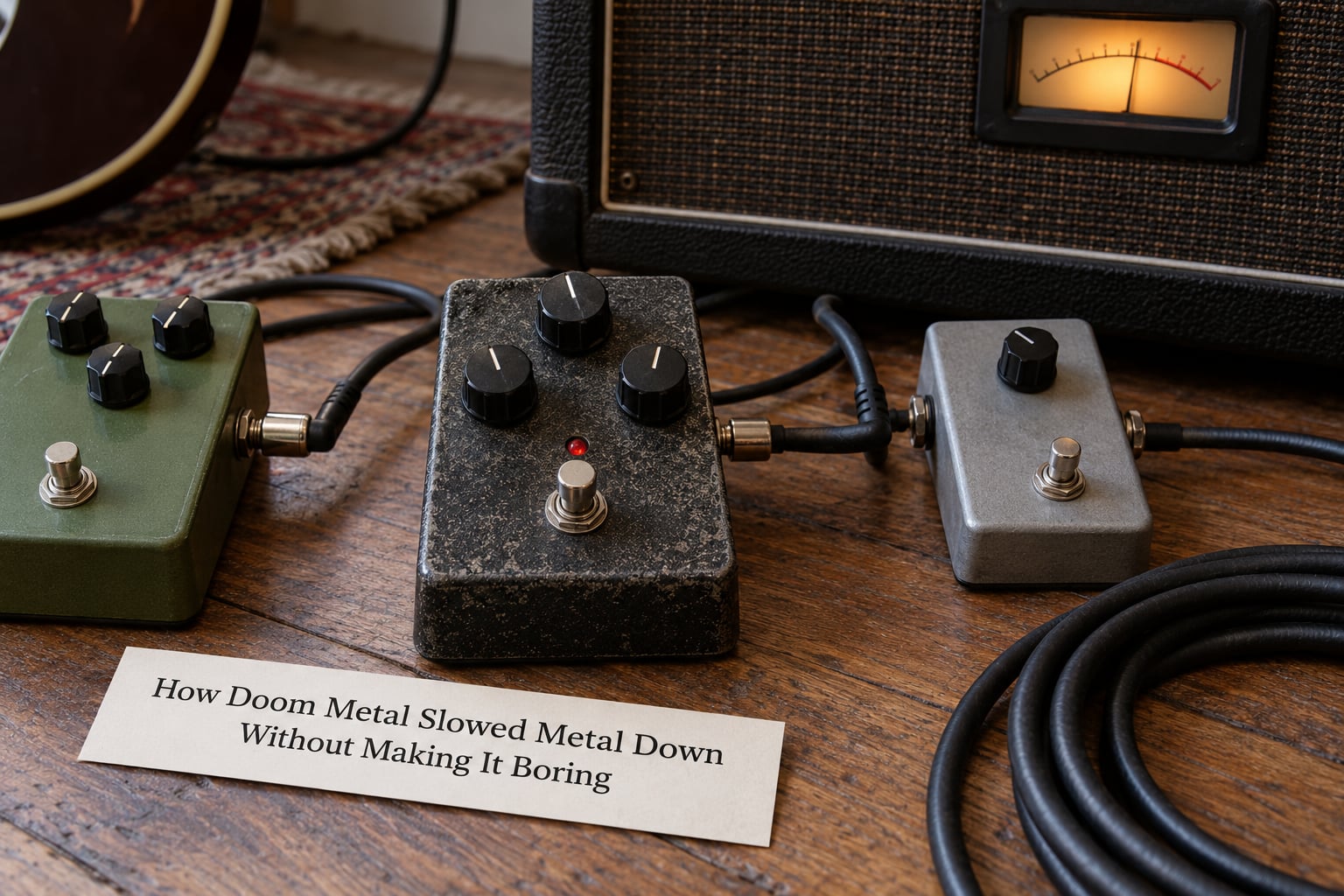
The standard objection is that slow means static. It is a fair criticism of a lot of lazy doom, and it is also a criticism of a genre that puts real work into dynamics instead of volume.
Look at what a good doom record actually does. Tempo changes inside a single song. A four-minute track that stays at one speed the whole way is unusual, not normal. Space and density trade places constantly, so a huge quiet verse hits harder because of the loud part before it. Negative space means each note arrives with weight instead of being buried.
Vocal range helps too. Operatic singing, shouted clean vocals, grunts and shrieks all exist inside the genre, which means a listener who cannot stand Messiah Marcolin’s approach may still like a band with harsh vocals and a slow backbone. Slow music also tends to reward attention: a listener who is slightly bored on a riff at 200 BPM often finds the same riff at 70 BPM completely absorbing.
How to Recognize Doom Metal’s Sound Today
Start with tempo and tuning together. If the guitar sounds like it is strung very low, the riffs are short and the tempo is under 100 BPM, you are probably in traditional doom. Two or three notes per bar, often repeating, with a bass line that moves in parallel.
Then check the guitar tone. Fuzz and overdrive in front of a valve amp with plenty of headroom is the classic recipe. Dirtier and more saturated, lower and grindier points to death-doom. Fuzzier and looser with a heavier swing points to stoner or sludge.
For vocals, clean and operatic means epic doom, harsh and guttural means death-doom, and almost absent means drone. For song length, anything over 10 minutes with very little happening is either funeral doom or drone, and the difference is whether there is a drum kit.
If you want an on-ramp, start with Born Too Late for raw traditional doom, Epicus Doomicus Metallicus for epic scale, Psalm 9 for atmosphere, then move to contemporary bands like Pallbearer, Atlantean Codex, Spirit Adrift, Windhand and Crypt Sermon to hear the same grammar handled by a current group. Women have shaped that current scene too, from Lori S. and Chelsea Wolfe to the newer gothic-leaning bands.
Frequently Asked Questions
What is the slowest metal genre?
Funeral doom is the slowest metal subgenre, usually sitting between 30 and 60 BPM. At that pace a four-minute song holds roughly 120 to 240 beats in total, spread across very few bars. Bands like Bell Witch pushed it further by dropping into even lower registers with minimal rhythm sections. Drone metal competes for the title, but it works by holding single chords rather than by moving slowly.
What tempo is doom metal in?
Traditional doom usually sits between 60 and 90 BPM, and epic doom from Candlemass often runs slightly lower at 60 to 80. Thrash and speed metal from the same era sit at 180 to 250, so the difference is close to a factor of three. Funeral doom drops to 30 to 60, and stoner and sludge sit higher, roughly 70 to 120.
Did Black Sabbath invent doom metal?
Black Sabbath created the vocabulary, not the genre name or a defined scene. Their down-tuned guitars, heavy bass and slow, dark riffs on the 1970 debut and Paranoid set the template that dedicated bands picked up later. Pagan Altar, formed in 1978, was among the first groups to describe themselves as doom. So the honest answer is that Sabbath made it possible and the early 1980s bands turned it into a genre.
What tuning is doom metal in?
There is no single tuning. Tony Iommi’s original down-tuning took Black Sabbath a fourth below standard, and most doom bands today sit somewhere between that and standard tuning. Many run in the lower range of the guitar, with baritone or extended-range basses doubling the guitar line an octave down. Trouble and Candlemass are known for particularly low guitar voicings.
What is the difference between doom metal and sludge metal?
Doom is built around very slow, heavy, often dark riffs with minimal groove. Sludge shares the low end but adds Southern rock bounce, punk attitude and a mid-tempo swing, so it is usually faster and easier to nod along to. New Orleans bands like Crowbar and Eyehategod defined sludge, while Candlemass and Saint Vitus defined doom. Plenty of bands sit in both.
What three bands make up the Unholy Trinity of heavy metal?
The usual trio is Black Sabbath, Led Zeppelin and Deep Purple. The term came from wider 1970s rock culture rather than the metal press, which matters because it places metal’s roots in heavy blues rock rather than in punk or underground music. Deep Purple brought classical and operatic influence, Zeppelin brought weight and dynamics, and Sabbath brought darkness and the low-end template.
Conclusion
Doom metal slowed metal down by dropping the tempo and raising the consequence of every note. Start with one album: Born Too Late for the raw version or Epicus Doomicus Metallicus for the grand one. Whichever you pick, the thing to listen for is the same thing, which is how much weight one low note can carry when nobody is rushing past it.