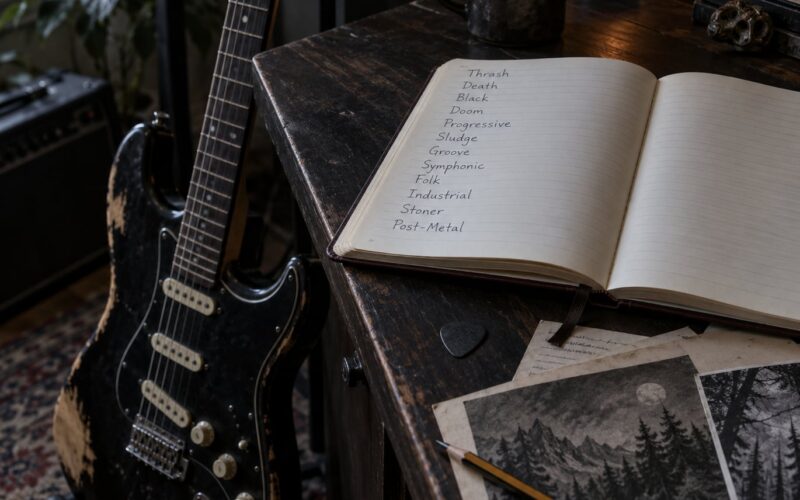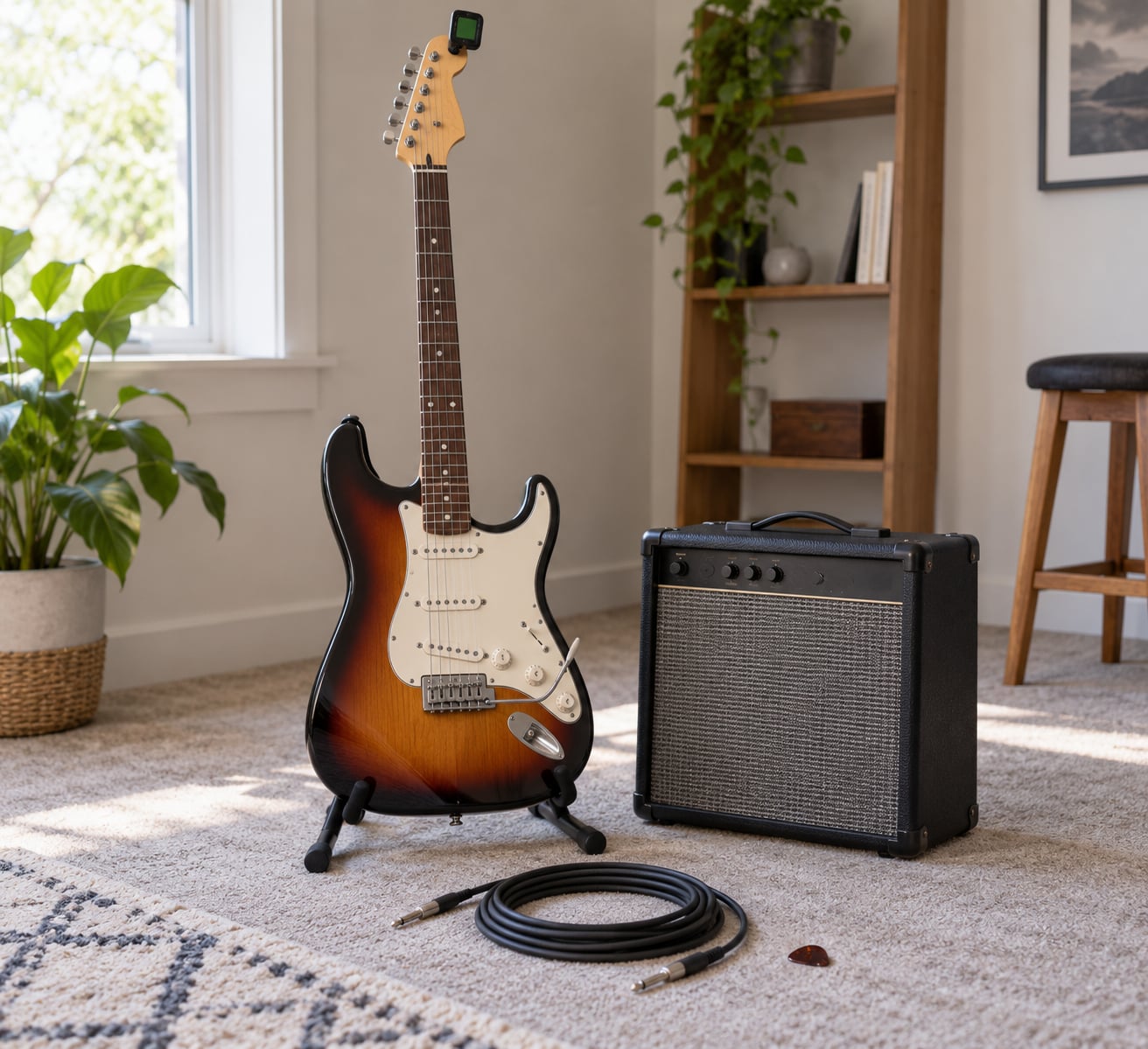
Learning how to write your first metal riff comes down to five moves: pick a groove you can feel, choose a tuning you can play cleanly, build a short root-and-fifth line, test it against a steady drum beat, then change one element at a time. The whole loop takes about half an hour, and the only gear it asks for is a guitar, a tuner and something to hit record on.
You do not need music theory, a DAW, or a fast left hand. You do need a reference point in your head, which is honestly the harder half. The old Metal Guitarist forum thread that still ranks near the top for this question opens with the most useful idea nobody has since turned into a proper process: put the guitar in your hand, sit in silence for a couple of minutes, and work out what you would want to hear before you touch a fret. Hum it, beatbox it, pull the root notes out as a plain melody, and record that.
Below is the route I would hand a beginner, in the order that keeps you unblocked: what you actually need, an eight-step build, the mistakes that trip everyone up, and how to get from one riff to a song.
Table of Contents
- What You Need Before You Start
- Step-by-Step: How to Build a Metal Riff
- 1. Start With the Groove You Want
- 2. Tune for the Style
- 3. Use a Simple Riff as a Foundation
- 4. Add Rhythm and Accents
- 5. Shape the Heavy Part
- 6. Create Contrast and Dynamics
- 7. Test, Edit, and Learn the Part
- 8. Build a Simple Metal Exercise
- Common Mistakes and How to Fix Them
- Frequently Asked Questions
- Do I need to know music theory to write metal riffs?
- How do I come up with metal riffs that don’t sound like everyone else’s?
- Should I write the riff first or the drums first?
- What key should I write my first riff in?
- How do I make my riffs sound heavy?
- What is the forbidden riff on a guitar?
- Conclusion
What You Need Before You Start
None of this is exotic. A beginner electric guitar, a phone and a couple of free apps will carry you through your first year of riff writing, and the tone will not be the reason anyone criticises your playing.
- A guitar you can play without thinking. Six strings, even action, nothing fancy. Hardware and weight have no effect on whether a riff is good.
- Something to make sound. A small practice amp, an interface into a laptop, or even a phone recording direct. Treat tone as the last problem, not the first.
- A tuner you trust. Most riffs sit low on the neck, and a slightly flat sixth string turns a power chord into mud.
- A pick that matches your attack. Medium or thick picks sound chunky and percussive; thin suits fast single-note runs.
- A steady pulse. A metronome app or a drum-loop app. Groove comes from the grid, not from the guitar.
- One-tap recording. A voice memo is genuinely enough at this stage. Ideas disappear within minutes.
- Later, not now: a DAW, a pitch shifter for auditioning drop tunings without restringing, delay, or a second amp layer.
Two things worth knowing about gear. Distortion is not what makes a riff heavy — palm-muted articulation and a good rhythmic idea do most of that work. A beginner asking on Quora whether they should write riffs on a clean channel before adding distortion got the right answer from the replies: play it clean, and you will hear every note you are actually playing.
And you do not have to restring to try a lower tuning. A pitch shifter set a tone or two down plays the shapes you already know an octave and a bit lower, which is enough to decide whether you like the feel before you commit to new strings.
Step-by-Step: How to Build a Metal Riff
Each step below assumes the last one worked. If you cannot get a step to sound right, fix it before moving on, because a bad groove underneath a great riff still sounds bad.
1. Start With the Groove You Want
Decide what the riff is meant to feel like before you play a note: fast and aggressive, heavy and half-time, or tense and syncopated. Write that as a tempo and a drum pattern, then test it with palm-muted eighths or a single-note line.
Groove-first is the most repeated piece of advice anywhere riff writing gets discussed. On r/metalmusicians, the top answer to whether you write drums or riff first is blunt: put a simple drum beat down and write on top of it, because the groove comes from how the two lock rather than from the guitar alone.
How do you know it worked? Tap your foot against the loop. If the riff sits behind the kick drum, it is not finished yet.
2. Tune for the Style
Standard tuning (E A D G B E), drop D (D A D G B E) and drop C (C G C F A D) cover almost everything a beginner needs. Tuning is a creative choice, not a test of ability, so start wherever your hands are already clean.
Drop D moves the open sixth and fourth strings a whole step apart, which reshapes every power chord and makes low riffs feel heavier. Drop C lowers everything another whole step; plenty of modern players like the feel, but it pushes low strings toward the point where they buzz. A pitch shifter lets you hear the difference tonight, without new strings.
The honest beginner rule, repeated across the forums: do not drop the tuning until you can play the riff cleanly in standard. Change the tuning and the difficulty at the same time and you will never know which one is the problem.
3. Use a Simple Riff as a Foundation
Memorable riffs are built from a tiny pool of notes — the root, the fifth, an octave, maybe one note in between. Start with a power chord, which is a root and a fifth with no third, and leave the third out on purpose. That missing note is a big part of why the result sounds heavy rather than poppy.
Chugging means playing the figure as short, palm-muted stabs. Keep one figure and repeat it, and let the drum pattern tell you when to stop repeating. A workflow tip from a 2011 Ultimate Guitar thread is still the most sensible version of this: start with a basic fast chug, vary it in small ways, and once you like something, hold that and vary a different part.
4. Add Rhythm and Accents
Notes are only half a riff. Where they sit and how hard you hit them is the other half, so vary note length, drop rests in unexpected places, and make some notes louder than their neighbours.
Accent shifting is the cheapest trick in metal writing. Play the exact same notes and move the emphasis from the downbeat to the offbeat, or from the first note of the bar to the third. Same notes, different riff. Accenting what falls between the beats — syncopation — is what makes a line feel tense rather than marching, and it costs you nothing technically.
Alternate picking and down-up picking are about attack, not speed. Commit to one for a bar or two so the pattern sounds chosen instead of accidental.
5. Shape the Heavy Part
Power chords give a riff its weight, but they turn to mud the moment a riff sits low against a distorted bass. Move the figure up the neck, mute more of it, or double it an octave higher so the top end carries the definition.
Double stops and octave jumps do the same job with more bite. When the guitar and the bass are fighting over the same low end, the cleanest fix is usually to move the guitar up an octave, or to drop the root entirely and play the fifth. Both sound bigger, not smaller.
6. Create Contrast and Dynamics
Heavy does not mean one volume for the whole song. Two quiet bars before the first full-volume hit, a rest where the listener expects a chord, or the same riff an octave higher in the last eight bars will do more than five extra notes.
Writers on r/metalguitar reach for interval variety for the same reason: fourths, tritones, a slide into an unexpected note, or a large unexpected leap make a line feel restless without making it harder to play. One deliberately dissonant note in the right place is worth six notes of noodling.
On tone, one correction worth keeping: less gain can sound heavier. Clarity lets the ear pick out the notes, and the notes are what carry the weight once the riff drops to a quiet dynamic.
7. Test, Edit, and Learn the Part
Record the riff the instant it works, even if it is a phone memo of a bad take. Then loop it against the same drum pattern and mark every spot where it slips behind or ahead of the beat.
Most beginner riffs fail from having too much material, not too little. Cut any note that does not earn its place, then check the remaining figure against the kick drum specifically. Play the finished part start to finish at speed without stopping and notice which bar you dread — that bar is your next edit.
8. Build a Simple Metal Exercise
Turn the riff you just wrote into a four-version practice drill. Play it clean and fast, palm-muted and fast, with heavy accents on the first note of every second bar, then at full volume with distortion over a loop.
Each version trains something different: the clean one trains your fingers, the palm-muted one trains your right hand, the accented one trains your timing, and the loud one trains your ability to hold a groove with other people. Cycling all four for ten minutes fixes more “my riff sounds bad” complaints than writing three more riffs.
Common Mistakes and How to Fix Them
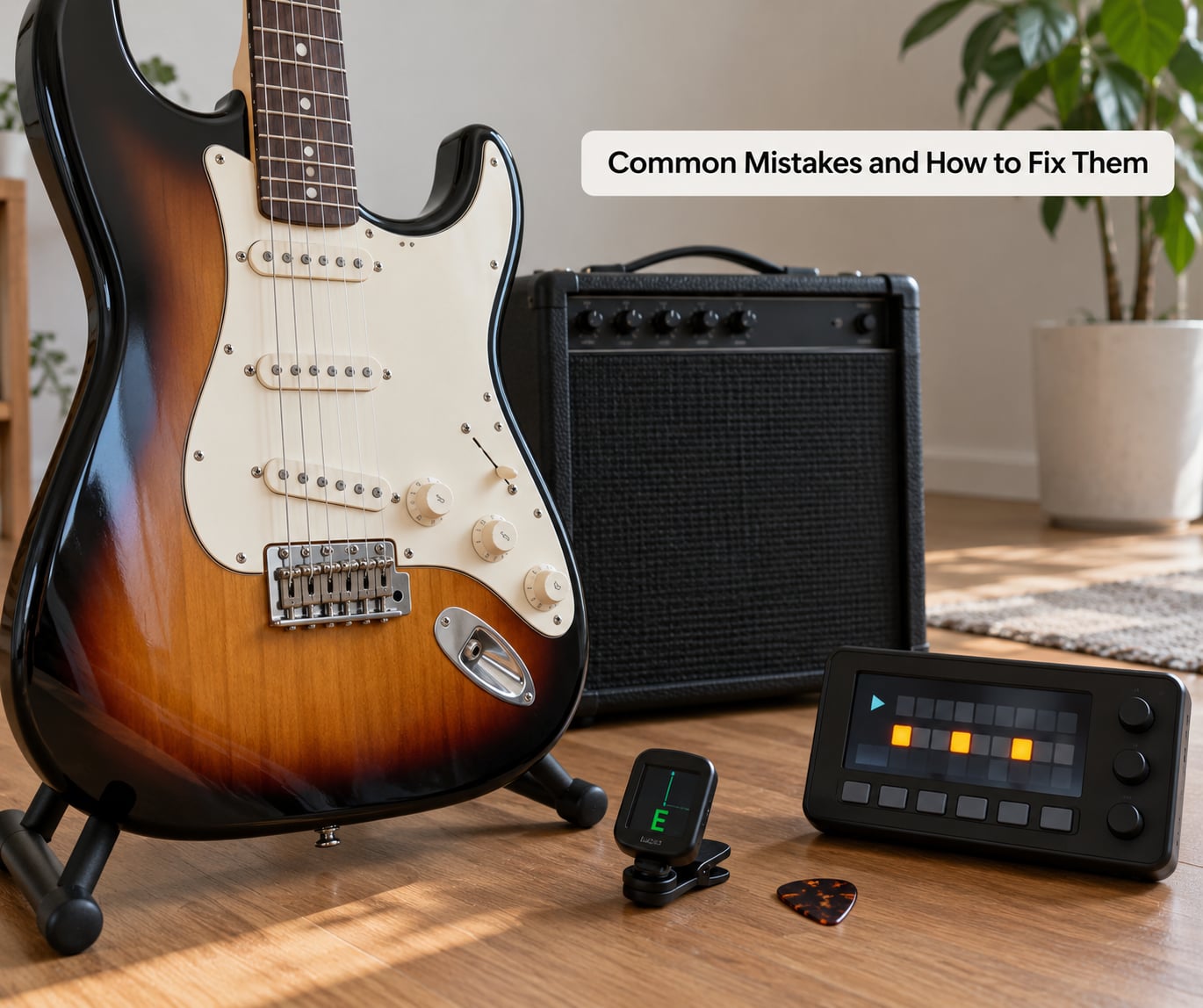
Every one of these shows up in almost every beginner thread, and each has a specific fix rather than a pep talk.
- Writing without a pulse. A riff written with no drums behind it drifts the moment real drums arrive. Fix: lock a loop or click to a BPM before you judge anything.
- Copying a song without understanding it. Learning a tab by ear is fine; copying the notes and hoping is not. Fix: transcribe the riff, work out which scale its notes belong to, then mutate it. The old Metal Guitarist thread does exactly this with Testament’s Into the Pit mapped to A harmonic minor and Kreator’s Betrayer intro read as an inverted power chord — a fourth.
- Dropping a tuning too early. Fix: play it clean in standard first, and use a pitch shifter to audition the lower tuning before restringing.
- Using speed to sound heavy. Fix: drop the tempo by a third, accent the first note of every second bar, and put the speed back when the groove is solid.
- Muddy power chords. Fix: palm mute harder, move the figure up the neck, or play the fifth instead of the root. Fretting the same chord two or three frets higher often fixes the whole tone.
- Adding unnecessary notes. Fix: strip the riff back to root, fifth and one extra note, then check whether it still works. If it does, the extra notes were hiding a weak idea.
When you are properly stuck — the everything-I-write-sounds-generic complaint that keeps turning up on r/Guitar and r/metalmusicians — the fix is a constraint rather than more effort. Pick one and write a new riff under it:
- Use only four notes.
- Use only two strings.
- Keep the rhythm and change every pitch.
- Move the riff a whole step up or down.
- Play the riff backwards.
- Set the same notes in 6/8.
Most of the time the idea shows up inside the first three. Constraints kill filler and force a motif, which is exactly what a riff is.
Frequently Asked Questions
Do I need to know music theory to write metal riffs?
No. You need one scale, its note names, and a key you can comfortably sing. Pick a minor key such as E minor, learn the notes that belong to it on one string, and treat everything else as off-limits while you write. Root, fifth, octave and power chords can all be learned by ear. The useful theory shows up once you have a handful of riffs under your fingers, not before.
How do I come up with metal riffs that don’t sound like everyone else’s?
Use constraints, and mutate something you already like. Transcribe a riff from a song you love, work out which scale it fits, then change its rhythm, invert it, or move it to another key. Limiting yourself to four notes or two strings forces a motif instead of a wander. Forum writers who escape the power-chord habit all land on the same tools: fourths, tritones, and a slide into an unexpected note.
Should I write the riff first or the drums first?
For a first riff, put down a simple drum loop first. The groove usually comes from how the two lock, and a riff written in silence tends to shift the moment real drums arrive. If you have a drummer in the room, play a beat together and record on the spot. If you are working alone, an eight-bar loop at a fixed tempo is enough to keep you honest.
What key should I write my first riff in?
Whatever sits comfortably in the middle of your voice. Low keys sound heavier but punish an uneven pick hand and turn muddy in a phone recording, while very high keys read fast and thin. E minor, D minor and A minor are common first choices in metal because the shapes are familiar across the neck. If you cannot hum the riff in the key, the key is wrong regardless of how it looks on the fretboard.
How do I make my riffs sound heavy?
Palm muting, a low riff and a steady pulse do most of the work, not the distortion. A riff played with a tight, clipped right hand and a well-muted low string will out-hear the same notes through a wall of gain, and it will sit far better against bass and drums. Less gain often means more clarity, and clarity is what the ear reads as weight.
What is the forbidden riff on a guitar?
It is a short run built on a diminished chord, using chromatic passing notes and a tritone, that guitarists are constantly asked to play and almost nobody can name. It keeps showing up in lessons and memes because it looks like a mistake and sounds like a bar from a thrash record. Treat it as vocabulary rather than a prank: the tritone and the half-step crawl are worth learning on purpose.
Conclusion
To write your first metal riff, do exactly this: pick a groove and a tempo, use the tuning you already play cleanly, build four bars out of root, fifth and palm-muted stabs, and test it against a steady beat before you touch anything else. Change one element at a time.
Write three this week and keep the one that sticks in your head a few hours later. That one is worth turning into a song.