A photo pass is a credential that lets you shoot from the pit instead of the floor, and you get one by offering something back: published coverage, credited images for the artist, or fast delivery of usable files. In short, concert photographers get photo passes by building a portfolio, then trading coverage for access.
That is the whole transaction. A pass is not a favour, and it is not a reward for having a lot of followers. Someone with authority over the show decides whether your images are worth the access, and they usually need to see proof before they hand over a wristband.
One note on wording before we start. Search engines often confuse “photo pass” with a photo-printing service of the same name. This guide is about photographer credentials, not about buying printed pictures at a show.
Table of Contents
- What You Need
- Step-by-Step
- Step 1: Build a Professional Concert Photography Portfolio
- Step 2: Identify the Correct Person to Contact
- Step 3: Know How Concert Photographers Get Photo Passes for Each Show
- Step 4: Prepare a Targeted Credential Request
- Step 5: Contact Labels, Publicists, Venues, and Festivals Research first. Press pages, tour announcements, venue media guidelines and event listings usually name the right contact. For large venues and many festivals, an online credential application portal exists, and those applications close weeks ahead of the show. Send individually. A mass email to forty venues reads as spam and gets filtered, and it burns the relationship before it starts. Follow up once, politely, about a week later if you have no answer. A short bump that references the specific show is fine. A third message is not. Reach out before shows are announced where you can. Publicists plan coverage months ahead, and a request that arrives after the tour is booked is competing against a list that already exists. The signal: a reply, even a no. Silence usually means you found the wrong address. Step 6: Confirm Restrictions Before the Show
- Step 7: Deliver Professional Work and Build Long-Term Access
- Common Mistakes
- Frequently Asked Questions
- Do concert photographers pay for photo passes?
- Are festival media passes guaranteed after an application?
- Can a guest list include concert photography access?
- How early should I contact a band’s publicist?
- Why was my photo-pass request denied?
- What should I do after receiving a credential?
What You Need
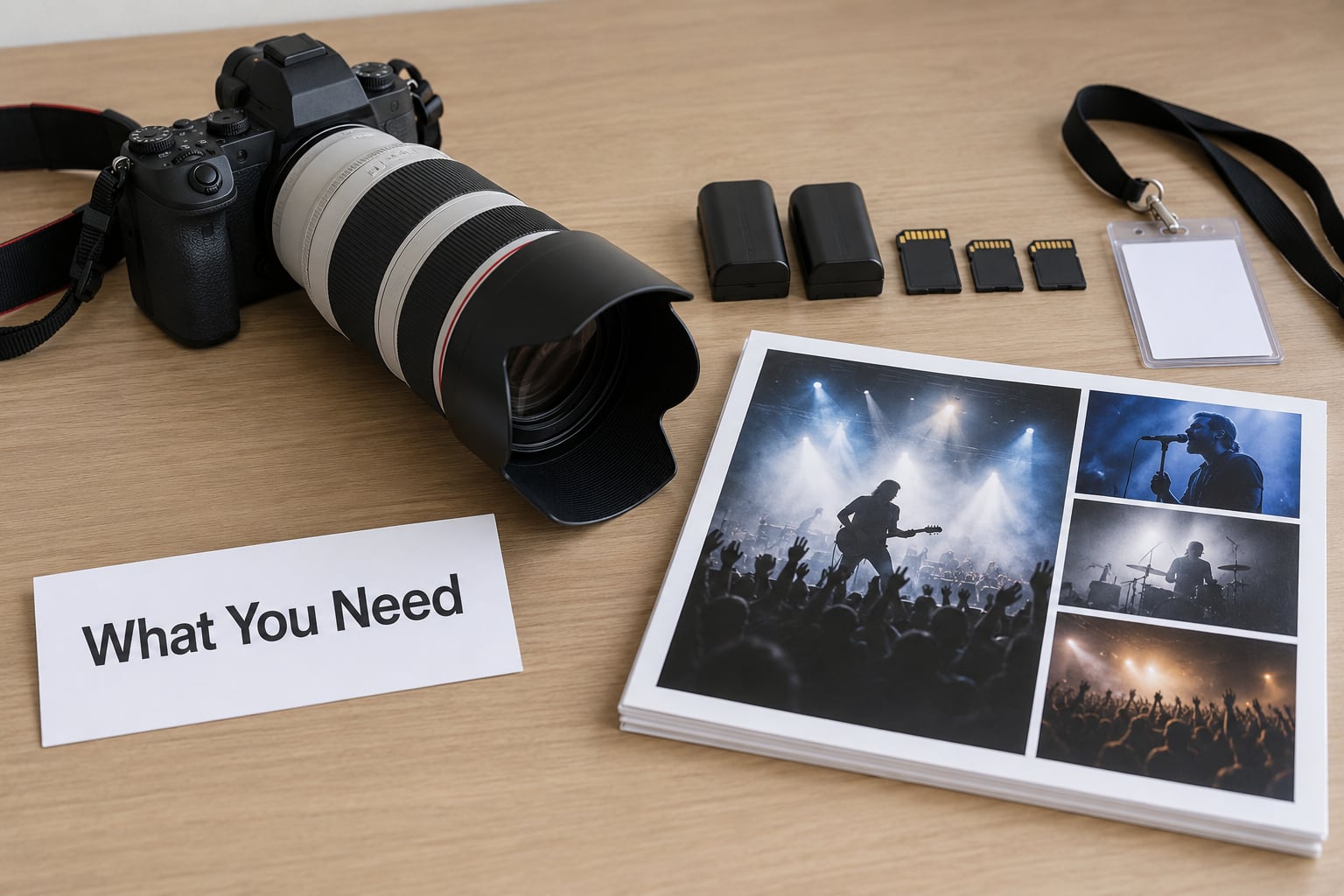
Start with a portfolio other people can actually open. Twenty strong live images beats a hundred snapshots, and a single page that loads fast on a phone beats a slow portfolio site you are proud of.
You also need something that identifies you professionally. A working email address on a domain you control, a phone number, and ideally an affiliation: a publication, a blog with a real readership, a label, a fan community, or your own freelance work with a named client.
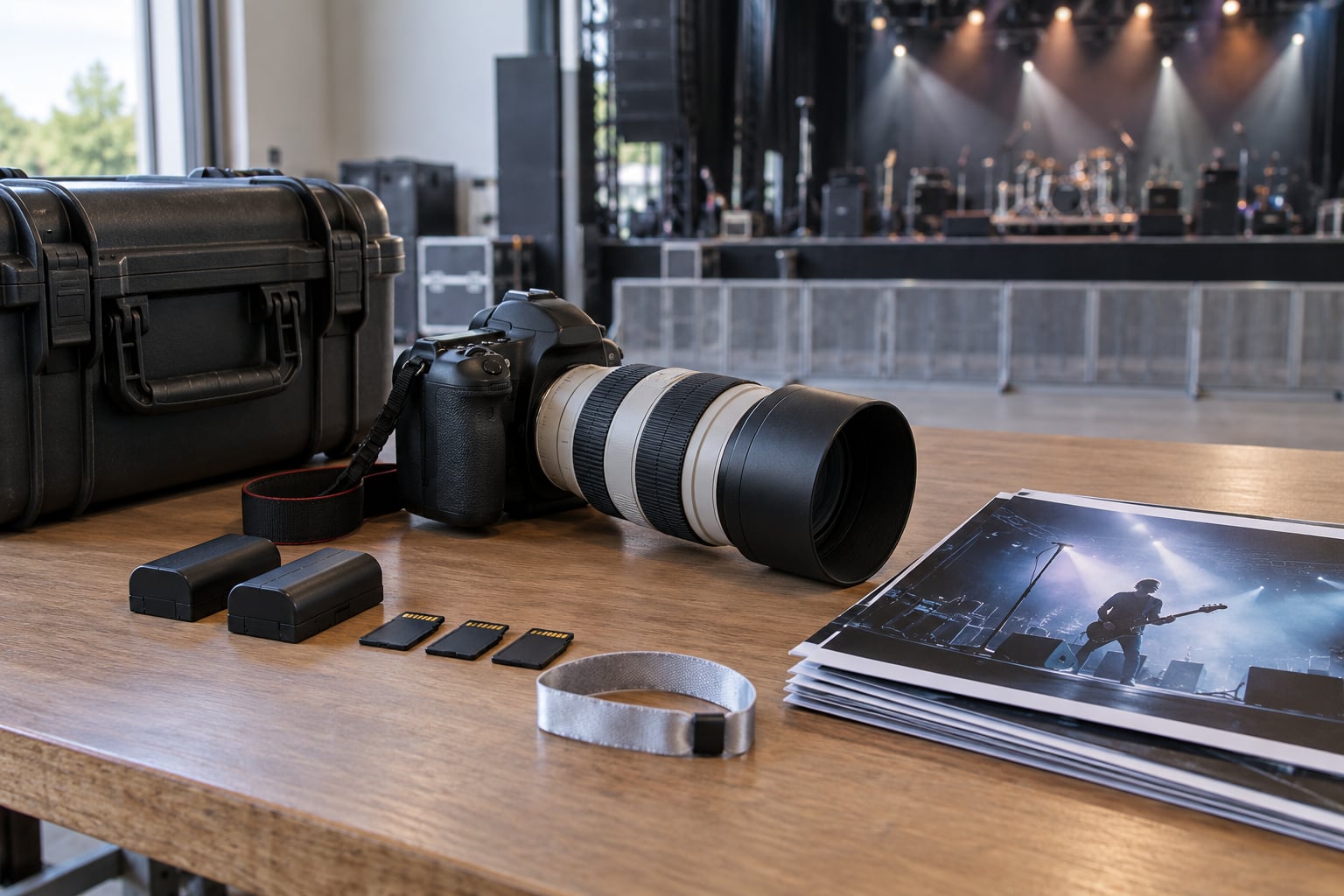
Equipment matters less than people think. A body you know well, a fast lens, spare batteries and multiple cards will carry a whole tour. What actually limits you is arriving with a full card and a dead battery at the barrier.
Then line up the practical bits: a list of contacts with names and roles, a clear idea of what you will deliver afterwards, and a short note of every venue house rule you can find published.
Step-by-Step
The order below is how concert photographers get photo passes without wasting a season. Each stage has a signal that tells you it worked, and if you cannot see that signal, fix it before moving on.
Step 1: Build a Professional Concert Photography Portfolio
Pick images that prove you can handle the hardest conditions in live photography. Low light, fast movement, backlighting and partial occlusion, all in the same set.
Show range rather than volume. A wide shot of the full stage, a tight portrait, a crowd moment and one image where the lighting is genuinely difficult tells a publicist more than thirty near-identical frames of the same guitar player.
Credit every artist you have photographed, by name, in the caption. Music photographers care deeply about this, and uncredited images are the fastest way to lose a contact who works in the scene.
Add a sentence about what you did with the images. Published in a magazine, used for an album announcement, delivered same-night to the tour manager. That sentence turns a gallery into a portfolio with a track record.
The signal: a stranger can tell who you shot, what the images are for, and whether you delivered them.
Step 2: Identify the Correct Person to Contact
Emailing a band’s social inbox is the most common miss. The decision sits with a smaller set of roles, and each one controls a different kind of show.
- Publicist handles press and media for a large touring act, approves most media credentials, and is the person most likely to forward a request internally.
- Tour manager controls day-to-day operations and often approves pit access directly, especially for mid-level and support acts.
- Artist or band management decides for smaller acts with no publicist and no formal press system.
- Venue media contact issues passes for in-house shoots and can grant access based on house policy alone.
- Promoter books the show and often has standing relationships with photographers who work their rooms.
- Festival press office runs accreditation for large multi-stage events through a formal application.
Also watch what working photographers do on the same circuit. Forums like r/concertphotography and r/musicphotography carry practical threads, and people there will tell you which route actually produced a pass at which venue.
The signal: you can name the person who owns the decision, not just the band.
Step 3: Know How Concert Photographers Get Photo Passes for Each Show
The phrase “photo pass” covers several different credentials, and mixing them up is why requests get ignored. Knowing which one you are asking for tells you who approves it and what you get.
- Guest list pass is added by the artist or their team to the show’s guest list. It grants entry with a name at the door, and it often includes pit access at small and midsize shows.
- Venue-issued credential comes from the venue’s media or marketing department and can grant a marked shooting position or barrier access independent of the artist.
- Artist or publicist approval is granted for a specific date and routed through the band’s press contact, usually with an expectation of coverage in return.
- Festival accreditation comes through an application portal with a published deadline, often requiring an outlet letter on file.
- Commissioned access happens when a publication, label or brand hires you to cover a tour. You are working, not asking, which changes the conversation completely.
Naming conventions vary by country and venue, so ask directly rather than guessing. Also know what a pass does not include: a photo pass is almost never backstage access, a green room visit, or an interview.
The signal: your request names a credential type and the person who issues it.
Step 4: Prepare a Targeted Credential Request
Keep it under ten lines. Long emails get skimmed, and a wall of biography reads as a favour being asked rather than an exchange being offered.
A request that works contains: the artist and venue, the date, who you are and what you shoot for, a single portfolio link, what you will deliver and by when, your equipment in one clause, and the date you need an answer.
A template that has worked across many shows:
Subject: Photo request for [Artist] at [Venue], [Date]
Hi [Name],
I shoot live music for [publication / blog / label / my own work], and I will be at [Venue] on [Date]. I am requesting photo pit access for the full set.
Portfolio: [link]
I will deliver 10 to 15 high-resolution selects within 24 hours of the show, credited to the artist, suitable for press and social use. I can also supply vertical crops for announcements.
I shoot with [body and lens], RAW, no flash, and I follow pit protocol including the three-song rule.
Could you confirm whether you can add me to the list or issue a credential? I would appreciate an answer by [date].
Thanks for your time,
[Name, email, phone]
Name the deliverable and the deadline. Publicists approve requests that state a return clearly, because they can forward them upward without doing extra work.
Step 5: Contact Labels, Publicists, Venues, and Festivals
Research first. Press pages, tour announcements, venue media guidelines and event listings usually name the right contact. For large venues and many festivals, an online credential application portal exists, and those applications close weeks ahead of the show.
Send individually. A mass email to forty venues reads as spam and gets filtered, and it burns the relationship before it starts.
Follow up once, politely, about a week later if you have no answer. A short bump that references the specific show is fine. A third message is not.
Reach out before shows are announced where you can. Publicists plan coverage months ahead, and a request that arrives after the tour is booked is competing against a list that already exists.
The signal: a reply, even a no. Silence usually means you found the wrong address.
Step 6: Confirm Restrictions Before the Show
Get the details in writing before you travel. Venue policies differ sharply by size, and small rooms are often stricter about where a photographer can stand than arenas are.
Confirm the credential type and name it on the list, the arrival time and door, the photo pit procedure, whether you need a letter from an outlet, age requirements for unaccompanied minors, and which items are banned. Bags, batteries, water and tripods are the usual flashpoints.
Ask whether approval guarantees a shooting position. It usually does not. Access is granted, the shooting spot is assigned on the night, and you may be asked to shoot the first three songs only before moving to a side position or the balcony.
If you get refused at the door despite a confirmation, stay calm, do not argue with security, find the venue media contact or tour manager, and ask them to sort it out. Escalating at the entrance is the fastest way to lose the credential and the contact.
The signal: you know your arrival time and pit procedure before you leave home.
Step 7: Deliver Professional Work and Build Long-Term Access
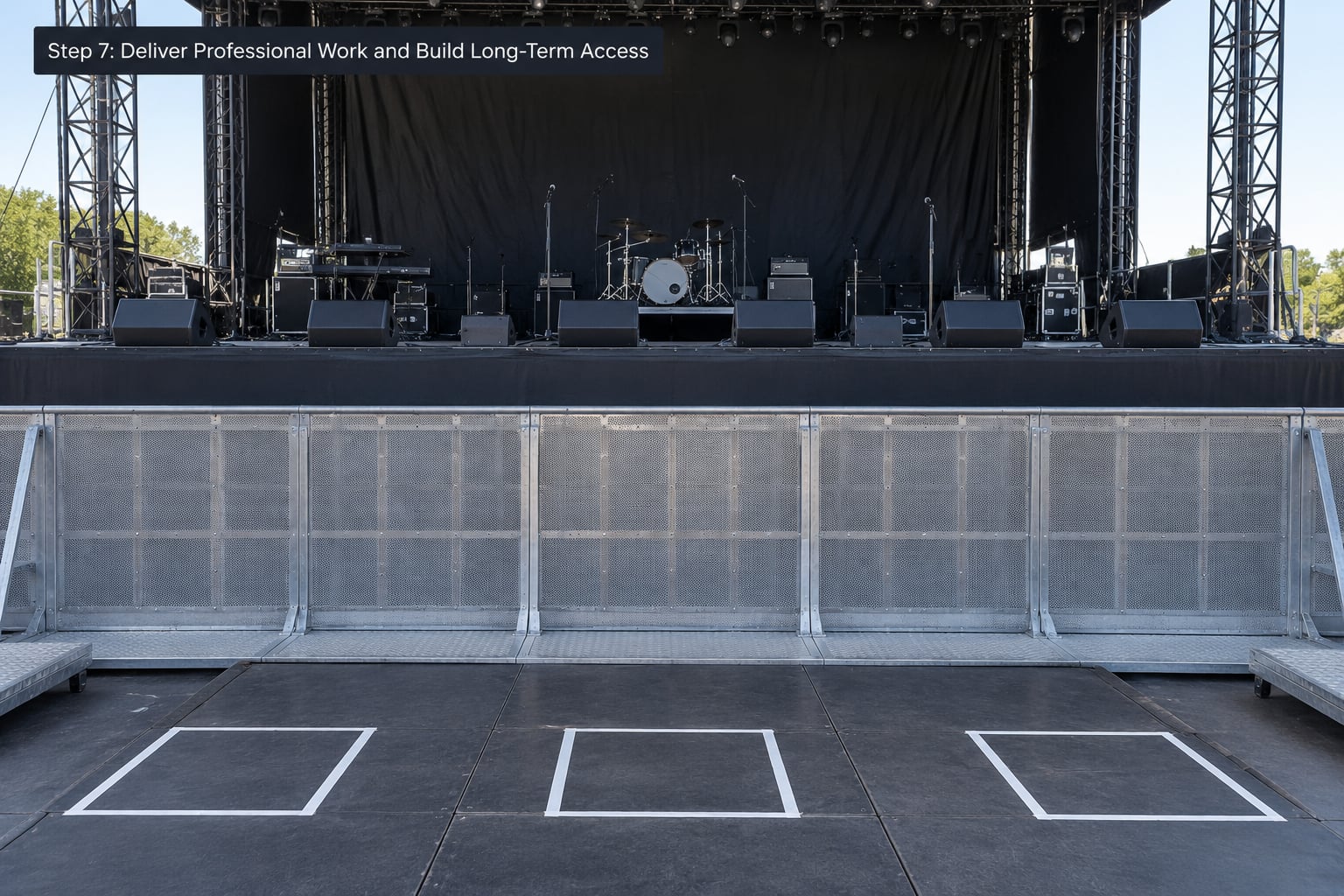
Treat the delivery as the real job. Forum consensus is blunt about this: send the images the same night or within 24 hours, with credit, or you will not get a second pass from that contact.
Send a small curated set rather than everything. Ten to fifteen strong selects, full resolution, captioned with the artist name and the venue, is more useful than a link to four hundred frames.
Before doors, confirm your position, check battery and card space, agree your settings for the lighting, and note which moments you need to catch. Stay on your mark, keep the lens off other photographers’ frames, and never use flash.
Afterwards, tag the artist and the venue, share the images where they were promised, and send a thank-you that mentions the next date on the tour. A short, specific message beats a generic one, and it is what turns one pass into a standing arrangement with a publicist or promoter.
The signal: the same contact answers your next request faster.
Common Mistakes
Contacting the wrong person. The band’s booking email handles bookings. Find the role that controls media instead, and expect one rejection before you reach the person who can say yes.
Sending a weak or oversized portfolio. Twenty curated images that load instantly outperform a slow site with six hundred near-duplicates.
Asking with no purpose. If you cannot say what the images are for or when they will be delivered, the answer is already decided.
Demanding unrestricted access. Request a credential for a specific show, respect the three-song rule, and ask about restrictions rather than arguing against them.
Skipping the rules confirmation. Arrival times, age limits and banned items are not suggestions. Check them before you drive.
Behaving badly at the venue. Disrupting the audience, arguing with security or blocking other photographers costs you future access more reliably than anything else.
Frequently Asked Questions
Do concert photographers pay for photo passes?
No. Photo passes are issued free of charge as a credential in exchange for coverage, and that is true of guest list passes, venue credentials and festival accreditation alike. What costs money is the work around it: travel, admission tickets when you are not on the list, equipment, and often the unpaid hours spent editing and delivering. The exception is a small venue that sells a photographer add-on or table package, which is a commercial arrangement rather than a standard credential.
Are festival media passes guaranteed after an application?
No application guarantees anything. Festivals cap the number of working photographers they credential because the pit space is physically limited, and they weigh applications against a mix of assigned outlets, existing contributors and required coverage of every stage. Late applications are often closed outright. Apply on the published schedule, name which outlet you represent and which stages you will cover, and expect a decision within the timeframe the organiser states.
Can a guest list include concert photography access?
Yes, and this is the most common route for smaller and midsize shows. A publicist or tour manager can add your name to the guest list and note that you are photographing, which usually gets you into the pit at a club. At arenas it is less reliable, because the artist does not control the pit. Always confirm in writing whether guest list status includes pit access at that specific room, rather than assuming it carries over from a smaller venue.
How early should I contact a band’s publicist?
Two to eight weeks ahead of the show is the useful window for a touring act, and earlier is better for festivals, where deadlines can close a month or more ahead. Publicists plan coverage before a tour is announced, so a request that lands while routing is still open is easier to approve. Avoid the final week, when press lists are locked. For local shows the timeline collapses: a few days is enough, because the person adding names to the list is usually working that week.
Why was my photo-pass request denied?
The usual reasons are an unclear deliverable, a portfolio that does not show live work, contacting a role with no authority over access, or asking at a venue where the pit is already fully staffed. Small and midsize rooms also often have no policy for granting passes at all. A polite reply asking what they would need to see gives you a real answer, and a venue media contact can usually tell you exactly what that room requires.
What should I do after receiving a credential?
Confirm the arrival time, door and any equipment or age restrictions in writing, then arrive early enough to be briefed by the media or security lead. Bring the credential and identification and ask where you are shooting rather than assuming. Follow pit protocol, no flash, and any set-length limits. Afterwards, deliver your selects within 24 hours with credit, then send a short thank-you that references the next date on the tour.
Start tomorrow by shooting a local show with no pass at all, culling twenty images and crediting the band. That portfolio is the thing every route above depends on, and it costs you nothing but a ticket.