To start a music blog about metal, you need three things: a narrow editorial angle, a self-hosted site you actually own, and a publishing rhythm you can keep for a year. Pick a corner of the scene, register a domain, install WordPress, then publish one honest piece a week about records and shows you genuinely care about. The whole setup takes a weekend and costs less than a single vinyl run.
That last part surprises people. The hard bit of running a metal blog was never the website. It is deciding what you cover, then having the discipline to cover it again next month when the well of new releases feels dry and nobody is commenting.
This guide walks through the whole build: what to buy, what to skip, where underground metal actually surfaces, how to write a review that a scene reads without rolling its eyes, and how to reach people without begging algorithms for scraps. Budget roughly two days for setup and six to eight hours a week to keep it alive.
Table of Contents
- What You Need
- Why Metal Blogs Still Matter
- Step-by-Step
- How to Start a Music Blog About Metal by Choosing a Clear Niche
- Plan Your Editorial Format and Publishing Schedule
- Build a Simple Site That Is Easy to Move Through
- Write Useful Metal Posts With Your Own Perspective
- Create a Consistent Visual and Audio Identity
- Promote Posts and Build an Audience
- Track Performance and Improve the Blog
- Common Mistakes
- Frequently Asked Questions
- How do I start a music blog about metal with no money?
- What platform is best for a metal music blog?
- How do I find new metal bands worth writing about?
- Can I review a record that the label sent me for free?
- How do I get press passes for metal shows?
- Are music blogs still profitable?
What You Need
Almost every beginner arrives with the same question: which platform? The honest answer is that the platform matters far less than your writing, but it does decide how much you can change later. These are the six options worth knowing.
| Platform | Relative cost | Ownership | Best for |
|---|---|---|---|
| WordPress (self-hosted) | Low | Full | Long-term owners who want control and portability |
| Ghost | Medium | Full | Newsletter-first publications with a clean look |
| Substack | Free to low | Limited | Testing an angle before you commit to a site |
| Squarespace | Medium | Full | Design matters more than technical flexibility |
| Wix | Free to medium | Full | Absolute beginners who want drag-and-drop |
| Blogger | Free | Partial | A practice blog with no hosting to manage |
Self-hosted WordPress wins for metal specifically, and experienced bloggers in the comments of every music-blogging forum point to the same reason: flexibility and portability. You can redesign, add contributors, or move the whole archive to another host years from now without losing a single URL. The trade-off is a five-hour setup window, most of it spent choosing a theme and deciding where the sidebar goes.
Ghost suits a newsletter-first approach where the email list is the actual product and the website is the archive. Substack is the cheapest way to test whether you can commit to a rhythm at all, since it takes an afternoon. If you bounce off Substack after ninety days, that ninety days has still taught you more than any guide will.
Beyond the platform, a metal blog needs a handful of other decisions made early:
- A domain name. Short, spelled-out, and not tied to one subgenre you might grow out of. Register it somewhere with an email account you own, not through a cheap registrar you will forget.
- A band email address on your own domain rather than a free personal account. Bands reply to free accounts far less often, and it looks professional when a publicist forwards you to a tour manager.
- A hosting plan. Shared hosting is enough for a text-heavy music site with photos. You do not need a dedicated server unless you are hosting large audio files.
- A microphone, if you will record interviews. A decent USB condenser covers phone calls and press-conference interviews; a handheld dynamic model is what you want for a loud room.
- A camera, only if you enjoy shooting shows. Phone cameras handle a dim venue better than most people expect, and the photo pit will test your lighting far more than your lens will.
- A disclosure habit. Decide now that you will note whenever a record, ticket, or piece of merch arrived free. Write it into your template.
Total spend for a bare-bones first three months is small: a domain, a year of cheap hosting, and one microphone if you want one. The only line item worth genuinely splashing out on is recording gear, because thin audio undermines an interview faster than any amount of careful writing rescues it.
Why Metal Blogs Still Matter
It is a fair question. Recommendation playlists and social feeds push new music to enormous numbers of people every day, so why would anyone need a person with a byline? Because an algorithm can tell you a record exists, and almost nothing else about it.
Streaming discovery is organised around similarity. Feed it one death metal record and it serves you more of the same, which is exactly how a listener stays inside a genre they already know well. That is useful, and it is also the reason an entire underground circuit can go years without a single banner ad while bands keep releasing records. Nobody is being served the thing they have not heard of yet.
That is the gap a metal blog fills, and it has filled it since before there was an algorithm. For a long time, Hype Machine was where metal fans found records nobody had written about. No Clean Singing and Invisible Oranges built large followings by explaining context: who a band grew out of, which city produced it, which label shaped it, which earlier record it answers. A playlist cannot do that work. Only a writer can.
There is a business reason too, and it is worth being blunt about. The advertising money that once paid independent music writing moved to platforms that aggregate it, and the layoffs at music journalism outlets were documented rather than rumoured. The blogs that survived did not survive on ad revenue. They survived because they became useful enough that bands and labels wanted the coverage, and because the archive was worth a byline and an audience of their own.
For a beginner, that is encouraging rather than discouraging. You are not trying to out-algorithm a recommendation engine. You are writing for the few hundred people who want context badly enough to read four thousand words about a demo, and that audience has always been the reason metal culture works.
Step-by-Step
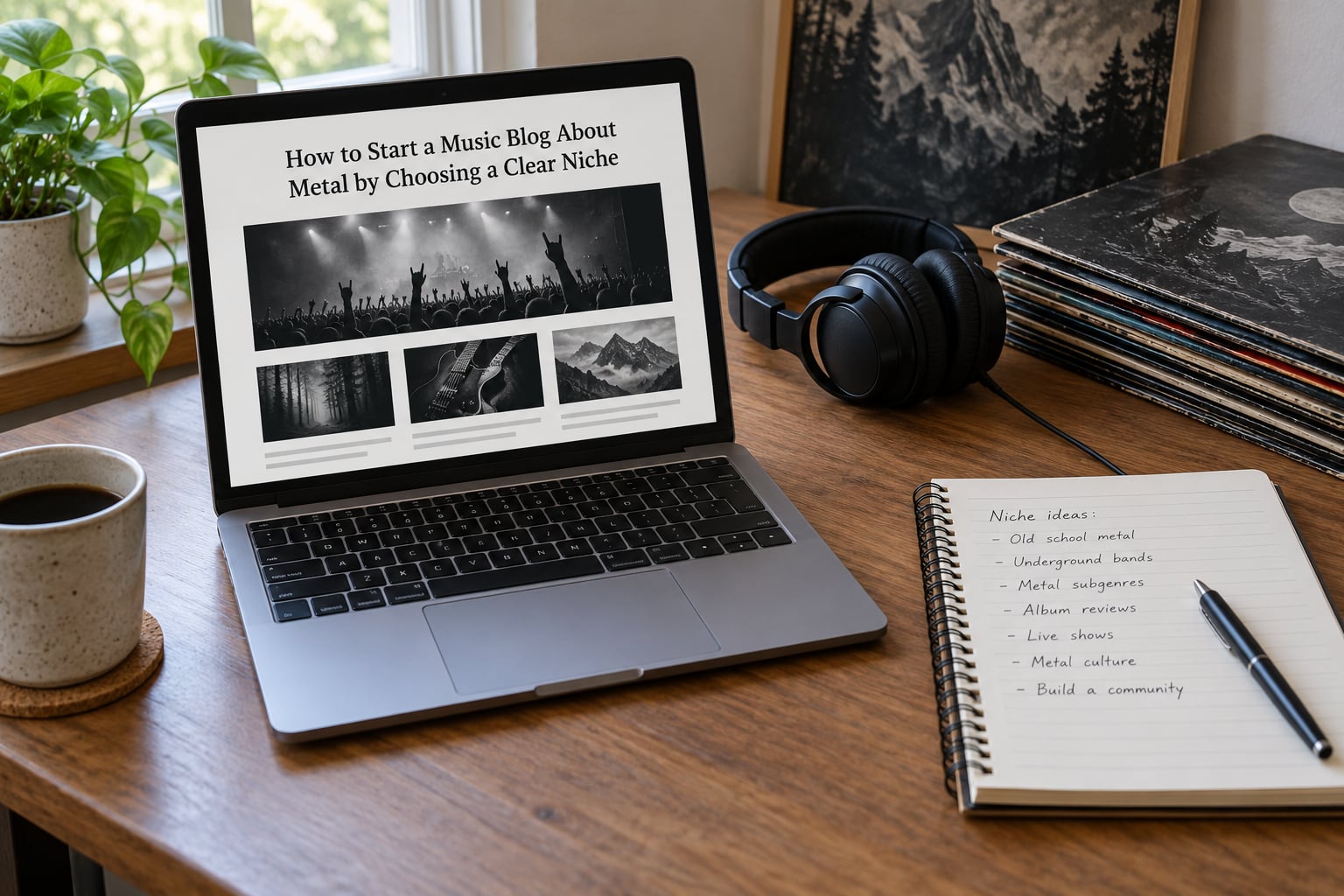
How to Start a Music Blog About Metal by Choosing a Clear Niche
Narrow by one axis and hold it for a year. The axes that work are subgenre (technical death, blackened crust, old-school thrash), era (1980s underground, first-wave black metal, the 1990s tape-trading circuit), geography (your city, the UK, the Nordic scene, the Southern United States), or format (only live reviews, only reissues and demos, only the history of one label).
Pick the axis you can sustain on a slow week when nothing interesting came out. A subgenre niche can dry up for three weeks at a time. A regional scene blog never dries up, because there is always another basement show, another demo, and another band splitting up that nobody documented yet.
Write your niche as one sentence before you build anything: “I cover black metal demos released outside Europe since 2015, and I interview the bands directly.” If you cannot finish that sentence, keep narrowing.
Plan Your Editorial Format and Publishing Schedule
Decide which formats you will actually run before you launch, because each one eats a different amount of time. Album reviews take two to four hours. Track-by-track breakdowns take five or more. Live reviews take an evening plus a morning. Interviews take weeks of scheduling.
- Album reviews — the backbone. One a week keeps you visible and costs the least credibility if a release is mediocre.
- Live reviews — the strongest local currency. Cover the opening band as carefully as the headliner and you become someone bands recommend.
- Interviews — the highest-effort, highest-trust format. Expect three weeks from first email to published piece.
- Scene reports — a monthly trip through a city or regional scene, with photographs and a running theme.
- Retrospectives and reissue coverage — genuinely under-served, rarely time-sensitive, and they keep earning search traffic for years.
- Opinion columns — where you argue something. Write one a month at most, or your byline becomes a reaction account.
Then set a schedule you can keep when you are tired: one long-form review a week, one live review a month, one interview a month. Anything more and you will publish filler in month four, which is worse than publishing less.
Ramp over ninety days rather than starting at full speed. Weeks one and two: publish three pieces so the site is not empty. Month two: add a weekly post and open a newsletter. Month three: pitch your first guest pieces and reach out to two publicists. Consistently visible over three months does more for your credibility than a launch-week burst of twelve posts.
Build a Simple Site That Is Easy to Move Through
Install WordPress on your host, pick a clean magazine-style theme, and set up four navigation items: Reviews, Features or Interviews, Shows, and About. That is your entire skeleton for the first year.
The pages that matter more than the theme are the ones readers will check before trusting you: a real about page with your name and your history in the scene, a contact page with the band email address, a disclosure policy, and an archive organised by tag rather than only by date. Someone landing on a review from two years ago through search should be able to click through to ten more of your writing in two clicks.
Get the mobile experience right before you obsess over typography. Most readers arrive from a phone, usually while standing in a venue. Compress images, keep embeds lightweight, and use at least one embed per post rather than five. On search basics, submit your sitemap through Google Search Console, keep permalinks that include the release year, and give every post a description written for a human.
Write Useful Metal Posts With Your Own Perspective
A review that scores 8.5 out of 10 helps nobody. A review that explains what changed since the band’s last record, who the drummer used to play in, and why the production sounds the way it does gives a reader three reasons to care.
A workable review structure: one sentence on why this record matters right now, a paragraph of context (lineup changes, label history, where the band came from), the specific musical observations you can defend (timbre, structure, vocal approach, mixing), one honest weakness, and a verdict that ties back to your opening claim. Keep the score at the end, not the front.
Specificity is the whole game. “The guitars sound heavier” is empty. “The guitars dropped a half step and the whole record got slower and stranger because of it” is a sentence someone can argue with, which is what earns comments.
For interviews, prepare eight written questions in advance so the conversation has shape, and never fabricate or paraphrase a quote into something the musician did not say. For news, link to the primary source rather than a repost, and date the post when the news broke. For scene reports, photograph the room, not just the stage, and name people who showed up to do work.
Two ethics rules matter more in metal than in most music writing. First, disclose anything the subject gave you: review copy, a ticket, merch, a placement. Readers forgive a disclosed gift; they do not forgive being fooled about one. Second, take a position when politics or community controversies come up rather than pretending neutrality, and describe the facts of an accusation rather than repeating it as fact.
Create a Consistent Visual and Audio Identity
Pick three colours and two fonts, then stop fiddling. Metal sites tend toward black, one accent colour, and heavy display type; the danger is illegible dark-on-dark body text and a layout that buries the writing under banners.
On images, you have three legal options. Use your own photographs. Use images a label or band has explicitly licensed for press use, which usually arrives in a press kit. Or use properly licensed stock and libraries with album art available for editorial use. Do not scrape artwork off Bandcamp or Discogs and re-upload it. Cover art belongs to the label, and takedowns hit new sites fastest.
Credit artists whenever you can, and keep a simple image credit line at the bottom of every post. Audio examples are optional but useful for instrumental and extreme metal coverage, where describing the sound sometimes fails. Keep clips under thirty seconds, host them yourself, and include a download credit to the artist or label.
Promote Posts and Build an Audience
Search is the compounding channel and the slowest. Write headlines a person would actually type, keep one release year and one subgenre in the title, and link internally between related reviews so old posts keep feeding new ones.
Social is the fast channel. Post one specific observation per link rather than a bare link drop, and use the release artwork sparingly since most platforms downrank it. Cross-promotion is the underrated one: email three other small metal blogs offering a guest piece, a trade, or a link exchange. Small blogs are unusually generous with this, and it is how most working metal blogs built their first 500 readers.
In metal communities, self-promotion is tolerated only when you bring something else to the table. On forums like Reddit’s metal communities and on Discords, drop a bare link and you will get ignored or removed; show up, answer questions about records for a month, then share a piece. Never repost the same review to five subreddits in one day.
Two formats are worth setting up early. A newsletter captures readers who never come back to the site, which for a review blog is most of them. A publicist pitch email is short: who you are, what you cover, one link to your best existing piece, and a specific question about the release. Bands and labels get dozens of generic pitches a day; the ones that name an actual song do get answered.
Here is a template that works:
Subject: Question about the second track on the new release
Hi [name] — I run [blog name], a metal blog covering [specific angle]. I’ve been following [band] since [release], so the new record came up a few times in my listening this week. The jump on track two caught me out; I’d love to ask about how it was tracked. Here’s my most recent piece: [link]. Happy to send questions in advance or work around your release date. — [name, blog URL]
Track Performance and Improve the Blog
Ignore pageviews for the first six months. Three numbers actually tell you whether a small metal blog is working: how many readers come back a second month, how many people open your newsletter, and which posts get shared or linked by other writers and bands.
Set up Google Search Console and a simple analytics dashboard in month one so you have history to compare against. Look at which posts bring search traffic months later, and write more in that direction. Retrospectives and scene guides usually out-perform new-release reviews for traffic, because new-release posts decay within a week.
Update your backlist twice a year. Add a newer, better review link at the top of older posts, refresh anything factually out of date, and make sure old reviews still open fast on a phone. Read your comments and your email replies, then treat the same request appearing three times as your next assignment.

Common Mistakes
Covering every subgenre at once. A blog that reviews death metal on Monday and power metal on Thursday has no identity and no regular reader. Pick one axis and stay there for a year, then expand.
Copying the look and voice of an established site. Readers can tell, and bands can tell, which is worse. Study what No Clean Singing, Invisible Oranges or Decibel do structurally, then write in your own voice about material they ignore.
Publishing without checking facts. Wrong release dates, wrong lineup attributions and invented quotes are the fastest way to lose scene credibility, because fans correct you publicly. Verify the pressing, the format, the lineup and the label before you publish.
Using copyrighted artwork. Cover art and photography belong to labels and photographers. Use your own shots, press-kit images you are permitted to use, or properly licensed libraries.
Ignoring phone readers. Test every post on your own phone before hitting publish. If the images push the text off the screen or the embeds take ten seconds to load, fix it now.
Chasing pageviews from day one. Traffic without a return audience does nothing for a blog that wants press access, records, and contributors. Depth and consistency are what get you the email address that matters.
Writing in a gatekeeping tone. Metal communities punish condescension harder than any other genre. You are allowed to dislike a record; you are not going to win friends by telling readers what they should like.
Publishing four reviews a week you do not believe in. A smaller archive of argued pieces is worth more than a large one of rating aggregates. Cut the schedule before you cut the standards.
Frequently Asked Questions
How do I start a music blog about metal with no money?
Use a free platform first. WordPress.com, Blogger, Wix and Substack all let you publish without paying, and a free subdomain is fine while you learn. Register your own domain once you have published fifteen pieces and know what you are covering. Keep hosting and gear minimal, and put any spare money into one microphone rather than a paid theme.
What platform is best for a metal music blog?
Self-hosted WordPress, if you can spend an afternoon on setup. Existing metal bloggers point to it because you own the archive and can restructure it whenever you want, which matters when you add contributors or redesign. Ghost suits newsletters, and Substack is a cheap way to test whether you can hold a publishing rhythm before you commit.
How do I find new metal bands worth writing about?
Bandcamp is where most underground releases surface first, and its tag and location filters beat any playlist. Metal Archives is the reference for lineup and release history, and Discogs is the best source for vinyl pressings, repress variants and regional editions. Local venue calendars and small-label mailing lists will feed you material no algorithm surfaces.
Can I review a record that the label sent me for free?
Yes, and most independent metal labels expect coverage, but you have to disclose it. Add a clear line at the top or bottom of the post saying the label supplied a copy, then write the review you would have written anyway. Readers forgive a disclosed gift; they lose trust when they find out after reading a hype piece.
How do I get press passes for metal shows?
Start by covering small local shows before you ask anyone for anything. Photograph the room, write about the opening band properly, and show the promoter you turn work around on schedule. Once you have published live coverage, contact the band’s publicist with two links to past show reviews. Passes come from a track record of turning up early and filing fast.
Are music blogs still profitable?
Display advertising for small music sites has largely collapsed, so most new metal blogs earn nothing for months. Realistic income paths are a paid newsletter, band sponsorship, merch affiliate links, sync licensing, or building the blog into a writing portfolio that leads to paid journalism work. Treat the blog as a calling card first and a business second.
Start with the smallest version of this that you will still be running in six months. Write your niche as one sentence, register the domain tonight, install WordPress this weekend, and publish three pieces before you share the link with anyone. Everything after that, the interviews, the show photography, the publicist replies, follows from whether those first three pieces were any good.