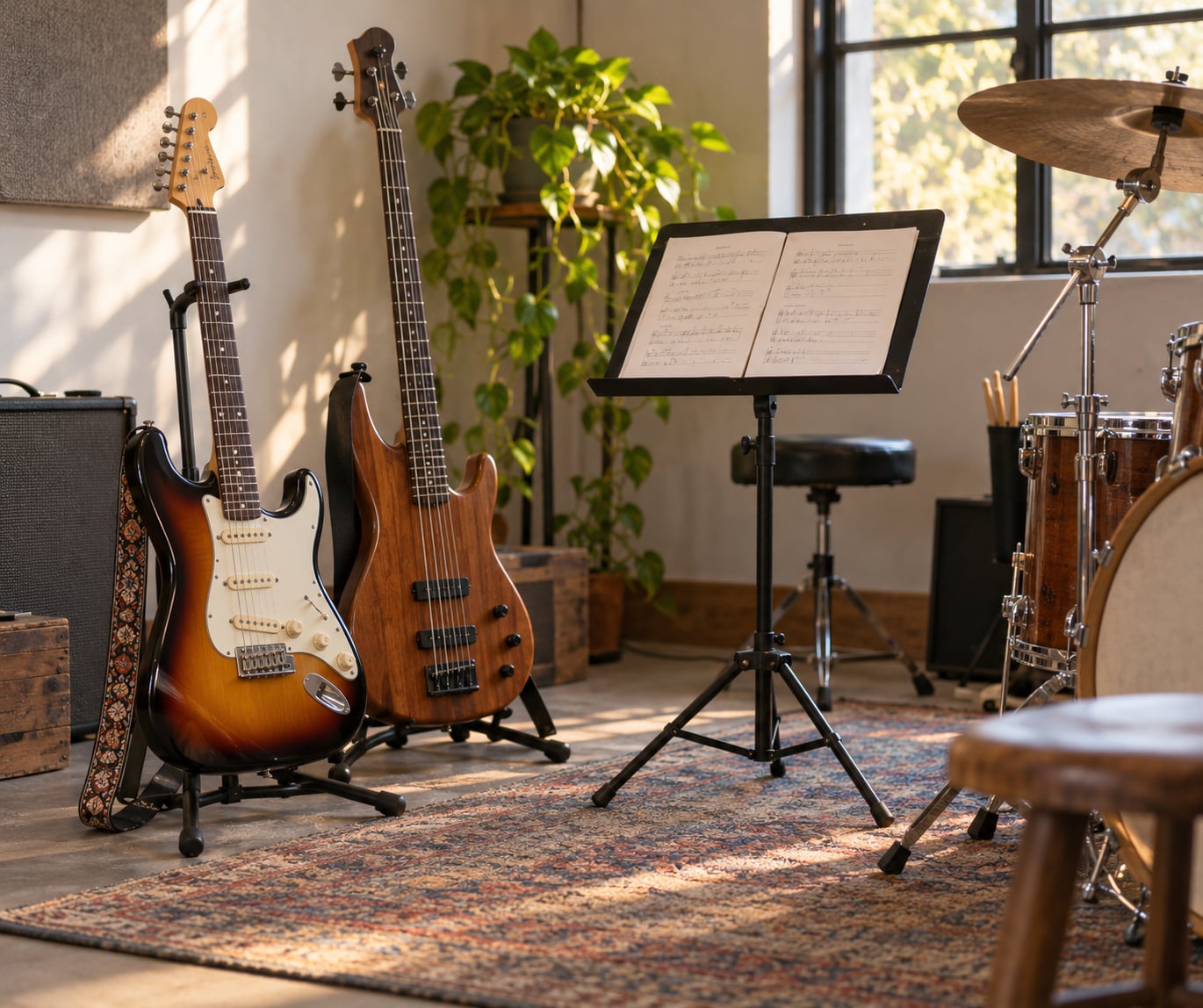
How band lineup changes affect a sound is mostly a question of habits. Every member arrives with their own timing, pick attack, note choices, phrasing and volume instinct, and the record you know is the record those habits produced. Swap one person in and you have not changed one part of the music; you have changed one layer that every other layer had to adjust around.
That is why AC/DC sounded heavier after Bon Scott died in 1980, why Van Halen’s 1984 had a different engine than Fair Warning, and why fans hear a “different band” long before anyone can explain why. The change is audible. It is also specific, and it can be described.
This guide breaks the effect down role by role, then gives you a listening method for comparing eras without either worshipping the past or pretending every change is a downgrade.
Table of Contents
- What Is a Band’s Sound?
- The five layers you are listening through
- How Band Lineup Changes Affect a Sound
- How Each Musician Shapes the Music
- Why a New Singer Can Transform a Band
- Timbre and weight
- Range and melody
- Phrasing and accent
- Intensity
- How Guitar and Bass Changes Rewrite the Rhythmic Identity
- Why the Drummer Matters More Than Expected
- Cymbals
- Kick placement
- Ghost notes
- Restraint
- What Happens to the Band’s Chemistry
- Replacing a well-known member
- Adding a compatible player
- How Lineup Changes Affect Songwriting and Arrangements
- From singer-led to riff-led
- From riff-led to concept-led
- From sparse to layered
- When a new lineup limits material
- Why Studio, Touring, and Replacement Players May Sound Different
- How to Compare Lineup Eras Without Losing Perspective
- 1. Pick two specific eras, not a vibe
- 2. Confirm who actually played on each recording
- 3. Compare tracks doing the same job
- 4. Separate personnel from production
- 5. Do not judge unfamiliar songs by old habits
- Listen to unfamiliar material on purpose
- Frequently Asked Questions
- Is a band’s new lineup better than the old one?
- What should I listen for first when a band changes members?
- Why do so many bands keep a recognizable sound through changes?
- How long does it take a new lineup to settle?
- Should I judge a band by its best era or by individual songs?
- Conclusion
What Is a Band’s Sound?
A band’s sound is not a genre label. It is the combined result of five things: what each member’s role contributes, the habits that role brings, how well the parts interlock, what the producer and engineer do with them, and what the group decides to write and arrange.
Take those away one at a time and you can usually hear which one moved. Swap the engineer and the drums turn brittle. Add a rhythm guitarist with a taste for long descending figures and the songs get a new shape. Change who holds the melody and the lyrical register changes with it.
That is also why genre is a poor stand-in for sound. Plenty of bands described as the same subgenre sound nothing alike, because the label describes instrumentation and attitude, not the actual playing.
The five layers you are listening through
- Rhythm section — the lock between bass and drums sets weight and tempo feel.
- Riff layer — how guitars construct and repeat figures.
- Vocal layer — timbre, range, phrasing, accent and intensity.
- Arrangement — what gets built around the core parts.
- Production — room, compression, mix weight and editing.
Lineup change touches all five. It only ever starts at one.
How Band Lineup Changes Affect a Sound
Here is the direct answer: a new member swaps an entire layer of musical decision-making, and the rest of the band has to reorganise around it. A drummer who plays behind the beat makes every guitar part sound more aggressive. A bassist who plays fewer notes makes a busy riff sound cleaner. A singer with a narrower range forces the melodies to move somewhere else.
Two honest qualifications. Not every departure changes every song. A band that changed drummers in 1998 and changed guitarists in 2006 has two distinct sounds, but tracks that depend mostly on vocal and bass may barely register the difference. And the effect is not always a downgrade — some transitions are the best work a band ever made.
Musicians on the receiving end describe it more bluntly than fans do. In a thread on r/metalmusicians, players argued that drums make the riff: if the drums are weak, the song is weak, no matter how good the guitar part is. In r/Bass, practitioners pointed out that the bassist effectively defines the harmony and holds the tempo, so a bass change moves the whole arrangement, not one part of it.
So when someone tells you a new lineup made the music better or worse without naming an instrument, they are reacting to something real. They just have not located it yet.
How Each Musician Shapes the Music
Each role contributes a different layer, and each layer has its own set of audible cues. Here is the short version.
| Role | What they contribute | What changes when they are replaced |
|---|---|---|
| Lead vocalist | Timbre, phrasing, lyrical subject matter, stage identity | Vocal colour, melodic range, accent, the themes the band feels compelled to write about |
| Lead guitarist | Riff construction, solo vocabulary, tone | Length and shape of riffs, pick attack, use of effects, how recognisable a part is |
| Rhythm guitarist | Harmonic support, texture, double-time drive | Density, whether the low end stays clear, whether harmony stays present |
| Bassist | Harmony, tempo, low-end weight, note choice | Root notes versus melodic movement, groove density, how much weight the mix carries |
| Drummer | Tempo feel, dynamics, accent, fills | Cymbal character, kick placement, ghost-note detail, whether a part feels straight or pushed |
| Keyboardist | Texture, arrangement layers, atmosphere | Density of arrangement, whether the band sounds more or less produced |
| Touring musician | Live continuity, show reliability | Less than you would expect musically, more than fans expect emotionally |
Read the middle column as the answer to “what was that member actually doing?” It is usually more specific than the fan version of the story.
Why a New Singer Can Transform a Band

A singer carries more of a band’s identity than any other role, because the voice is the part a listener connects to emotionally before they analyse anything. Replace it and the change is unmistakable, even when the band plays identical material.
Here is what actually shifts.
Timbre and weight
The same line delivered in a thicker, raspier voice sounds like a different genre. A lighter, clearer vocal over the same guitars can strip the heaviness out of a record completely. Nothing was re-recorded except the voice, and the album reads as a different record.
Range and melody
A singer comfortable at the top of their range lets a band write hooks that climb. A singer who is not will pull the melody down and reshape the whole song around it. Watch what happens to the chorus shape between eras.
Phrasing and accent
Phrasing is where a band stops sounding like a band. Two singers can sing the same syllables at the same pitch and produce completely different grooves, because one leans into the beat and the other drags against it.
Intensity
Some singers play the lyric almost flat, some shade every line with pressure. Intensity that comes from delivery rather than volume changes the perceived emotion of a record without touching the instrumentation.
And here is the part fans get wrong. A technically very different singer can preserve an identity, because identity lives in the relationship between the voice and the material. Van Halen moved from David Lee Roth to Sammy Hagar in 1985 and the band’s character survived intact, because the riff writing and the showmanship stayed the same. AC/DC moved from Bon Scott to Brian Johnson after 1980 and the blues-based heaviness survived intact.
Contrast that with a singer who arrives with a very different idea of what the band is. Then the identity does move, and it moves everywhere at once.
How Guitar and Bass Changes Rewrite the Rhythmic Identity
Guitar changes are usually described as tone changes, but tone is the least interesting part. What actually shifts is rhythm and melody.
Tunings change how a riff is built. In a lower tuning the same riff sits lower, takes longer to articulate, and tends to be played with less pick attack. You hear it as weight.
Riff length is the one I notice first. Some guitarists write figures that resolve quickly and start again. Others write a long descending line that resolves once and lets it breathe. Same tempo, completely different momentum.
Pick attack matters more than most listeners expect. A player using a thin pick on a down-tuned guitar gets a thin, picked sound; a player using a flat pick gets a thick, sustained one. That single choice alters how the drums are played against it.
Melodic vocabulary decides whether the guitar part sings or chops. A player who works in intervals builds melodies over the top of the riff; a player who works in chord shapes builds weight underneath it.
Bass is where a lot of people underestimate the change. Two bassists can play the same root notes and produce different records, because of how long they hold them, whether they add passing movement, and how tightly they lock to the kick drum. Practitioners on r/Bass make the case that the bassist defines the harmony and the tempo, which is why a bass change can move an entire arrangement.
None of this is a ranking. A sparse, root-note bass suits some riffs and destroys others. The point is that when the bass changes, the low end either tightens or blurs, and every other part has to be mixed around the answer.
Why the Drummer Matters More Than Expected
The drummer gets the least attention in lineup discourse and has the largest effect on how a song feels. Fans often assume drums are a support role, then wonder why a band with a new drummer feels unfamiliar even when nothing else changed.
Here is what moves.
Cymbals
A drummer who rides a rock beat on a thinner cymbal and one who leans into a heavier set sound nothing alike on identical snare and kick. Cymbals shape the air around the band, and the ear reads that air first.
Kick placement
Straight eighths on the bass drum, kick and snare aligned, versus kick sitting slightly behind or ahead of the hats. This is the difference between feeling the pulse and feeling it sway, and it changes how the guitar parts are phrased against it.
Ghost notes
Quiet notes on the snare rim or hi-hat, barely audible, decide whether a beat sounds like a person played it or a grid did. In an r/Drumming thread on why drummers sound different playing the same part, the consensus was that feel, dynamics and how aggressively a player displaces beats distinguish players far more than the notes themselves.
Restraint
This is the one nobody expects. A drummer who plays fewer fills gives the song space and speed. A drummer who plays more fills slows it down, whether or not the tempo technically changes. Adding notes is never free.
That is how a straight, direct performance turns galloping or progressive without anyone touching the guitars, and how it turns punk-driven or, with a drummer who loves space, more open and atmospheric.
What Happens to the Band’s Chemistry
Chemistry is the unspoken agreement about how music should be played, written and pushed. It is not affection and it is not friendship. It is a shared instinct that lets a band make a decision in a rehearsal room in five seconds instead of five days.
Two kinds of change behave very differently.
Replacing a well-known member
This is the hard version. The band and the audience both know what was supposed to happen next, and nobody wants a surprise. The replacement is being measured against a memory, not a person, and the first records often sound like a band working around someone rather than with them.
Adding a compatible player
This is the easier version. If the new member’s habits sit close to the existing ones, the band keeps its instincts and gains a new option. Erik Rutan’s path into Cannibal Corpse is the pattern fans cite most: he produced several of the band’s albums before ever joining, so the band knew how he played before he was standing in the room with them.
Chemistry shows up in arrangements and spontaneity. A group with trust leaves space and plays off each other. A group without it over-arranges, plays it safe, and sounds correct in a way listeners rarely remember.
For musicians, trust matters even more than skill. The guitarist who can hear exactly what the new drummer intends will follow the intent. The guitarist who cannot will play the written part and hope.
How Lineup Changes Affect Songwriting and Arrangements

Personnel changes reshape what gets written before they reshape how it is played. A songwriter’s habits dictate the song, and each role tends to pull the band toward a different model.
From singer-led to riff-led
When the vocalist is the front person, songs tend to be written as melody plus support. Change the balance and the riff can become the song, with the vocal arriving later and working around a fixed figure.
From riff-led to concept-led
A guitarist with strong narrative or thematic interests will push the band toward concept albums and long-form pieces. A drummer with an interest in arrangement can push toward denser, more percussive writing.
From sparse to layered
A keyboard player or a second guitarist who likes harmony and texture can add layers a lean lineup never had. The songs get more moving parts and, sometimes, less air.
When a new lineup limits material
The honest case is not always an upgrade. Some transitions produce cleaner, more focused records. Others produce music that suits fewer songs, and the band spends an album fighting arrangements it did not choose.
Watch how the credits change too. The songwriting split tells you who the band was building songs for.
Why Studio, Touring, and Replacement Players May Sound Different
A permanent member and a touring substitute are different categories of change, and the difference matters more than fans usually allow.
A permanent member changes the music because they change how songs are written and recorded. A touring substitute changes how songs are played, because they are working from an existing arrangement with limited rehearsal time and a setlist built around someone else’s judgment.
Three things limit a substitute’s musical footprint. Rehearsal is usually days rather than years, so nothing is being rebuilt. Technical proficiency has to cover material the player may not have grown up with. And stage volume changes the balance, which changes what the audience hears far more than the player thinks.
That last point is worth sitting with. Much of the “the new drummer can’t play” reaction is a balance problem reported as a skill problem.
Production complicates things further. A new member recorded in a different room, through a different chain, on a different day than everyone else can sound like a different band even when the playing is identical. The producer’s role in a transition is real and mostly invisible: matching rooms, matching players to the parts they already fit, and deciding early whether the transition is a new era or a correction.
How to Compare Lineup Eras Without Losing Perspective
Most bad band arguments are comparisons done badly. Here is a method that holds up.
1. Pick two specific eras, not a vibe
Choose the two periods you actually want to compare and name them. “Singer A era versus Singer B era” is workable. “The old stuff versus the new stuff” is not.
2. Confirm who actually played on each recording
Touring members, session players and studio members are credited differently, and this is where most online argument goes wrong. Check the credits before you form an opinion. A drummer who toured for a year did not necessarily record the album.
3. Compare tracks doing the same job
Pick one vocal showcase, one riff-led track and one rhythm-heavy track. Comparing a ballad to a drum showcase tells you nothing except that one is a ballad.
4. Separate personnel from production
If the guitars got heavier too, check whether a new producer or a different studio did it. Live versions of the same song with the same lineup are useful for isolating personnel effects.
5. Do not judge unfamiliar songs by old habits
The most common mistake. A song that would not have existed in the old lineup is not a lesser version of an old song; it is answering a different question. Judge it against its own era, and judge the old material against the constraints it was written under.
Listen to unfamiliar material on purpose
Pick three tracks from an era you dislike and play them straight through without shuffling. Half the dislike is usually familiarity, not quality. Give an album the same attention you gave the record you love.
Frequently Asked Questions
Is a band’s new lineup better than the old one?
Neither is automatically better. A new member changes an entire layer of musical decisions, so the result only counts as better if it serves the songs. Some of the most acclaimed albums in rock and metal were made after a major personnel change, while some original lineups ended on weak records. Compare like with like: same job done by the band, different players.
What should I listen for first when a band changes members?
Start with the rhythm section. Play a track from each era back to back and listen for where the kick sits, how much the bass plays, and whether the drums fill or leave space. Then check vocal timbre and phrasing. Those three layers reveal most personnel changes within the first thirty seconds, before you have decided what you think of the song.
Why do so many bands keep a recognizable sound through changes?
Usually because one long-standing member anchors the group’s instincts. When a constant member defines what the band is for, a new arrival is absorbed into an existing framework rather than rewriting it. AC/DC after 1980 and Van Halen after 1985 both kept their character because the core instrumental identity stayed put and only the voice changed.
How long does it take a new lineup to settle?
Usually one record, sometimes two. The first album after a change often sounds cautious because the band is still working out how to use the new member. The second is usually where the chemistry shows, because arrangements stop being built around the gap and start being built around the player. Touring musicians who never record can take much longer to be accepted by an audience.
Should I judge a band by its best era or by individual songs?
By individual songs. Eras are useful for understanding what a lineup was capable of, but every era contains filler and nearly every era contains one record better than the band usually manages. Pick three or four tracks you would defend on their own, listen without the era framing, and let the rest go. That habit makes almost every band argument shorter.
Conclusion
The main principle is simple. A lineup change replaces a whole layer of decision-making, and every other layer rearranges around it, which is why the effect on a band’s sound is audible long before anyone can explain it.
Start with two contrasting eras. Confirm who actually played on each recording, then put one vocal track, one riff-led track and one rhythm-heavy track from each back to back. Listen to the rhythm section first; it is where the change starts.
And keep an ear out for the version of the band you have not heard yet. Updated for 2026, this is the approach we come back to whenever a favourite band does something unexpected.