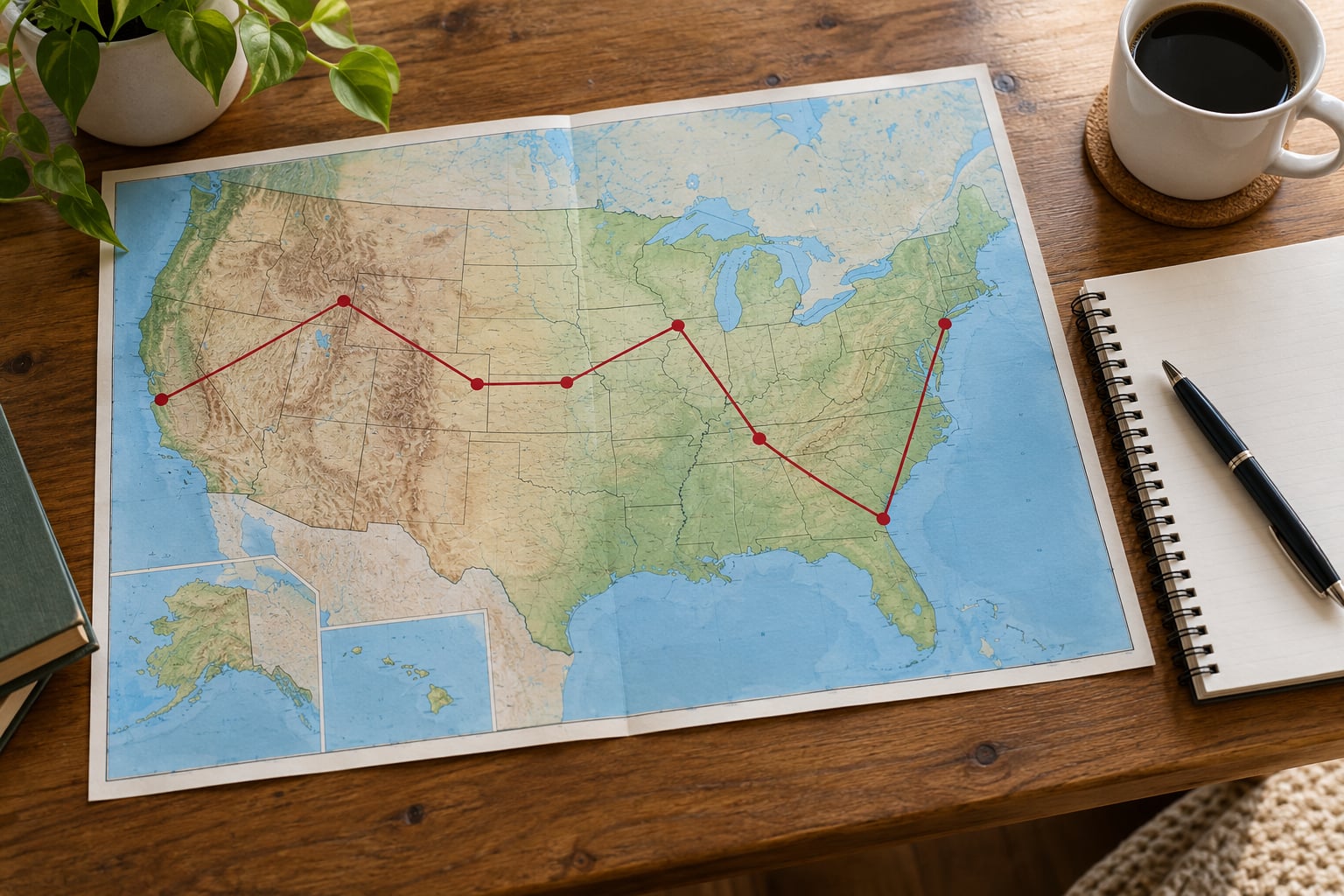
A US metal tour gets routed the way a logistics problem gets solved: a booking agent collects offers, a promoter picks the dates worth taking, and a tour manager stacks those dates into legs where the drive between shows is short enough to survive on four hours of sleep. Routing decides which cities get played, in what order, and whether any of it makes money.
It is also the part almost nobody outside the industry thinks about. Fans see a poster with fourteen dates on it and assume the cities were picked because the band wanted to see them. Mostly, the cities were picked because the drive from the night before was under three hours.
Table of Contents
- How Metal Tours Are Routed Across the US: The Basic Routing Process
- Why Routing Promoters Shape Metal Tour Maps
- What Makes a US Metal Route Work
- Audience size versus drive time
- When artists go on tour, do they fly or drive?
- How far in advance are tours planned?
- Scene strength and local support
- Weather, season and daylight
- Regional Clusters: Why Tour Routes Follow Music Scenes
- How Bands Plan Drive Days, Rest Days, and Travel
- How Metal Tours Are Routed Across the US on a Budget
- How Promoters Handle Venues, Support Acts, and Changes
- What Fans Can Learn from a Tour Route
- Frequently Asked Questions
- Who plans the route for a metal band?
- Why does my city get skipped while others get three shows?
- How far in advance are metal tour dates announced?
- Do bands still use tour buses?
- What is a blowout on tour?
- How can fans track upcoming dates in a region?
- Conclusion
How Metal Tours Are Routed Across the US: The Basic Routing Process
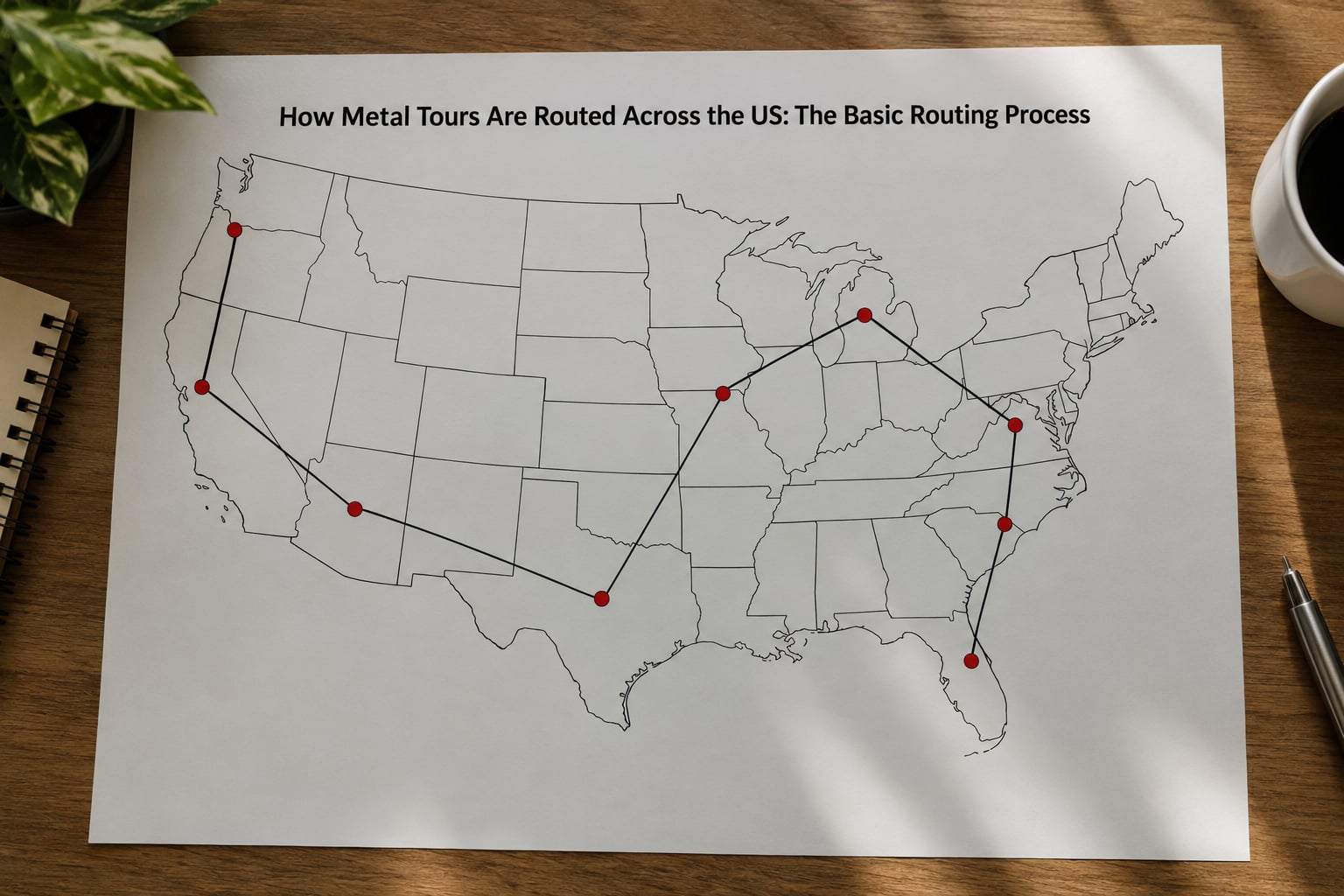
Routing is the process of deciding which cities a band plays, in what order, on which dates, and how the band, crew and gear physically get between them. A route map is not the same thing as a set of bookings. A booking is one show in one room. The route is the argument that all the bookings fit together without wrecking anyone.
Every route starts with anchors, which are dates that are already fixed. A festival offer is the strongest anchor because the date is set by someone else and the slot is already paid for. A headline support slot is next, since the headliner built the routing and the openers inherit it. Everything else is negotiable.
| Offer type | Who controls the date | Effect on the route |
|---|---|---|
| Festival slot | The festival | Fixes one date and pulls the surrounding days out of your control |
| Headline support slot | The headliner or their agent | Locks you into someone else’s city order and travel days |
| Regional club show | Your agent and the promoter | Fills the gaps around anchors and can be moved |
| Private or corporate date | A client | Often worth a detour, since the fee covers the drive twice |
Once the anchors are locked, the agent fills the holes with regional shows grouped by geography, then hands the draft to the tour manager, who checks drive times, load-in windows and whether the crew can physically function. Promoters confirm holds, deposits go down, and the route is re-cut every time a date moves.
Why Routing Promoters Shape Metal Tour Maps
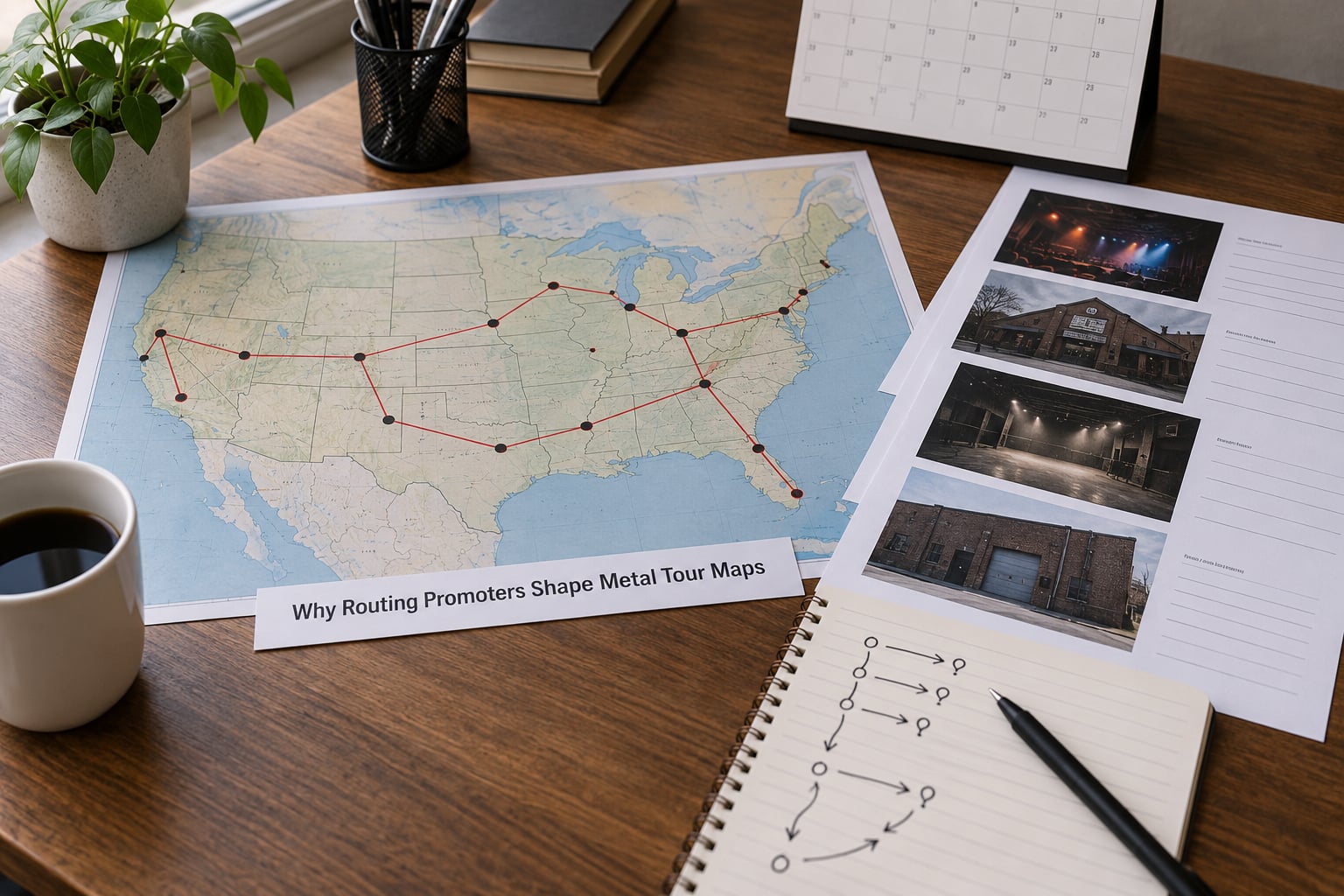
Promoters are the reason a route has shape. A promoter knows which rooms in a market can actually sell a metal show, which ones have a curfew that makes an eight-song set impossible, and which will only take a date on a specific night of the month. That knowledge is worth more than any spreadsheet.
They also set the money. A guarantee, a door split or a flat fee changes whether a distant date is worth playing at all, and it changes how hard the agent works to sell that date to the band’s manager. A promoter who cannot fill the room in February is not going to confirm October.
The feedback loop runs both ways. The agent sends offers with two or three date options, the promoter comes back with a counter, and the shape of the cluster changes. Good promoters push dates closer together so travel is cheaper for everyone. Lazy ones let shows scatter across a state and call it variety.
What Makes a US Metal Route Work
Audience size versus drive time
The tension in every routing meeting is simple: big rooms are usually far from each other, and small rooms are usually close together. A US run that chases the biggest gates in the biggest cities burns enormous time in a van. A run that stays tight earns less per night and keeps the band able to play.
Most metal tours lean toward density. Mid-size rooms at 400 to 1,200 capacity, packed six to a dozen nights into a corridor, tend to outsell a sparse run of arena-adjacent clubs.
When artists go on tour, do they fly or drive?
Mode is chosen by leg length, budget tier and cargo volume. Short regional legs get driven in a van, bus or semi. Anything past roughly 600 miles usually means the crew flies and the gear moves separately, sometimes ahead by a day on a freight truck. Festival runs mix both, driving between regional dates and flying into the festival anchor.
How far in advance are tours planned?
Two clocks run at once. Festival seasons are negotiated on an 18 to 24 month cycle, because lineups are built a full year ahead. Club dates close much later, often six to nine months out for a summer run, and individual shows can land inside 60 to 90 days once a route takes shape. The closer a date is to the show, the more the route around it has been locked.
Scene strength and local support
Markets are ranked by more than ticket history. A town with three active bands, a local label and a promoter who puts on shows in the off months will draw harder than a bigger town with an empty calendar. Support slots follow that: if there is a credible local act, the room fills earlier and the merch table works later into the night.
Weather, season and daylight
Winter routing across the northern states is tight because load-in times shift with darkness and roads get worse. Summer runs in the desert states face the opposite problem, where a mid-afternoon load-in in June is brutal on gear and crew. Mountain passes in shoulder season decide a lot of fall routing.
Regional Clusters: Why Tour Routes Follow Music Scenes
US metal routing clusters around established scenes, and those scenes sit in predictable places. Agents build the route around the cluster that pays best and then add the outliers only when the drive is survivable.
| Region | Routing strength | Typical constraint |
|---|---|---|
| Northeast corridor | Dense club circuit, short hops between major cities | Tight calendars, frequent sellouts, higher lodging costs |
| Southeast | Long chain of mid-size rooms, festival presence | Summer heat, long stretches between stops |
| Midwest | Consistent core audience, affordable rooms | Big distances, smaller guaranteed draws |
| Southwest | Desert festival circuit anchors runs | Long deadhead drives, punishing summer load-ins |
| Mountain West | Fewer dates, loyal regional crowds | Altitude load-ins, mountain-pass weather |
| Pacific Coast | Two dense metro corridors in one drive-heavy run | Cities at opposite ends of the region |
The Midwest is the region fans complain about most, and the complaint is fair. Fewer bands can afford the long drives between states, so the route often gets skipped entirely even when the room would fill.
How Bands Plan Drive Days, Rest Days, and Travel
Not all shows are the same size of problem. A local show is a drive out and back with gear in the back. A regional run is a string of shows inside one five to eight hour radius with one rest day in the middle. A national run is legs of ten to twenty shows separated by flights, freight moves and hotel nights that count as deadhead time.
Inside a leg, the daily clock is the same almost every night. Load-in opens at an agreed time, sometimes 4pm for a theater show and later for a club. Soundcheck runs 30 to 60 minutes. Doors, set, support sets, then the headliner set. Curfew is enforced by the city, not the band, and a curfew under midnight changes the setlist plan. Pack-out usually happens in the small hours, and the truck is rolling before breakfast.
| Mode | Typical leg distance | Best for | Cargo limit |
|---|---|---|---|
| Band van | Under 250 miles | DIY and support tours, small crews | Guitars, drums, small backline |
| Tour bus | 200 to 600 miles | Mid-size national runs with a crew | Full backline plus bunk space |
| Semi or box truck | 300 to 900 miles | Heavy merch, amps, full backline | Everything, freight included |
| Flights plus freight | Over 600 miles | Cross-country jumps, coast changes | Instruments as checked or shipped cargo |
Buses are still in regular use, and on metal runs they earn their place because the crew size is larger than on most pop tours. Sleeping on the bus is still normal between shows, usually four to six bunks, though many bands in a heavier merch position split into a bus for people and a truck for freight.
Rest days are built in on purpose. Every ten to fourteen shows, a routing has one where nothing is scheduled, and that is when laundry happens, gear gets repaired and the drummer gets a doctor visit. Routes without rest days tend to lose shows in the second half.
How Metal Tours Are Routed Across the US on a Budget
The route is a budget decision before it is a map decision. A show 500 miles from the previous one drags in fuel, freight or a flight, a night in a hotel, meals for a crew, and a lost day of prep that cannot be recovered later. If the guarantee does not cover that, the date is a blowout and the routing was wrong.
The cost categories a manager tracks on every leg: fuel and tolls, hotels and per diem, freight or baggage fees, crew wages, and the opportunity cost of the day that vanished into a van. Merch changes the arithmetic more than anything else, because a band doing serious volume is carrying weight on every leg.
There are honest ways to cut without wrecking a run. Cluster dates harder, which costs fewer nights on the road. Take fewer support slots that pay nothing and add miles. Fly the crew in advance of gear when freight is cheaper than checking it. Book rooms through the promoter’s rate instead of whatever the app suggests at 11pm in a dead zone.
What does not work is trimming food, cutting the crew down to unsafe numbers, or running a schedule that gets everyone through the tour wrecked. Bands that save money by burning out their crew tend to lose the shows at the end of the run, which costs more than the savings.
How Promoters Handle Venues, Support Acts, and Changes
A date usually starts as a hold, a soft reservation that expires. Promoters place holds in their best rooms, confirm the money, then pay a deposit that locks the room and the date. The band side signs a contract that specifies the guarantee or door split, the settlement method, hospitality and technical requirements.
Support acts cascade down from the top of the bill. The headliner picks the opener, the opener picks a local act in some markets, and the whole chain inherits the routing, including travel days they did not choose. When a support slot opens mid-tour, the routing reshapes to fit whoever is available.
Changes are routine. A festival cuts a slot for curfew or production reasons, and the band loses an anchor, so the manager re-cuts the surrounding dates, sometimes pushing a region out of the run entirely. Weather cancellations, venue overbooks and curfews trimmed by building management all force the same kind of emergency edit.
Curfew is the quiet killer. A city that enforces a 10pm hard stop means a five-song set, which changes what the band can tour, which changes what the promoter can sell, which changes the routing plan for that market entirely.
What Fans Can Learn from a Tour Route
A route tells you what the band thinks its audience looks like. Dense clusters of shows in one region mean the band believes it has a following there. A coast-to-coast run with two or three dates per city is a festival-and-radio run, where touring supports the album cycle rather than chasing door sales.
It also predicts growth. Bands add markets gradually, starting in cities they have played before. When those cities get a second and third date, the next run usually gets bigger rooms and a longer stay. If your city keeps getting skipped year after year while nearby cities sell out, the answer is usually room capacity or a routing constraint, not a lack of fans.
Long jumps between consecutive dates are worth planning around before you buy a travel booking. Posters rarely tell you the arrival time of the load-in or whether the show is likely to start on time. r/Metalcore posters regularly describe driving eight hours or more to reach a date, which tells you the routing had the band in a hurry and probably gave the local opener a late slot.
Frequently Asked Questions
Who plans the route for a metal band?
Three people share it. The booking agent secures dates and proposes clusters, the promoter picks which dates and rooms make sense in each market, and the tour manager builds the legs around those anchors, checks drive times and assigns travel modes. On bigger tours a production manager handles freight and vehicle logistics underneath all three.
Why does my city get skipped while others get three shows?
It usually comes down to room capacity and drive times, not fan loyalty. If the nearest scheduled date is more than a long day’s drive, adding your city means burning a travel day. Promoters also know which rooms can sell a metal show, so a market with one 400-cap room and no mid-size options tends to stay off the map.
How far in advance are metal tour dates announced?
Festivals are locked a year or more ahead because lineups are built early, and club dates for a summer run usually fall into place six to nine months out. Individual shows can be added inside 60 to 90 days once a route firms up, which is why late additions show up without much warning and why a dropped festival slot reshapes dates you were already booked for.
Do bands still use tour buses?
Yes, on metal runs more than most other genres. Crews are bigger, backline is heavier and the routes are regional rather than a string of isolated dates, so a bus with bunks and storage pays for itself. Bands running heavy merch often pair a bus for people with a box truck or semi for freight and backline.
What is a blowout on tour?
A blowout is a show that costs more to reach than the show pays out. It usually means a long drive or flight after a short turnaround, so fuel, freight, hotels and a lost rest day eat the guarantee. Managers watch for them because a schedule full of blowouts can lose money even when every show sells well.
How can fans track upcoming dates in a region?
Follow the band’s official announcement pages, the venue and promoter’s own listings, and local fan communities for the city. Promoters post dates when contracts close, which is often before a tour poster goes up. Watching which cities get repeat dates across consecutive runs also tells you which markets are growing.
Conclusion
Routing is the invisible craft behind every metal show. Anchors get locked, clusters get built around scenes, legs get assigned a travel mode, and the whole thing gets re-cut whenever a festival slot or a venue drops out. The map on the poster is the output of dozens of small money and logistics decisions.
When you follow a band, check four things first: the announced dates, how tightly they cluster by region, whether the drive between consecutive nights looks survivable, and whether the venue and promoter behind the date look established. That combination tells you more about the run than the poster design does.