Can you bring a camera to a concert? Usually yes, if it is small and has a fixed lens. Phones and pocket point-and-shoots pass security at most venues, while a DSLR or mirrorless body with a detachable lens counts as professional equipment and gets turned away unless you hold a media pass. The venue, the tour, and the artist all get a say, so check the specific show before you travel.
That last sentence is where most people get it wrong. Forum threads about concert camera rules are full of confident answers that contradict each other, because a policy that lets a point-and-shoot through at one arena on the same tour blocks it at the next city. What follows is the consolidated version: what the rules actually are, why they exist, how to verify yours, and what to do when security disagrees with the policy page.
Table of Contents
- Can You Bring a Camera to a Concert? The Short Answer
- How Do You Find the Camera and Recording Policy?
- Why fan forums disagree with each other
- What Camera Gear Is Usually Allowed?
- Smartphones
- Pocket point-and-shoot compacts
- Premium fixed-lens compacts
- Interchangeable-lens bodies, meaning DSLR and mirrorless
- Action cameras and Polaroids
- Can You Record Audio or Video at the Show?
- Why Might Security Ask You to Leave the Camera Outside?
- Sightlines and crowding
- Recording and broadcast rights
- Pit safety and equipment damage
- Bag rules and forced locker storage
- Discretionary refusals
- How Do Rules Change by Venue Type?
- Stadiums
- Arenas
- Theaters and concert halls
- Clubs and small venues
- Festivals
- How to Take Concert Photos Without Getting Removed
- What Happens at the Security Gate?
- They store it
- They take it away
- They send you home
- What If You Want Professional Photos Instead?
- Frequently Asked Questions
- Can I bring a DSLR or mirrorless camera into a concert venue?
- Can I record a concert on my phone if cameras are allowed?
- Are selfie sticks and monopods allowed at concerts?
- Will a small concert camera count as professional equipment?
- What happens if security refuses entry to my camera?
- Conclusion
Can You Bring a Camera to a Concert? The Short Answer
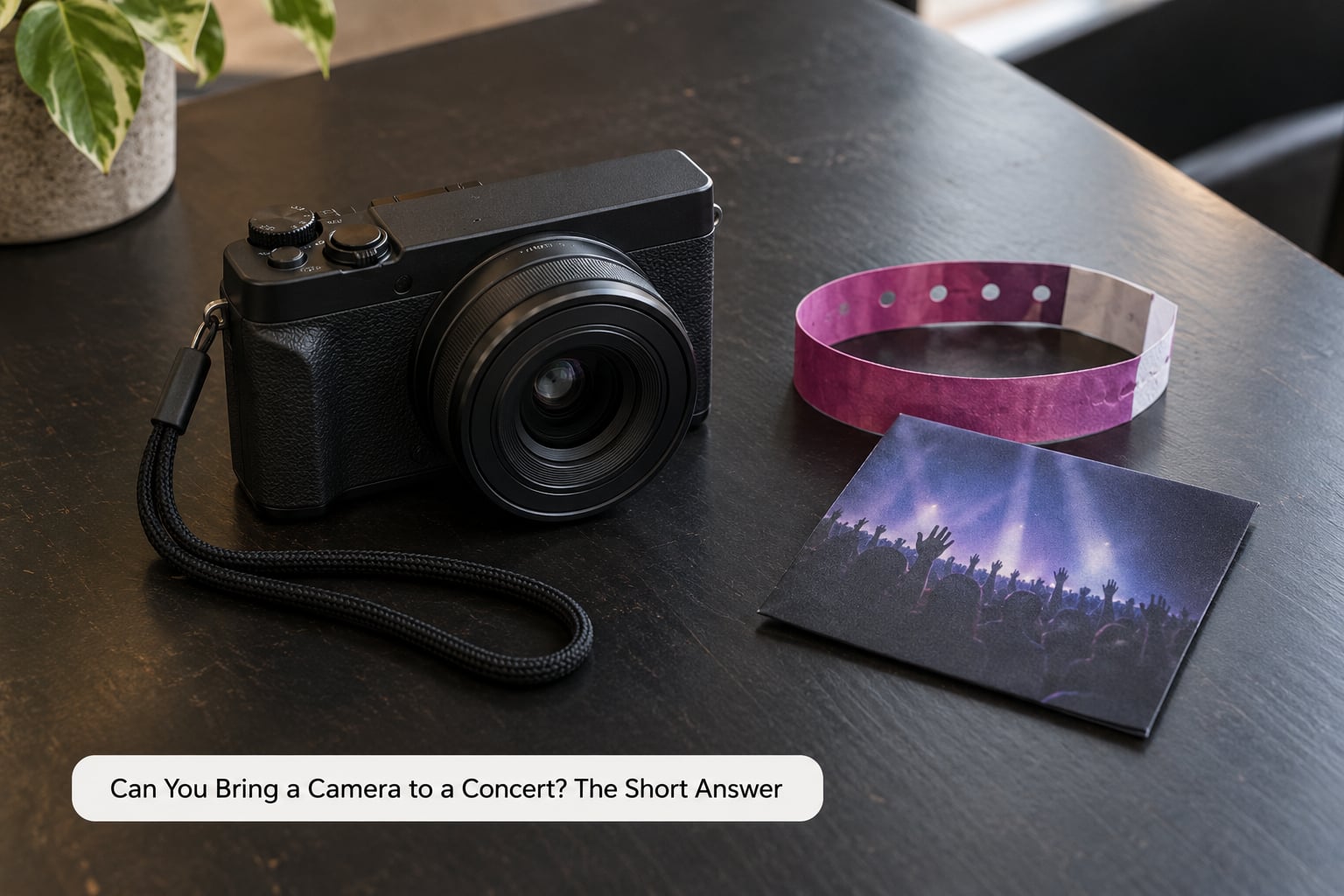
The dividing line most venues use is the detachable lens. Small fixed-lens cameras, including phones and point-and-shoots, are ordinary guest gear. Interchangeable-lens bodies are treated as professional equipment and are usually refused at the gate.
Size matters too, because security works from written thresholds rather than from a product list. Some stadiums publish a lens length limit, and photographers on r/AskPhotography report both Mercedes-Benz Stadium and Soldier Field using a “lens under 6 inches” standard. Other venues go by a looser “under 4 inches” guideline for small cameras. Above that, expect a conversation.
Two more things decide it. The venue policy governs entry, and the artist or tour can be stricter on top of it, especially about recording. A r/lesserafim thread captured this neatly: the standard “no professional cameras” line is the baseline, then individual markets go further, with a small fixed-lens premium compact acceptable in some rooms and a smartphone-only rule in others.
How Do You Find the Camera and Recording Policy?
Policy lives in five places, and they do not always agree. Work down the list until you have a specific answer rather than a general guess.
- The venue website. Look for a bag policy, prohibited items, or guest services page. Sports stadiums are usually the best documented, because they run the same entry rules for concerts and games.
- Your confirmation email or ticketing app. Order-specific emails often carry a short prohibited items list that the general venue page omits.
- The artist or tour page. Tour announcements sometimes carry stricter rules than the building itself, particularly for shows built around fan-recorded footage.
- The venue social accounts. Policy changes are usually announced a few days out, as a post on the venue account rather than an update to the website.
- A phone call to the box office. This is the underrated option. Ask the exact question: “Are detachable-lens cameras allowed through the door for the [artist] show on [date]?” You will usually get a straight yes or no.
Ask about recording separately from photography. They are different rules, and venues that permit still photos may ban video, audio capture, or livestreaming. Ask both questions in the same call so you do not get a partial answer.
Why fan forums disagree with each other
Because the policies genuinely differ. One r/twentyonepilots thread asks whether a media pass is required for a professional-looking camera and whether phone lenses are allowed at the Philippine Arena, which is a different question from the one another poster was asking. Forum answers are accurate for the show the person attended and useless as general policy.
One recent exception is worth repeating because it cuts against the blanket assumption that cameras are banned. A post in r/JonasBrothers documents bringing a camera into MetLife Stadium for a Jonas Brothers opening night, photos included. Small cameras get in. The pattern holds: the compact gear comes through, the interchangeable-lens rig does not.
What Camera Gear Is Usually Allowed?
Here is the breakdown by category, from most permissive to least. Nothing on this list is guaranteed, but it matches what venue policies and fan reports describe.
Smartphones
Almost always permitted as cameras. The restriction on phones is nearly always about recording, not about carrying the device. Phone lens attachments are a grey area, since a mounted accessory lens can read as a detachable lens to a guard who is judging by sight rather than by specification.
Pocket point-and-shoot compacts
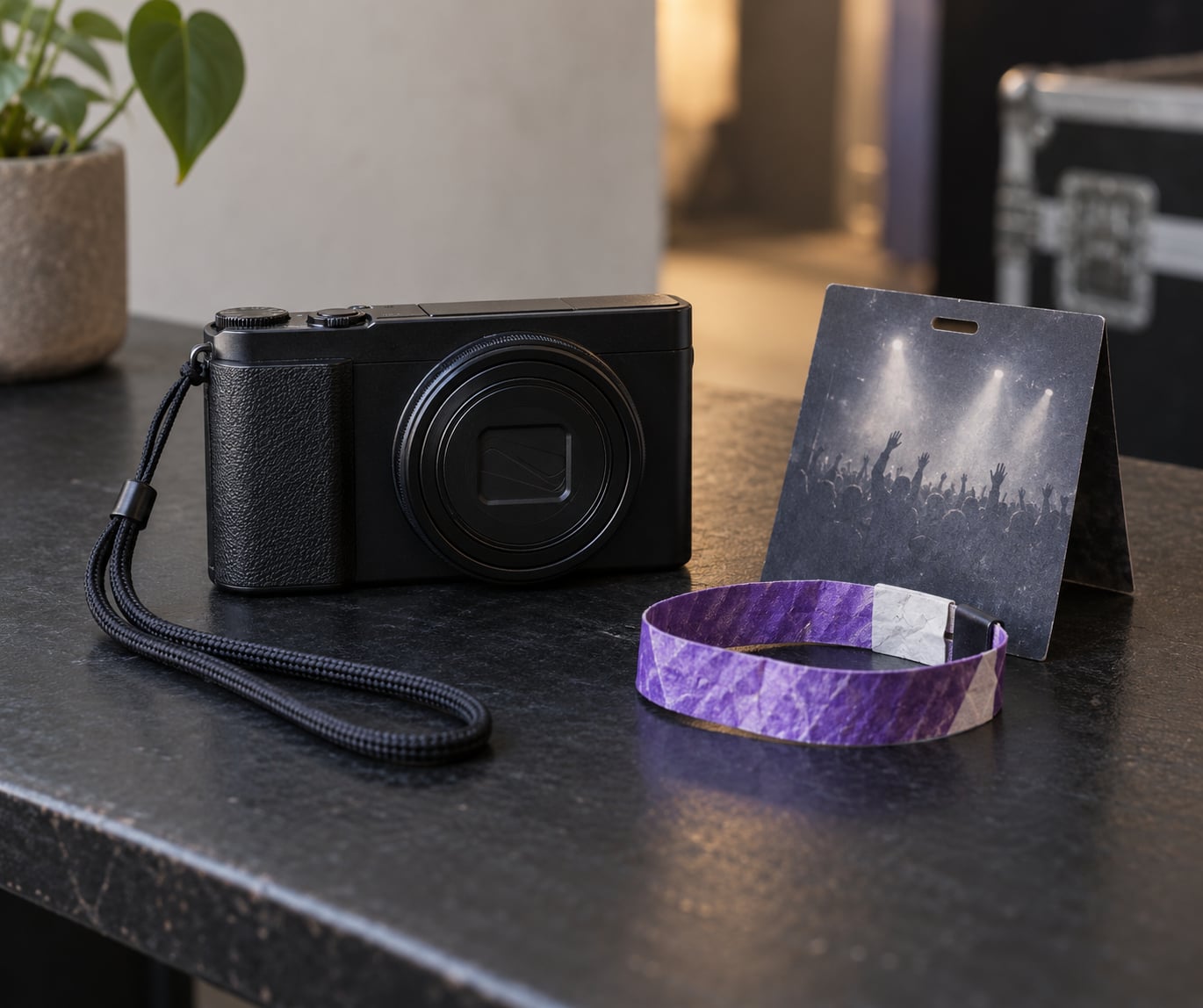
The safest category, and the one most people mean when they ask whether a concert camera is allowed. A small fixed-lens body with a short barrel passes at nearly every venue. Keep the lens retracted or capped so the barrel looks short from a few feet away.
Premium fixed-lens compacts
Formally small, sometimes treated as professional anyway. A long-running fujix-forum thread makes the case that a fixed-lens premium compact can be challenged because of how it looks and what it costs, not because it has a detachable lens. If your camera is one of these, check the specific venue and expect a judgment call at the door.
Interchangeable-lens bodies, meaning DSLR and mirrorless
Almost universally treated as professional and refused. This covers the camera body with any lens attached, prime or zoom, as well as a body in a bag with lenses stored separately. A wrist strap does not disguise it, and it does not matter whether the lenses are under a given length. Venue staff apply the category rule before any size assessment.
Action cameras and Polaroids
Action cameras are frequently blocked, usually on the same reasoning as pro bodies, plus mounting hardware and the risk of a stick or clamp being waved around above a crowd. Polaroid and instant film cameras are treated differently: they are usually allowed, because a physical print cannot be livestreamed or reposted instantly. Some artists still ban them, and some festival stages ban all photography.
Can You Record Audio or Video at the Show?
Taking photos and capturing recorded music are separate permissions, and holding the first does not grant the second. Most venues draw the line exactly there.
Audio recording is the one most consistently banned. Venues rarely want a phone capturing audio from a mixing desk, and artists whose label owns the master recording have contractual reasons to refuse. Video is more mixed: some shows permit short clips, others require phones to stay in a pouch, and some tour mandates no smartphone recording at all.
A r/Taipei thread documents an event where photos, video, livestreaming, and recording were prohibited outright, with performers stipulating no smartphone recording. That is the pattern fan-heavy tours follow, and it is announced on the tour’s socials more often than on the venue site.
A visible camera does not authorize recording. Even where stills are welcome, capturing the performance itself can pull your ticket and get you removed, and the removal usually starts with security rather than with a conversation.
Why Might Security Ask You to Leave the Camera Outside?
Understanding the reasoning helps you predict the call before you reach the door.
Sightlines and crowding
A raised camera in a packed floor section blocks the people behind it. On a general admission floor with everyone standing, that is the most common complaint venues hear, and it is the reason many rooms restrict the height of what you can hold up.
Recording and broadcast rights
Live performance footage competes with the tour’s own video releases and broadcast deals. Restricting audience recording protects those rights, and the artist’s contract usually gives them more control than the building would otherwise want.
Pit safety and equipment damage
A metal lens barrel swinging around in a pit is a hazard to you and to the person behind you. This is the practical reason behind detachable-lens bans, and it is also why tripods, monopods, and long zoom lenses get refused even when the body itself would pass.
Bag rules and forced locker storage
Clear bag policies cause as many problems as the camera rule itself. At venues with a strict clear bag or small bag policy, a permitted camera may still end up in a locker because it will not fit alongside your other things. An r/AskPhotography poster describes exactly this worry at downtown venues where there is no car to return to. Treat the locker as an option you might lose, not a plan.
Discretionary refusals
Security makes the call on the day. A camera that the policy permits can still be rejected, and a bag that met the published dimensions can still fail at the screening table. This is not malice, it is a person working a queue and applying a rule they were given verbally.
How Do Rules Change by Venue Type?
The building you are standing in predicts the rule better than the genre of music. Five venue types cover almost every show you would ask this question about, and each one gets there from a different pressure.
Stadiums
The most documented and the most restrictive, because stadium entry is built around bag screening for crowds in the tens of thousands. The NFL venue policies are the best-published examples in the US, and they apply identically when the same building hosts a concert. Clear bag policies or small bag limits dominate here, and the lens length thresholds cameras get judged against, such as the six-inch standard reported at Mercedes-Benz Stadium and Soldier Field, live on those pages.
Phones and small compacts get through. Everything with a detachable lens gets stored, refused, or binned.
Arenas
Less rigid on bags, stricter on the pit. Arena floors are general admission and tightly packed, so the camera conversation happens at the pit entrance rather than the front door. Some rooms tag photographers with a wristband at security and expect pit access only behind the band. Plan for your camera to be admitted and your ability to move to the pit to be a separate question.
Theaters and concert halls
The easiest rooms in the building, and the only ones where the front of house sometimes sends a message about courtesy. Seating is assigned, sightlines are controlled, and a seated person with a small camera disrupts almost nobody. Photography from your seat is usually fine. Flash never is, and moving into an aisle or onto a soundboard position to get a shot will not be tolerated.
Clubs and small venues
Almost nothing is published, so the policy exists mostly as house rules and staff judgment. Capacity is small enough that a raised camera genuinely blocks someone, and the working assumption is that phones do photos quietly or not at all. Ask at the door or the promoter rather than assuming, because written policy often does not exist.
Festivals
Credentialing runs the whole show, and the rules are published earlier than anywhere else. Festival sites typically spell out the pit access process, and fans planning their first pit pass are advised to confirm in advance whether a point-and-shoot is permitted on the floor, since some festivals and not others will allow one. Multi-stage grounds add a wrinkle: a camera allowed in one stage’s field is not automatically fine in another’s, and stage handovers often tighten the rules for the headliner.
How to Take Concert Photos Without Getting Removed
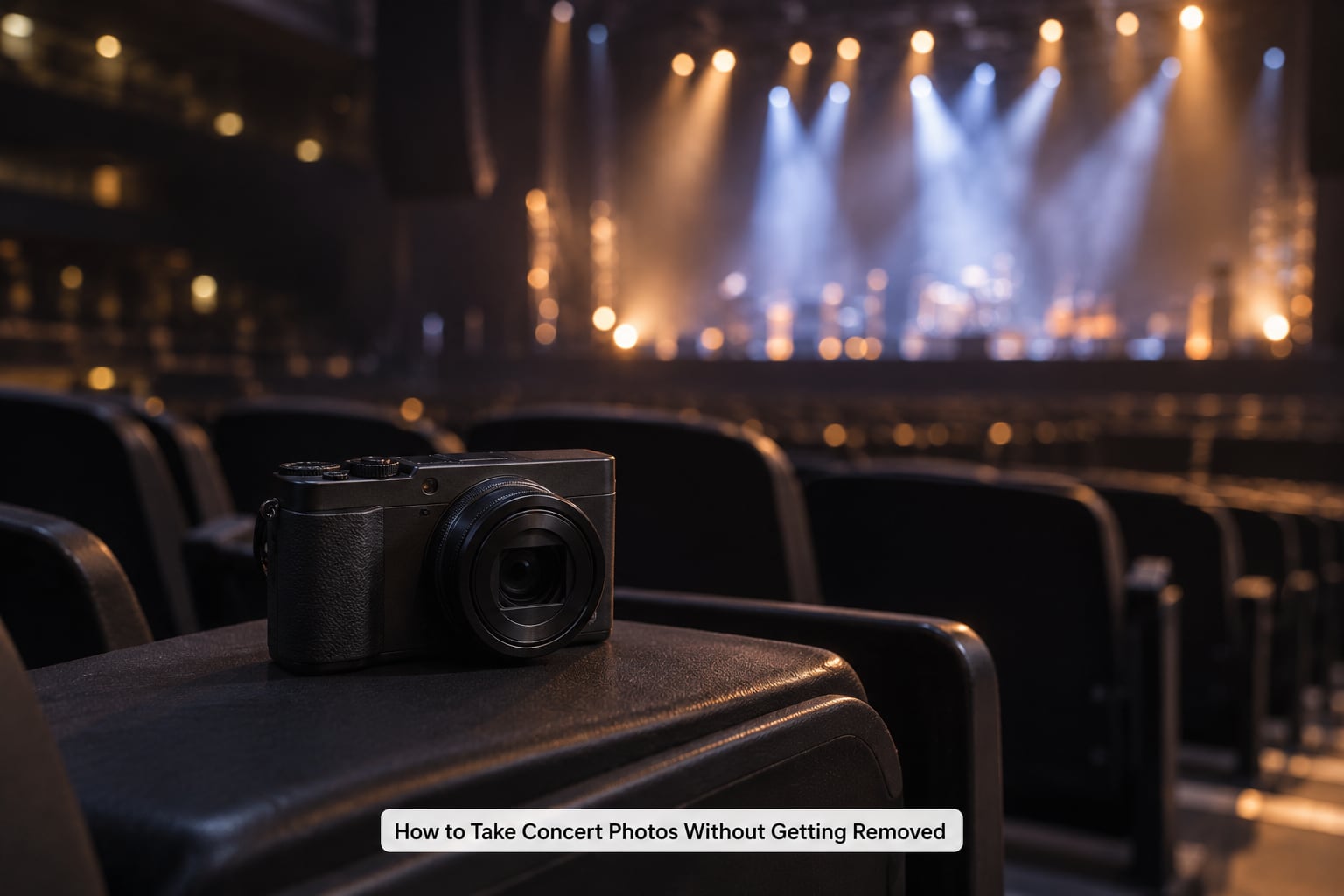
If you get a camera in, the goal is to be invisible. Stay seated where seating exists, work from your spot, and never step into the aisles or the photo pit to get an angle. An r/photography etiquette thread puts it simply: do not disrupt the audience, and absolutely do not disrupt the performers.
Flash is off the table at nearly every show. It blinds the person behind you, hits the stage wash, and gets you moved on faster than anything else you can do. Most venue policies and every artist rider ban it outright.
Three settings do most of the work in a dark room: raise the ISO until the shutter speed is fast enough to freeze hands, open the aperture as wide as the lens allows, and shoot in silent or electronic-shutter mode if your camera has it so the mechanical shutter noise does not carry over the crowd. A small fixed-lens compact will struggle more than a phone, which is why many fans end up shooting on both.
Keep the camera low and the strap on your wrist. If a security worker or usher asks you to stop, put the camera down immediately and calmly. Do not argue, and never physically resist anyone over a device. The realistic worst case is losing the camera, not winning the exchange.
What Happens at the Security Gate?
Your bag goes on a table and someone decides, quickly, what stays and what goes. Knowing the three possible outcomes in advance makes the moment less stressful.
They store it
The friendly version. Many venues that ban cameras still run a bag check or offer lockers, and a compliant camera goes into storage while you keep the ticket. Downtown venues are the weak spot, because a locker there means you cannot retrieve it between sets, or at all if you leave early.
They take it away
Some rooms will confiscate rather than store, particularly when the item is classed as professional rather than merely restricted. Ask before you hand it over, and get the name of the person who took it if you can. It rarely matters, but it does no harm.
They send you home
The worst outcome, and the one worth avoiding entirely. If you cannot leave the gear behind, you may be asked to leave the venue. This is why the box office call is the single most useful thing you can do before a show.
Alongside the camera, expect other concert staples to be flagged on the way in. Outside drinks, glass, chairs, professional audio or video recorders, laser pens, large signs, and anything that could be used as a projectile. Bins at the door exist for exactly these. Umbrellas are frequently refused indoors on the grounds that you cannot open them anyway. Nothing on this list surprises security, which is why it goes fast.
What If You Want Professional Photos Instead?
Professional gear at a live show is a credentialed arrangement, not a purchase decision. Pit or stage access normally requires accreditation issued by the promoter’s media team, the tour’s publicist, or sometimes the artist’s own operation. The credential usually covers a specific show at a specific venue, and the venue’s list of working photographers is set well in advance.
That structure is why heavy gear gets refused at the general door. The room has to know how many credentialed photographers are already inside, and how many bodies it expects in the pit. A stranger arriving with a large kit and no pass is a safety and rights problem, not just a photography preference.
For everyone else, the sensible path is the official venue or tour photographer. Buy the album, watch the tour’s official video releases, and support the photographers who already got accredited. You get better images of that show than you would have managed from row twelve anyway.
Frequently Asked Questions
Can I bring a DSLR or mirrorless camera into a concert venue?
Rarely. Cameras with detachable or interchangeable lenses are treated as professional equipment by nearly every venue and are refused at the door unless you hold a media pass issued by the promoter or tour. The category rule usually applies before size is considered, so a small zoom on a compact body still gets turned away. Check the venue policy page and ask the box office directly before you travel, because the final call at the screening table rests with security on the day.
Can I record a concert on my phone if cameras are allowed?
Sometimes, but allowing photos does not mean allowing recording. Many venues permit still photography while banning video, audio capture, or livestreaming, and some tours mandate no smartphone recording at all. Recording the performance itself is the part most likely to get your ticket pulled. If video matters to you, confirm the exact rule for your show before you go, and treat audio recording as almost always prohibited.
Are selfie sticks and monopods allowed at concerts?
Usually no. A stick or monopod gives you reach above the crowd, which is exactly what venues restrict on a general admission floor, and it turns a small permitted camera into an obstruction. Most rooms refuse them at the gate or at the pit entrance even when the camera itself is fine. Tripods are refused almost everywhere. A wrist strap and your own arms cover nearly all the legitimate cases.
Will a small concert camera count as professional equipment?
A genuinely small point-and-shoot with a fixed lens usually passes, because it is pocket-sized and cannot grow into a working rig. Premium fixed-lens compacts are the grey zone, since guards sometimes judge by appearance rather than specification. The defining feature venue policies describe is a detachable lens. If your camera has a barrel you can remove, assume it is professional until the venue tells you otherwise.
What happens if security refuses entry to my camera?
You generally have three outcomes: they store it in a locker for the show, they confiscate or refuse to return it, or they tell you to leave the venue and go back to the car. The first depends on whether the venue runs lockers, which downtown venues often do not. If the policy said your camera was fine, ask calmly for a supervisor before handing it over, and do not argue physically over a device.
Conclusion
Check the policy for your specific show before you leave home, then call the box office if the wording is vague. Bring a phone or a small fixed-lens point-and-shoot if one is allowed, keep flash and recording gear at the venue, and plan to be boring about it: seated, low, and out of the way. If you want the real shots, the tour photographer already has the access you would need.
Last updated 2026. Policies change between shows on the same tour, so treat this as a starting point rather than the final word.