Scales shape metal solos in two ways: they fix the set of notes you are allowed to play, and the intervals between those notes decide the colour you hear. The same six notes can sound like a thrash run, a death metal lead or a power metal melody depending on which tones you stress, how you rhythmise them and which chord tones you land on. Knowing how guitar scales shape metal solos therefore comes down to weighting the notes inside the scale you already play, not collecting more shapes.
Most players who feel stuck are not short of shapes. They have all five minor pentatonic box positions down and still land on something that reads as blues played loudly. That is a phrasing and reference problem, not a shapes problem, and it is the thread running through this guide.
Table of Contents
- What role do scales play in a metal solo?
- Which scales are most useful for metal guitarists?
- Minor pentatonic: 1 b3 4 5 b7
- Blues scale: 1 b3 4 b5 5 b7
- Natural minor, also called Aeolian: 1 2 b3 4 5 b6 b7
- Harmonic minor: 1 2 b3 4 5 b6 7
- Phrygian dominant: 1 b2 3 4 5 b6 b7
- Phrygian: 1 b2 b3 4 5 b6 b7
- Melodic minor: 1 2 b3 4 5 6 7
- Diminished: 1 b2 3 b5 5 6 b7
- Whole tone: 1 2 3 4 5 b7
- Major and Lydian
- Exotic scales: when not to reach for them
- How do modes change a scale without changing the notes?
- How do chord tones make a solo sound connected?
- How can I practice scales and turn them into metal phrases?
- How do rhythm and phrasing shape the sound of a scale?
- How do I stop sounding like I am only running through scale shapes?
- Frequently Asked Questions
- What is the best scale for metal guitar solos?
- Should I learn the modes or stick with the minor pentatonic scale?
- How do I use scales without sounding like a scale exercise?
- What scale works best for fast metal solos?
- Do I need to learn every scale to write stronger solos?
- How do scales work with power chords and palm-muted riffs?
- Conclusion
What role do scales play in a metal solo?
A scale is a fixed collection of pitches plus a map of where those pitches sit on your fretboard. That is genuinely all it controls. It does not decide rhythm, articulation, dynamics or where a line should stop.
Pitch collection: the notes a scale allows
Choose E minor pentatonic and your available notes are E, G, A, B and D. Add the blues note and you have F as well. Play that F hard against an E power chord and it will fight you; play it as a quick passing note between two pentatonic tones and it will sound intentional.
Interval colour: where the mood comes from
The mood lives in the intervals, not the note names. The flat second in Phrygian gives that low, snarling scrape. The raised seventh in harmonic minor gives the classical-minor yearning that power and neoclassical leads lean on so hard.
Neck geography: shapes decide how far you can move
Your position shapes decide how much of the fretboard you can reach without thinking. Someone stuck in position one has a scale but no map, and a solo that never leaves one octave reads as an exercise no matter how good the notes are.
What a scale never does on its own
Scales never decide whether a line sounds metal. A well-phrased major pentatonic lick over a palm-muted riff sounds more metal than a fast harmonic minor run played with no accents and no rests.
Which scales are most useful for metal guitarists?
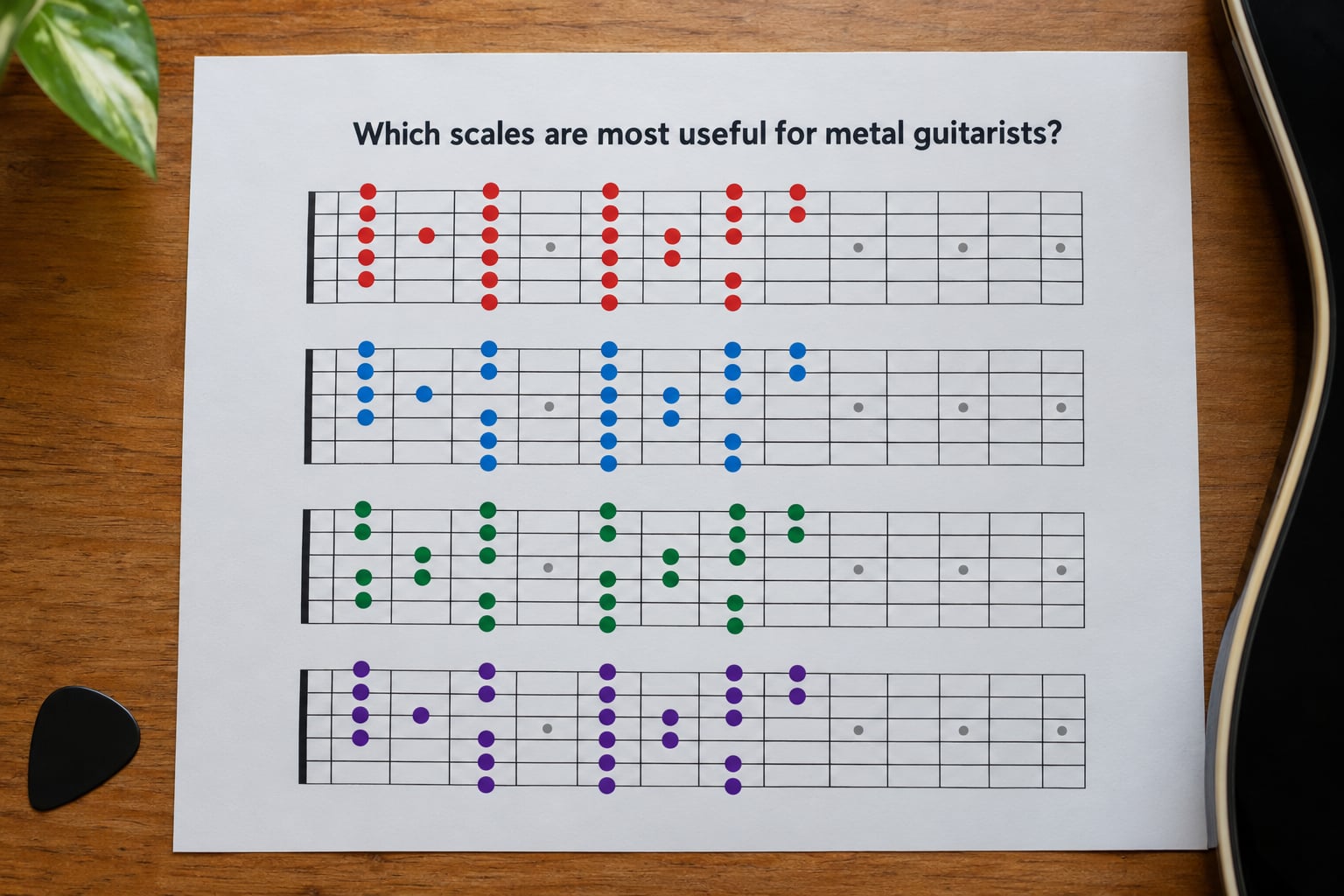
Ten scales cover the overwhelming majority of metal lead playing. Here they are in the order most players should learn them, with the interval that gives each one its character.
Minor pentatonic: 1 b3 4 5 b7
Five notes, no gaps worth arguing about, and the most used scale in heavy metal guitar playing according to forum consensus. It works over every power chord riff because those riffs rarely contain a note that clashes with it. Kirk Hammett built a career on it, and honestly most metal leads are a pentatonic line with attitude.
Blues scale: 1 b3 4 b5 5 b7
Minor pentatonic with the flat five added. That single extra note is where the darkness and the bluesy pull comes from, which is precisely why it gets left out of a lot of metal. Use it as a passing tone between the fourth and fifth degrees rather than landing long phrases on it.
Natural minor, also called Aeolian: 1 2 b3 4 5 b6 b7
Two notes more than the pentatonic, the flat second and flat sixth. Those extras widen the vocabulary for melodic death leads and doom riffs, where a five-note scale can feel thin. Forum players rate natural minor a close second behind the pentatonic for good reason.
Harmonic minor: 1 2 b3 4 5 b6 7
The minor scale with the seventh raised, which is what gives it its bite and its classical-minor flavour. This is the signature of neoclassical and shred soloing, the scale Yngwie Malmsteen uses most and the one Wolf Hoffmann of Accept wrote in on tracks like Metal Heart and Russian Roulette. The augmented second between the flat sixth and raised seventh has to be handled carefully, so treat those two notes as a dramatic interval rather than a step in a run.
Phrygian dominant: 1 b2 3 4 5 b6 b7
Phrygian with a major third instead of a minor one. That single change puts the raised seventh back against the flat second, and the clash is the entire point. It is the most Spanish-flavoured scale on the list and a favourite for thrash riffs and aggressive leads.
Phrygian: 1 b2 b3 4 5 b6 b7
The mode that shares its notes with the natural minor but centres somewhere else. Because the third is minor rather than major, it can hang over a minor chord without sounding like a major scale wandered in. Melodic death and technical death players lean on it constantly.
Melodic minor: 1 2 b3 4 5 6 7
Minor with a raised sixth and seventh ascending. That major sixth is the sweet note, and it turns a dark scale into something that sings, which is why it shows up in melodic leads and in the occasional progressive passage. Descend using the natural minor notes and you get the jazz minor trick that sounds instantly professional.
Diminished: 1 b2 3 b5 5 6 b7
Symmetrical, repeating every minor third, so it moves in loops and sits over almost any dominant chord when you place the root correctly. Half-whole diminished is the more useful of the two flavours. This is an outside note source, not a home scale; a whole bar of it usually sounds like you lost the plot.
Whole tone: 1 2 3 4 5 b7
Six notes, every whole step, repeating every major third. There is no leading tone and nowhere stable to land, which is precisely why it works best at the top of a fast run over a held chord. Whole tone lines are what turn a thrash shred into something dreamier.
Major and Lydian
Neither belongs in the metal core set, but both are worth keeping in your pocket. A major scale line under a fast palm-muted riff gives instant contrast, and Lydian with its raised fourth sounds bright and technical over a suspended chord without adding much clutter.
| Scale | Formula | Sound | Fits best |
|---|---|---|---|
| Minor pentatonic | 1 b3 4 5 b7 | Direct, forgiving, bluesy edge | Thrash, groove metal, metalcore leads |
| Blues | 1 b3 4 b5 5 b7 | Dark, gritty, vocal bends | Slower metal, blues-influenced leads |
| Natural minor | 1 2 b3 4 5 b6 b7 | Dark, wide, brooding | Melodic death, doom, black metal |
| Harmonic minor | 1 2 b3 4 5 b6 7 | Dramatic, classical-minor pull | Neoclassical, shred, power metal |
| Phrygian dominant | 1 b2 3 4 5 b6 b7 | Snarling, Spanish tension | Thrash riffs, aggressive leads |
| Phrygian | 1 b2 b3 4 5 b6 b7 | Dark, nasal, droning | Technical death, djent |
| Melodic minor | 1 2 b3 4 5 6 7 | Singing, sophisticated | Melodic leads, progressive passages |
| Diminished | 1 b2 3 b5 5 6 b7 | Unstable, symmetrical, tense | Outside runs over dominant chords |
| Whole tone | 1 2 3 4 5 b7 | Weightless, floating | Fast run endings, dream sequences |
| Major / Lydian | 1 2 3 4 5 6 7 / 1 2 3 #4 5 6 7 | Bright, contrast | Counter-melodies, clean sections |
Exotic scales: when not to reach for them
Hirajoshi, Hungarian minor and the augmented scale are fun and occasionally useful as colour. They are also the fastest route to the noodling that makes a solo sound like a warm-up. Forum players who picked one up report the same two outcomes: either it clicked into a song instantly, or it did nothing at all. Give any new scale a fixed test: play it over one riff for a week. If nothing improves, shelve it.
How do modes change a scale without changing the notes?
A mode is the same set of notes with a different centre. C major and A natural minor contain identical pitches; what changes is which note the line rests on and which notes sit a semitone above the tonic. That single interval decides whether the passage lands major and triumphant or minor and unsettled.
So you do not need a new scale for every mood. Play an E natural minor box over an E chord and you get doom. Rest the same notes on B and pull the phrasing towards its flat sixth and you get something darker and more unsettled. Play A major and lean on the raised fourth and you have turned the same box into a brighter, floating tone.
The practical benefit is real: modes let you cover more ground with fewer shapes, which is exactly what you want when you are already comfortable moving across the neck.
How do chord tones make a solo sound connected?
How guitar scales shape metal solos over a progression
Scales give you the passing notes. Chord tones give you the meaning. A run made only of scale tones over a changing progression floats; a run that lands on the root, third and fifth of each chord tells the listener exactly where the harmony is going.
Here is a four-step way to pick and place a scale over a progression:
- Find the key. Listen for the root the riff is built on, or check the lowest note of the power chords. In standard tuning that root gives you the key immediately.
- Mark the chord tones. For each chord in the progression, find its root, third and fifth on the neck in whatever position you intend to solo in.
- Pick the colour. Choose the scale that contains every chord tone you marked. If it does not, the progression is asking for a seventh or an added note, which usually means harmonic minor, melodic minor or borrowing a tone from a parallel mode.
- Test for clashes. Play each non-chord tone against the chord it sits over. A note that sounds wrong when held is a passing note, not a landing note.
Static progressions forgive far more than you would think. A held E power chord vamp leaves the whole fretboard free, which is why so many neoclassical leads are harmonic minor over an open fifth.
How can I practice scales and turn them into metal phrases?
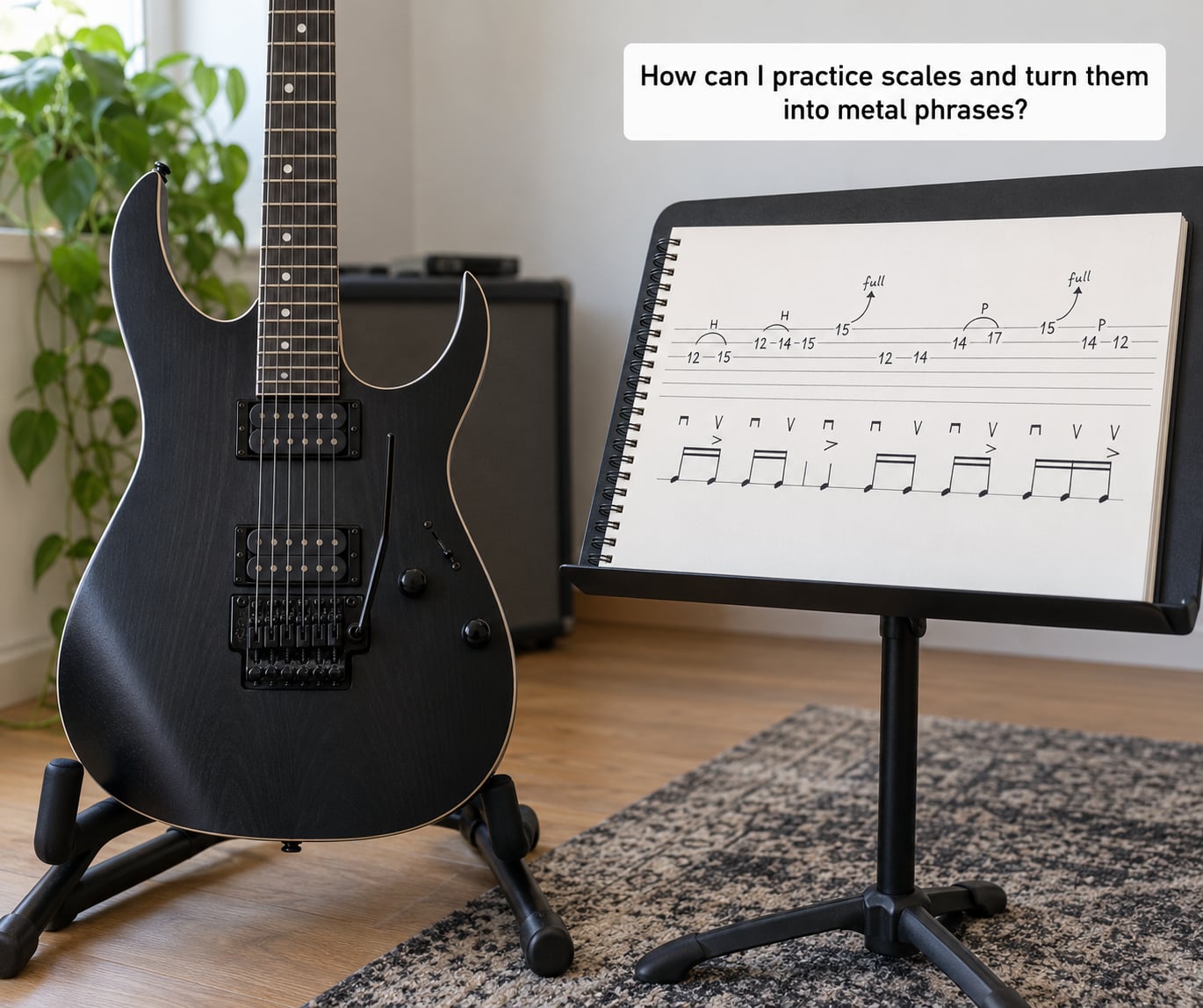
Most scale practice fails because the goal is clearing the shape, not building anything you would play in a song. These five steps turn the exercise into phrases.
- Clean position work first. Play one position ascending and descending slowly and evenly. No picking technique yet. If the notes are uneven, nothing you add later will fix them.
- Add a pulse. Metronome at 60. One note per click, then two, then four. The goal is that any note can be dropped into the middle of the pattern and still land on the beat.
- Connect two positions. Do not try all five at once. Play position one, walk up into position two, walk back. When that transition is invisible, add position three. This is the fix for getting boxed in.
- Apply a technique to a shape you already know. Alternate picking, legato, string skipping, then the same run with a bend on the target note and vibrato on the arrival. Sweeping suits the symmetrical scales best because those shapes sit evenly across the strings.
- Apply it over something. A backing track in the key, or the actual riff. Improvise for two minutes at a time and finish on a chord tone. Record yourself; listening back is the fastest way to hear the noodling you are blind to while playing.
Give this routine three or four sessions a week. Most players who stick with it find they need far fewer positions than they thought, because the connecting is what was missing. That connecting work is the larger half of how guitar scales shape metal solos, and it is the half almost nobody practises deliberately.
How do rhythm and phrasing shape the sound of a scale?
Ask ten players why the same pentatonic line sounds metal on one song and bluesy on another and most will talk about which scale it was. That is usually the wrong answer.
Metal phrasing leans on rests, syncopation and accents, often leaving space around the fast notes instead of filling it. Blues phrasing leans forward, pushing into the beat with bent notes and long vocal sustains. The notes can be identical and the result is two different genres.
An Ultimate Guitar moderator put it better than most teachers manage: most rock and metal pentatonic use still is bluesy, it is just fast enough and angry enough that you do not really notice. The practical version of that advice is to slow your phrases down, record them, and listen for where the blues is hiding. It is usually the bends, the sliding into a note, and the way the phrase leans ahead of the beat.
Smaller habits move the sound a long way. Alternate picking with a slight gap gives a harder attack than legato. Slides and hammer-ons give a metal lead its fluid surface. Rests before a run make the run hit harder. Tempo changes, even subtle ones, make a solo feel written rather than improvised.
How do I stop sounding like I am only running through scale shapes?
The diagnosis matters more than the technique, because players with all the shapes and no phrasing have a different problem from players who cannot move across the neck.
If your solos sound like exercises, the shape itself is being the phrase. A real line has a beginning, a direction and an ending, and most exercise-shaped solos have none of the three.
- Build motifs, not runs. Play a two or three note idea, repeat it transposed, then vary the last note. That is how melody is constructed, and it is the opposite of running the shape from the bottom.
- Aim at intervals. Instead of playing a scale, play a target: reach the b5, land the b2, resolve up a tone to the third. A line with a goal sounds written.
- End on chord tones. Any phrase that ends on the root or fifth of the underlying chord sounds resolved. Phrases that end on an arbitrary scale tone sound unfinished.
- Omit notes. A four-note fragment of a five-note scale sounds like a melody. The full scale in one direction sounds like practice.
- Use dynamics. Quiet runs into loud accents, or a note pushed slightly behind the beat, changes the perceived weight of the same notes more than any scale choice.
- Give it a real opening and ending. Start on a strong arrival note rather than creeping up from the low string, and stop rather than fading out. Most players never practise either.
One more thing that helps more than it should: know some lead guitar you want to sound like, and learn actual lines from it. Players stuck in pentatonic-land often find that the fastest way out is transcribing a Hammett phrase note for note and then learning why it works, rather than adding another scale.
Frequently Asked Questions
What is the best scale for metal guitar solos?
The minor pentatonic is the most used scale in heavy metal lead playing, and it works over almost every power chord riff because those riffs rarely contain a note that clashes with it. Once you can move between positions, add the natural minor for the flat two and flat six, then harmonic minor when you want drama. Variety comes from phrasing first, not from more scales.
Should I learn the modes or stick with the minor pentatonic scale?
Stay with the minor pentatonic until you can solo over a full riff without thinking about which position you are in. After that, modes are cheaper than new scales because the notes overlap. Natural minor, Phrygian and Phrygian dominant share notes and only change where the line rests, so learning them mainly teaches you to change the emotional centre of the same shape.
How do I use scales without sounding like a scale exercise?
Play with a goal instead of a direction. Build a two or three note motif, repeat it transposed, and change the final note each time. Aim at a target interval such as the flat five or the raised seventh, finish on the root or fifth of the chord, and leave rests before the fast part. A run with a beginning and an ending does not sound like practice.
What scale works best for fast metal solos?
Speed comes from the fingering and the picking, not from the scale name. Symmetrical scales are the easiest to run fast because the pattern repeats evenly across the neck, which makes the diminished and whole tone scales practical for very fast passages. End fast lines on a slower, accented note rather than accelerating all the way through, since the landing point carries the weight.
Do I need to learn every scale to write stronger solos?
No. Ten scales cover the overwhelming majority of metal lead playing, and most guitarists get further by learning three of them properly than fifteen of them badly. Learn the minor pentatonic, natural minor and harmonic minor inside and out, connect two or three positions each, then borrow the diminished and whole tone scales as outside notes for the occasional run.
How do scales work with power chords and palm-muted riffs?
Power chords contain only a root and a fifth, which leaves nearly every other note free. That is why the minor pentatonic sits so comfortably over most riffs. When the riff does include a note outside your scale, treat your scale note as a passing tone between two chord tones rather than landing long phrases on it.
Conclusion
Pick one scale today, the minor pentatonic if you are undecided, and learn it in three connected positions rather than five separate boxes. Write out which notes are the chord tones, decide which two intervals you want to lean on, and play a short motif that lands on a chord tone over a riff you already know.
Do that for a week before adding anything new. That is the practical side of how guitar scales shape metal solos: pick the pitches, then decide which notes carry the line, how they are timed and where it ends.