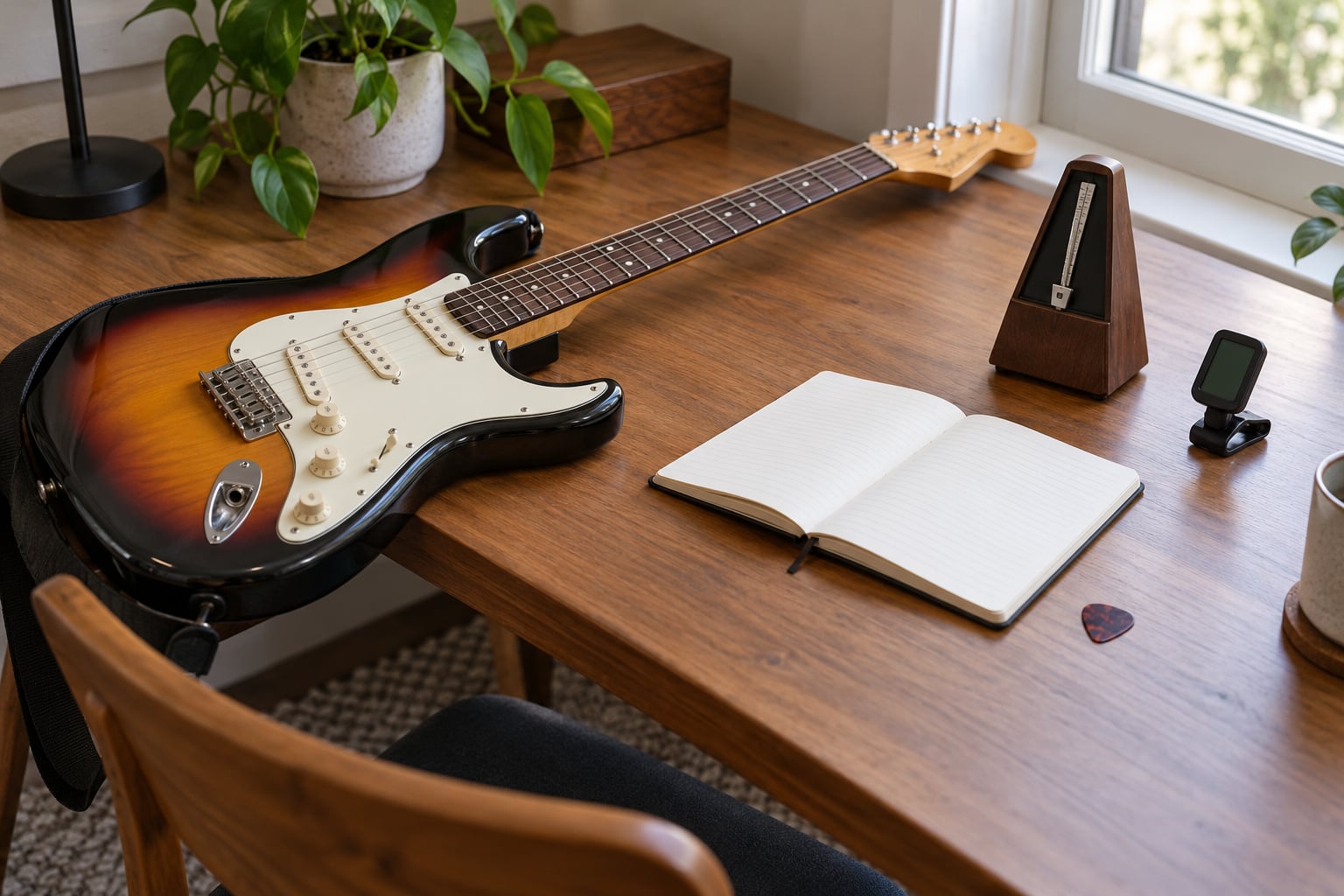
To improve alternate picking accuracy, slow down until every note is clean, then raise the metronome by 1 or 2 BPM at a time. Alternate picking accuracy means hitting exactly the string you meant to hit, exactly once, on exactly the beat, while the pick hand alternates down-up-down-up without extras.
Most players try to fix a picking problem by picking faster. That is the wrong end of the stick. Tension, drifting rhythm, and stray string contact all show up before the tempo ceiling, so chasing speed first locks in the sloppiness and caps how fast you can ever get.
The practical version: pick a tempo where you can hit 100% of the notes cleanly, hold it there until it is boring, and treat that boredom as progress. Set aside 15 to 20 minutes a day and expect a few weeks before it stops feeling like a fight.
Table of Contents
- What You Need
- How to Improve Alternate Picking Accuracy
- Step-by-Step
- A 15-Minute Practice Routine
- Frequently Asked Questions
- How fast should I start when learning alternate picking?
- How often should I practice alternate picking to improve accuracy?
- Why do I hit the wrong string when alternate picking?
- Should alternate picking always be faster than sweeping?
- How do I increase tempo without losing accuracy?
- What should I do if my picking hand gets tired?
What You Need
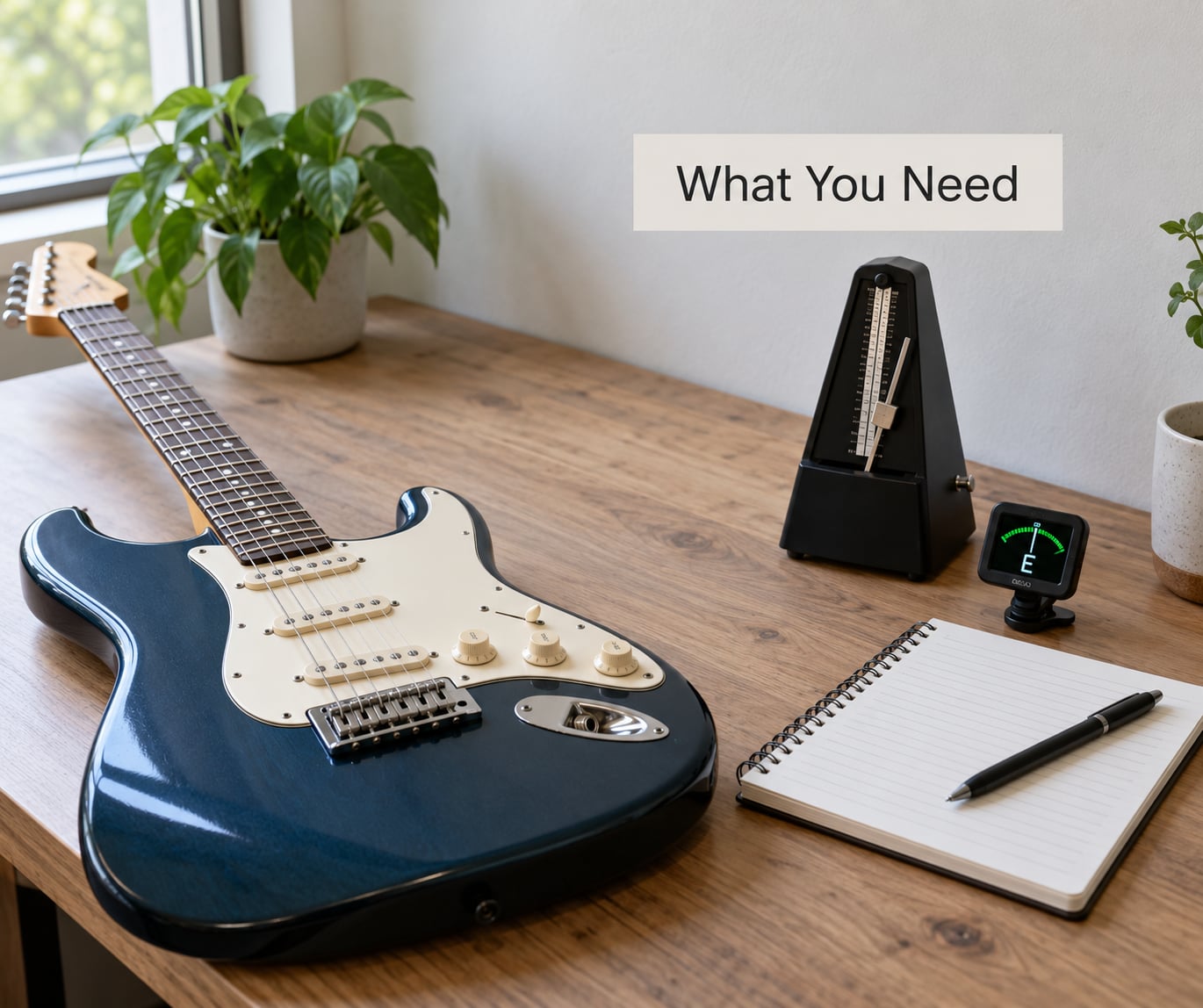
The equipment list is short, which is good news, because the whole method runs on attention rather than gear. You need a guitar with strings you can move across without the pick snagging or sliding off.
A clip-on tuner counts every stroke, and a metronome with a beat you can hear over your rig keeps you honest about rhythm. A practice notebook is the third item, and it is the one most people skip. Write down the tempo and the clean-note count from every session.
A phone recorder stands in for an amp or audio interface when you want to hear yourself from the outside. Recording is how you catch the tiny unevenness you cannot feel while you are in the middle of it.
None of this needs to be expensive. A beginner with a secondhand solidbody, a phone metronome app, and cheap strings can follow the entire routine below. Clean technique beats costly equipment every single time.
How to Improve Alternate Picking Accuracy
Three things have to be true at once: the pick moves strictly down then up, the stroke depth stays even, and the string change happens without a detour through the neighbouring string. Break any one of those and the pattern falls apart, usually fastest at string crossings.
Start on one string. Play single notes with the smallest motion you can control, wrist-led, roughly the width of the string spacing. Listen for two things: that every note speaks clearly, and that the gap between down and up is equal. A down-up rhythm that feels like da-DUM-dum is a timing problem, not a picking problem.
Then move to string pairs, still slowly. When you cross to the next string, lift the pick just clear of the strings and let the hand travel. Most accuracy failures at this stage are the pick dipping into the string it just left, which produces a ghost note on top of the real one.
Only when the notes are clean do you touch the metronome. Set a tempo, usually somewhere between 60 and 90 BPM for eighth notes on a beginner, and stay there. Speed is the by-product of clean notes, never the other way around.
One more thing worth naming early: strict alternate picking is not always the fastest route. On big string skips, a single downstroke over two or three strings often beats fighting the pattern. Keep the picking hand accurate in that spot too, and come back to strict alternation once the skip is clean.
Step-by-Step
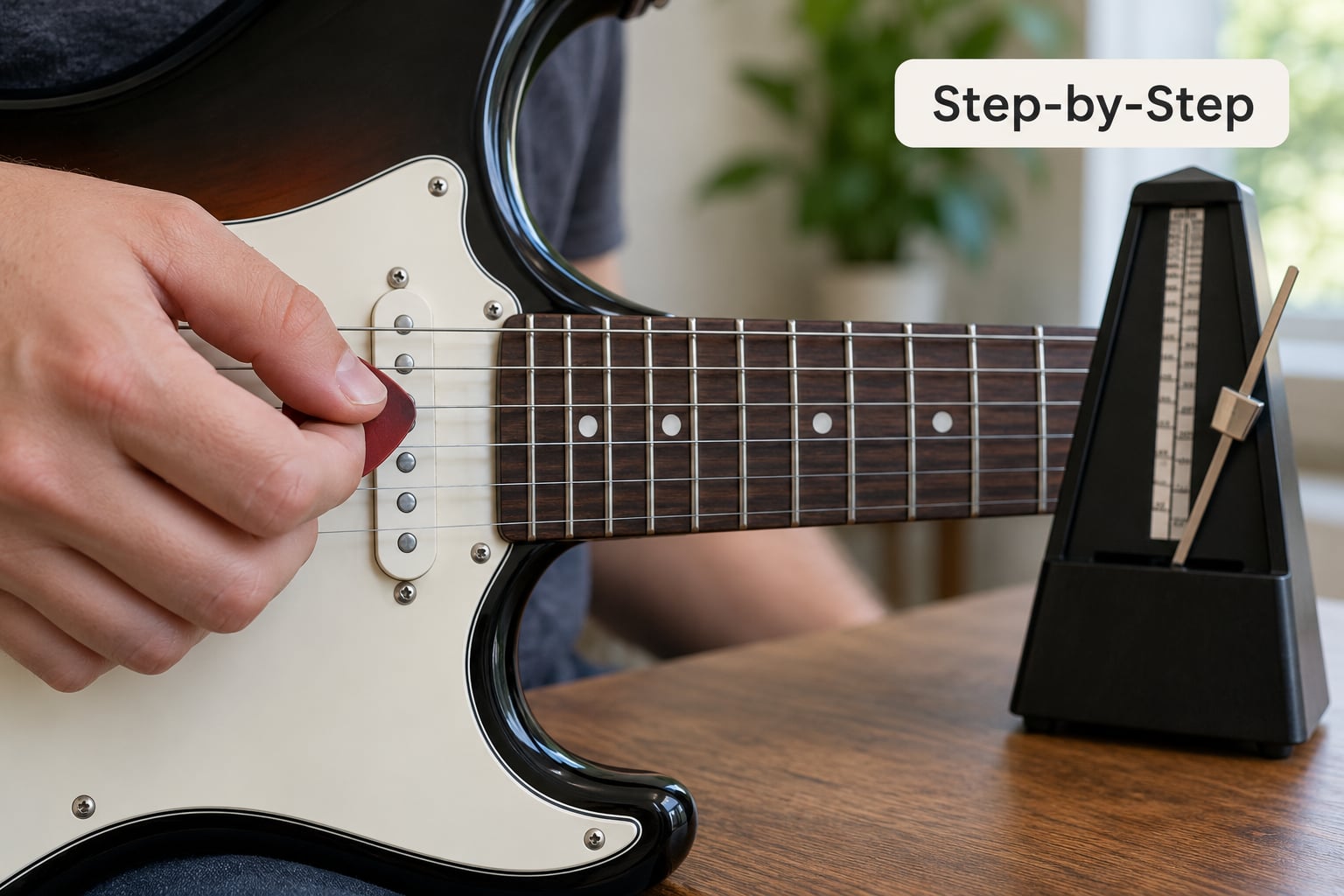
This sequence moves from setup to string-crossing drills to a recorded tempo test. That order is how to improve alternate picking accuracy without burning out, since each step fixes what the one before it exposed. Work through it in order, and do not skip ahead to the fast material. Each step has a clear success test, so you know when to move on.
1. Set a Clean Up-and-Down Picking Motion
Grip the pick between thumb and index finger with the tip showing a few millimetres. Keep the hold loose. A tight grip is the root of most pick bounce, and pick bounce is the root of most wrong-string hits.
Play eighth notes on the third string, fingers resting on the frets as an anchor. Move only from the wrist, no forearm swinging, no rocking of the whole hand. You should see the pick travel a short distance and return.
Success test: the tone is even on every note, the beat is even, and you can stop on any note and your hand feels still rather than wound up. Hold that for a full minute before moving on.
2. Isolate String Changes
Go from one string to the next and back, alternating strictly, with one note per string. Keep the pick between the two strings and out of the ones you are not playing. Beginners usually aim the pick at the string in front of it instead of the one under it.
Widen to three strings, then back to two. While practicing, exaggerate the transition: lift higher, travel further, land softly. The exaggeration teaches the hand the path, and you shrink it afterwards.
Success test: you can cross strings for a full minute without hearing a single unintended note. Rhythm stays even too. If the note count drifts while you are concentrating on strings, slow down again.
3. Practice with a Metronome
Run eighth notes at a tempo you can play perfectly, typically 60 to 90 BPM to start. Stay there for two or three minutes, not thirty seconds. Resist the urge to push the dial; the boredom is the work.
Then step up. Go sixteenth notes at the same tempo, which doubles the note count without changing the click. Once that is clean, add three or four BPM and repeat. A gain of two BPM every few sessions keeps you moving without ever breaking the pattern.
Success test: you can play with the click on, and when you turn it off your groove sits in the same place. Record yourself once per session and check that the first and last notes line up.
4. Use Accuracy Drills
Use four drills that each target a different weakness. One-string frets isolate your pick path with the fretting hand out of the picture. Two-string patterns add the simplest crossing. Three-note groups on a string train evenness, since three strokes a beat make a rushed middle stroke obvious.
Add repeated string crossings, where you cross on every note between two strings, and a muted-string check, where you play the pattern with all strings damped and listen for the exact number of pick contacts. If you hear four strokes instead of two, you have found the habit.
Success test: every drill stays even and clean. A drill that only works at a sloppy tempo is not a drill, it is a habit being reinforced. These are slow, boring repetitions by design.
5. Apply the Pattern to Musical Passages
Take one real riff, scale run, or arpeggio and slow it until you can alternate through it cleanly. Simplify the rhythm first if needed, get every note right at half speed, then rebuild the original tempo one notch at a time.
Work the hard bar on its own rather than playing the whole tune to reach it. Pentatonic scale runs and metal lead lines expose string-crossing errors quickly, and broken chords and arpeggios keep the fretting hand honest alongside the picking hand.
On acoustic guitar and through chord shapes, use the same alternation with a shallower stroke and lighter touch. Thin first strings make the pick glide, so angle it slightly and use less depth there than you would on a wound third string.
Success test: the difficult section is as clean as the easy one. If not, the section is not ready for its original tempo, no matter how many times you have played it.
6. Test and Record Your Progress
Pick one drill and one tempo as your benchmark. Play twenty notes, record them, and count how many are clean. That number is your baseline. Every few weeks, repeat the same test at the same tempo.
Watch for three things in the recording: unwanted string noise, notes landing late against the click, and uneven gaps between the down and up stroke. Each one points at a specific fix, and hearing them makes them obvious in a way that feeling them does not.
Keep a weekly log in your notebook with three lines: tempo, clean notes out of twenty, and one note on how the hand felt. Measurable goals beat vague ones, because you can see the trend. Cleaner string changes, fewer missed notes, and steadier rhythm at the same tempo are real progress.
Common Mistakes
Rushing before accuracy is secure. Fix: drop the tempo by five BPM and stay there until every note is clean. Add tempo only after the pattern survives a full minute.
Too large a picking motion. Fix: shrink the stroke until it is barely visible. Speed comes from frequency, not travel distance, so a shorter path at the same speed is harder and more accurate.
Gripping the guitar and pick too tightly. Fix: check your grip every few minutes. Tension travels from the hand to the pick, and a stiff pick skips or dives into the next string.
Adding a bounce or curve at string changes. Fix: keep the pick travelling in a straight line through the crossing. If you can hear a scrape, the pick is dipping into the string you just left.
Uneven alternation. Fix: slow down and exaggerate the upstroke until both directions carry the same weight. Three-note groups expose this faster than eighth notes.
Skipping the transitions. Fix: play string pairs and three strings, not just one. Accuracy problems almost always live in the crossing, not on the string.
Practising hard material with no simpler version. Fix: make an easier version of the bar and play that until it is clean, then restore the original.
Raising tempo without recording. Fix: record before and after each increase so you can hear the moment the pattern degrades. That point is your real ceiling right now.
And one more that nobody mentions: do not play through pain. Sharp tension in the forearm or wrist is a signal to stop, rest, and shorten the next session.
A 15-Minute Practice Routine
Two minutes: warm up with single notes on one string, eighth notes at an easy tempo, focusing on even down and up strokes and nothing else.
Three minutes: single-note accuracy across string pairs, one note per string, checking for ghost notes and stray contacts.
Four minutes: the metronome progression, eighth notes then sixteenth notes at the same tempo, adding three or four BPM only when the run is flawless.
Three minutes: one real musical passage, slowed down, with the tricky bar isolated and rebuilt note by note.
Two minutes: play the whole thing once at your current tempo, then record twenty notes and write the clean count and tempo in your notebook.
For a longer session, repeat that block two or three times and rotate keys between rounds, since the same pattern in a new position catches errors that repetition in one position hides. If you only have five minutes, do the warm-up and the twenty-note test. That pair alone will show you whether the week went well.
Frequently Asked Questions
How fast should I start when learning alternate picking?
Start where you can hit every note cleanly, usually 60 to 90 BPM for eighth notes. Most beginners go faster than they can hear, and the errors get built in. If you cannot play a minute of strict down-up without a stray note, drop five BPM and hold there until it is automatic. Raise the tempo later.
How often should I practice alternate picking to improve accuracy?
Fifteen focused minutes five or six days a week beats an hour once. Accuracy comes from frequent, low-fatigue repetitions, so short daily sessions let you stay clean when your hand is fresh. Record the same twenty-note test weekly at the same tempo and track the clean count in a notebook.
Why do I hit the wrong string when alternate picking?
Usually the pick dips into the string you just left, or your aim drifts toward the string in front of the one you want. Slow the crossing down, lift the pick higher between strings, and exaggerate the travel until it becomes automatic. Practice two-string patterns, and check your grip, because a tight hand causes both errors.
Should alternate picking always be faster than sweeping?
No. Strict alternate picking uses every stroke for one note, while sweeping and economy picking cover several notes per stroke, which wins on long string skips and fast arpeggios. Alternate picking still gives you cleaner timing and a more even attack on scale runs. Use it where it fits the line, and keep the skipping hand accurate too.
How do I increase tempo without losing accuracy?
Raise the metronome only when the current run is flawless for a full minute, and move in increments of two to four BPM. Record yourself before each increase so you hear exactly when the pattern starts to fall apart. That failure point is your real ceiling, and it usually sits lower than your sense of what you can manage.
What should I do if my picking hand gets tired?
Stop. Sharp tension or pain in the forearm, wrist, or grip means the session has gone past useful. Rest for a few minutes, shake the arm out, and restart with smaller motions on one string at a low tempo. Fatigue degrades accuracy before it degrades speed, so a shorter clean session beats a long sloppy one.
Start tomorrow with the twenty-note test: pick a tempo, record twenty notes, and count the clean ones. Whatever that number is, it is your starting line, and everything after this is just moving it up two BPM at a time.