A guitar solo fits a song when every note belongs to the song’s own harmony and every phrase sits in the right part of the arrangement. To learn how to play a guitar solo that fits the song, map the chords, land a chord tone on each change, borrow the vocal’s rhythm and shape, then leave silence around the good lines.
That takes about an hour for a first pass on a song you already know. The hard part was never speed. It was deciding where the solo goes, which notes you are actually choosing, and when to shut up.
Most solos that sound wrong are not wrong in a technical way. They are fighting the song: too many notes, no room to breathe, no relationship to the vocal line. Fix those three things and the same notes sound like part of the track.
Table of Contents
- What You Need
- Step-by-Step: How to Play a Guitar Solo That Fits the Song
- 1. Listen for the Song’s Emotional Center
- 2. Map the Song’s Major Sections
- 3. Find the Chords, Scale, and Note Pools
- 4. Borrow the Song’s Rhythmic Language
- 5. Answer the Melody Instead of Improvising Randomly
- 6. Create Shapes and a Clear Note-Level Path
- 7. Control Space, Dynamics, and Ending
- 8. Record, Compare, and Refine
- Common Mistakes
- Frequently Asked Questions
- Conclusion
What You Need
None of this needs expensive gear or a formal music degree. It needs the song, a way to slow it down, and somewhere to record yourself.
- The song. A reference recording you know well. If you have to ask what key it is in, that is fine, the first step finds that.
- A chord chart or the ability to hear chord changes. Search for the song’s chords or chords tab online, or just listen for the strum in the record. A four-chord sheet beats nothing.
- A slowed reference track. Most DAWs and tempo apps can drop a track to 60 or 70 percent without changing the pitch. This is the single most useful tool in the whole process.
- A guitar and amp you already know. The gear is not the variable here. A cheap guitar played with good note choices beats a boutique guitar played with bad ones.
- A capo. Useful when the recorded version sits higher than you want to play, or when the guitar in the mix is tuned down and you would rather not retune.
- A recorder. Phone voice memos are enough. Play the solo over the track, then listen back with fresh ears.
- Optional: a backing track with the solo muted, or loop software that loops the song section for as long as you want. Loopers are standard in rehearsal and saves time versus restarting the track every attempt.
One habit worth stealing from working players: check your solo dry first. Turn the delay, reverb and distortion off on both the rhythm track and your line, listen to the raw notes, then add the effects back. If it falls apart dry, effects will not save it.
Step-by-Step: How to Play a Guitar Solo That Fits the Song
1. Listen for the Song’s Emotional Center
Before you touch the guitar, find out what the song is already doing emotionally. A solo fits when it continues that arc instead of starting a new one.
Listen three times. First time, only the feeling: is the song sad, defiant, nostalgic, or driving? Second time, notice the dynamics, because a song that stays quiet for two minutes wants a solo that builds rather than one that opens loud. Third time, find the exact moment of peak intensity. Usually the band already tells you where the solo belongs, and it is almost never the first available gap.
Note the tempo and feel too. If the band drags behind the beat on the chorus, a straight eighth-note solo over the same bars will sound stiff.
2. Map the Song’s Major Sections
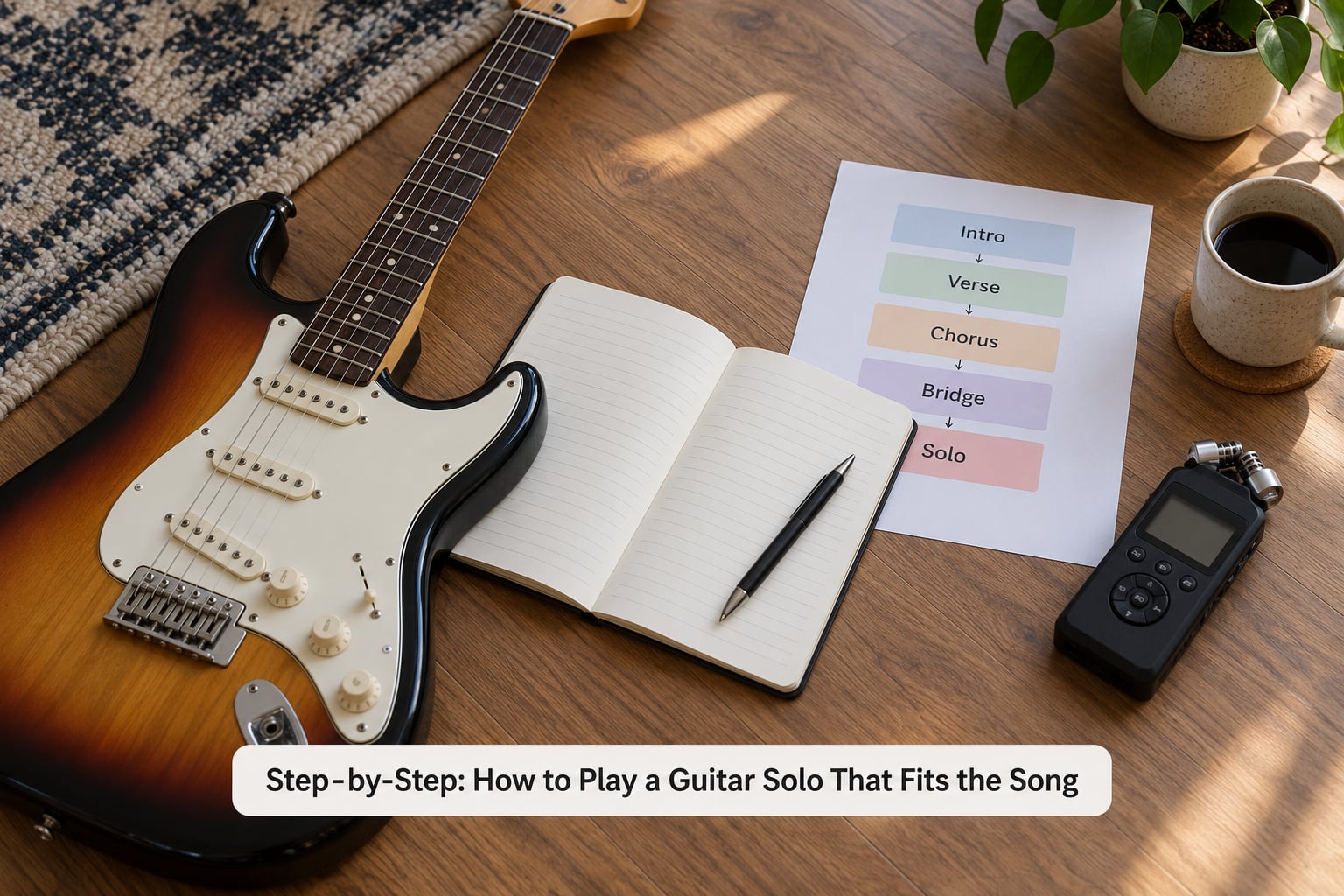
Write the arrangement down on paper or in a notes app: intro, verse, pre-chorus, chorus, bridge, breakdown, solo, outro. Then mark the last bar of each section and the first bar of the next.
This solves the question that trips people up most, which is how much solo actually fits. The answer depends on the section, not on your stamina.
| Song section | Typical solo length | What it should do |
|---|---|---|
| Intro or first verse | 4 to 8 bars | State the motif. Establish the sound before anyone sings. |
| After the last chorus | 8 to 16 bars | Answer the vocal one more time, then climb. |
| Repeat of a verse | 8 bars | Same idea with more notes, not a new idea. |
| Bridge or breakdown | 4 to 8 bars | Contrast. Quieter, sparser, usually higher register. |
| Outro | 8 bars, or one long sustained note | Resolve and stop. Do not drift out. |
The rule underneath the table is simple: a solo over a verse section has less room than a solo over an instrumental bridge. If the vocal returns, you leave space for it. Count bars out loud while you practise so the section length becomes automatic.
3. Find the Chords, Scale, and Note Pools
Now collect your raw material. A chord tone is any note inside the chord being played at that moment. Guide tones are the third and the seventh, the two notes that define the chord’s colour. Landing on chord tones over the changes is what makes a line sound written for the song instead of placed on top of it.
Most players only need one or two scales per song. Match the scale to the chord that sits under most of the solo, then add extra notes when a chord needs them.
| Chord or progression | Scale or mode that fits | Notes to lean on |
|---|---|---|
| Minor chord (i, iv) | Minor pentatonic | Root, minor 3rd, 4th, 5th, flat 7 |
| Major chord (I, IV) | Major pentatonic | Root, major 3rd, 2nd, 6th, flat 7 |
| Dominant 7 (V7, V7b9) | Mixolydian or the blues scale | Root, 3rd, flat 7, and the altered 9th or flat 13th |
| Diminished chord | Diminished scale from the chord root | The chord tones plus any note a half step away from them |
| i-VI-III-VII in a minor key | Natural minor or Aeolian, with minor pentatonic on top | Every note of the progression’s own chords |
| Modal vamp, one chord repeating | Whatever mode the bass and guitar already imply | Avoid the major and minor 3rd conflict entirely |
One method worth knowing because it works fast: analyse the chords, find each triad across three strings, arpeggiate it, then build a melody on top and connect phrases with common tones and half-step movement between chords. A common tone is a note shared by two chords. Holding onto it while the harmony changes underneath is what stops a solo sounding like disconnected boxes.
4. Borrow the Song’s Rhythmic Language
Fit is as much about rhythm as pitch. Take the rhythm from something the band already plays and copy it exactly for a phrase.
Choose one of these: the vocal melody’s rhythm in a verse, the drum accents, the strummed chord pattern, or a signature riff from the intro. Play your solo notes on that rhythm with the same number of notes per bar. Same rhythm, different pitches, and the line already sounds related to the song.
Syncopation works here too. If the song’s guitars play on the offbeat, do not land your long notes on the downbeat.
5. Answer the Melody Instead of Improvising Randomly
The strongest shortcut to a solo that fits is to stop improvising and start responding. After the vocal delivers its last line of a section, your guitar should answer it.
Repeat the vocal’s rhythm, follow its contour (up where it went up, down where it went down), and land on the same final note. Then take that answer somewhere: raise the last note a step, drop an octave, stretch it out. One clear answer is worth more than a bar of scale running.
A useful habit for anyone learning under time pressure: sing the line in your head first, then find it on the fretboard. It works whether you have four days or four years.
6. Create Shapes and a Clear Note-Level Path
Worked example, so you can hear the logic. Take i-VI-III-VII in A minor, which is Am, F, C, G, and a very common pop-punk and rock progression.
- Am: arpeggiate A, C, E. Keep A and C as your landing notes.
- F: arpeggiate F, A, C. A and C are common tones held over from the Am, so the phrase connects with almost no effort.
- C: arpeggiate C, E, G. E is the common tone from the F chord’s upper note.
- G: arpeggiate G, B, D. C moves down by a half step to B, which is the half-step voice leading that gives the phrase forward pull into the repeat.
You can play that whole eight bars using only chord tones and it will already sound correct. Then make it a solo: after every two or three chord tones, slide or step through one scale note to reach the next landing note. Alternating arpeggio with a short scale run is the fix for arpeggios sounding thin, which is the most common complaint about pure chord-tone playing.
Connect phrases with common tones, half steps, or slides. Move between registers so the line travels instead of sitting in one box. Bends, pull-offs and hammer-ons are for shaping a phrase that already has notes in it. Technique on top of no phrasing sounds like a practice exercise.
7. Control Space, Dynamics, and Ending
Dense solos fight the track. Space is what makes a short line sound intentional.
Play fewer notes and let them ring. Hold a bend for two beats instead of running past it. Drop out entirely for a bar at the end of a phrase and let the drummer fill it. Drop your volume for the first four bars and come up in gain for the last four, and the solo will have a shape even if every note is simple.
Decide how the solo ends. A long note fading under the return of the band, a bend resolving up into the next chord, or a final chord tone ringing out while the rhythm section cuts off all at once. Drifting until the song restarts is the most common way a good solo turns into noise.
8. Record, Compare, and Refine
Record at least three versions on the first session. Play them back the next day, not immediately, because your ear is kinder to a solo right after you wrote it.
Check the timing against the track: are you rushing the change into the Am? Check the pitch: did any bend land under? Then cut anything busy. One recording rule that saves more solos than any other: if a note does not make the phrase better, it is out.
One more take, then stop. Solo writing rewards a second pass, not a fourth hour on the same eight bars.
Common Mistakes
Each of these is easy to diagnose in a recording, and each has a specific fix.
- Playing one scale over the whole song. The fix: check what the chords are doing. If the progression is minor for eight bars and major for eight, use minor pentatonic in the minor part and major pentatonic in the major part.
- Soloing over the entire song instead of one section. The fix: count the bars, pick one spot, and write an ending for it. A section without a solo is a section where the arrangement breathes.
- Copying a famous solo note for note. Learning by transcription is a legitimate method, and it is how most players build vocabulary. The fix: learn the vocabulary, then write your own line with the same rhythm and a different note choice.
- Ignoring rests. The fix: leave a bar of silence at the end of every phrase. Recorded solos usually have twice the notes they need.
- Rushing the phrasing. The fix: play the rhythm of the vocal, not the rhythm in your head. If the vocal is slow, your long notes can be very slow.
- Overpowering the vocal. The fix: record the solo and the full mix together, then turn the vocal up. If the vocal disappears, the solo is too loud or too busy.
- Judging it through heavy effects. The fix: listen dry first, then add delay and reverb one at a time. A muddied rhythm track is usually the real problem.
And one honest limitation: this method will not fix a song with no space for a solo, such as a quiet folk ballad with a lyric that never stops. Sometimes the right answer is no solo at all, which is a musical decision, not a failure.
Frequently Asked Questions
How do you write a guitar solo from scratch?
Start with the chords, not the notes. Map the progression, then choose one chord tone to land on at each chord change and add one or two scale notes in between. Shape those notes into two or three short phrases that answer the vocal melody, and leave silence between them. Recording three versions and keeping the calmest one finishes the job.
What scale should I play over a chord progression?
Match the scale to the harmony. Over minor chords use minor pentatonic, over major chords use major pentatonic, over a dominant seventh use Mixolydian or the blues scale, and over a repeating modal vamp use the mode the rest of the band implies. Learn the chord tones first and treat the scale as the material that fills gaps between them.
How can I learn to solo using chord tones?
Find each chord’s triad across three adjacent strings, arpeggiate it slowly with the picking hand, and sing a short melody on top. Move between chords by holding the common tone or sliding a half step to the nearest note of the next chord. Practise the arpeggios until they are automatic, then the melody stops feeling like a puzzle.
How long should a guitar solo be?
Four to eight bars after a first verse, eight to sixteen after the last chorus, and eight in an outro. The section you are soloing over sets the limit, not your stamina. Count the bars out loud while you practise and mark the last note, so the solo ends on purpose instead of fading out.
Why does my guitar solo sound out of key or thin?
Out of key usually means the scale you picked does not match the chord underneath, or the key change in the bridge was never accounted for. Thin usually means a straight arpeggio with no phrase, no space and no expression. Add passing notes between chord tones, rest after each phrase, and let one note ring before you play the next.
Should I copy an existing solo or write my own?
Transcribing other solos is a standard learning method and nobody will fault you for it, as long as you are learning vocabulary rather than performing someone else’s line. Take the rhythm and the shape from the original, change the notes, and the result is yours. Copying a solo note for note in a performance or recording is a different matter.
Conclusion
To play a guitar solo that fits the song, work from the arrangement inward. Find the key, map the chords and the section the solo belongs in, land a chord tone on every change, borrow the vocal’s rhythm and shape, connect phrases with common tones, and leave space around the good notes.
Start now with a song you know well. Write down the sections, pick eight bars, choose one chord tone per change, and record a single restrained phrase that answers the arrangement. That one take will teach you more than an hour of noodling, and you will know exactly where the second phrase goes.