Learning how to ship vinyl safely to fans comes down to three things: stiffness, separation and pressure limits. Put the record in a rigid, record-sized mailer with cardboard stiffener pads on both faces, keep the jacket and the disc apart so neither carries the load, and never stack more than a dozen records in one parcel. Most damage claims I have seen trace back to skipping one of those three.
The whole job takes about ten minutes per single LP once you have your materials ready. The awkward part is not the packing; it is choosing packaging that matches what you are sending, whether that is a 7-inch single, a standard 12-inch LP, a two-record set, or a box set with a booklet the size of a small novel.
This guide is written for independent labels, bands, record stores and anyone filling orders out of a home collection. If you have never packed a record before, work through it in order and you will get a result that survives the trip.
Table of Contents
- What You Need
- Step-by-Step
- Step 1: Prepare the Record and Order
- Step 2: Pack the Vinyl Without Shifting
- Step 3: Use a Rigid Outer Box for Valuable Records
- Step 4: Weigh, Measure, Label, and Ship
- Common Mistakes
- Frequently Asked Questions
- What is the best packaging for vinyl records to send for postage?
- Is USPS Media Mail safe for vinyl records?
- Does USPS have boxes for vinyl records?
- Can I ship a vinyl record in a padded envelope or bubble mailer?
- How do I stop a record jacket from splitting in transit?
- What should I do if a record arrives damaged?
- Wrap-Up
What You Need
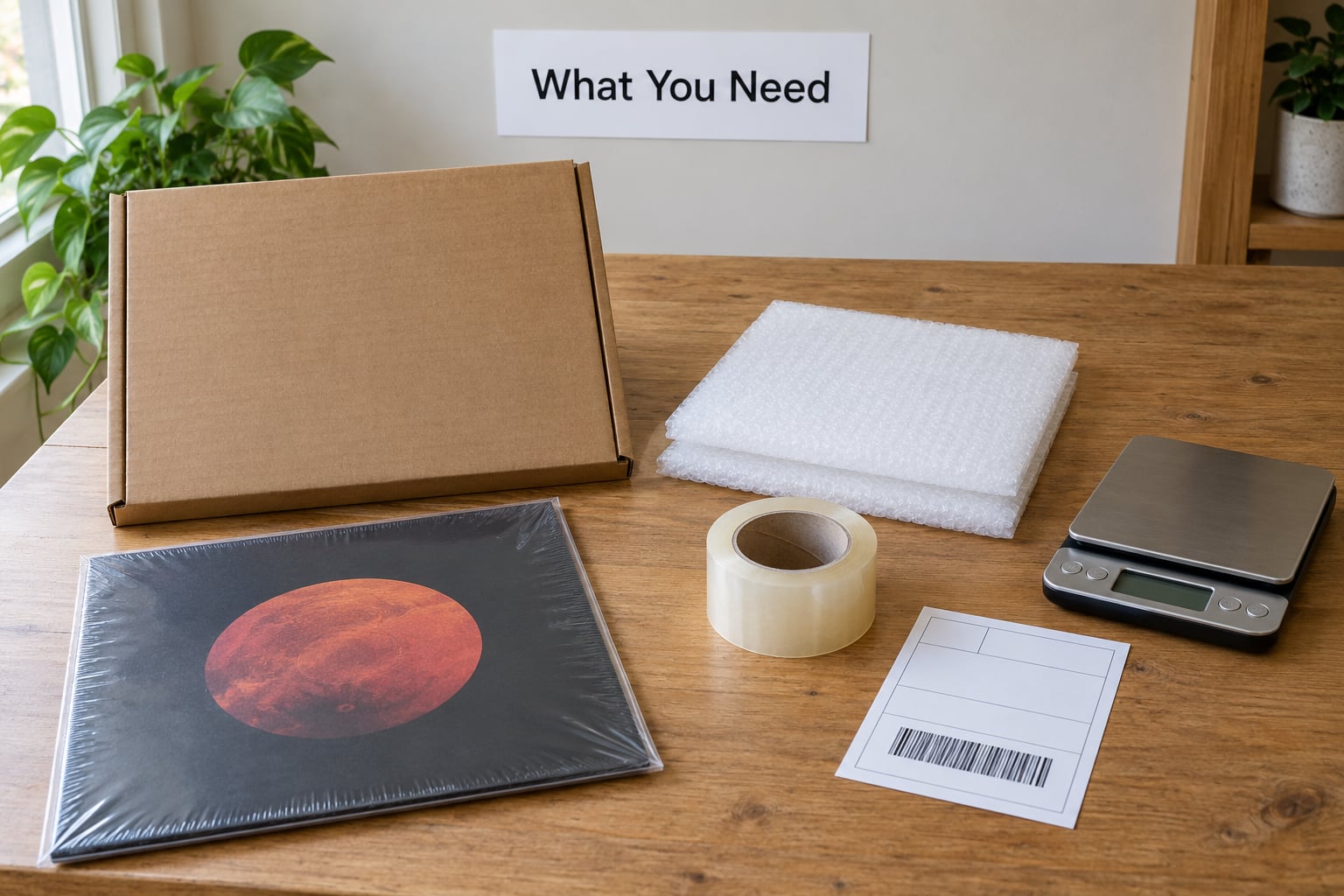
A record mailer built for 12-inch LPs is the one non-negotiable item. Everything else on this list is support for it.
- Record mailer or record box. Look for a mailer with interior dimensions around 12.5 by 19 inches. That gives roughly a quarter inch of clearance on each side of a standard LP, which is enough for the jacket without letting it slide.
- Corrugated cardboard stiffeners. Two pieces cut a couple of inches larger than the jacket on each side. This is the sandwich: jacket in the middle, cardboard front and back. Cardboard bends far less than a padded envelope across a wide flat surface, which is exactly the surface a record presents.
- Anti-static inner sleeve. A soft outer poly sleeve protects the jacket’s printed surface from scuffs and blocks seam splits caused by the disc pressing against the jacket wall during transit.
- Corner protection. Small foam or cardboard corner guards for gatefolds and box sets. Gatefold creases are the first thing to show damage and the hardest to fix.
- Packing tape and scissors. Tape every seam, and never tape anything directly onto a jacket.
- Void fill. Crumpled kraft paper, bubble wrap or foam for boxes. Bubble wrap works well for edge cushioning; it is a poor substitute for stiffness.
- Digital scale. Weigh the packed parcel, not the record. Guessing is how parcels end up paying a surcharge.
- Shipping label, tracking and insurance. Buy the label after the box is sealed and measured, and note the tracking number.
Matching materials to contents is mostly a size question. A 7-inch single fits a small square mailer with the same sandwich method, and a 45 rpm needs less padding than an LP only because it weighs less. A two-LP set or a box set goes in a larger mailer or a rigid box with the same stiffener rule. An unusually thick pressing, or anything with a booklet, deserves a rigid outer box rather than a flexible mailer.
Step-by-Step
Step 1: Prepare the Record and Order
Confirm the right record is in the box, along with any insert, download code or extras the buyer was promised. Take out anything loose that can rattle, shift or press on the jacket from the inside.
If the order is a sealed or limited pressing worth real money, photograph the contents after they are packed but before the mailer is closed. Those photos cost nothing now and settle most arguments later. For a damaged-on-arrival claim, carriers want evidence of how the item was protected, not just evidence that it arrived broken.
Slide the jacket into a clean outer sleeve if it does not already have one. Two records that press against each other inside a package generate exactly the kind of pressure that splits a seam, and a scuffed cover printing is not something a collector can undo.
Step 2: Pack the Vinyl Without Shifting
Set the record into the mailer so it sits flat and centered. Add one stiffener on each face of the jacket, then fill the gap on the sides with a thin pad so the assembly cannot slide an inch in any direction.
Protect the corners if the record is a gatefold or has a deep box set. Then close the mailer and test it: shake it gently, tilt it front to back, then side to side. If you hear or feel anything moving, take it out and pack it again. A record that shifts in the mailer becomes a record that shifts in a conveyor tray, under a stack, or in a parcel that gets tossed.
For thicker LPs, split the difference by removing the disc from the jacket and shipping the two side by side rather than nested. It costs you the sealed presentation, and it removes the main source of seam splits on a heavy pressing.
Step 3: Use a Rigid Outer Box for Valuable Records
Skip the mailer alone when the record is valuable, when the mailer itself is flexible, or when the destination is international. Put the packed mailer inside a corrugated shipping box that leaves a finger of room on every side.
Fill the empty space with crumpled kraft paper or foam so the mailer cannot move inside the box, but do not overstuff it. Packing material forced in too tightly pushes back on the corners, which is the opposite of what you want.
Seal every seam with packing tape, including the bottom. Keep the tape line clear of the shipping label and barcode area, because a courier scanner will not read a label that sits on a glossy tape seam. A well-packed box also survives being used as the bottom layer of a stack at a carrier depot, so the outer box is doing real work, not decoration.
Step 4: Weigh, Measure, Label, and Ship
Before you buy postage, run a final check. The correct record, the correct address, inserts included, nothing loose inside, seams sealed, address written clearly, and any old labels and routing marks removed. Old labels are how a parcel ends up delivered to the wrong sort.
Weigh the sealed parcel and measure the box. Both numbers determine the postage, so buying the label after this point is the only way to avoid a surprise charge. When comparing services, weigh speed and insurance against cost: a tracked service with insurance is the sensible choice for anything a fan would be upset to lose, while a cheaper tracked service is fine for common records.
For international orders, complete the customs form accurately. Describe the contents as a phonograph record, state the value honestly, and check the destination country’s import rules before you ship, since duties and taxes are usually the buyer’s responsibility and vary widely.
Write the address legibly by hand if you are not confident with a printed label, and never put both a handwritten and a printed address on the same parcel. Keep the tracking number, the receipt and the packing photos until the delivery is confirmed and the return window has passed.
Common Mistakes
Almost every damaged record I have handled came from one of a short list of mistakes, and each one has a simple fix.
- An undersized mailer. A mailer that has to be forced closed puts bending force on the jacket corners. Fix: buy the next size up and let the mailer do the fitting.
- The record left loose in the mailer. Anything loose becomes a projectile. Fix: stiffeners on both faces and side padding until nothing moves.
- Relying on a padded envelope. Bubble mailers bend in the middle across a wide flat surface, and collectors treat them as a red flag on an item listing. Fix: cardboard for stiffness, bubble wrap only for edge cushioning.
- Taping directly onto the jacket. Tape adhesive leaves a residue that can lift printing. Fix: tape the mailer, never the record.
- Overpacking the outer box. Void fill forced too tight pushes into the mailer. Fix: fill loosely, then test for movement again.
- Stacking too many records together. Ten to fifteen LPs per box is the practical ceiling, because a heavier stack crushes the bottom record. Fix: split the order into more boxes.
- An unverified address. A typed but wrong address is worse than a handwritten one because nobody checks it. Fix: read it back against the order screen before sealing.
- No insurance on a valuable order. Fix: insure anything you would have to replace yourself, and keep the packing photos.
- No check after sealing. Fix: the final inspection above takes a minute and catches most of the rest.
One habit worth adopting: keep the record mailers that arrive with your own orders. A collector’s mailbox is full of perfectly good rigid mailers, and reusing them costs nothing and cuts packing material costs. Several forums run collection giveaways of unused mailers to local record stores.
Frequently Asked Questions
What is the best packaging for vinyl records to send for postage?
A rigid record mailer sized for 12-inch LPs, with corrugated cardboard stiffeners on both faces of the jacket and a clean outer sleeve over the jacket itself. Add side padding so nothing shifts, and seal every seam with packing tape. For valuable records, put the finished mailer inside a corrugated shipping box and fill the void with kraft paper or foam.
Is USPS Media Mail safe for vinyl records?
Media Mail is safe for well-packed records. The service itself handles parcels gently, and sellers report years without damage using nothing else. The weakness is what it does not include: Media Mail carries no insurance, so a lost or badly damaged record is your problem. Pack stiff, use tracking, and insure high-value items on a service that offers coverage.
Does USPS have boxes for vinyl records?
There is no USPS box made specifically for vinyl, but the free Priority Mail flat boxes work well. The large flat box holds roughly forty LPs when packed flat with stiffeners between records, which makes it a good choice for bulk orders and moving a collection. For a single record, a purpose-built record mailer is cheaper and lighter to ship.
Can I ship a vinyl record in a padded envelope or bubble mailer?
A plain padded envelope is the one format to avoid. It bends across the middle under a stack or a parcel thrown on top, and the disc takes the bend. A jumbo bubble mailer is better only if you add cardboard stiffeners, which is why the technique is called sandwich packing. Cardboard supplies the stiffness; the mailer just wraps and protects the edges.
How do I stop a record jacket from splitting in transit?
Split happens when the disc presses against the jacket wall, so separate the two. Slide the jacket into a clean outer sleeve, which takes the pressure without splitting, or pull the disc out and ship both side by side for a heavy pressing. Sandwiching the jacket between stiffeners stops the mailer seam from bearing the load as well.
What should I do if a record arrives damaged?
Photograph everything before opening further: the parcel as it arrived, the packing, the mailer seams and the damaged record. Then file a claim with the carrier within the window on your tracking record, attaching those photos and the order record. Contact the buyer straight away, and if the item was insured, the carrier will ask for exactly this evidence.
Wrap-Up
Start with the mailer, not the tape. Get a record-sized mailer and two stiffeners, sandwich the jacket, and most of the risk on a single LP disappears. Everything after that, double-boxing, insurance, the claims folder you keep for a year, is just insurance on top of good packing.