Sweep picking is how metal guitarists play fast arpeggio runs without the picking hand stalling at every string change. One continuous pick motion covers two, three or four strings, the pick attacks each string exactly once with even volume, and the fretting hand rolls its fingers onto the shape as it arrives.
The reason it matters is simple: alternate picking handles the string crossings fine until the tempo climbs, then the hand falls apart. Sweeping removes that bottleneck, but only when the mechanics are clean, which is where most players get stuck.
Table of Contents
- What Is Sweep Picking in a Metal Solo?
- How Sweep Picking Differs from Alternate Picking
- How the Picking Motion and String Changes Work
- How Sweep Picking Is Notated in Guitar Solos
- How Rhythm Shapes a Sweep-Picked Metal Solo
- How to Practice Sweep Picking Without Building Bad Habits
- How to Use Sweep Picking Expressively in a Metal Solo
- Common Sweep Picking Mistakes and How to Fix Them
- Frequently Asked Questions
- Conclusion
What Is Sweep Picking in a Metal Solo?
Sweep picking is a technique where the pick moves in one continuous stroke across two or more strings, striking each string once with equal volume, while the fretting hand plays a single unbroken arpeggio pattern.
So how sweep picking works in metal solos is really a question about timing. The pick never stops and never reverses direction inside the figure. What the ear hears as separate notes are planned landing points along one unbroken path.
A single-string sweep is the starting point. Take an arpeggio shape, play one note, and let the pick continue past the string instead of resetting on it. That trailing motion is what you will later turn into a multi-string sweep.
Sweeping also sits between alternate picking and legato, and players often assume it replaces one or the other. It does not. It is a picking-hand method, and it can be combined freely with hammer-ons, pull-offs and slides coming from the fretting hand.
A two-string sweep in practice
Play the first two notes of an E minor arpeggio, on the G and B strings, and keep the pick moving downward through the string set instead of lifting after each attack. Nothing else changes yet: same notes, same speed, different hand path.
Why it sounds even
Each string gets one clean attack at the same depth in the pick stroke. That consistency is what makes a sweep sound like a single line instead of a string of disconnected plucks.
How Sweep Picking Differs from Alternate Picking
Alternate picking moves the pick up and down once per note, so it crosses a string on every stroke. Sweeping moves in one direction through a group of notes and crosses only at the boundaries, which is why the two techniques feel nothing alike at speed.
| Technique | Pick motion | Speed ceiling | Tone | Best use |
|---|---|---|---|---|
| Sweep picking | One continuous stroke through the string set, one attack per string | High, limited by string crossings rather than pick speed | Even, fluid, arpeggio lines | Fast run sequences, triad and seventh chord figures |
| Alternate picking | Strict up-down, one stroke per note | Moderate; hand slows at each crossing | Even and articulate at moderate tempo | General lead work, chords, anything rhythmic |
| Economy picking | Down on every note, up only when the direction reverses | Moderate to high | Slightly uneven by design | Fast single-string lines, pentatonic runs |
| Tremolo picking | Very fast repeated strokes on a single string or pair | High but narrow range | Buzzing, aggressive | Sustained single notes, death metal tremolo passages |
They overlap more than the labels suggest. A sweep figure that descends then ascends still needs a pick reset, and many players handle that reset with an economy-picking upstroke. Legato players use sweeps constantly; the sweep supplies the attacks the hammer-ons could not.
How the Picking Motion and String Changes Work
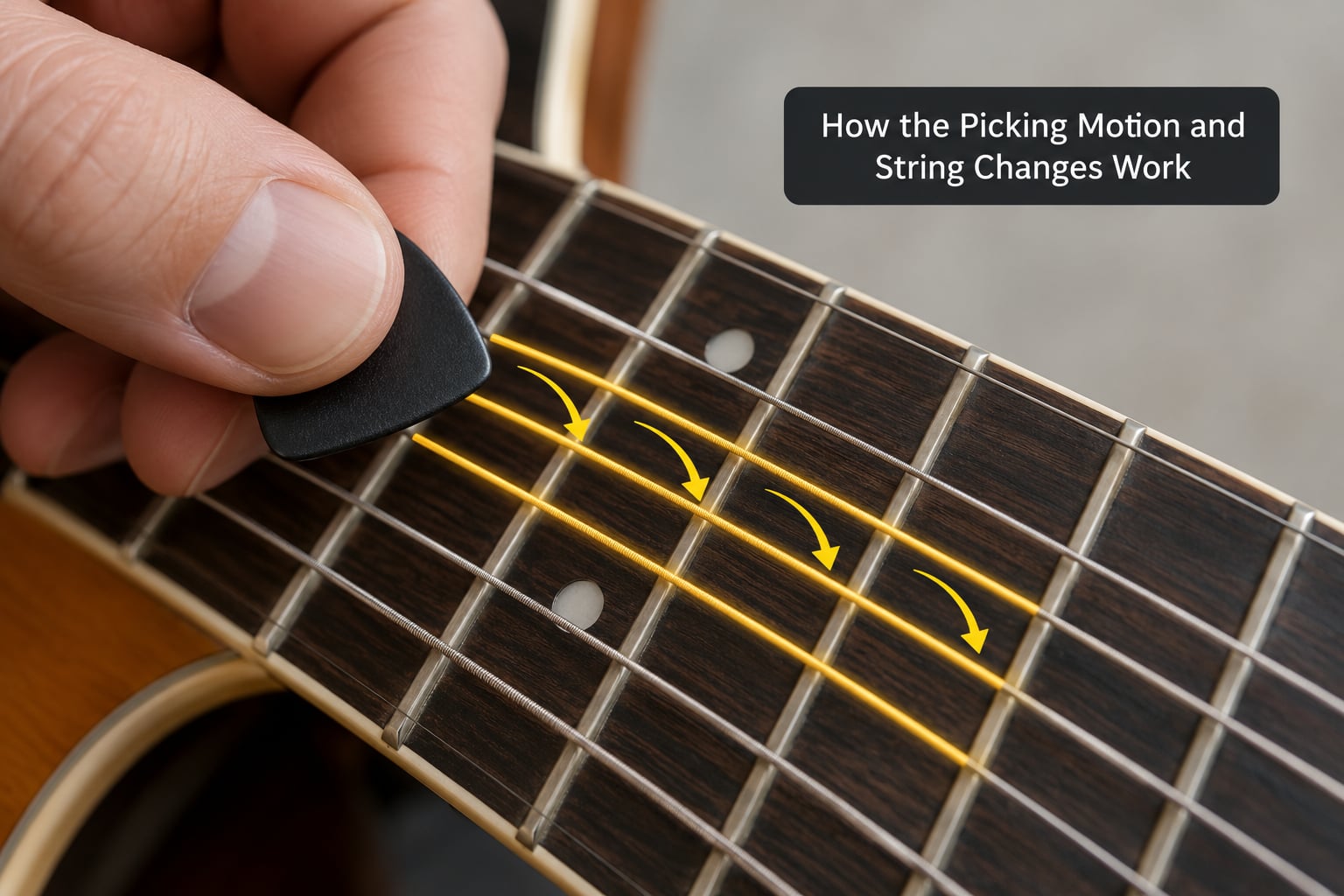
The string crossing is the bottleneck players keep describing. Moving between strings, the picking hand has to drop to roughly half the speed of its regular alternating strokes, and that drop is exactly what makes a sweep stumble.
The fix is to stop treating the crossing as a separate action. Your wrist pivots and the forearm rotates, so the pick travels through a shallow arc across the strings rather than being dragged from one to the next.
The pick angle matters more than grip
A relaxed, slightly open grip keeps the tip engaged with the string. Tilt the pick back and it skims; press in and it buries and mutes. A shallow angle with the point passing just beside the string is a good middle ground.
The fretting hand has a job too
Rolling is the move most beginners have never heard named. Instead of lifting each finger and placing it squarely on the next fret, the finger leans and slides a short distance, landing as the pick arrives. It saves fractions of a second per note, and across a 24-note run that adds up to more speed than you would expect from the pick hand alone.
Muting is what keeps it clean
Light palm muting from the picking hand stops the strings you are not playing from ringing. On high-gain settings the fretting-hand side also needs contact, resting the tips just enough to kill sympathetic vibration without choking the notes you want.
A concrete example: on the G, B and E strings, play 12, 13, 12 sweeping down, then hammer on to 15 on the top string and slide up to 20. The sweep sets the rhythm, the fretting hand finishes the phrase.
How Sweep Picking Is Notated in Guitar Solos
Sweep-picked passages are usually written with slurs or tied notes, which makes them look like pure legato. Read them that way while learning and you will pick every note and bury the timing.
Standard notation does not mark pick direction well, so the reliable rule is this: a slur over two or more different strings in a fast arpeggio almost always means sweep. A slur on the same string means hammer-on or pull-off.
Tab handles it better. A run marked with alternate picking symbols is meant to be picked, and a run drawn as a diagonal line across several strings is the conventional way to show a sweep, even though the pick is not physically stopping on each string.
Rhythmic groupings are where notation and playback disagree most. A figure written as eighth notes gets swept as eighths, and the pick passes each string at a steady rate equal to the written rhythm. Write a dotted pattern and the pick slows and accelerates with it.
How Rhythm Shapes a Sweep-Picked Metal Solo
A technically hard run sounds like an exercise until you give it accents and rests. Metal players use sweeps for phrasing, not decoration, and the phrasing comes from what happens between the attacks.
Accent the first note of a three-string sweep and drop the volume on the last, and the ear hears a phrase with a direction instead of a burst of sound. Palm muting on the quiet notes adds another dimension without extra technique.
Syncopation helps too. Starting a sweep on the offbeat of a beat puts it in the pocket of a groove, where a run that starts dead on the beat can sound stiff. Dotted figures across a six-string pattern give the same kind of push.
Landing the sweep on a chord tone and letting a chord ring underneath is the other half of it. The sweep is the tension, the chord is the release, and the tension only reads if you actually land somewhere.
Rests count too. Dropping out for a beat before a run lands harder than any increase in speed.
How to Practice Sweep Picking Without Building Bad Habits
Start with two-string crossings and stay there until they are clean. Players who jump straight to three-string shapes build the habit of hiding behind speed, and the string crossings stay uneven no matter how fast the whole run gets.
Then move to a basic triad across three strings, add a seventh, and only after that work on full six-string patterns. Forum players report five or six months of focused practice before sweeps felt smooth, and that timeline assumes someone was fixing the coordination rather than collecting more licks.
How to practice the progression
- Play one shape at 50 to 60 beats per minute on a metronome, resting a full second between repetitions.
- Check every note rings cleanly before adding any speed. A dead note is a picking-hand problem, not a speed problem.
- Record one repetition and listen for uneven volume between strings, which is the most common fault and the easiest to hear once you know what to hear for.
- Add a few beats per minute per week, and drop back the tempo the moment the crossings start to drag.
- Once the shape is clean, practice it in phrases with rests and accents rather than looping it.
- Finish by connecting it to a motif you already play, so the sweep serves your soloing instead of sitting next to it.
Ten focused minutes on one shape beats an hour of running through twenty. The muscle memory you are building is coordination, and coordination only changes when you practice it slowly enough to notice.
How to Use Sweep Picking Expressively in a Metal Solo
The sweep is one ingredient in a solo, not the whole recipe. Real metal leads alternate it with bends, slides, hammer-ons and chord work, and the contrast is what makes the sweep land.
Hammer-ons and pull-offs inside a sweep figure let you cover notes the pick never touches, which lightens the whole run. Sliding into the top note of a shape makes the arrival feel intentional instead of mechanical.
Bends after a sweep create a pitch change with no rhythmic attack, a contrast that flat picking cannot give you. Rests, light palm muting and chord landings set up the next figure so it has somewhere to arrive.
Whichever subgenre you are playing in, treat the sweep as a phrase with a beginning and an end. Most players who quit the technique did so because they could play it but never had a reason to.
Common Sweep Picking Mistakes and How to Fix Them
Almost every sweep problem traces back to one of four things: the pick path, the fretting-hand timing, muting, or rushing. Diagnose which one before practicing more.
| Symptom | Likely cause | Fix |
|---|---|---|
| Arpeggio blurs into chord mush | Unplayed strings ringing | Light palm muting from the picking hand, plus fingertip contact on the fretting hand |
| Picking hand slows at each string crossing | Crossing treated as a separate stroke | Practice two-string crossings in isolation, slow, until the arc feels continuous |
| Notes uneven in volume across the run | Inconsistent pick depth or angle | Slow to half tempo and match each note’s attack depth to the first note |
| Dead notes at high speed | Pick not landing squarely on the string | Lower tempo until every note speaks, then add speed gradually |
| Sweep sounds flat and lifeless | No phrasing, even volume throughout | Accent the first note, palm mute the quiet ones, add rests |
| Tension in the wrist and forearm | Grip too tight, or pick angled too far back | Relax the grip, use wrist pivot plus light forearm rotation |
On the wrist question that comes up constantly: neither a locked wrist nor a wild rotation is right on its own. The wrist pivots, the forearm contributes, and the pick follows a shallow continuous path. If you cannot sweep three notes without your shoulder creeping up, the tension starts in the grip.
Frequently Asked Questions
How do you perform sweep picking correctly?
Move the pick in one continuous stroke through the string set and let it attack each string exactly once at equal depth. Let the fretting hand roll its fingers onto each note as the pick arrives instead of placing them squarely, and mute the unused strings lightly from the picking hand. Start on two-string crossings at a slow metronome tempo before moving to three-string shapes.
Is sweep picking one of the hardest guitar techniques?
It ranks somewhere in the middle. The difficulty is not raw speed but coordination between two hands and a timing problem at each string crossing. Players who practice two-string crossings slowly for a few months usually get there. Hand tension and a tight pick grip cause more trouble than the technique itself.
Did Eddie van Halen use sweep picking?
Yes. Van Halen’s two-handed tapping is the better-known part of his technique, but his playing is full of arpeggio sweeps, and his influence on Randy Rhoads and the players who followed him is where the technique entered metal vocabulary. Early Ozzy-era Van Halen leads are the reference for using sweeps with feel rather than just speed.
Does Kirk Hammett use sweep picking?
Hammett uses sweeps selectively rather than as his default lead technique. His playing leans on single-note lines, chromatic runs and expressive vibrato, and sweeps appear when an arpeggio figure fits the phrase, which is roughly how most working guitarists use the technique.
Should I use a pick for sweep picking, and can you sweep on bass?
A thin, pointed pick gives you the shallow arc that makes clean string crossings easier, and a thicker pick can bury and mute notes if you over-grip. The same mechanics apply on bass across fewer strings, and four-string runs work well there. Fingernail technique works as well but takes far longer to build up.
How long does it take to get a clean sweep?
Players on forums commonly report five or six months of focused practice before sweeps became smooth and even. That assumes slow work on string crossings and muting rather than practicing more and more licks. A clean sweep at a moderate tempo usually arrives well before the fast, even-sounding version does.
Conclusion
Start with two-string crossings played slowly enough that every note rings and every crossing sounds identical. Once that is automatic, widen to triad and three-string shapes, add muting and rolling, and only then put rhythm and phrasing on top.
Sweep picking in metal solos works because the pick never stalls and the fretting hand never stops moving. Build those two things first and the speed follows on its own.