Last updated: October 2026
Here we mean heavy metal music, not construction steel. Metal reaches a sports arena in a handful of repeatable ways: as a player’s walkout track, as a scoring cue, as a victory anthem, as a live pre-game set, and as licensed background for broadcast highlights. Loud, riff-driven music suits a room built to deliver a room-wide jolt, though dense low-end content is unusually hard to reproduce cleanly in a circular bowl.
That last part matters more than people expect. Ask anyone who has stood in the floor at a big arena show and they will tell you the same story: the night was huge, the crowd was enormous, and the sound was a mess. Both things are true at once.
Table of Contents
- How Metal Is Used in Sports Arenas
- Why Teams and Fans Choose Metal for Arena Moments
- From Walkout Music to the Final Horn
- How Heavy Metal Differs From Other Arena Music
- How Arena Music Teams Choose the Right Metal Tracks in Sports Arenas
- How Metal Becomes a Sports Fan Tradition
- Notable Ways Metal Enters the Sports Arena
- Volume, Timing, Style, and Safety in the Arena
- Frequently Asked Questions
- Why is metal popular for sports arena entrances?
- Do most professional sports arenas use heavy metal music?
- Which genres of metal do teams commonly use in arenas?
- Who chooses the music played during a sports game?
- How can I find out which metal song my team uses?
- Conclusion: Start With the Moment, Not Just the Genre
How Metal Is Used in Sports Arenas
Teams use metal in sports arenas to make loud moments feel bigger. A walkout cue gets a player into a ritual instead of a tunnel, a scoring track gives the noise a shape, and a postgame anthem turns a win into something the crowd sings back. The music is short, familiar and edited to hit at an exact second.
Five jobs cover most of it. Entrances, where a team or a single player is introduced. Warmups, where a steady tempo fills dead air. Scoring punctuation, played the instant a play counts. Celebrations, from a first goal to a championship lap. And identity, the track a home crowd treats as its own.
| Arena moment | Typical placement | Musical approach | Intended effect |
|---|---|---|---|
| Tunnel walk and player introductions | One to two minutes, right before the player appears | Riff-heavy intro, vocal held back or cut | Focus the room on one person |
| Team entrance and warmups | Several minutes, loops as needed | Instrumental breaks and long guitar solos | Fill time without adding words |
| Timeouts and dead balls | Short bursts between live play | Fast edits of the loudest section | Reset attention fast |
| Goal, touchdown or home run | Instant, under five seconds | Single distinctive hit or riff | Mark the play instantly |
| Victory lap and championship | Two to four minutes, no edits | Full song, chorus first | Hand the moment to the crowd |
Nothing here is improvisation. Every one of those cues is picked, cleared, loaded into a playback system and rehearsed against a game clock.
Why Teams and Fans Choose Metal for Arena Moments
Volume is the obvious reason and the least interesting one. The real reasons are musical.
Metal builds in layers. A quiet verse sits under conversation, then a riff arrives that a whole bowl can feel through the floor. That arc maps neatly onto an event that also builds in layers: warmups, introductions, then the thing everyone came for.
Riffs are also short and repeatable. A hook you can hum after three hearings is worth far more in a noisy room than a chorus with eight syllables nobody catches. That is why arena cues tend to favour instrumental sections.
Rhythm does the rest. Metal runs on a driving backbeat, and a crowd that claps on the beat is a crowd you can cue back to a chorus with a hand signal instead of a spoken announcement.
From Walkout Music to the Final Horn
A night unfolds in a predictable order, and the music follows it step for step.
Doors open and a house DJ or in-venue playlist fills the room. Announcements and intros run short, functional tracks. Then the tunnel walk, where a longer piece with a big opening riff sets the tone for the team coming out.
Individual entrances are the sharpest moments. A track gets cut to about ninety seconds, the intro is stitched to the best vocal line, and playback is triggered on the player’s cue rather than a timer. Miss that trigger and a star athlete walks out into silence.
Warmups, timeouts and intermissions take the long pieces. This is where a guitar solo does the work, because nobody is listening to lyrics and the crowd noise needs something to sit under.
Scoring moments get the opposite treatment. A goal or a touchdown needs to be recognizable in the first second, so arenas use a single riff, a snare hit or a vocal shout rather than a whole song. Championship and victory-lap music gets the reverse treatment: full arrangement, chorus first, no edits at all.
An arena production will shorten a track, lift the intro, sequence two cues back to back or time playback to a horn. That reshaping is normal and it does not misrepresent what the song is for. A ninety-second edit exists to be cut; the record still sounds the same at home.
How Heavy Metal Differs From Other Arena Music
Rock, hip-hop, pop, country and classical stadium music all work in arenas. They get there by different routes.
Rock and stadium rock share metal’s guitar-led DNA but usually sit in a narrower dynamic range. Metal leans harder on double-kick drumming, palm-muted passages and long instrumental stretches, which means fewer lyrics per minute and more timbral change.
Hip-hop arrives with a different structure entirely. It is voice-first, built on a beat that can carry a verse over long stretches, and it rarely needs the intro stripped away because the vocal is the hook from the first bar.
Pop is short by design. A pop cue usually runs thirty to ninety seconds, hits the chorus, and leaves. Metal cues need more runway because the payoff is a riff rather than a vocal sample.
Country arena music tends toward tempo and lyric, often with a singalong line the whole building can finish. Metal singalongs exist, but they usually rely on a mid-section hook rather than a chorus.
Classical stadium music works through orchestral swell and a well-known melody laid over a big finish. The opposite of metal, which usually wins by density and impact.
The useful conclusion is not that metal wins. It is that the best arena cue matches the emotional job of the moment, and genre is only one way to get there.
How Arena Music Teams Choose the Right Metal Tracks in Sports Arenas
Nobody picks a walkout song on taste alone. It has to survive a checklist.
Duration comes first. A player entrance has a hard window, and a track that cannot be cut without losing its identity is a bad pick. Tempo comes second: something around 120 to 160 beats per minute survives being shortened without feeling rushed.
Then edit points. Producers look for a clean riff that can start the cue without a long fade-in, and a section that resolves so the playback engineer can cut out smoothly rather than fading mid-phrase.
Vocals are a separate question. Many arenas prefer instrumental passages for entrances so no words compete with the announcer. Where a vocal cue is used, the clean version matters, because an explicit line at a family section is a real problem and gets the track pulled.
Recognizability is the last filter and the most subjective. A song nobody recognises does not work as hype, but one everybody recognises can feel lazy if it has no tie to the team.
The strongest choices have a genuine connection: a band from the city, a player who names the track, a song that already belongs to a rivalry. That connection is what separates a cue from wallpaper.
How Metal Becomes a Sports Fan Tradition
A cue becomes a tradition through repetition, not through any single decision.
Play the same entrance track for a season and the crowd learns it. They clap the opening beat before the player comes out. Kids who grew up hearing it now expect it, and an adult who has never read a preview article still knows when to start stomping.
Players notice. An athlete who picks their own entrance track is doing something different from someone assigned one, and the crowd reads that difference as personality. Once a player has used a track for two or three seasons, changing it can feel like a small loss.
Local adaptation happens constantly. A band from the metro area gets chosen because the fans shout the name before the riff even lands. Rivalry games get harder, louder cuts. A goal song that started as a playoff novelty becomes the regular-season cue because it worked.
Memorable scores accelerate it. A goal, a walk-off, a comeback that nobody saw coming, and suddenly a track is attached to a moment people tell for years. The song is no longer just the music; it is the soundtrack to a memory.
By the time it is a tradition, the music director is no longer choosing it. The crowd is.
Notable Ways Metal Enters the Sports Arena
Some uses are better documented than others. These examples come from reported events rather than a ranked list, because arena metal history is a set of specific nights rather than a top fifty.
Metallica has the most visible Bay Area record. In 2021, during the pandemic, the band performed the national anthem remotely before a Golden State Warriors game at Chase Center, with James Hetfield and Kirk Hammett on the video feed rather than in the building. The performance also drew on a longer local habit: the band has connections with the San Francisco Giants, the Warriors and the San Jose Sharks, and fans wearing band-shaped jerseys have become a familiar sight in the seats.
Chase Center also hosted S&M2, Metallica with the San Francisco Symphony, as part of the arena’s opening. A thrash band playing orchestral arrangements in a building that had just been christened is the clearest example of metal being used as an opening statement rather than a background cue.
At the other end of the scale, a pre-show set is normal programming rather than an event. Thousand Foot Krutch played a Jacksonville Jaguars pre-show concert at Jacksonville Municipal Stadium, and the coverage described rock acts turning up at sports venues as a routine ambassadorial slot rather than a novelty.
Wrestling and MMA run the same entrance logic at higher intensity. A fighter walkout is short, personal and camera-facing, which is close to an ideal metal use, though the licensing for televised walkouts is handled differently from in-arena playback.
Hockey offers the clearest scoring cue of any major sport, since goals come constantly and the window between the puck crossing the line and the horn is very short. Home-run celebrations work similarly, needing something that registers in about two seconds.
Volume, Timing, Style, and Safety in the Arena
Arena acoustics are the part of this topic nobody writes about, and they explain a lot of complaints.
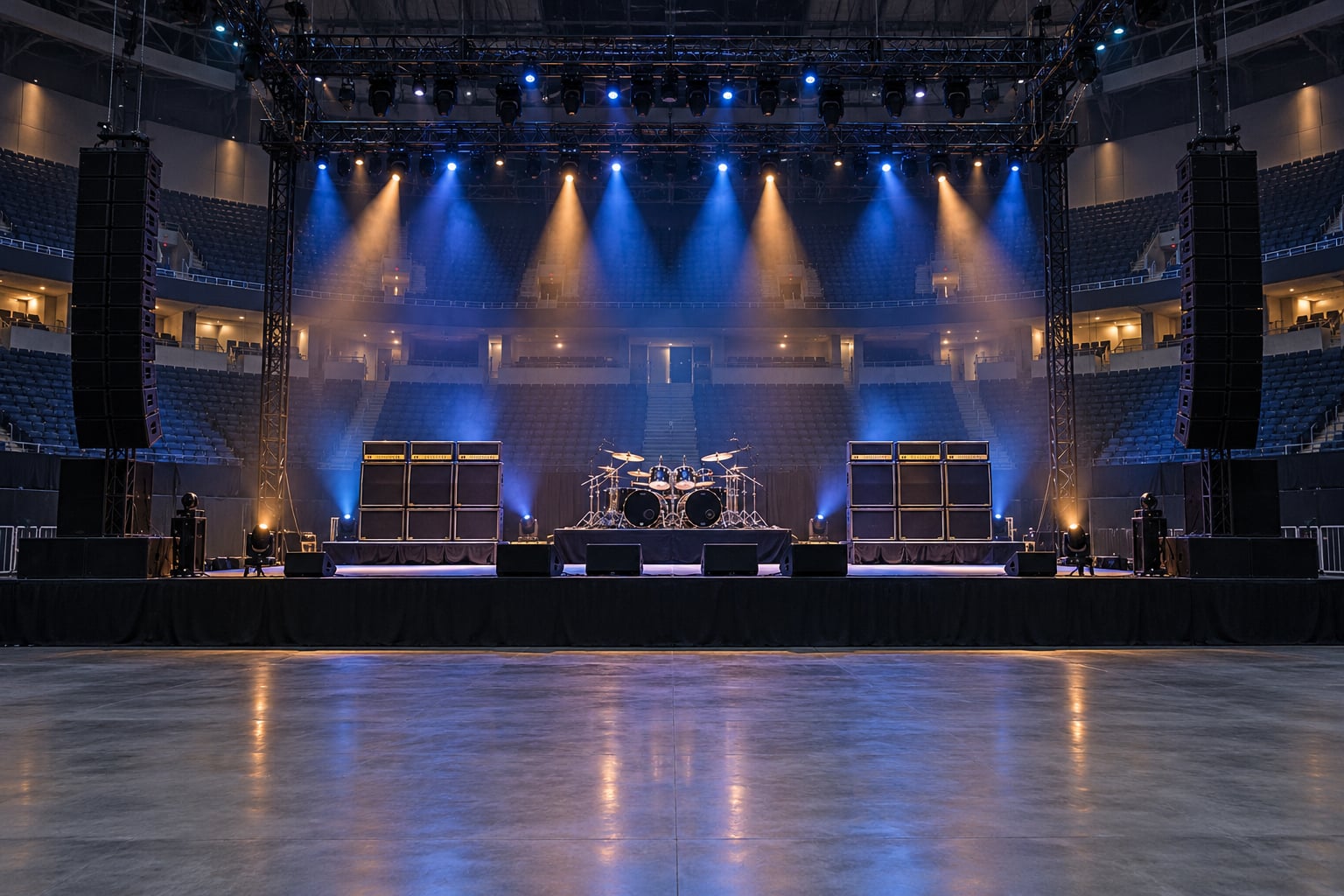
Heavy metal is among the hardest genres to reproduce in a round arena. The reason is dense low-mid content and a wide mix arriving from a stage that is far narrower than the building. Filled with people, the bowl absorbs high frequencies and keeps the bottom, so the mix can sound like it is coming from one point at centre stage.
Arenas fight this with delay towers, which are speaker arrays hung around the bowl and fed the main mix a fraction of a second late so late-arriving sound lines up with direct sound. That fix creates the other problem: standing directly beneath one hanging array can sound worse than standing between two of them.
Delay effects on lead vocals also become obvious at that scale. In a small room they blend; in a bowl of twenty thousand people, the repeats arrive separately and the vocal sounds doubled. Fans have described it as a single-channel mono speaker in the middle of the stage, and that complaint shows up repeatedly in long-running threads about arena metal mixes.
Volume is bounded by venue rules, not by the band. Curfews, neighbourhood limits and a house system with a known output ceiling all cap how loud a set can get. Bands adapt by gaining characters rather than sheer volume, which changes the setlist in interesting ways.
There is a licensing layer too. Anything played in a venue or broadcast needs clearance, and cleared tracks for in-arena playback, television highlights and sports video games are usually separate agreements. That paperwork decides as much as taste does.
Two practical notes. Check the venue’s policy on explicit content before you go, and if you are attending a loud show, properly fitted earplugs will not spoil the music, while cheap foam plugs mostly just muffle it.
Expectations help too. Fans who sit higher in the bowl generally report a more even, clearer mix than those in the floor, and the floor is where density can be hit or miss depending on how the show is going. A dead pit is a real risk with any floor ticket, not a metal-specific failure.
Frequently Asked Questions
Why is metal popular for sports arena entrances?
Metal suits an entrance because it builds and then hits hard, which matches the emotional shape of a player coming out. Its instrumentation, especially guitar riffs and driving drums, cuts through crowd noise, and the genre has a long tradition of loud communal shows. A short riff is easy for a crowd to recognize in a noisy bowl, which is exactly what an entrance cue needs.
Do most professional sports arenas use heavy metal music?
There is no single universal metal cue, because each team builds its own library. What is common is the structure: arenas across the NBA, NFL, NHL, MLB and college use rock and metal-derived cues for entrances, timeouts and scoring celebrations. The specific track changes by team, sport and even season, but the format is genuinely widespread.
Which genres of metal do teams commonly use in arenas?
Traditional heavy metal and hard rock are the most common, largely because they carry the strongest riffs in the least time. Hard rock and glam-leaning tracks appear often too. Thrash metal shows up for scoring cues and championship moments, and heavier styles such as death or black metal are rare in arenas because of length, tempo and explicit content, though individual fans use them as walkout cues.
Who chooses the music played during a sports game?
An in-house or contracted music director handles the bulk of it, building a cue library and scripting playback to the game clock. Teams and players often supply input, and an athlete’s own walkout choice carries weight. Outside groups, promotional use in broadcast highlights and video games goes through separate licensing, and fans influence the list through repeated, visible requests.
How can I find out which metal song my team uses?
Start with entrances, since that is where identifiable tracks live. Watch the warmups and introductions rather than only live play, check the team or venue site for a published music list, and search the team’s walkout or goal song together with the season. Season recap videos and highlight packages often name the cue, and the crowd clapping on a specific beat is a reliable hint.
Conclusion: Start With the Moment, Not Just the Genre
Arena metal works when the track does the job the moment needs: a short riff for a goal, a full song for a championship lap, a cut-to-ninety-seconds edit for a walkout. Genre matters less than fit, and a familiar hook beats an unfamiliar one every time.
Start with one question for your own team: what is its signature entrance moment, and what plays there? Once you have identified that cue, the rest follows, and the tracks connected to it are where the tradition lives.