Getting your band on streaming platforms takes one thing: a digital music distributor, sometimes called an aggregator. Spotify, Apple Music and Amazon Music do not accept uploads from artists directly, so you hand a finished master, cover art and metadata to a distributor, and they deliver the release to every service for you. Budget three to eight weeks from upload to live, depending on whether it is a single or a full album.
That is the short version. The rest of this guide covers what a band actually needs before touching a distributor, how to pick one without losing your catalog later, and how the promotional side works once delivery is done. If your band is metal or hard rock, there are a few extra wrinkles worth knowing, especially around member splits and genre storefronts.
Table of Contents
- What You Need
- Step-by-Step: How to Get Your Band on Streaming Platforms
- 1. Confirm Rights and Release Readiness
- 2. Choose a Distribution Service
- 3. Create and Verify Artist Profiles
- 4. Prepare Masters, Artwork, and Metadata
- 5. Upload and Test the Release
- 6. Schedule the Release for Delivery to Streaming Platforms
- 7. Pitch the Music During the Release Campaign
- 8. Verify, Promote, and Maintain the Release
- Common Mistakes
- Mismatched metadata across releases
- Uncleared samples and unauthorised covers
- Incomplete split sheets
- Late uploads
- Artwork that fails validation
- Confusing a distributor with a label
- Relying only on organic discovery
- Frequently Asked Questions
- Do I need a record label to get my band on streaming platforms?
- Can an independent band upload music directly to Spotify or Apple Music?
- How long does it take for a new release to appear on streaming platforms?
- What is the best distributor for a new independent metal band?
- How do independent musicians pitch music to streaming playlists?
- Can I move my catalog to a different distributor later?
- Conclusion
What You Need
Most first releases fail in the boring places: an unsigned split sheet, artwork with the wrong dimensions, a name that spells itself three different ways. Gather this list before you sign up for anything.
- Finished master audio. 16-bit or 24-bit WAV at 44.1 kHz or higher, with the track starting and ending in silence so platforms can detect the length and level it correctly.
- Cover art. Square, 3000 x 3000 pixels, RGB, JPG, under about 20 MB on most distributors. No URLs, social handles, price tags or distributor logos on the cover. If you re-release a record years later, the artwork has to be a different file from the original release.
- Credits. Who wrote it, who produced it, who plays what, who mixed and mastered it. Also a clean explicit and a clean version if lyrics warrant a clean edit.
- Signed split sheets. One per song, showing songwriting percentages and master recording ownership for every member, plus any session players or co-writers.
- Sample and cover clearances. Written permission for anything lifted from another record. Covers need a mechanical license from a publishing administrator, and a sample needs both a master clearance and a publishing clearance.
- Legal names and IDs. The exact spelling used on tax documents, plus the band name decided in one form and checked against a trademark database and the streaming services.
- Contact details. An email the whole band reads, a press photo, and a short bio you can reuse everywhere.
One more decision belongs on this list: how many members share in the money. Bands routinely argue about this after the first royalty statement arrives, which is far too late.
Step-by-Step: How to Get Your Band on Streaming Platforms
The workflow runs in eight stages. The order matters less than the lead times baked into it, because every stage depends on the one before it.
1. Confirm Rights and Release Readiness
You cannot distribute music you do not control, and this is where most independent bands get stuck. Every member of the band should be able to answer three questions: who wrote the song, who owns the recording, and can we distribute it commercially?
Songs written by the whole band are simple. Songs with a co-writer outside the band are not. If you interpolated a chorus, lifted a drum break or covered another track, you need documented permission, and that permission should say the deal covers digital distribution worldwide rather than live performance only.
Your producer and session musicians may hold publishing or master points depending on the contract, which is why the signed split sheet matters. When everyone agrees on percentages in writing before delivery, royalty statements become arithmetic instead of a dispute. If a member has already left, work out in writing who owns their share before the release goes out. Changing it later is painful.
2. Choose a Distribution Service
A distributor is the company that stores your release, encodes it, attaches the ISRC identifier, and feeds it to every service. Spotify, Apple Music, Amazon Music, YouTube Music, Tidal, Deezer, Beatport, Pandora and dozens of others all buy their music from distributors rather than from bands.
Most plans fall into one of three shapes: a yearly subscription, a one-time fee per release, or a free tier funded by a share of your royalties. Each has a real consequence for a band.
Subscription services such as DistroKid, TuneCore and Ditto keep your music live as long as you pay. Stop paying and the catalog comes down. That point comes up constantly in distribution forums, and it is the single most common regret first-time bands report. One-time models such as CD Baby charge per release and keep delivering years later, but take a commission on top.
Free tiers exist and are reasonable for a test release, with the tradeoff that a share of royalties goes to the distributor. What you get on paper matters more than the headline number: store coverage, whether you can choose a release date yourself, whether the catalog stays with you, how fast support answers, and what extras cost. Optional add-ons such as lyric syncing, Shazam registration and YouTube Content ID are frequently priced separately, so ask before assuming they are included.
Our advice for a first release: shortlist two, read the pricing page line by line, then check what happens to your music if you cancel. That single check separates most of the field.
3. Create and Verify Artist Profiles
Your artist page is your storefront, and creating it twice splits your streams and your listeners in half. Decide on one spelling of the band name, including punctuation and capitalisation, and use it identically everywhere.
Deliver a release first if you have to, because an artist profile usually becomes claimable once your music appears on the service. Then claim the dashboards: Spotify for Artists, Apple Music for Artists, Amazon Music for Artists, a YouTube channel with an Official Artist Channel application, and Shazam. Each one gives you editorial access, analytics and, eventually, a way to correct metadata.
Member-side profiles are a separate question. Many bands run a main page for the band plus a page per musician for solo work or side projects. If several members release solo material, set those up deliberately rather than letting the services guess, and link them to the band page.
4. Prepare Masters, Artwork, and Metadata
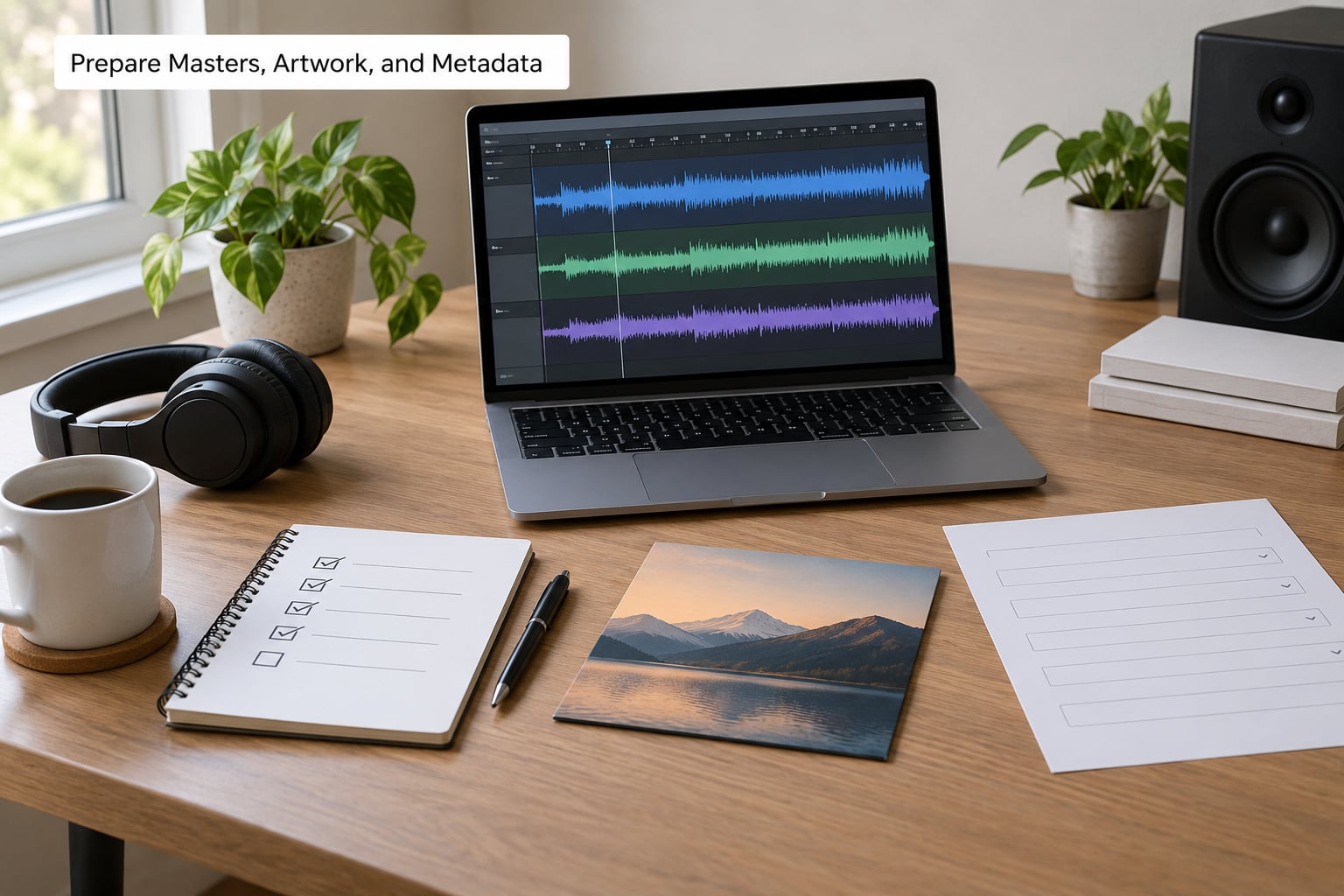
Metadata is the plain-text information attached to a release: artist name, track titles, featured artists, songwriter credits, genre, language, release date, explicit flags and label name. Once a release is delivered, most of these fields cannot be edited, so treat the metadata page as a final proof rather than a draft.
Two identifiers do the invisible work. The ISRC code identifies a specific recording across every service so royalties follow it, and the UPC or EAN code identifies the release as a whole. A distributor issues both for you at delivery. Reusing an old ISRC for a remaster is fine; assigning the same ISRC to two different recordings is not.
Your preflight check, in order: artwork is square, high resolution and free of text that will shrink illegibly on a phone; every name is spelled identically to the profile; every songwriter is credited with the correct share; the sample clearance paperwork is attached; and the release date is a Friday at least four weeks out for a single or eight weeks for an album.
5. Upload and Test the Release
Most distributors let you build a release as a draft and check it before it goes anywhere. Use that pause. Play the preview, confirm the track order and durations, and read the credits panel out loud, because contributor credits are how fans find out your drummer also produced it.
Check territories too. Leaving the world map fully selected is usually correct for a new band unless you have a licensing reason to hold specific countries. Flag lyrics as explicit when they warrant it, since getting this wrong causes silent removals later.
If your distributor offers a delivery or validation report, read it before approving. Most validation tools check file integrity, artwork dimensions and required fields; the ones that catch contributor credit mistakes are the ones worth using.
6. Schedule the Release for Delivery to Streaming Platforms
Delivery and availability are two different dates. Delivery is when the distributor sends your release onward. Appearance on a specific streaming service happens after that service reviews and processes it, which usually adds several days and can take longer around holidays.
Plan four to six weeks of lead time for a single and eight to twelve for an album or EP, mostly so you have time to pitch, build a pre-save link and fix mistakes while changes are still possible. Release day is Friday, because the editorial and algorithmic cycles key off it. On delivery, a release becomes an in-progress item that most distributors will not edit, so treat that date as your last chance to correct anything.
7. Pitch the Music During the Release Campaign
Editorial pitching is a one-shot request to a human or algorithm at each service, and it is free. Spotify for Artists lets you pitch one unreleased track at a time from the dashboard, and the deadline is at least seven days before release. Two to three weeks out works better in practice. You get to write the pitch, choose the mood, instruments and a story, and you select one track per release; the other tracks never get pitched through that tool.
Do the same in Apple Music for Artists and Amazon Music for Artists, and send personal emails to relevant independent playlists, metal blogs and radio stations with a private stream and a short, specific note. Bands that live on live evidence sell better to editors: show dates, ticket numbers, a mailing list size and a track that already works live.
Never promise or imply a guaranteed placement, and stay away from paid playlist services that guarantee streams. Bots and purchased plays get detected, and artificial streams are a leading cause of removed payouts and stalled profiles. Forum users burned by that pitch describe the same pattern repeatedly, so treat any guarantee as a red flag.
8. Verify, Promote, and Maintain the Release
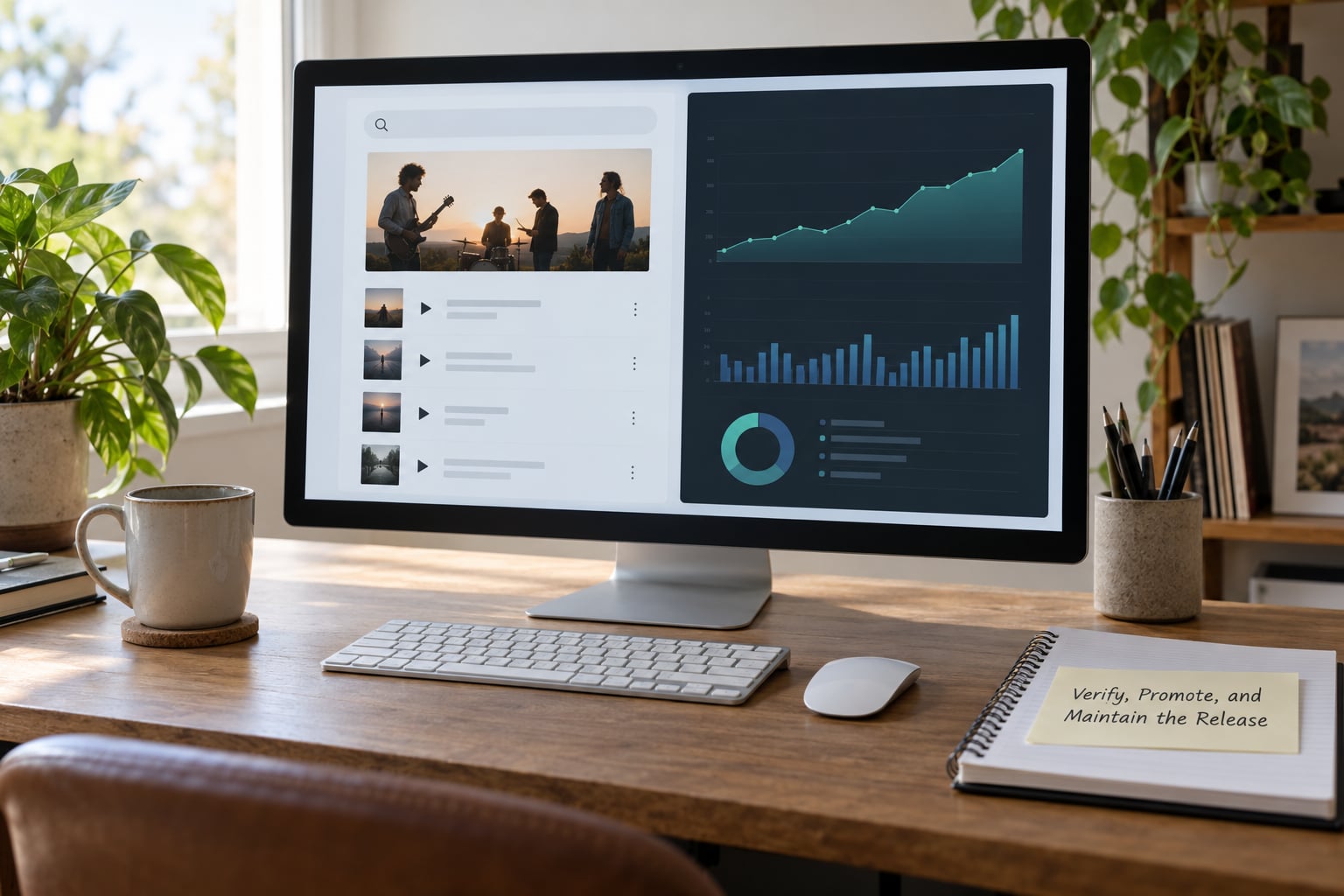
On release day, search your band name on each service from a logged-out browser and confirm the release shows, the artwork matches, and the credits are right. Test the pre-save link, check Shazam recognises the track, and confirm your pages point to the right destination.
When metadata is wrong, your distributor can usually amend spelling and credits after delivery, but the changes take days to propagate and some fields never move. Save screenshots of everything you submit, since those become your evidence when something needs correcting.
The four weeks after release matter more than release day. Follow up with everyone who added your song to a playlist, post short performance clips rather than studio posts, and keep the release in rotation. Track territory availability, watch for streams that look suspiciously high and then disappear, and update your artist pages when the band picture or lineup changes.
For ongoing releases, treat each one as a fresh submission. New ISRCs for genuinely new recordings, new artwork files for re-releases, and pitches submitted on schedule are what keep a catalog growing instead of static.
Common Mistakes
Every failure below shows up repeatedly in musician forums, usually described the same way each time.
Mismatched metadata across releases
One release says “Iron Vein”, the next says “Iron Vein (Band)”, and the services split your audience. Fix it by fixing the name everywhere in one sitting, including any pre-save page and social bio, before you need it.
Uncleared samples and unauthorised covers
Uploading a track containing a cleared-nothing sample can get the release removed after it is live, with the takedown landing on the distributor rather than you. Get written clearance, or release a re-record.
Incomplete split sheets
A signed split sheet per song, stored somewhere the whole band can reach, prevents the argument that starts when the first statement arrives. It takes an hour and settles a dispute that can take months.
Late uploads
Two weeks is not a lead time, it is a hope. Delivery plus platform processing plus the pitch window adds up fast, and pitching after delivery is impossible.
Artwork that fails validation
Non-square images, embedded text and social handles cause rejections that eat a week. Use a 3000 x 3000 square file and read the distributor’s artwork rules once, carefully.
Confusing a distributor with a label
A distributor delivers and collects. A label owns your masters, takes an advance, and earns a share. Bands who sign a label contract expecting delivery usually end up with less control and less money.
Relying only on organic discovery
Release day is not a launch. Every independent release competes against an enormous daily upload volume, so pre-saves, a mailing list, live dates and direct editor outreach are what actually produce listeners in the first month.
Frequently Asked Questions
Do I need a record label to get my band on streaming platforms?
No. A distributor handles delivery, metadata, identifiers and royalty collection without owning your music or signing you. A label, by contrast, buys or licenses your masters, usually takes an advance, and earns a percentage of the revenue. Most independent metal and hard rock bands release through a distributor alone for years, then revisit the question once a release finds an audience.
Can an independent band upload music directly to Spotify or Apple Music?
No. Neither service accepts direct uploads from artists or bands. Both buy their catalogue from approved distributors, which is why an ISRC code and consistent metadata are attached to every release you see on them. Some streaming services have direct artist submission for audiobooks and podcasts, but music always goes through a distributor.
How long does it take for a new release to appear on streaming platforms?
Allow four to six weeks for a single and eight to twelve weeks for an album, counting upload, delivery and platform review. Delivery to your distributor takes a few days, and each streaming service adds its own processing time after that. Holidays stretch it further. The date your distributor confirms is a delivery date, not a guarantee that every service will be live on the same morning.
What is the best distributor for a new independent metal band?
There is no single winner, so compare them on four things: store coverage including the genre services your audience uses, catalog ownership if you cancel, the commission or extras charges, and release-date control. Metal and hard rock bands usually want broad DSP delivery plus Beatport, Tidal, Deezer and Bandcamp. Read the cancellation terms before you upload anything you care about.
How do independent musicians pitch music to streaming playlists?
Pitch free through the artist dashboards: Spotify for Artists allows one unreleased track at a time with a minimum seven days notice, and two to three weeks works better. Apple Music for Artists and Amazon Music for Artists have their own submission forms. Then email independent playlist curators and metal blogs directly with a private stream, your live dates and a short specific reason your track fits their audience.
Can I move my catalog to a different distributor later?
Yes, you can move a catalogue, but you cannot have two distributors delivering the same recording at once, because duplicate ISRCs cause conflict and takedowns. With some services you upload the new delivery and the old one is removed; with others the distributor requests the takedown for you. Check whether your current distributor charges for transfers, and remember that moving releases does not move the analytics or playlists you already earned.
Conclusion
Start with the paperwork, not the upload. Confirm that everyone in the band owns their share and has signed the split sheet, then choose a distributor based on catalog ownership rather than the cheapest headline figure.
Your preflight sequence, in order: master finished and level-matched, artwork square at 3000 x 3000, metadata read through by hand, ISRC issued, release date a Friday at least four weeks out, artist dashboards claimed the moment your music appears, and one editorial pitch submitted at least seven days before release. Get those right and how to get your band on streaming platforms becomes a routine process you can repeat for every record that follows.