The best way to run a productive band rehearsal is to walk in with one written goal, a ranked song list, and a repeatable session order: warm up, run the tunes, fix the weak spots, then play the set straight through. Two to three hours is the sweet spot for most working bands.
This guide is for bands that already play together and want to get better, not just louder. It works for a four-piece rehearsing in a garage, a cover band working off a setlist, and an original act tightening songs before a record. No method here needs a musical director, a metronome app, or more than a notebook.
The thing I keep coming back to is that rehearsals fail for boring reasons. Nobody is ever short of things to play. They are short of things to fix, and they waste the hour arguing about measure 54 instead of playing measure 54.
Table of Contents
- What You Need
- A rehearsal space you can actually hear in
- A ranked list of what you are working on
- The reference recording and any charts
- Equipment that survives the session
- A visible schedule and something to write on
- How to Run a Productive Band Rehearsal Step by Step
- 1. Set a Specific Goal Before the Rehearsal
- 2. Prioritize Songs and Weak Spots
- 3. Warm Up With the Right Musical Focus
- 4. Work from Small Sections to Full Arrangements
- 5. Run the Song Like a Performance
- 6. Give Specific, Actionable Feedback
- 7. Record Notes and End With a Clear Plan
- Common Mistakes
- Frequently Asked Questions
- How long should a productive band rehearsal be?
- What should a band rehearse first?
- How do you give feedback during a rehearsal without frustrating the band?
- Should a band record itself during rehearsals?
- How can a band stay focused when one member is unprepared?
- What is the best way to plan a rehearsal for an upcoming show?
- Conclusion
What You Need
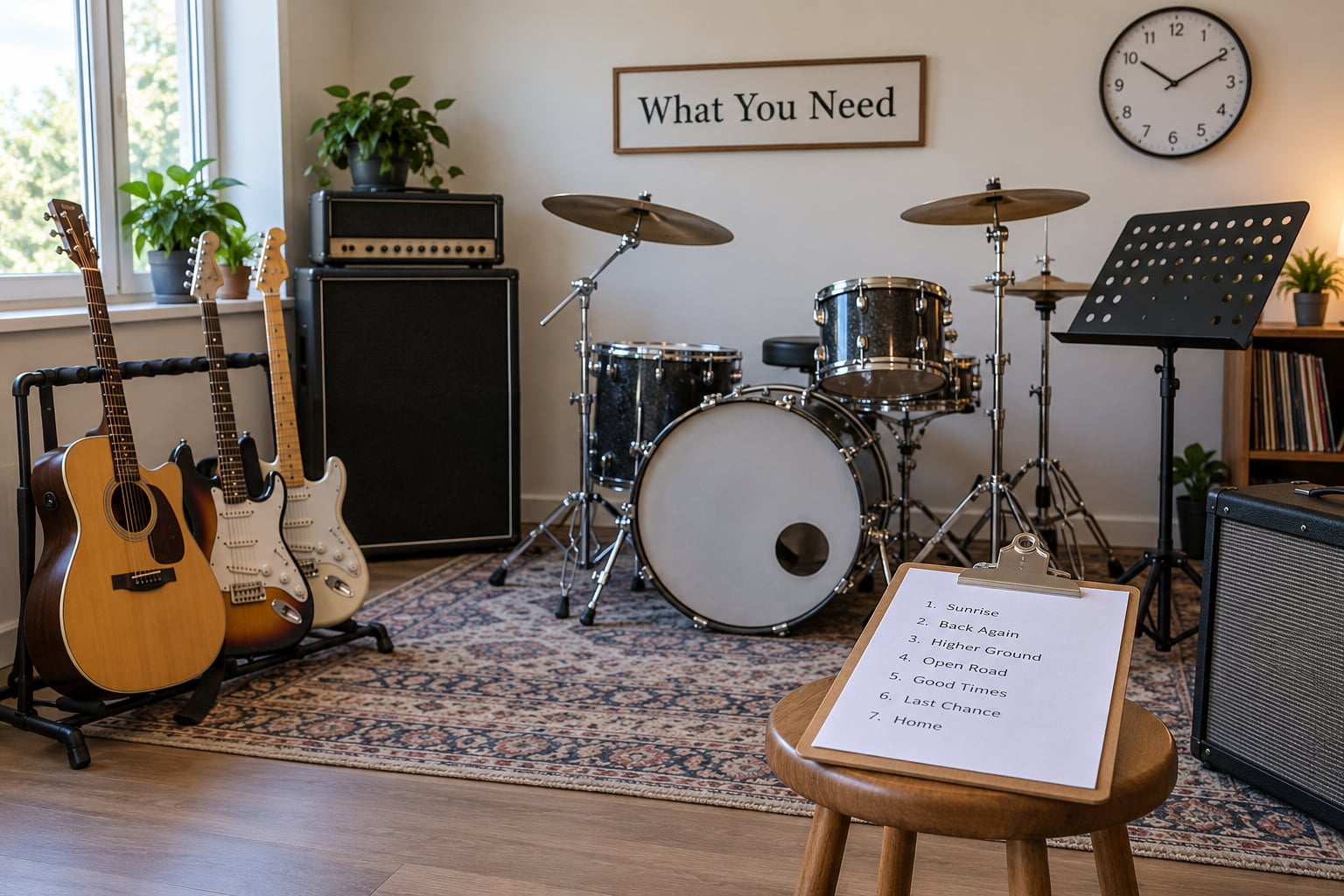
Before you worry about how to run a productive band rehearsal, get the room and the paperwork right. A rehearsal space that is too quiet or too loud will shape your session whether you planned it or not.
A rehearsal space you can actually hear in
You do not need a professional room. You need one where the quietest instrument is audible at the loudest member’s volume. A garage with rugs on the walls, a spare room, a basement, a community hall booked by the hour. Cheap foam panels from a hardware store do more for a jam room than anything marketed as acoustic treatment.
Watch the temperature too. A hot room gets irritable by hour two, and that is when the feedback turns personal.
A ranked list of what you are working on
This is the single most useful thing to bring. Not a setlist, not a folder of tabs. A ranked list: song number one today is this, song number two is this, and here is the specific problem in each one. “Learn Fade to Grey” is not a task. “Get the bridge to land without stopping” is.
The reference recording and any charts
Everyone should hear the target version of a song at least twice before rehearsal. A reference track settles arguments about tempo, feel and structure faster than talking ever will.
Charts are not just for jazz. Working bands chart everything, including songs everyone already knows. A one-page map with the form, the key, the odd time signature, and the changes is enough. Nashville numbers for the horn section, plain form for the rest. If a member cannot read music, tape the form on their stand with the counts written in.
Equipment that survives the session
Fresh strings, new drumheads or at least sticks, cables, spare picks, a tuner, a clip on the mic stand for the reference track. Soundcheck takes longer than you think, and it is usually because somebody brought a cable that only works when bent.
Phones go on silent and out of hands. The average rehearsal session is under three hours, and half of the wasted time in a bad one comes from everyone checking a screen between attempts.
A visible schedule and something to write on
A cheap kitchen timer, a phone timer, or a clock on the wall beats a feeling about how long things have been going. And someone has to hold a pen. A clipboard, a rehearsal book, or a shared note on a phone is fine. The medium does not matter; what matters is that problems leave the room written down.
How to Run a Productive Band Rehearsal Step by Step
Here is the flow I would hand to a band leader on day one. It works for a two-hour block and stretches comfortably to three.
| Block | Length | What happens |
|---|---|---|
| Setup and soundcheck | 15-20 min | Amps, drums, levels, reference track |
| Warm-up | 10 min | Tone, timing, the trouble spot from last week |
| Run-through | 25 min | Play ranked songs once, no stopping |
| Work-through | 45-60 min | Small sections, fixed problems, retest immediately |
| Break | 10 min | Step outside, phones stay away |
| Full run | 20-25 min | Setlist or key songs, straight through |
| Notes and next steps | 10 min | Read the assignments back |
1. Set a Specific Goal Before the Rehearsal
Pick one primary objective before anybody touches an instrument. Not three, not a list of everything the band would like to improve. One. Typical primary goals: get twelve songs to performance-ready, nail a new arrangement from start to finish, or prepare a specific set for a show in three weeks.
Then add two or three secondary targets. The primary objective is what success looks like; the secondary ones are the fallback when the primary one finishes early or turns out to be harder than expected. Having both means you always know what to play next.
Send those goals to the band before the session, ideally with the ranked songs and the reference tracks. Musicians who know what is coming prepare for it. That one habit does more for rehearsal efficiency than any technique in this guide.
How to tell it worked: everyone in the room can state the goal without checking a message. If they cannot, you wrote it down and that is not the same as communicating it.
2. Prioritize Songs and Weak Spots
Rank the material before you start, using four questions: how soon do we perform it, how many times does the band need to hear it to learn it, how technically difficult is it, and how much does it hurt the show if it is still weak.
A brand new song needs more repetitions than a nearly finished one, so it comes first while attention is highest. A song that is nearly ready gets finished and shelved. Anything that is simply unlearned and rarely played can be marked and left for sectionals instead of eating the room.
Keep a visible running order. A whiteboard with numbered songs and a tick next to each one turns the band leader into an air traffic controller rather than a negotiator, and it removes the standing question of what to play next.
How to tell it worked: you finish the night having played every song on the list at least once, and the songs that got the most time were the songs that most needed it.
3. Warm Up With the Right Musical Focus
Ten minutes, no more, and it is not scales for their own sake. Warm up the thing you are about to break: the groove you are rushing, the stretch your lead player needs for the solo, the timing between drummer and bass on that one fill.
Standard moves that pay off: a single tuning and intonation check across the whole band, a metronome pass on the hardest tempo in the set, and a run of the trouble transition from last session at three tempos. If the band plays with horns or sings, do a short section for those too.
Keep it short because it is a foundation, not a workout. Ten focused minutes followed by playing beats twenty minutes of noodling, and the noodling wins.
How to tell it worked: the band arrives at song one already locked to a tempo, instead of drifting into it over the first two attempts.
4. Work from Small Sections to Full Arrangements
This is where most rehearsal time is won or lost. Pick the worst problem, loop the smallest chunk of music that contains it, and repeat with one note of feedback per pass. Three or four deliberate passes beat twenty unfocused ones because each pass has a single variable.
When the section holds, rebuild outward: play the eight bars before it straight into it, then the eight after, then the whole verse into the chorus. Errors hide at the seams, so the seams are where you point your attention.
Fix the worst problem first. It is tempting to save it for last because it is the hardest, but a song with one broken section is not a song you can perform, and the rest of the rehearsal is wasted until that section works.
How to tell it worked: the problem section holds three times in a row, and it also holds when the band plays it as part of the full arrangement rather than in isolation.
5. Run the Song Like a Performance
Accuracy is not readiness. Songs fail live on transitions, starts, endings and dynamics, because those are the parts nobody counts in. A band can play twelve songs perfectly in the room and still lose the set on a stop nobody rehearsed at bar 34.
Run transitions deliberately: play the last bar of one song into the first bar of the next, with the same visual cue you would use on stage. Practice the ending that is not a big stop, whether it is a fade, a click track out, or a hard cut while the crowd talks. Then take the whole tune with dynamics, meaning it should get quieter somewhere and louder somewhere.
Look at each other. Rehearsing without eye contact trains people to drift, because nobody can read a cue they are not looking for. Pick one song for the run-through and stand so you can see the people you cue.
How to tell it worked: you played the song once without stopping, without asking a question, and it sounded like the record rather than like a rehearsal.
6. Give Specific, Actionable Feedback
Feedback ruins more rehearsals than laziness does, usually because people say “that was good but” and then deliver a paragraph. Here is a format that survives contact with a tired band at eleven at night: observation, then one request, then an immediate retest.
- Observation: “After the second chorus, the bass and the guitar come in a beat late.”
- One request: “Bass, count the chorus out loud on the second one.”
- Retest: play those eight bars again, right now.
Observation first means you are describing what happened rather than judging who did it. Address one thing at a time, and take it to the person who owns it. General remarks about the rhythm section produce nothing.
Negative feedback, when it is honest, gets one sentence, then the fix. Praise specifically too, because “good job everyone” teaches nobody what to repeat.
How to tell it worked: the band retested the fix inside a minute and the fix held. If it did not hold, the feedback was not specific enough, so go again.
7. Record Notes and End With a Clear Plan
The last ten minutes decide whether tonight mattered. Somebody takes notes as you go, not at the end from memory. Three columns is enough: what we fixed, what is still broken, who is working on it before next time.
Read the assignments back out loud so nobody leaves without knowing their job. Then agree the single focus for the next session, and send it to the group with the ranked song list before anyone unpacks their gear.
Recording the session helps too, and it costs almost nothing. One phone on a stand or a stand in the corner captures balance and arrangement in ways your ears miss at the time. Play back one song, not the whole tape. The drummer will hear the timing problem in ninety seconds of audio that they could not hear in three hours of playing.
How to tell it worked: every open problem has a name attached to it, and the next session already has a plan before anyone opens a message about it.
Common Mistakes
Most of these are shared experience from working bands and rehearsal spaces rather than theory, and each one has a straightforward fix.
Playing everything at full volume the whole time. Exhaustion sets in, and the last hour of a loud rehearsal sounds like noise. Turn amps down for work-throughs and bring them up for the final run. Loud is a performance setting, not a practice setting.
Debating instead of playing. A discussion about how a part should go can eat twenty minutes and change nothing. Play the two options back to back, pick one, move on. There is rarely a right answer, only a decided one.
Repeating what is broken with no new instruction. If three identical attempts produced the same result, the fourth will too. Change something specific, or accept it and park it. Honest limitation beats a fourth wasted run.
Vague feedback. “You were rushing” tells a player nothing to do differently. “You came in on the downbeat instead of after the rest” tells them exactly what to change.
Ignoring dynamics. Bands play everything at ten. Mark one spot per song to get quieter and one to push, and note them on the chart. This is the change that most improves how a band sounds to other people.
Ending with nothing written down. Everything fixed in the room disappears within a week unless somebody writes it down. Notes take five minutes and are the difference between progress and a vague feeling that things improved.
Turning up unprepared. This one needs a conversation before rehearsal, not during it. Send the parts early, say plainly what the expectation is, and ask about the obstacle. Most unprepared members are not being disrespectful; they have not learned how to get parts up by ear.
Never leaving any free time. Bands that only work on setlists lose the thing that got them playing in the first place. Fifteen minutes of playing something nobody asked for keeps the session from feeling like a shift.
A few smaller tips that cost nothing: agree on a fixed ending time, which removes most lateness and gives everyone a real deadline; assign sectionals for the material the full band does not need to be in the room for; and keep the door closed during the run-through, because the hardest thing to rehearse is music with an audience in it.
Frequently Asked Questions
How long should a productive band rehearsal be?
Two to two and a half hours is the most useful length for most working bands. Long enough to warm up, work through several songs and play a full run at the end. Past about three hours, attention drops and mistakes get repeated instead of fixed. Set a fixed ending time when you book the room; it removes lateness and gives the band a real deadline to plan around.
What should a band rehearse first?
Rehearse the song with the biggest gap between how it sounds and how you want it to sound, usually a new arrangement or something being prepared for an upcoming show. A song that needs many repetitions to learn should come early, while everyone is fresh. Songs that are nearly finished go last, because they need one clean pass rather than more work.
How do you give feedback during a rehearsal without frustrating the band?
Describe what you heard, make one request, then play it again immediately. Observation before judgment, one issue at a time, and the correction belongs to the person who owns that part. Address the playing, not the player, and keep tough remarks to a sentence. Feedback that is followed by an immediate retest feels fair, because the band sees the fix work.
Should a band record itself during rehearsals?
Yes, even on a phone. One device on a stand records balance, timing and arrangement in ways musicians miss while playing, because they are hearing themselves too closely. Play back one song rather than the whole session, and treat what you hear as information, not evidence. Recording works best alongside written notes, not instead of them.
How can a band stay focused when one member is unprepared?
Sort it before the session rather than during it. Send parts and reference tracks days ahead, state what you need learned, and ask what is blocking them, because usually the answer is a method they were never taught. In the room, give that member a job that does not depend on the missing part so they stay useful instead of sitting out.
What is the best way to plan a rehearsal for an upcoming show?
Work backwards from the show. List the set in order, mark every song as solid, needs work, or barely started, and give the barely started ones the most rehearsal time. Rehearse the transitions and the ending as carefully as the songs. Finish with one full run of the set in order, standing up, with no stopping.
Conclusion
The first thing to do is pick tonight’s one goal and write it down, then rank the songs and send both to the band before the session. Protect the ten-minute warm-up, work trouble spots in short loops with one note of feedback each, play the set straight through at the end, and leave with every open problem carrying a name.
That sequence, repeated, is most of what a productive rehearsal actually is. Everything else is detail, and the detail only works if the order underneath it holds.