How to write lyrics for metal music comes down to four moves: pick one central conflict, build a structure that suits the riff, draft plain lines with a strong repeated hook, then count syllables until the words sit on the vocal accents. That last step is where most first attempts fail, and it is fixable in an afternoon.
Most metal writers start with the riff rather than the words. That is a workable position, not a problem, but it changes the order of operations: you are fitting language to a melody that already exists, so you need a method for matching syllables and stress instead of guessing. This guide walks through that method in eight steps, with the harsh-versus-clean vocal issue handled where it actually bites, in the writing of the line itself.
You do not need formal training to use any of it. You need a notebook, a rough hour, and a willingness to throw away your favourite line if it will not sing.
Table of Contents
- What You Need
- Step-by-Step: How to Write Lyrics for Metal Music
- Step 1: Find the Song’s Central Conflict or Idea
- Step 2: Choose a Structure That Matches the Song
- Step 3: Build an Image Bank Before Writing Metal Lyrics
- Step 4: Draft a Rough Verse and Memorable Chorus
- Step 5: Add Metal-Specific Vocal Contrast
- Step 6: Check Stress, Rhythm, and Singability
- Step 7: Sharpen the Language and Remove Cliches
- Step 8: Perform, Record, and Revise the Final Lyric
- Common Mistakes
- Frequently Asked Questions
- How do I start writing metal lyrics when I have no idea what to write about?
- Should metal lyrics rhyme in every section?
- How do I write lyrics that work with harsh vocals?
- What makes a metal chorus memorable?
- How can I use clean and harsh vocals in the same song?
- When should I revise lyrics after writing them?
- Conclusion
What You Need
You need five things, and none of them are expensive. The first is a lyric document or a paper notebook, somewhere you can write messily because half of this process is generating volume.
The second is one reference track. Pick a song in the vein you are chasing and write down what its lyric does, not what it says: how many lines per verse, where the hook lands, whether the chorus changes the vocal style.
The third is a simple rhyme and syllable plan, which can be a scratch column in the same notebook. The fourth is a recording device, because a line you can only read is a line you have not tested. The fifth is time set aside for revision, which is where the craft actually happens.
On that last point, be honest with yourself about how long a first draft takes. A verse and a chorus should be writable in under an hour. The third pass, where you fix stresses and cut weak words, is the one that separates a demo that works from a demo you keep apologising for.
Step-by-Step: How to Write Lyrics for Metal Music
Here is the process in order, from the idea to the recorded pass. Each step has a check you can apply to know it worked before moving on, so you do not build a chorus on a foundation that will not hold.
Step 1: Find the Song’s Central Conflict or Idea
Reduce your subject to one pressure point. Not a topic, a pressure point: survival, betrayal, isolation, faith, revenge, transformation, or the slow loss of a person you depended on.
Write the premise as a single sentence using a verb. “A man walks back into a town that no longer recognises him.” “A saint orders his own execution and obeys.” “Nothing is wrong and that is the problem.” If you cannot write the sentence, you do not have a song yet, and no amount of riff will supply one.
It worked if you could describe the song to a stranger in one breath and they would ask a follow-up question.
Step 2: Choose a Structure That Matches the Song
Structure follows the music, not the other way round. Fast, palm-muted material wants short lines and heavy repetition. Slow, wide material wants longer lines and space between them.
- Verse-chorus suits most modern metalcore and thrash. Clean verses, harsh chorus, a hook you can shout back at the stage.
- Verse-verse-chorus builds pressure with no chorus in the first half, which works when the riff climbs or the tempo shifts.
- Call-and-response fits breakdowns and gang sections. You sing a line, the room answers it, the structure does the work so you barely need words.
- Narrative suits concept material and progressive structures, where the lyric has to carry an arc across eight minutes.
- Hybrid is the honest default. Most songs you will write need verse-chorus with a breakdown that interrupts it.
Decide before you draft. It worked if you can sketch the running order on the back of a setlist without hesitating.
Step 3: Build an Image Bank Before Writing Metal Lyrics
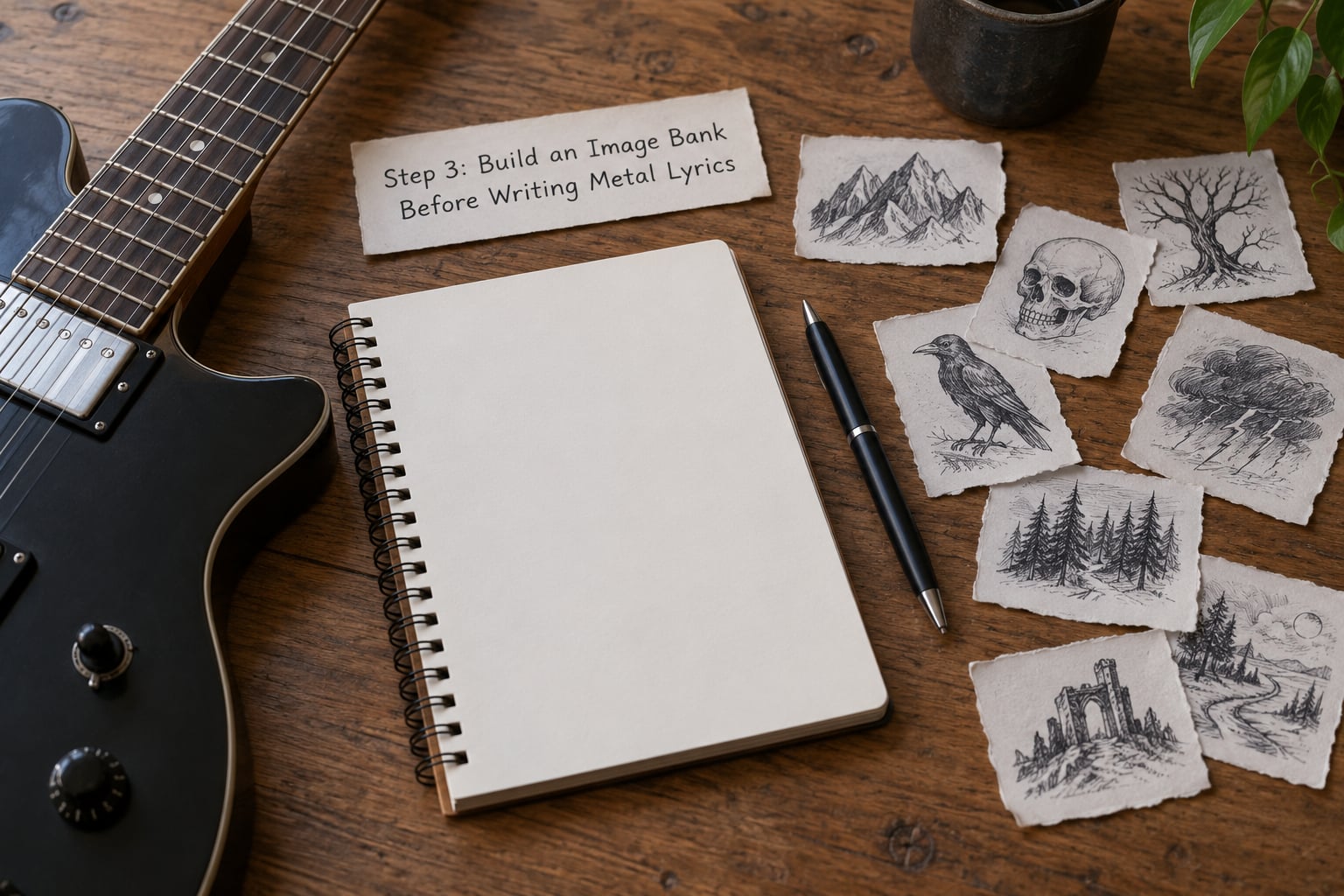
Beginners rhyme first, and that is why their lyrics sound generic. Rhyming first pulls you toward rhyme pairs that happen to exist, and rhyme pairs that happen to exist were already used by someone.
Instead, collect images that belong to your premise. Write nouns, places, actions, textures, temperatures. A premise about a failing town might produce: a bus shelter, unpaid bills, a dog that still waits, fluorescent light, a lawn that stopped being cut, a neighbour who stopped saying hello. Thirty of those, and the chorus is nearly written before you have touched a rhyme.
It worked if any two of your images can be combined into a line that says something. Good metal lyrics lean on consonants partly because those hard edges project well over a distorted mix, so alliteration is a practical tool, not decoration.
Step 4: Draft a Rough Verse and Memorable Chorus
Write the first draft as plain speech. No rhyme, no polish, no self-censorship. The fastest way to kill a line is to stop mid-line to check whether it sounds clever.
For the chorus, use repetition deliberately. Pick your strongest phrase and let it recur with small variations each time, so the chorus accumulates meaning instead of resetting. Three or four lines is usually right; a metal chorus is short because it has to be recalled on the first attempt in a loud room.
Make the chorus mean more than the verse. The verse can describe a situation, the chorus can state what the narrator decides about it. That contrast is what makes a song feel like it goes somewhere.
It worked if you can shout the chorus from memory after hearing it once.
Step 5: Add Metal-Specific Vocal Contrast
This is where metal lyric writing diverges from generic advice. The same words need to work in two very different delivery systems, and they are not interchangeable.
Clean vocals demand meaning, phrasing and vowels. Harsh vocals, whether growl, shout or scream, demand consonants, short syllables and stress on the front of the word. A line full of soft vowel sounds that works beautifully clean will turn to mush under a growl, because the vocal character eats exactly the frequencies vowels rely on.
So decide what each section is for. Clean verse carries the story. Harsh chorus carries the emotion and the hook. Spoken passages over an instrumental build tension and let the listener hear consonants clearly. Gang responses give the crowd something to shout and let you write a fourth of the words.
Two other devices are worth trying. Put a second viewpoint in the bridge, so the song argues with itself, and vary the syllable density so the harsh section is not seventeen syllables of the same shape. And if you are writing metalcore specifically, test whether your chorus still says something with the vocal stripped away, because that genre’s harsh delivery is the most stylised in the scene.
It worked if a listener can tell which section is which with their eyes shut.
Step 6: Check Stress, Rhythm, and Singability
Here is the mechanical part that most guides skip. Read the line aloud and count the syllables, then read it again and mark the stressed ones. Those stressed syllables must land where the vocal melody accents fall, and where the riff accents fall underneath.
Take one verse line and lay it out. The table shows the same idea counted two ways.
| Line | Syllables | Strongest stress | Result |
|---|---|---|---|
| The town still keeps my name on file | 8 | town, name, file | Clean: sings fine |
| The town still has my name on file | 8 | town, name, file | Clean: same count, plainer |
| They kept my name, they kept my smile | 7 | kept, kept, smile | Growl: drops a syllable, stresses double |
When a line will not fit, you have four moves: cut a syllable, swap a long word for a short one, shift the phrase so the stress lands on a different beat, or change the vocal melody. Resist changing the riff, because the riff already works and you will lose more than you gain.
Then sing it out loud over the riff, badly, at speed, while walking. Reading silently hides stress problems. Your voice finds them immediately, usually in the same place every time, which means you have found the line to fix.
Step 7: Sharpen the Language and Remove Cliches
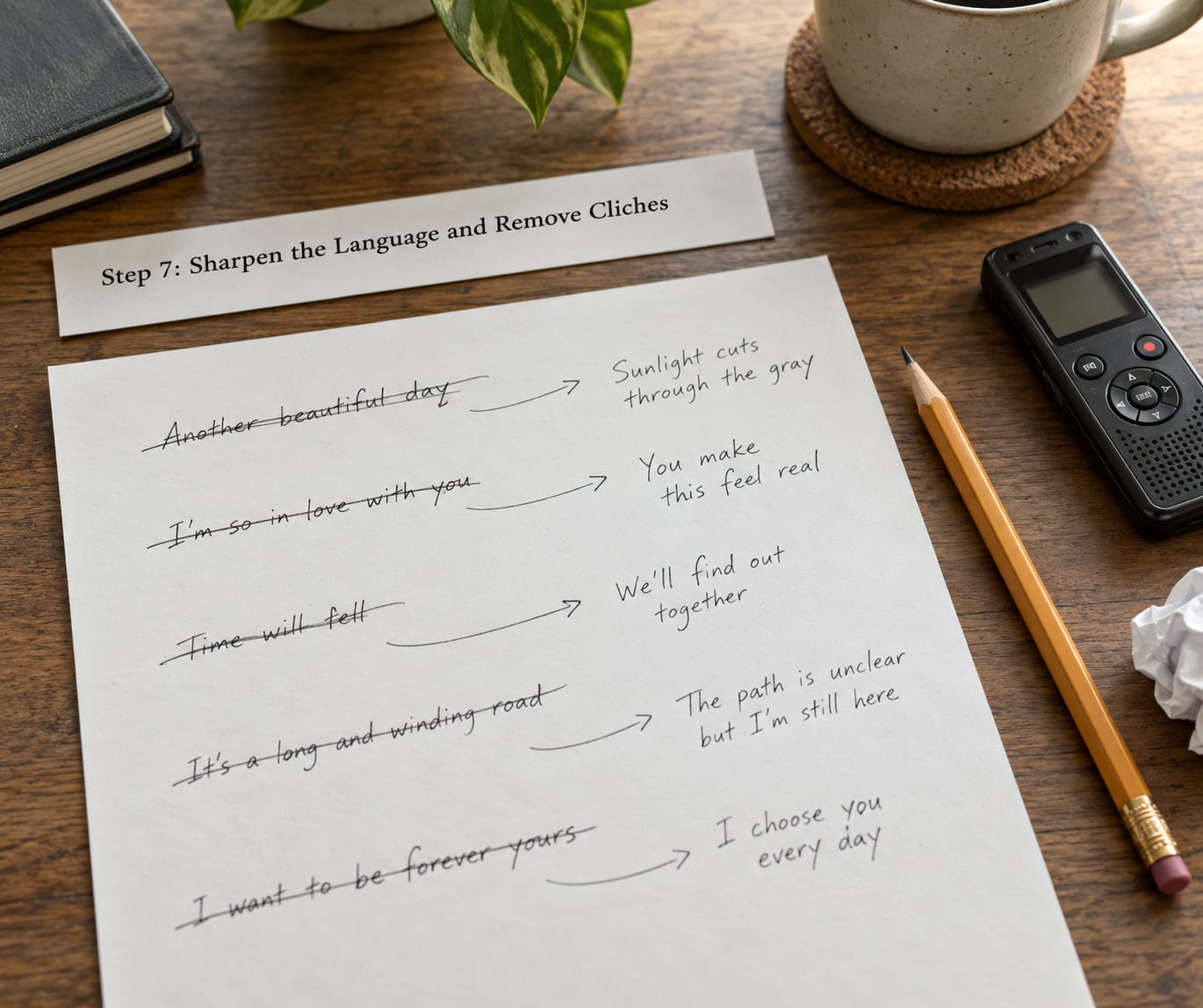
Read the draft and cross out anything you could put in any metal song ever. Fire, blood, falling angels, cold steel, darkness, chains. These are not banned words, they are free words, and free words carry no weight. Every one of them has been used by a hundred bands and none of them means anything on its own.
Replace them with the specific thing from your image bank. “The fire in my soul” becomes “the lawn that stopped being cut.” You lose the grand gesture and gain a listener who has actually stood on that lawn.
Vary your line lengths. Three long lines and one clipped line is a better pattern than four lines of identical shape, and the clipped line is where the payoff goes. Then check the meaning: if a line is clever and says nothing, cut it. Complexity is not a substitute for content, and this is the single most common reason a metal lyric reads as parody rather than as craft.
Keep one or two familiar expressions if they genuinely serve the song. Metal convention is not a disease. What worked is specificity plus a point of view, and a chorused line anyone could shout is doing its job.
Step 8: Perform, Record, and Revise the Final Lyric
Lyrics change when other people sing them. Rehearse the song with the band, all of it, at tempo, standing up. You will discover that line 14 is unsingable by anyone who did not write it, and that the second verse runs four syllables long every time.
Record a full pass on a phone before you commit to a real session. Listen back and ignore the mix entirely, because a bad demo mix makes good lyrics sound bad. Judge the lyric on clarity, energy and whether the chorus arrives with more weight than the verse.
Make your final cuts on those three things. Leave the rest alone. Lyrics that survive a loud room, a tired crowd and a singer who is not the person who wrote them are finished.
Common Mistakes
Too many syllables for a harsh vocal. Fix: cut the line to its load-bearing words and add an instrument underneath instead. A growled seventeen-syllable line is a stumble, not a flex.
Forcing every line into the same rhyme scheme. Fix: let the rhyme be optional. Internal rhyme, consonance and a good slant rhyme carry a metal lyric, and an obvious end rhyme is worse than none at all.
Borrowed imagery. Fix: use the corny self-check below. If a line could belong to a band you dislike, it is not finished.
Confusing difficulty with depth. Fix: say it out loud in ordinary words. If the meaning only appears when someone explains it, rewrite it.
Ignoring the riff’s natural accents. Fix: tap the riff, mark where you naturally stress it, then place your line’s stressed syllables there. The riff is the skeleton, not the obstacle.
Writing the whole song in one vocal style. Fix: assign a job to each section, as in Step 5, and change something between them.
Two useful self-checks before you call it done. Ask whether a reader who cannot hear the music would still get the idea from your words alone, and ask whether your three loudest lines are your three most specific ones. If the answer to the second is no, the song is hiding behind its own production.
Frequently Asked Questions
How do I start writing metal lyrics when I have no idea what to write about?
Start from a specific event rather than a mood. Write down one thing that happened to you or someone you know this week, and describe it in three concrete sentences: what was seen, what was done, what it cost. Metal themes like war, faith and despair are not the subject, they are the setting, and they work far better when a real scene sits underneath them.
Should metal lyrics rhyme in every section?
No, and forcing rhyme is the most common reason a metal lyric sounds weak. A clean chorus can carry a clear rhyme, since listeners expect one there. Verses, bridges and breakdowns are usually better with internal rhyme, consonance or repeated consonants that sit well under distortion. A forced rhyme that bends the line out of shape is worse than no rhyme at all.
How do I write lyrics that work with harsh vocals?
Write short, front-loaded syllables with hard consonants, and put your stress on the first beat of each word. Vowels disappear under a growl, so your meaning has to live in consonants, stress and repetition. Read the line aloud in a raised voice before you accept it. If you cannot get the point across while growling it, the line is too long or too soft.
What makes a metal chorus memorable?
Three things: a short phrase you can recall after one hearing, a repeated line that gains meaning each time it returns, and a jump in energy from the verse that arrives through dynamics, not just volume. Most metal choruses run three or four lines. Keep the words simple enough that a room full of people can shout them back at you, and make the rhyme land only if it does not cost you meaning.
How can I use clean and harsh vocals in the same song?
Give each one a job. Clean vocals carry the story and the specifics, because they need vowels to make sense. Harsh vocals carry the emotion and the hook, because they project consonants and raw energy over a loud mix. A spoken passage over an instrumental build works as a bridge between them, and a gang response on the final chorus lets the crowd cover a fraction of the words.
When should I revise lyrics after writing them?
Three times, and each one catches a different problem. Revise straight after the first draft to cut the lines that say nothing. Revise once the vocal melody exists, to fix syllable counts and stress against the riff. Revise again after rehearsing with other people, to catch the lines that only you can sing. Then record a full pass and stop.
Conclusion
Writing metal lyrics well is mostly sequencing: one central conflict, a structure chosen to match the riff, a chorus that says the most in the fewest words, a vocal plan that gives each section a job, and a syllable check that makes the words land on the accents instead of fighting them. Every step is mechanical enough to practise, which means the gap between a first draft and a usable song is time, not talent.
So start smaller than feels productive. Choose one conflict, write a single plainspoken verse, and sing it out loud over your opening riff. If the stresses land, you have a song. If they do not, you have found the exact line to fix, and that is the most useful thing a first attempt can give you.