Concert lighting design is the planning, programming and operation of the lights in a live rig so the look, colour and movement support the music rather than just making the stage visible. Knowing how concert lighting design works means following the chain: a designer picks fixtures, writes a plot, builds a stack of cues and plays it in time with the band.
The idea sounds tidier than it is. Most shows are a compromise between what the music wants, what the venue allows, and what fits in the load-in window, and the good designers are the ones who hide that compromise completely.
Below is how the whole thing actually gets built, from the first conversation with a band to the last cue of the encore, plus the vocabulary you need to follow along.
Table of Contents
- What Is Concert Lighting Design?
- How Concert Lighting Design Works From Concept to Show
- What Does a Lighting Designer Do?
- Which Lights and Equipment Are Used at Concerts?
- The fixture families and what each one is for
- What a lighting rig looks like at different show scales
- How Lighting Designers Create Color, Contrast, and Focus
- How Is a Concert Lighting Plot Created?
- How Does Lighting Programming Control the Show?
- Why Does Haze Matter for Concert Lighting?
- How Do Lighting Designers Rehearse and Adapt During a Show?
- Frequently Asked Questions
- What are the three main types of stage lighting?
- What is the 3 lighting rule?
- What are some creative ideas for concert lighting design?
- What skills are needed for a lighting designer?
- How do lighting designers sync lights to music?
- How long does it take to program a concert lighting show?
- What To Take Away From This
What Is Concert Lighting Design?
Concert lighting design is the craft of deciding what the audience sees, when they see it, and what it makes them feel. It covers four jobs at once: making performers visible, directing attention to whoever is playing, controlling mood, and building spectacle that survives being filmed from the pit.
Visibility is the least interesting part. A front wash exists so faces read and so nobody trips over a cable, but a stage lit like a meeting room is technically correct and emotionally dead.
What separates design from operation is that someone made decisions in advance and wrote them down. Turning a fixture on is an operation. Deciding that the bridge of a song should be lit warm and low while the drums are in silhouette, then building a cue that does it in two seconds, is design.
It is also not the same as running a band’s usual show. Plenty of touring acts carry a look they built years ago and play it every night, which is a legitimate creative choice. The designer’s job there is refinement: adapting cues to a new room, a different stage width, a different lighting operator.
How Concert Lighting Design Works From Concept to Show
The workflow runs from a creative brief to a saved show file in roughly nine steps. Each step produces something the next one depends on, and skipping any of them usually shows up as a problem during sound check.
- Read the music and the brief. The designer gets the set list, reference shows and any notes from the band and the production manager. The useful brief information is tempo, dynamics and intent: a slow acoustic number and a fast riff section want opposite lighting even in the same show.
- Survey the venue. Room dimensions, ceiling and truss height, available power, cable paths, existing fixtures, haze rules and the sightline from the worst seat in the house. A design drawn before the survey usually gets redrawn.
- Choose fixtures. Working out what each position needs to do, then matching that to whatever the rig, the house inventory or the rental company can supply.
- Draw the plot. Every fixture gets a position number, a hang point, a fixture type and a DMX address. The plot is what the riggers, the electrics crew and the designer all work from.
- Focus and align. Lamps are aimed one at a time, usually before sound check while the stage is still clear. This is slow, unglamorous work and it is where the difference between a clean stage picture and a messy one is decided.
- Build the look book. Colours and states are designed in advance, per song, so the designer is choosing looks rather than inventing them live with an audience waiting.
- Program the cue stack. Each look becomes a numbered cue with recorded intensities, colours, gobo, pan and tilt positions and fade times.
- Pre-visualise. Modern 3D software renders the plot with the fixture models in place, which surfaces problems like blocked sightlines or beams hitting the back wall before anyone is standing in the room.
- Rehearse and save the show file. Cues get walked against the set list with the band, timings get adjusted live, and the finished file gets backed up in more than one place before load-out.
Steps four through seven are where how concert lighting design works becomes a mechanical process. It is also where the craft sits, because every one of those steps is a place where a choice can be lazy or deliberate.
What Does a Lighting Designer Do?
A lighting designer turns an idea about how a set should feel into a working set of cues, then owns the result through load-in, rehearsal and the show itself. The job is roughly half art direction and half technical coordination, and the technical half grows every year.
The responsibilities in practice:
- Translate intent. Converting a vague brief, or a look the band half-remembers from another tour, into specific looks for specific songs.
- Collaborate. Working with the production manager, the monitor engineer, the stage manager and the band’s creative director, who often have vetoes the designer works around.
- Protect people. Keeping front-light levels high enough for performers to see their gear, keeping beams out of the audience’s eyes, and coordinating strobe warnings with the venue.
- Adapt live. A cue fired at the wrong moment, a changed setlist, a late start or a dead fixture all need a fix in seconds, with no one in the audience noticing.
- Deliver the paperwork. Plot, cue list, patch sheet, fixture schedule and power calculations, submitted to the venue and crew a set number of weeks ahead.
Skills that get named in job ads and actually matter: colour sense, a working grasp of DMX and fixture addressing, comfort with 3D pre-visualisation, the ability to read a set list musically, and the temperament to sit through three days of load-in without taking it personally.
Which Lights and Equipment Are Used at Concerts?
The fixture families and what each one is for
Concert rigs mix a few fixture families, each with one job. Most designs use three or four types doing different things rather than one type doing everything.
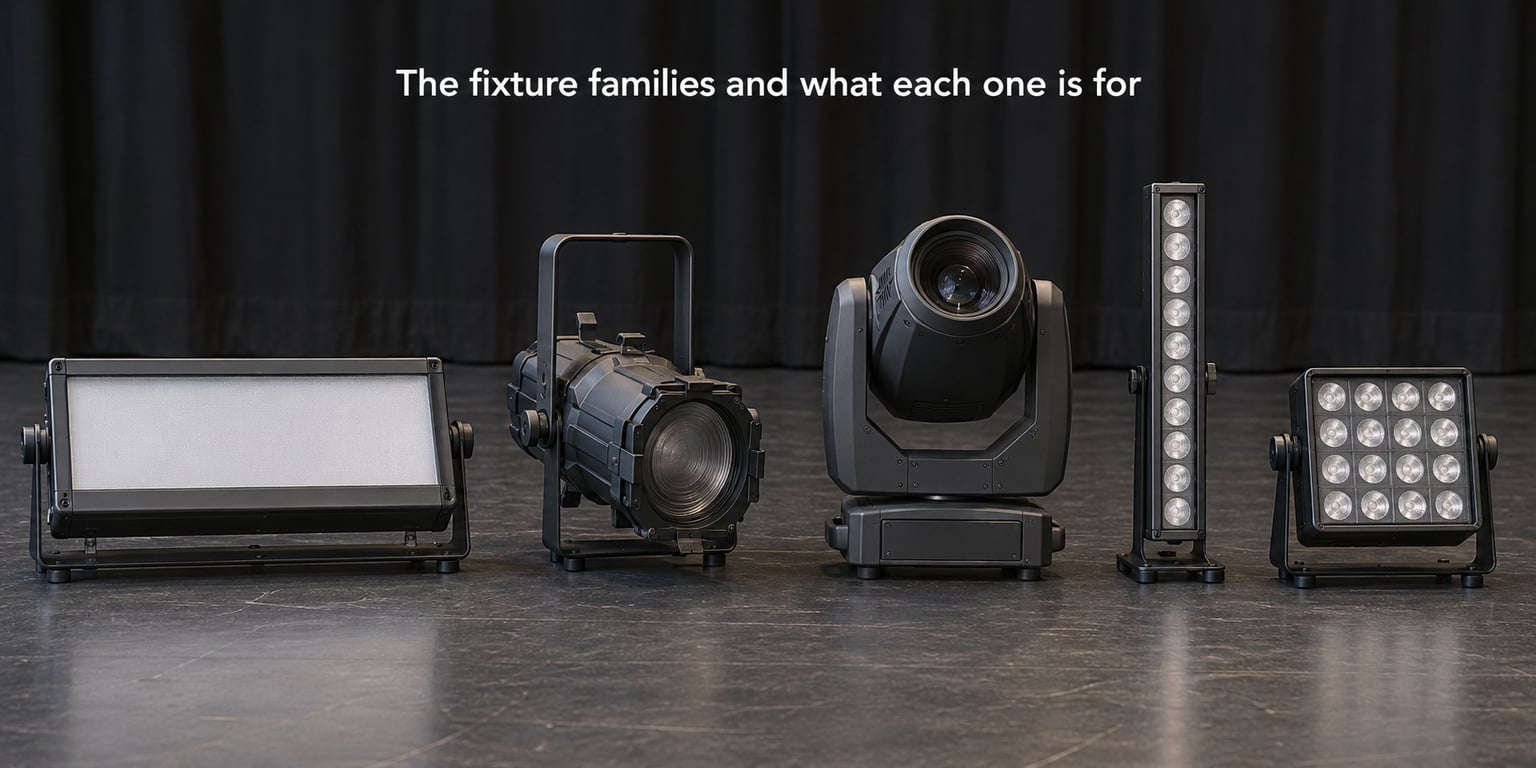
| Fixture family | What it does | Common mistake |
|---|---|---|
| Wash | Broad, even coverage that fills a position with colour and makes performers visible | Running washes full up all show, which flattens everything |
| Profile or spot | A tight, shaped beam; profiles throw patterns and gobos, spots stay sharp | Leaking spill so the beam is not as tight as the design assumed |
| Moving head | Pan and tilt movement plus zoom, so one fixture covers many looks | Pointing every fixture at the same place, which wastes the movement |
| LED bar | A vertical or horizontal line of pixels; pixel mapping builds shapes and chase effects | Pixel effects that fight the music instead of landing on it |
| Strobe | Short high-frequency flashes for accents on hits or a whole section | Running continuously with no warning posted |
| Audience light or blinder | Short-throw fixtures pointed into the crowd for a lift | Striking the first few rows without warning |
| Followspot | A hand-operated operator tracking one performer, usually a singer or a guitarist | Late picks and wide framing, which reads as a stumble |
Most modern fixtures are LED, which changed two things. Power draw per fixture dropped, so rigs that once needed a large distribution feed run on far less, and tungsten’s colour shift went away, so a mixed rig matches far better than it used to.
The other part of the rig is not a lamp at all. Control comes from a lighting console at front of house, signal runs out over DMX512 cable or wireless DMX, and haze comes from a machine the operator works alongside the desk.
What a lighting rig looks like at different show scales
A bar and a stadium do not run the same rig, and the difference comes down to throw distance, available power and crew size. Knowing which scale a show falls into explains most of what you see on stage.
| Show scale | What the rig tends to look like | What it can achieve |
|---|---|---|
| Bar or back room | A handful of PAR cans, maybe two small moving heads, a board behind the bar | Colour changes and one basic beat cue; beams read only if the room already has haze |
| Small club | Front wash positions, some backlight, a few movers, a programmed console | Distinct looks per song, performers actually focused, workable colour contrast |
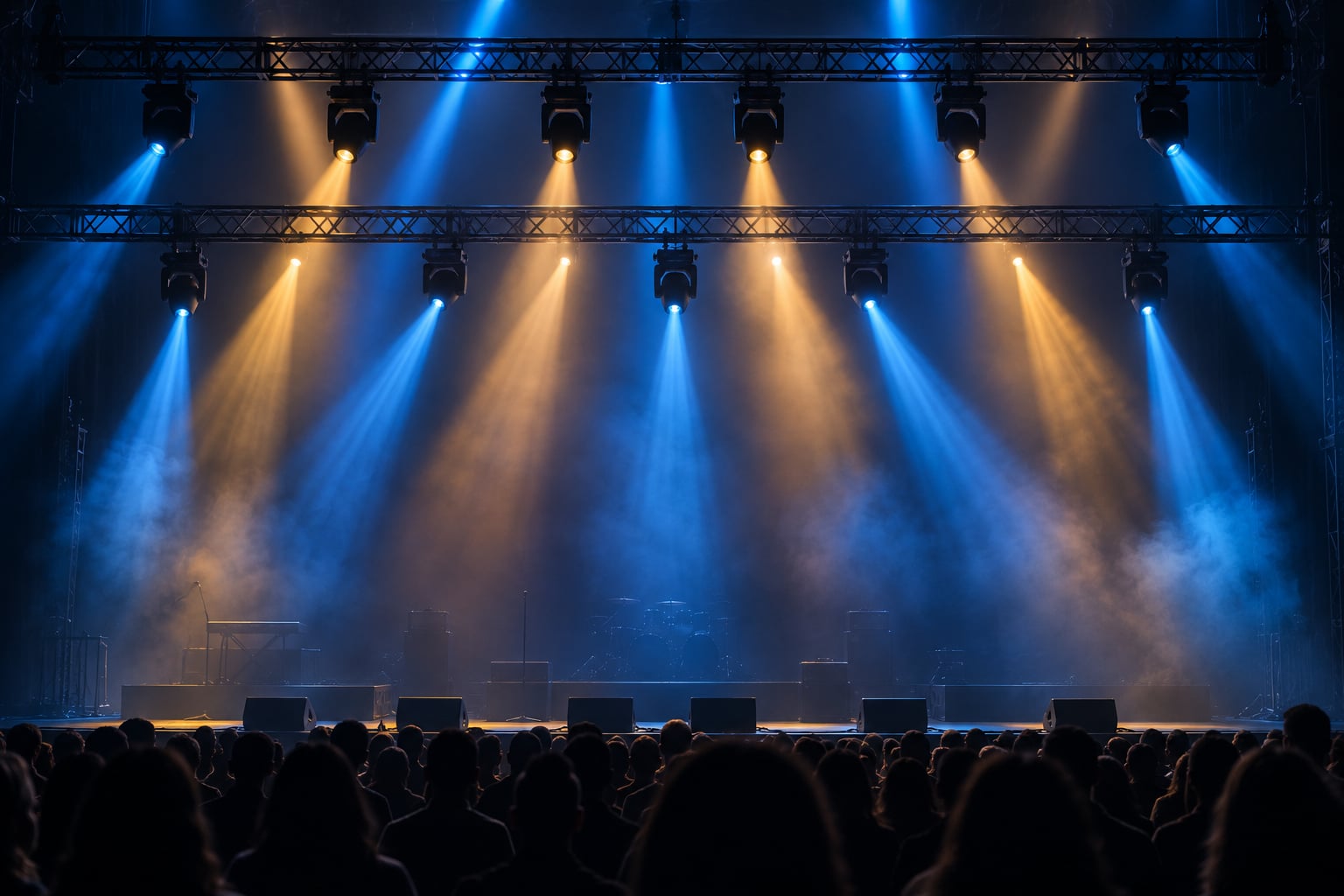
| Mid-size room | Full truss rig with profiles, wash, movers, strobe and audience lights | Layered states, gobo texture, timed builds, blinds that lift the pit |
| Arena or festival stage | Large moving-light counts, video and projection integration, redundant control | Big physical effects, long throw precision, spectacle scaled to the room |
The jump from club to arena is not simply more fixtures. Long throw needs narrower beams for the same coverage, far heavier rigging and power infrastructure, and much longer alignment sessions, which is why big shows spend days of load-in on a show that lasts ninety minutes.
How Lighting Designers Create Color, Contrast, and Focus
Designers build a stage picture out of contrast between positions, not by making every position beautiful. Warm against cool, bright against dim, hard edge against soft, moving against static. Where two states agree, the picture reads flat and the audience stops looking at it.
Colour temperature is the first decision. Warm amber around 3200K reads intimate and older; cool white around 5600K and above reads modern and clinical. Most designs sit somewhere in the middle with one colour pushed away from neutral to create the contrast that carries a look.
RGBW mixing is how modern fixtures get there. Red, green and blue mix to a limited palette; adding a dedicated white channel gives a clean neutral and a much better white point than three colours can fake.
Intensity is the level that decides what the audience actually looks at. Anything brighter than the front position becomes the subject whether the designer intended it or not, which is why silent acoustic sections usually drop most of the rig rather than dimming it slightly.
Beam angle does the rest. A wide beam covers an area softly; a narrow beam cuts a hard shape that reads as an event. Zoom lets one fixture do both, which is why movement fixtures dominate touring rigs.
| Position | What it produces |
|---|---|
| Front wash | Faces and bodies read clearly to the audience; the safe, unglamorous baseline |
| Side light | Edge definition and a sense of depth across the stage width |
| High backlight or backlight | Halos and rim light around performers; the position that does more for how professional a stage looks than anything else on the rig |
| Top light | Downward shape, shoulders and instruments, separating performers from the floor |
| Upstage wash | Separates the back line from a backdrop and gives the stage depth |
| Audience lights | Punches the crowd in the last song; effective, easy to abuse |
Movement is the last layer. A move that arrives on the downbeat reads as confidence, and the same move a beat late reads as a mistake.
Lighting scenes also follow the shape of a set. An intro sits in one low state, verses hold something steadier so the eye rests, a chorus opens up the rig, a breakdown strips it back to almost nothing, a solo gets a feature light on one performer, and the encore is where the blinders and the strobes live.
In heavy music that mapping tightens up. A riff section can sit on a static colour for four bars and then hit a change on the double kick, which lands far harder than a continuous chase. A blast-beat passage can strobe on the hits for a bar and drop to darkness on the next.
How Is a Concert Lighting Plot Created?
A lighting plot is the technical map of the rig: a scaled drawing of the room with every fixture shown at its real position, labelled with position number, fixture type and DMX address. It is the shared document between the designer, the riggers hanging the lamps and the electrics crew running cable and power.
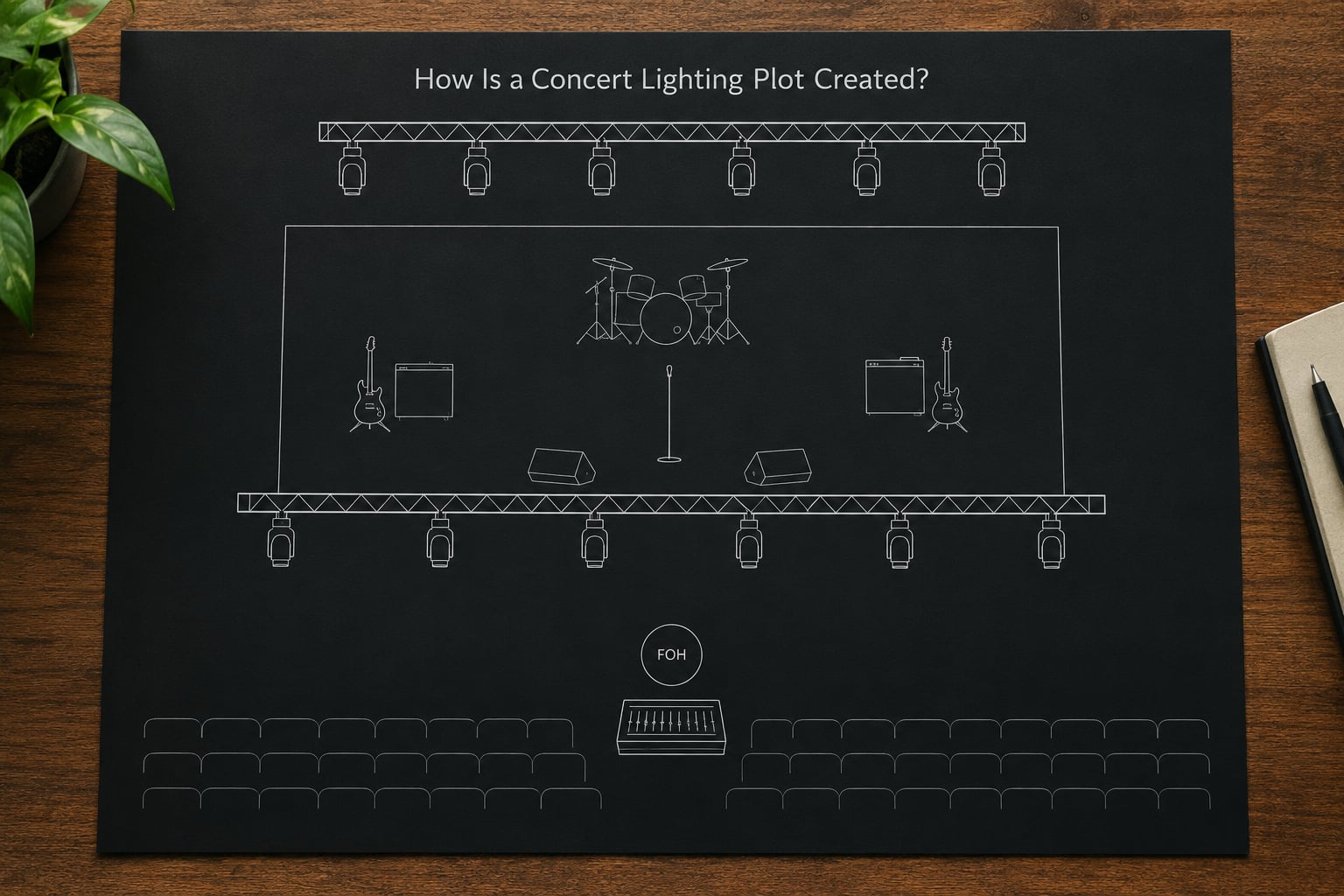
A usable plot carries a fair amount of information beyond the lamp positions: room and stage dimensions, truss positions named upstage, midstage and downstage, fixture weights and power draw for rigging, the load on each electrical circuit, DMX universe and address per fixture, and emergency exit and fire system locations that must stay clear.
The dimensions matter because most fixture decisions depend on throw distance. Beam coverage, fixture spacing on a truss and the right lens or zoom range all come from knowing how far the light travels and how wide the area is that needs covering.
Power data matters because circuits and distribution are limited, and a rig that exceeds them cannot be hung as drawn no matter how good the design is. Rigging data matters for a simpler reason: a wrong weight calculation is a serious problem for everyone under the truss.
How Does Lighting Programming Control the Show?
A cue is a stored snapshot of the whole rig: every fixture’s intensity, colour, gobo, pan, tilt, zoom and fade time, saved as one numbered entry in a cue stack. The operator recalls cues in sequence, sometimes by hand and sometimes from timecode, and the stage changes state as the music changes.
Small vocabulary first, because most of the confusion in this area is terminology rather than difficulty:
| Term | Plain-English meaning |
|---|---|
| DMX512 | The standard that carries lighting data from the console to fixtures over one cable, 512 channels per run |
| Address | The number a fixture listens on, so it knows which part of the DMX stream belongs to it |
| Dimmer channel | One controllable value, such as intensity on a fixture |
| Patch | The map of which console channel goes to which fixture and parameter |
| Look or state | One visual arrangement of the whole rig |
| Palette | A fixed group of colours reused across looks so a show stays coherent |
| Chase | A sequence of states that steps through fixtures, usually on the beat |
| Timecode | An audio track the console follows, firing cues at set times |
| Plot | The drawing showing where every fixture physically hangs |
| Hazer | The machine that puts a thin, even haze in the air so beams become visible |
Because each fixture has its own address, a show of forty fixtures and hundreds of channels is not one big switch. It is many small ones, and the designer’s real skill is making those channels behave like one picture.
Scenes record a static combination. Palettes hold the colours so a red used in eight cues is the same red every time. Effects generate movement live rather than as recorded steps, which is what keeps a chase in time when the band speeds up.
Timecode locks cues to a recorded track, so a fixed part of the set plays identically in every city. MIDI trigger fires cues from a keyboard or a surface the drummer hits, which is how a build can start exactly on a double kick. Both need a fallback, because neither survives a band that changes what it plays.
Live operation is the part nobody sees. On r/lightingdesign, practitioners describe the working method plainly: read the music, pick a palette per song, and reach for chases only when the material has movement. When a song is still, colour that moves becomes noise.
Why Does Haze Matter for Concert Lighting?
Haze is the thin fog that makes a beam visible in the air. Without it, light from a fixture travels invisibly until it hits something, so the audience sees bright patches on a backdrop instead of shafts of light moving through the room.
Haze also gives depth. Light scatters at different densities, so beams at different distances read as nearer or further, and the stage gains a dimension it does not physically have.
Most venues restrict it. Haze is an aerosol, so building management and fire systems may cap how much can be used or ban it outright, and some places require a written procedure and a trained operator.
The workarounds are real and designers use them regularly: pattern gobos on the back wall instead of visible beams, cyc lighting or video content for depth, tighter beam angles that read without much atmosphere, and floor-level effects positioned away from sprinklers and air returns. A show can look excellent with no haze at all, though it is working harder for it.
How Do Lighting Designers Rehearse and Adapt During a Show?
Rehearsal is where the design stops being a document and becomes a show. The sequence is predictable: focus and alignment, then sound check, then a cue walkthrough with the band, then fixes, then the doors open.
During focus checks the designer walks the stage position by position and sets each lamp to its intended position. Anything aimed from stage left is better adjusted from stage left than from the console at the back of the room.
Sound check is when timing gets solved. The band plays each song once and the designer fires the cues, marking anything that felt early, late or in the wrong place.
Show calls are the scheduled checks in the running order when the stage manager, the designer and the band confirm what is happening next, whether a cue has moved, and whether anything got cut.
Adaptation is constant and mostly invisible. Setlists change, songs get extended or trimmed, a talk segment runs long, a lamp fails. Designers keep spare cues, a blackout on the desk and a baseline state they can return to in seconds.
Audience comfort gets planned rather than improvised. Strobes get a warning posted at the door and an announcement, blinders get aimed at the back of the pit rather than the first rows, and front light stays high enough that performers can see their sets. Practitioners on sevenstring.org have argued for years that shows have simply got too bright, and the complaint is consistent enough to treat as a design constraint, not a preference.
One honest note for anyone budgeting a first show: production time is tighter than most people expect. Forum operators describe shows with as little as ten hours of technical time, or roughly an hour of programming, which means the cue list has to stay small and the looks have to be designed before load-in rather than built live.
Frequently Asked Questions
What are the three main types of stage lighting?
The three main families are wash, profile or spot, and moving head fixtures. A wash fills a position with broad, even colour. A profile or spot throws a tight, shaped beam, and profiles also project patterns. A moving head adds pan, tilt and zoom so a single fixture covers many positions. Most rigs combine all three because each fails at the others’ jobs.
What is the 3 lighting rule?
The three-point lighting setup is the classic answer: a key light that establishes the subject, a fill light that softens the key’s shadows, and a back light that separates the subject from the background. Concert rigs use the same idea at stage scale. Front wash is the fill, high backlight is the back light, and side or top light stands in for the key.
What are some creative ideas for concert lighting design?
Colour blocking assigns different colours to different stage zones so the picture reads as shapes rather than a wash. Silhouette reveals hold performers dark and light them late. Gobo textures add pattern without another fixture. Blinders on the downbeat of a final chorus give the crowd a lift, and slow fades into a breakdown make a quiet section feel deliberate rather than forgotten.
What skills are needed for a lighting designer?
Colour sense and an instinct for contrast come first. Technical skills include DMX addressing, patching, fixture setup and 3D pre-visualisation software. You also need musical judgement, since cues have to land on tempo and dynamics, and the temperament to handle a failed lamp or a changed setlist without visible panic in front of an audience.
How do lighting designers sync lights to music?
Three methods are common. Live operation means an operator at front of house plays cues by hand, which absorbs tempo changes and improvisation best. Timecode locks cues to a recorded track so a fixed part plays identically every night. MIDI trigger fires cues from a keyboard or drum pad, which is useful for builds that must start on an exact hit.
How long does it take to program a concert lighting show?
It depends entirely on the cue count and the production window. Small-club shows with a handful of looks can be built in an afternoon. A touring rig with dozens of looks per song is typically programmed in stages over several days, with the real crunch coming in the rehearsal hours when the band plays and cues get adjusted.
What To Take Away From This
Concert lighting design works because decisions get made days in advance and written down as a plot and a cue stack, then played back in time with the music. Everything else, the colours and the movement and the haze, is in service of that sequence.
If you want to understand a show better, watch the front row at a quiet song and count how many positions drop out. If you want to start, pick one song, design three looks for it, and build the cues before you ever see the fixtures.