Encores are planned weeks or months ahead. A touring band picks the songs it will hold back, writes them after a separator line on the running order, briefs the lighting and front-of-house engineers on the stage exit, and rehearses the walk-off. On the night, the exit is a cue, not a decision. The only part of the encore that is ever spontaneous is whether there is a second one.
That is the honest answer, and it is the part almost nobody tells you at a gig. There is a real, older version of the encore where an audience shouted bis or ancora until the performers went back on, and a couple of acts still try to sell you that. But at any touring level, from a 500-capacity club to a festival headline slot, the encore is a block of setlist that somebody decided on in advance.
Here is how that decision actually gets made, who makes it, and what you can look at before showtime to work out what the band has saved for last.
Table of Contents
- How Artists Choose an Encore Song
- Who Helps Plan an Encore?
- How Artists Rehearse the Transition
- What Happens During an Encore?
- How Long Should an Encore Be?
- Why Do Some Bands Skip the Encore?
- How Promoters and Venues Prepare for Encores
- How Encores Are Planned: The Decisions Before Show Night
- Frequently Asked Questions
- Do bands always plan an encore?
- How do artists choose which song to perform for an encore?
- Is a one-song encore common?
- Why does a band sometimes leave the stage and come back?
- Can a venue or promoter force a band to skip its encore?
- How long does a typical rock or metal encore last?
- What to Listen for at Your Next Show
How Artists Choose an Encore Song
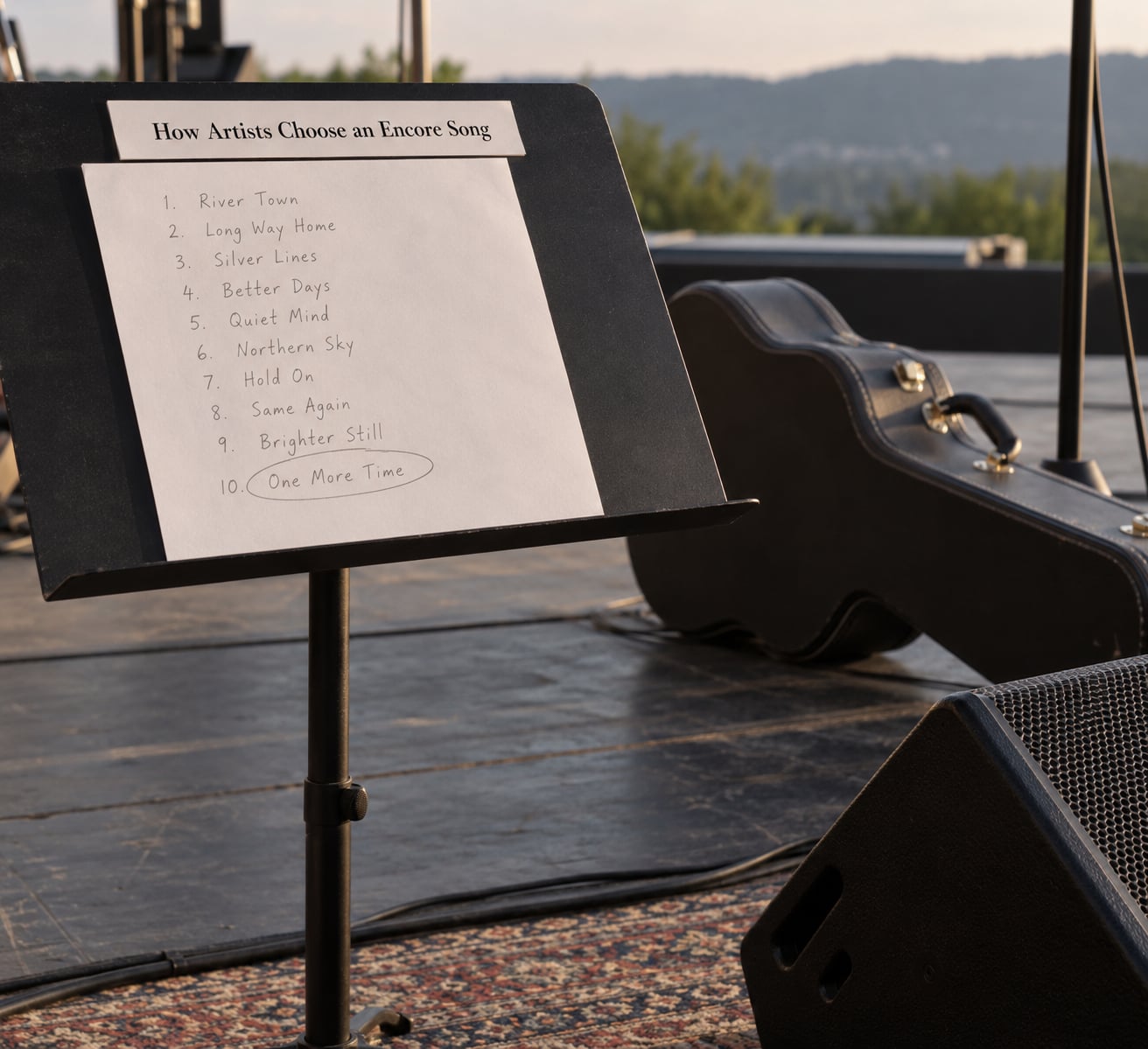
Song choice comes down to three things: what the band wants to end on emotionally, what the crowd will sing back, and what will not break the show’s pacing.
The pattern most touring acts settle on is simple. The main set builds, and the biggest singalong numbers get withheld and put at the end. Fans notice this constantly and rarely connect it to a decision — someone on a fan forum will ask why their favourite track keeps getting pushed into the encore instead of the main set, and the honest answer is that the encore is where a singalong does the most work for the least effort. Everyone already knows the words there. Elsewhere in the set, you are asking a room to learn something.
Not every encore slot goes to a hit, though. Bands that have played a venue forty times will drop something rarely played, because the payoff of playing a deep cut to a room that mostly knows it is different in kind from playing the number one single. Festival headline sets often use an encore to debut something new, since the crowd is already at maximum attention and the tour has room to recover from a song that does not land.
The other recurring encore format is the acoustic reset. One guitar, no full rig, often done partway through the encore block before the band comes back up for the last two or three songs. Guest appearances are the expensive version of the same idea and need far more notice, so they get locked in during pre-production rather than improvised on stage.
Who Helps Plan an Encore?
More people touch an encore than most fans realise, and almost none of them are on stage when it happens.
The bandleader owns the setlist. They decide which songs exist in the show at all and in what order. In most cases the encore block is theirs, and nobody overrules it.
The tour manager owns the clock. They know the curfew, the running order of the whole night, how long the changeover to the next artist is, and how many encores the last show in a residency ran. If a curfew is going to bite, it is the tour manager who says so at the production meeting, usually the morning of the show.
The production manager handles the stage and the crew. If the encore needs extra time — a riser moved, instruments swapped, a guest’s backline wheeled on — that is a paid reset, and it has to be in the budget and the schedule.
The front-of-house engineer and the monitor engineer build for it. An acoustic encore means a different vocal mic and a different monitor mix, usually written into the show file as its own scene. The lighting operator has a matching state, often a blackout with a single follow spot on the stage door.
Behind all of that is the promoter and the venue, who have already agreed a set time and, in many cases, a hard stop. The encore is the easiest part of the show to lose, which is why it is the part that gets cut first when a night is running late.
How Artists Rehearse the Transition
The walk-off gets rehearsed, because a scripted exit that looks improvised but lands wrong is worse than no ritual at all.
In soundcheck the band plays the closing number, then plays the last eight bars again and walks. That is the whole rehearsal for many acts — get the timing, the traffic off the stage, and the point at which the walk begins so it is not visible. Some bands deliberately start the walk during the outro so the crowd sees them leave mid-cymbal rather than standing around at the front of the stage waving.
Then there is the reset. If anything changes between the two halves, the change is rehearsed too: a guitar swapped for an acoustic, mic stands moved, a riser rolled on, monitors repositioned. That reset is the real reason an encore cannot be improvised. Nothing about the state of the stage is decided by the applause in the room.
Counting back in is the part fans rarely notice. The band knows how many bars of silence or how many counts before the first note, and the drummer or the monitor usually holds the tempo. A band doing a genuine spontaneous encore has no such agreement, which is one reason the scripted versions feel tighter.
What Happens During an Encore?
Here is the sequence, show after show, at every size.
- The closing number. The main set ends on a peak. In some shows the exit is written inside the song — the band walks during the outro.
- The stage clears. Often the front line goes off while the drummer keeps time, and the lights drop to a low state or full blackout.
- Dead time. One to three minutes. The crowd is clapping, the crew is checking the stage, the FOH engineer rides levels. Fans are manufacturing the noise because everyone already knows what is coming.
- The return. Usually the same door, often a blackout that covers the walk-on. Some shows stage it as a big production moment instead: riser, pyro, a different lighting state, the band arriving to a pre-programmed sequence.
- The speech. One, sometimes. It can be the last word to the room, a thank you to the opener, or a plug for something. Bands that already have a long speech scheduled in the show file know it is short.
- The encore block. Two to three songs, in the order on the running order.
- The second encore, sometimes. Only when the room is genuinely loud and the curfew allows. This is the closest thing to a spontaneous encore left in the format.
The dead time is the part fans complain about most, and it is the part with the least room for improvisation. The lights, the audio, and the stage access are all committed in advance.
How Long Should an Encore Be?
Two to three songs is the standard answer, and one song is common enough that you should not assume anything.
Encore length tracks the size of the room and how much time is left in the running order, not the artist’s generosity.
| Context | Typical encore | Why |
|---|---|---|
| Support or opening slot | None | Short changeover; the set is already cut to fit |
| Club, roughly 500 to 1,000 capacity | Zero to one song | Small rooms often play straight through, or do the exit with no return |
| Theatre, 1,500 to 3,000 | One or two | Seated rooms, limited crew, quick resets |
| Arena or stadium headline | Two or three | Full crew on site, reset time built into the schedule |
| Festival headline slot | Three to five | A short changeover and a hard stage time make an encore nearly free |
| Metal festival set | Three to five, scripted | Long sets with a predictable block fans read the encore from |
| Second encore | One | Rare, and usually because the curfew still allows |
A single-song encore is not a failed encore. Plenty of bands do the exit, come back, play one number and go. Fans who come to a show expecting three and get one usually read it as a comment on the band rather than the schedule, which is the wrong conclusion, but a very human one.
Why Do Some Bands Skip the Encore?
Some bands end the show after one song and leave, and that is usually a decision rather than a constraint.
The curatorial version is the most interesting. A handful of acts have publicly dropped the ritual because the fake exit felt hollow — the crowd applauds, everybody knows what happens next, and the whole thing reads as a bit. Lorde and the Arctic Monkeys are the names most often raised in discussions of bands who stopped bothering, alongside acts like Boy & Bear and Husky. What replaced it is usually not nothing: the band plays a couple of songs, takes a bow, and goes, or drops the stage exit and plays the run-out straight through so the show never breaks.
The practical reasons are less interesting but more common. Support slots and short sets skip it. So do nights where the curfew is tight, festival sets running late, and club dates where nobody wants to sit in the dark for a reset. A few bands treat it as a flex: play the encore only if the room earned it by noise and length, which is genuinely reactive and part of the show’s design.
Whatever the reason, the response is often sharp. Fans who bought a ticket for a specific song assume it was withheld, and dropping the block reads as a snub. It is the clearest example of the ritual breaking when somebody stops honouring it.
How Promoters and Venues Prepare for Encores
The venue side of an encore is mostly about time, and the word that decides most of them is curfew.
A promoter sells a set length with the artist, and the venue holds a hard licence stop. When the bill is running long, or the changeover to the next artist is tight, the encore is the first thing that gets trimmed — usually from three songs to one, sometimes to nothing. The band and promoter may agree this in advance as a standing arrangement rather than renegotiating in the room.
Production queues matter just as much. If the headliner has to clear the stage for a curfew, a confetti cue, or a 45-minute change to a headline set on a shared festival stage, the encore window may be less than the reset actually needs. A crew that cannot afford the changeover gets a one-song encore at most, and often a straight ending.
Security and crowd flow shape the exit itself. Festival and arena bowl seating means the audience is standing and mobile during the dead time, so the lights stay low and the music usually stays in; a theatre with seated tiers will often hold the house lights down and stay quiet, which can make a two-minute gap feel like ten. Stage access is the quiet constraint of all: if the return route is blocked by a barrier or a camera riser, the band walks a different way or the encore is scripted differently.
Which is why a festival headline slot almost guarantees a proper multi-song encore. The curfew is the least likely to bite, the crew is fully staffed, and the crowd is still fresh. It is the easiest encore of the year to plan and the easiest to run.
How Encores Are Planned: The Decisions Before Show Night
Pull the sections above into one list and the planning process looks like this.
- Pick the songs. Two or three, with the songs they replace decided at the same time. What is held back changes what the main set has to do.
- Write the running order. The encore block goes after a separator line, and the last song of the main set is chosen for how it hands over to the exit.
- Mark the exit. Where in the closing number the walk starts, which door, and how long the gap is. This goes to the lighting operator and the FOH engineer as a cue.
- Rehearse it. Play the outro and walk. Rehearse the reset if anything changes on stage, and agree the count-in for the return.
- Budget the reset. Extra crew time for anything that moves. A reset that is not paid for is a reset that does not happen well.
- Decide the fallback. What runs if the show is running late: a shortened encore, or none. Agreeing this before the show removes the argument from the stage.
Everything above is settled in pre-production. The only open item carried into the performance is the second encore, which gets a nod on the way off if the room has earned it and the clock allows.
Frequently Asked Questions
Do bands always plan an encore?
Almost always, yes, at any touring level. The encore block is written into the running order during pre-production, the exit cue is briefed to the lighting and front-of-house engineers, and the walk-off is rehearsed at soundcheck. What stays open on the night is whether there is a second encore. The genuine version, where an audience demands one and the band obliges on the spot, is now the exception.
How do artists choose which song to perform for an encore?
The bandleader picks, based on three things: how the show needs to end emotionally, which songs the crowd will sing back hardest, and what the main set looks like without them. Holding the biggest singalongs for the encore means asking the least effort for the most energy. Deep cuts and debuts get encore slots when the room knows the band well enough to enjoy something unfamiliar.
Is a one-song encore common?
It is more common than most fans expect, especially in clubs and theatres where crew time and curfew limit the reset. A one-song encore usually means the band was told to keep it short, or that something on stage is being stripped down. It also happens when a band genuinely has one number left that has to be played. Fans often read a short encore as a statement, but it is usually a schedule.
Why does a band sometimes leave the stage and come back?
Because the exit has to be programmed: the lights, the audio, the stage access and the reset time are all committed before the band walks off. Fans on music forums have a simple test for a scripted encore: if the applause after the exit dies within a minute or two, it was always going to happen. A genuinely earned encore tends to run two or three minutes of noise before anyone comes back on.
Can a venue or promoter force a band to skip its encore?
A venue can, through the curfew. The promoter sells a set length with the artist and the licence imposes a hard stop, and when a night runs long the encore is the easiest thing to trim, usually down to one song. Promoters also shape it earlier by negotiating the length of the changeover and what production is on the stage clock. A band can decline, but it means ending the set without the songs fans came for.
How long does a typical rock or metal encore last?
Two to three songs, which runs somewhere around eight to twelve minutes including the gap after the exit. Festival headline sets and metal festival slots often run three to five, because the curfew is the least likely to bite and the crew is fully staffed. Club and support dates frequently get zero or one. The number of songs is a scheduling decision long before it is a musical one.
What to Listen for at Your Next Show
You can work out most of an encore before the band plays a note, if you read a setlist properly.
On a site like Setlist.fm, the encore appears as a separate block, usually set off from the main set by a blank line or a divider. The separator is the whole tell: the moment a list breaks into two groups, the second group is pre-planned. Setlists are entered by fans, so the marking is inconsistent — some shows get an encore block, some do not — but across a tour by the same band the pattern is usually stable.
What to look for in the run-up: which songs from the previous show sat below the divider, whether the last main-set song has an outro long enough to walk off into, and how many songs sat below the line at the venues closest to yours in size. If a band plays four below the divider at an arena and one below it at clubs, you have your answer before the tour starts.
And in the room, listen to the gap. A show that has been designed with a two-minute reset and a lighting cue tells you so in the first fifteen seconds of darkness — the timing is too clean to be improvised, the applause is too short. That is not a knock on the band. It is a system working exactly as it was built.
Encores are not dying as a ritual, as of 2026. What is fading is the pretence that they are a reward. What remains is a genuinely good piece of show design: a planned final block, a scripted exit, and a short list of songs the band has decided you will leave on your feet for.