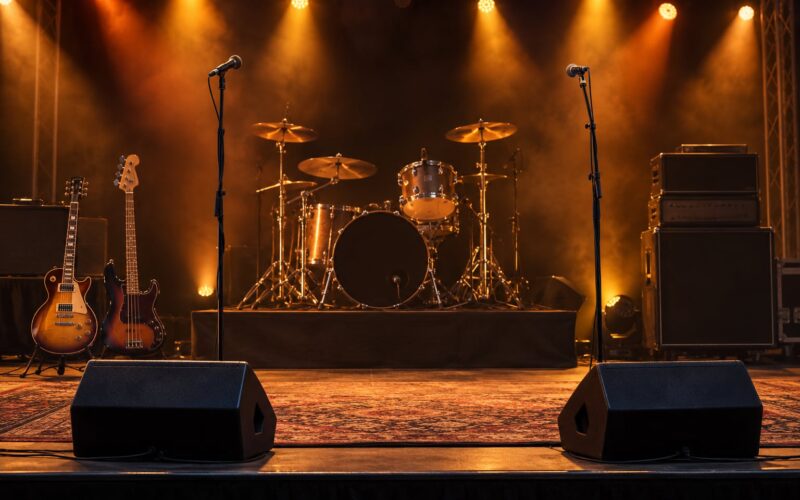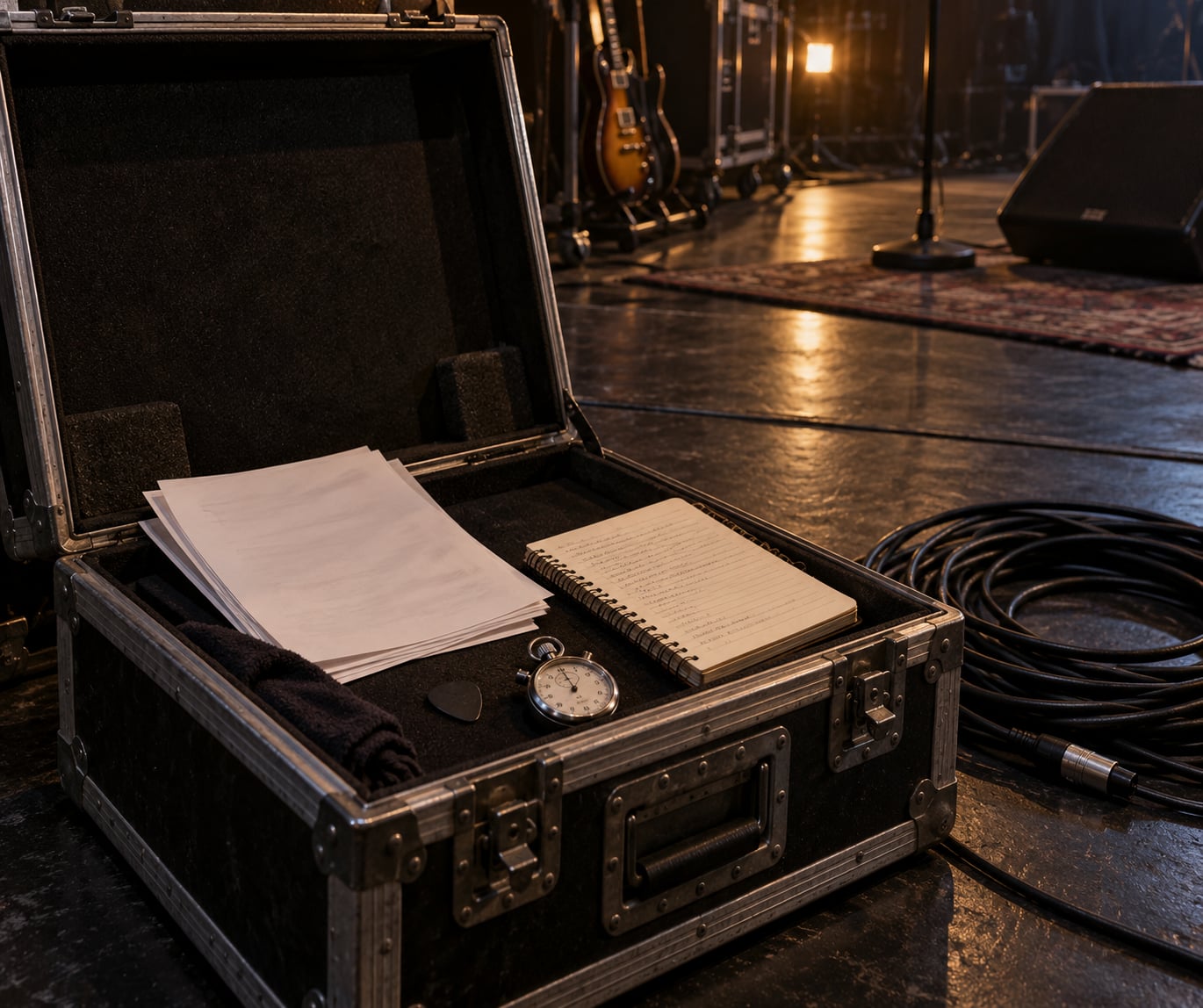
A tour setlist is the ordered running order of songs a band plays at a show, built weeks or months ahead by the artist together with their bandmates and manager, locked against the stage production, and revised as the tour goes on. Understanding how setlists are built for a tour means looking at three things at once: which songs get picked, what order they run in, and what production each one needs locked down before anyone steps on stage.
Most people only ever see the printed sheet taped to the stage floor or glowing on a prompter screen. The version that actually gets argued over in a rehearsal room is a longer document, with cue notes, key signatures, monitor changes and a reserve pile of songs nobody planned to play.
This guide walks through that whole process, from the first draft to the third night of a run, including the numbers that decide whether a 90-minute theater set holds 26 songs or 31.
Table of Contents
- What Does a Tour Setlist Need to Achieve?
- What a tour setlist actually is
- How setlists are built for a tour, step by step
- How Do Bands Choose Songs for a Tour?
- How Do Setlists Balance Energy and Variety?
- How Long Should a Tour Setlist Be?
- How Do Bands Adapt a Setlist for Each Show?
- What Goes Into the Encore and Final Song?
- How Do Musicians Rehearse a Tour Setlist?
- Frequently Asked Questions
- How many songs are in a 1 hour setlist?
- What is the average length of a setlist?
- What is an encore on a setlist?
- How long are festival sets?
- How to check concert setlists?
- Why doesn’t the band change the setlist every concert?
- Where to Start If You Are Building One Right Now
What Does a Tour Setlist Need to Achieve?
A tour setlist has to do more than list songs. It has to shape an emotional arc across a fixed number of minutes, represent the act honestly, serve the crowd in front of it, and give every crew department enough lead time to build their part of the show around it.
What a tour setlist actually is
The confusion starts because several different documents get called a setlist. Bands, managers, crew and fans each use the word for something slightly different, and once you know the difference most of the confusion dissolves.
| Document | What it holds | Who uses it |
|---|---|---|
| Setlist | The public-facing song list, usually on a venue site or poster | Audience, promoter |
| Running order | The real performance order with cue notes, keys, transitions and encore reserves | Band, musical director |
| Stage plot | Instrument, mic stand, monitor wedge and riser placement | Front of house, monitor engineers |
| Show file | Lighting and video programming, one console page or state per song | Lighting director, video department |
| Cue-to-cue | Line-by-line script of transitions, segues and between-song talk | Band and show caller |
When a promoter emails asking for the setlist three weeks out, they mean the first one. When the tour manager asks if the set is locked, they mean the running order and whether production can start programming.
How setlists are built for a tour, step by step
The build runs in seven stages, and it usually loops. A night one change in the middle of a run can send it back to stage one for the next leg.
- Build the pool. Every song the touring lineup can play well, rehearsal-ready, in the keys the touring players sing and play them in. This is longer than any single set, usually by a lot.
- Fit the slot. Trim or extend the pool until the running time matches the contracted set length, with the changeover and curfew in mind.
- Order it for energy. Sequence songs so the show has a shape rather than a mood that drifts.
- Hold back an encore reserve. Keep two to four songs out of the main set that only get played if the room asks.
- Mark the cues. Add tuning notes, key changes, segues, talk segments, video triggers and lighting bump cues.
- Distribute it. Print it, load it to the prompter, and hand each department the version they need.
- Revise it. Change it between shows and between legs based on how the night actually went.
Step two is the one most bands underestimate. A running order that would be great at 75 minutes is a liability if the venue holds a hard 60-minute curfew and the promoter will not budge.
How Do Bands Choose Songs for a Tour?
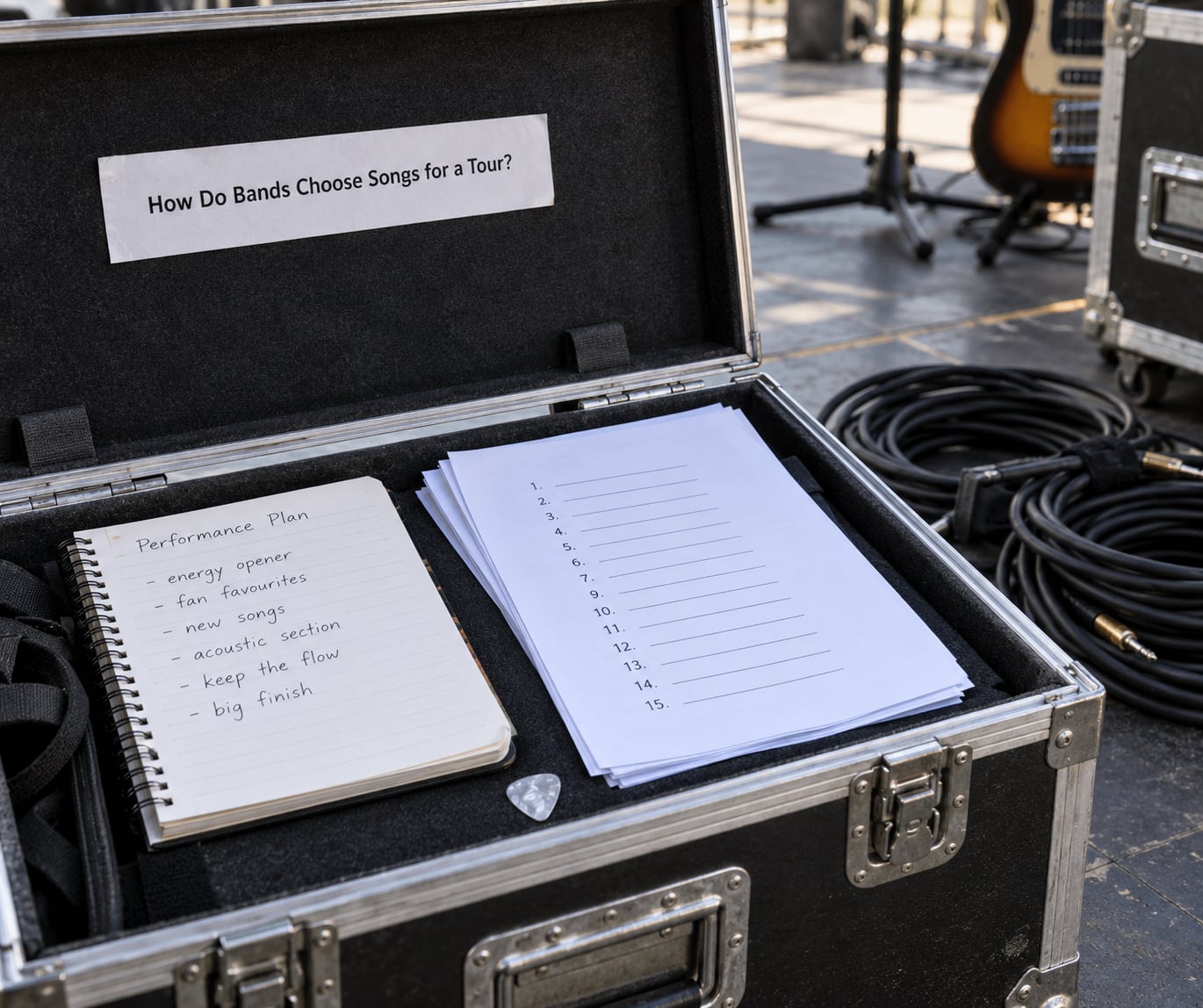
Songs get chosen from signals rather than taste alone. The loudest one is how the room reacted the last time the band played the song live, and touring is long enough that the band has real data on almost everything in the pool.
Selection usually comes down to a handful of filters:
- Live response. Songs that reliably lift a crowd get their slot back every leg. A guitarist on a long-running touring forum described the pattern plainly: start the run in album order, then move things around based on crowd reactions once the data comes in.
- Tour goals. A leg supporting a new record leans on the new material. A leg with no release in it is where deep cuts finally get played.
- What the touring lineup can actually deliver. A song that needs a specific harmony the singers cannot hit, a key change nobody rehearsed, or a part only the original guitarist plays comes out of the running order. Bands get burned by exactly this when a setlist assumes an arrangement the road lineup has not drilled.
- Crowd expectation. Songs with huge streaming numbers get played whether or not the band loves performing them. Fans notice when a big single is missing, and they notice even more when an album is played front to back in order.
- Variety. Two or three fast songs next to each other loses people. Tempo and dynamics count as much as energy.
- Logistics. Anything that triggers a segment change, a riser move or a video sequence costs crew time, and crew time is what makes a show expensive.
Unreleased material gets a careful slot. It goes in early enough that a stranger still has patience, and late enough that the room has already committed. Mid-tour, unreleased songs are the easiest thing to move because nobody has recorded the crowd’s verdict on them yet.
The decision itself is rarely one person’s. The artist usually sets the shortlist, the band weighs in hard on playability, and the manager or tour manager runs it past production and the booking agent to make sure it fits the night.
How Do Setlists Balance Energy and Variety?
A good running order treats a show like a set with a beginning, a middle, an ending and at least one moment that could not have happened anywhere else. Bands that play their album track by track usually lose the room somewhere around track four without noticing.
The opener does more work than most songs. It has to establish tempo, sound and intent inside about ninety seconds, before a crowd that is still settling or still eating. Fast and up is the safe pick; a slow, confident start works when the band wants to signal control. Either way it should be a song the band can play with no hesitation, because nerves show in the first two bars.
Early section is where a band earns permission to be heavy. Keep it dense, keep it short, and put a recognizable song near the front so people who came for one specific track know they got it.
The middle is where sets fall apart. Energy dips around song seven or eight, right after the crowd has used up its attention span once. The fix is a change of texture: a stripped-down acoustic breakdown, a slow build, a cover nobody expects, or a shift into a harder tempo. Something has to interrupt the pattern.
Watchers on music forums tend to converge on the same point about first and last impressions: the opener and the closer are what people remember, and what happens between them depends on how good the production is holding together.
The second-to-last song is the sneaky one. Too energetic and the closer has nowhere to go; too quiet and the room has already started putting coats on. Many bands end on their biggest song and it lands flat because nothing was saved for it.
Between songs, keep it short and uneven. Twenty seconds of talk before a quiet number, five seconds before something fast. Long between-song segments are also a lighting problem: the show file has to hold the look while nobody is playing, which is why stagehands and programmers care about them more than the band does.
How Long Should a Tour Setlist Be?
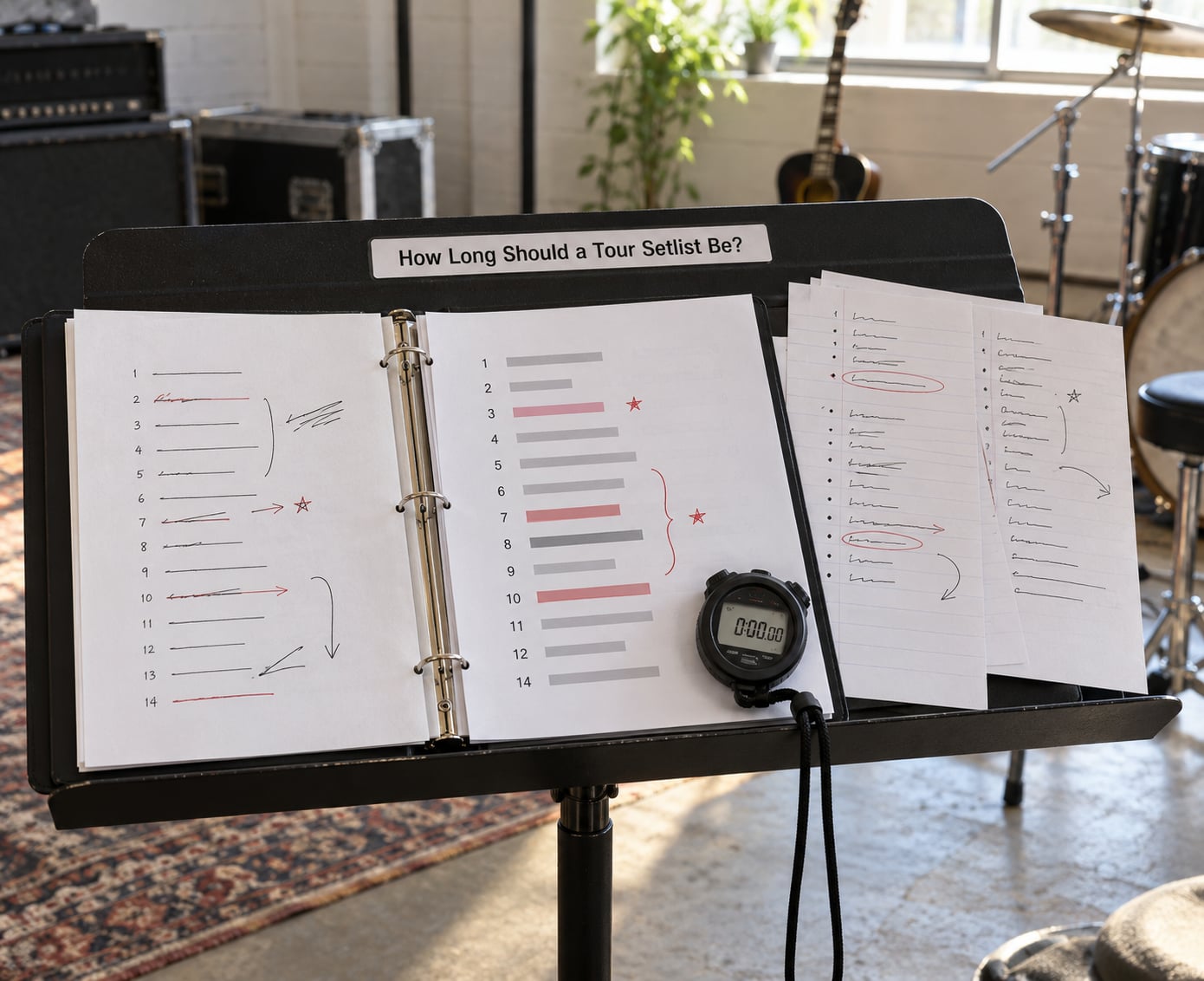
Set length is a contract, not a preference. Club support slots run 30 to 45 minutes, headline theater shows usually run 90, arena and stadium headline sets run 75 to 120. Festival slots are the tightest, and co-headline bills with a shared headline come with a hard stop that nobody gets to argue with.
The math is simpler than bands make it. Take your average song length, add 60 to 90 seconds per song for changeover, tuning and talk, and that is your per-song cost. Divide the set slot by that and you have a song count in about two minutes.
| Set length | Typical song count | Where you see it |
|---|---|---|
| 30 minutes | 9 to 11 | Opening slot, support bill, bar show |
| 45 minutes | 14 to 17 | Club headline, regional support run |
| 60 minutes | 18 to 21 | Theater support set, mid-size room headline |
| 75 to 90 minutes | 23 to 27 | Theater or arena headline, festival headline slot |
| 120 minutes | 32 to 36 | Stadium headline slot |
A 60-minute set at 3.5 minutes a song plus 90 seconds of changeover works out to roughly 19 songs. That is the number most headline support acts land on, and it is why so many 60-minute sets contain exactly eighteen songs and about three minutes of talking.
Hard rock and metal songs skew longer than pop or indie numbers, mostly from tempo and outro length. A band averaging four and a half minutes per song in a 45-minute slot is realistically playing eleven or twelve songs, not sixteen.
What gets cut when a slot shrinks follows a predictable order. Deep cuts go first, then cover songs that cost stage time, then the songs that depend on a lighting state or video sequence, and last of all anything the crowd has not demanded. Festival sets get trimmed hardest, and artists are usually frustrated by it because the songs removed are often the newest ones.
Curfew is the constraint that overrides everything. Festival curfews and venue curfews are absolute, so bands that want a 12-song festival set need to drop songs from the main running order rather than hope to rush through a shortened version.
How Do Bands Adapt a Setlist for Each Show?
Very few bands rebuild the set nightly. Most run a core running order for a stretch of shows and make small, deliberate changes between them, because every change costs something downstream.
Before the show, adjustments are mostly about the room rather than the music:
- Venue size. A song that fills a 300-cap club can disappear in a 5,000-seat theater. Bands move ballads and slow builds out when the room is much bigger than the last one.
- Time of day. A 6pm show on a weekday and a 9pm Saturday show in the same building are different sets, because attention drops in the second half of an early slot.
- Support slot changes. If the support act runs long or short, the changeover shrinks or grows, and the headliner’s stage time shifts with it.
- Festival formatting. Daytime festival sets usually play to a partly walking crowd, so shorter sets with more known songs tend to outperform a full album sequence.
- Production limits. A venue with no rigging, a low ceiling, or a package that cannot carry pyro rules songs out immediately.
- Special requests. Celebrities, industry guests and local promoters occasionally ask for a song. Bands that can honour the ask usually drop something to make room.
Between shows and between legs, the changes are bigger. That is where unreleased songs move, where a song that bombed in front of a hard crowd gets pulled and where the tour’s energy profile gets reshaped. Routing matters too: a European leg with different festival lineups and different rooms will not run the same order as a North American run.
Backstage, the running order lives in more than one form. Some bands print full sheets on a clipboard or tape a compact list to the stage floor. Others run a prompter screen or a tablet behind the amps. Bands with long runs use all three, because paper fails and screens run out of battery. The version taped to the floor is usually an abbreviated one with keys and cues, not song titles alone.
Front of house and the lighting desk get different cuts. The FOH engineer cares about levels, talk time and songs with unusual arrangements; the lighting and video programmers care about order, because their show file is built one page per song and a late swap means re-programming.
What Goes Into the Encore and Final Song?
An encore is the extra set of songs performed after the band leaves the stage, usually after a short pause and a return walk-on. It is written into the running order as reserved songs, not as an afterthought, and it is the single most misunderstood part of a setlist.
On most tours it is partly planned and partly theatre. The band plays the last song of the main set, says goodnight, and walks off while the house lights stay down and the crew holds the show file. Then they come back for two to four songs that were never in the visible setlist.
How long should an encore be? Two or three songs is the common answer, about ten to fifteen minutes. Long encores frustrate venues because they eat the changeover for the next act, and a 30-minute encore turns a great show into an early night.
Good encore choices share a few traits. They are unmistakable: everybody in the room knows the chorus, the payoff lands in thirty seconds, and the band has played them enough times to be loose. Big, loud and communal beats something surprising, though a well-chosen cover can be a genuine highlight if the band is proud of it.
Some bands skip the exit entirely and play a good 90 seconds of silence and banter instead, then keep going. On arena runs this is more common than on club runs. Walking off and coming back costs a crew changeover and stage reset, so once the stage has props that have to be struck, the walk-on becomes expensive.
On the running order, encore songs are usually marked as reserve with no cues programmed, or with a single lighting state that can be called in seconds. If the room does not ask, those songs move into the next night’s set and stay in rotation for the rest of the leg.
How Do Musicians Rehearse a Tour Setlist?
A running order is rehearsed like a piece of music, because it is one. Touring acts typically block out the full set with the touring lineup at least twice before the run starts, and the details they drill are the ones that fail in front of a crowd.
- Keys and tuning. Every song is noted in the key it will be played in. Anything involving a retune mid-song gets rehearsed until nobody has to think about it.
- Arrangements. Segues, breakdowns and any part where a member drops out or steps forward get rehearsed to the bar.
- Transitions. Between-song talk, segues and any segment where the band walks to a new position on stage get written into a cue-to-cue script with the show caller.
- Introductions. Guest intros, dedications and the first words of an opener are scripted, not improvised. A rambled intro on night one tends to get repeated every night after.
- Tracks and playback. If backing tracks or click are used, the whole band rehearses with them, including count-ins, and monitors get the right mix.
- Contingency. Every tour has songs that cannot be played as written, whether because of a broken string, a dead monitor channel, or a backing track that will not load. The band decides in advance what gets dropped rather than deciding at the stage door.
The stage plot, monitor mixes and show file are rehearsed separately at line check and soundcheck, but the running order ties them together. A song that moves three positions changes how the lighting desk follows the show, and that gets checked every night, not just at the start of the tour.
Frequently Asked Questions
How many songs are in a 1 hour setlist?
Most 60-minute sets run 18 to 21 songs. A 3.5-minute song plus 90 seconds of changeover, tuning and talk costs about five minutes of the hour, so roughly 12 songs per hour of stage time fits comfortably. Rock and metal sets average longer songs, closer to four and a half minutes, which usually drops the count to 16 or 17.
What is the average length of a setlist?
It depends entirely on the type of show. Opening slots run 30 minutes, club headline sets 45 minutes, theater headline sets 90 minutes, and festival slots are usually 30 to 60 depending on billing. The average headline arena set sits around 75 minutes, which works out to roughly 22 to 24 songs.
What is an encore on a setlist?
An encore is the additional set of songs played after the band leaves the stage for a short pause, usually two or three songs lasting ten to fifteen minutes. On the running order it is written in as reserve material held back from the main set, so the visible song count and the songs actually played often differ by two or three.
How long are festival sets?
Festival slots range from about 25 minutes for a low slot on a large stage to 75 or 90 minutes for a main-stage headline. Length is set by the festival, not the artist, and the stage finish time is enforced. Sets get truncated rather than rushed, so the band cuts whole songs instead of playing shortened versions.
How to check concert setlists?
Setlist.fm is the standard reference, with stats.fm offering per-artist averages for song length and how often a song appears across shows. Fans compare dates to work out which songs rotate in and out. A song missing from several shows in a row usually means it is on a break, not that the band stopped playing it.
Why doesn’t the band change the setlist every concert?
Because every change costs something. A late swap means re-programming lighting and video, updating the stage plot, relearning transitions and resetting monitor mixes, and it removes the band’s ability to read a set that is already working. Most acts run a stable order for a block of shows and revise between shows at most, and between legs often.
Where to Start If You Are Building One Right Now
Write down every song the touring lineup can play well, in the keys they will play them in. That pool is the only real starting point; everything after it is trimming, ordering and marking.
Next, pick the set length you are being paid for, run the song-count math against your average song duration, and trim the pool until it fits with a minute of slack. Then order for energy, hold back two or four songs for the encore, and write the cues in.
Lock it before production needs it, not after. A lighting and video show file built on a setlist that keeps moving is the most expensive kind of problem a tour can have.