Understanding how cover songs become bigger than the original takes about three minutes, and it changes how you hear almost everything on the radio. A cover wins when it arrives with more exposure, a bigger platform, a voice that suits the song better, or a moment where the audience was ready to hear it. The song itself is usually not the reason.
None of that makes the cover better. It makes it louder. Those are different things, and most arguments about covers collapse because people are really arguing about reach.
So here is the working definition. A cover version is a new recording of a song by someone other than the performer who first released it. The word is older and stranger than it sounds: in the 1920s and 30s, a “cover” meant a rival recording cut to compete with a song someone else had just put out. It was an act of warfare dressed as a compliment. Today the word just means any later version, which is why the word “cover” tends to understate what is really going on.
Here are the forces doing the work, the reasons most covers stay invisible, and how you can tell the difference between a cover that genuinely surpassed its original and one that merely found a bigger moment.
Table of Contents
- What Does It Mean When a Cover Becomes Bigger Than the Original?
- How Cover Songs Become Bigger Than Originals
- Why covers are cheap to make and who actually gets paid
- The Seven Forces Behind a Breakout Cover
- 1. Instant recognizability
- 2. A better fit for the performer
- 3. A stronger arrangement
- 4. Fresh emotional meaning
- 5. Radio and media placement
- 6. Audience discovery
- 7. Social and cultural timing
- Does a Cover Version Need to Change the Song to Work?
- Faithful covers
- Streamlined covers
- Adapted covers
- Genre-transplanted covers
- Why Do Some Covers Still Fail to Match the Original?
- How to Tell Whether a Cover Has Genuinely Surpassed Its Original
- Frequently Asked Questions
- How can a cover song become more popular than the original recording?
- What is the most famous cover that outperformed the original?
- Why do listeners sometimes prefer a cover of a song?
- Does a successful cover have to sound completely different?
- Can the original artist benefit when their song becomes a popular cover?
- What is the difference between a hit cover and the original becoming popular later?
- Conclusion
What Does It Mean When a Cover Becomes Bigger Than the Original?
“Bigger” is a measurement, and it depends on what you measure. A cover can beat the original on any of five axes and still lose on the other four.
- Streams and sales. Auditions on streaming services decide what most listeners hear repeatedly, and discovery there is less about the songwriter than about the version.
- Chart placement. A song can top a national chart without being the version most people own or remember.
- Radio reach. Radio pays songwriters and publishers, not the singers, so formats have a structural reason to program whichever recording is most familiar to listeners.
- Touring demand. Songs people sing back at bands get covered live far more often, whether or not that band wrote them.
- Cultural visibility. Film, television, advertising, short-form video and weddings decide which version a generation actually owns in memory.
The mismatch between those axes is the source of most confusion. The original may have sold more in its own week and still be the version almost nobody can hum today. Which is exactly the position Jeff Buckley’s “Hallelujah” put Leonard Cohen’s song in.
How Cover Songs Become Bigger Than Originals
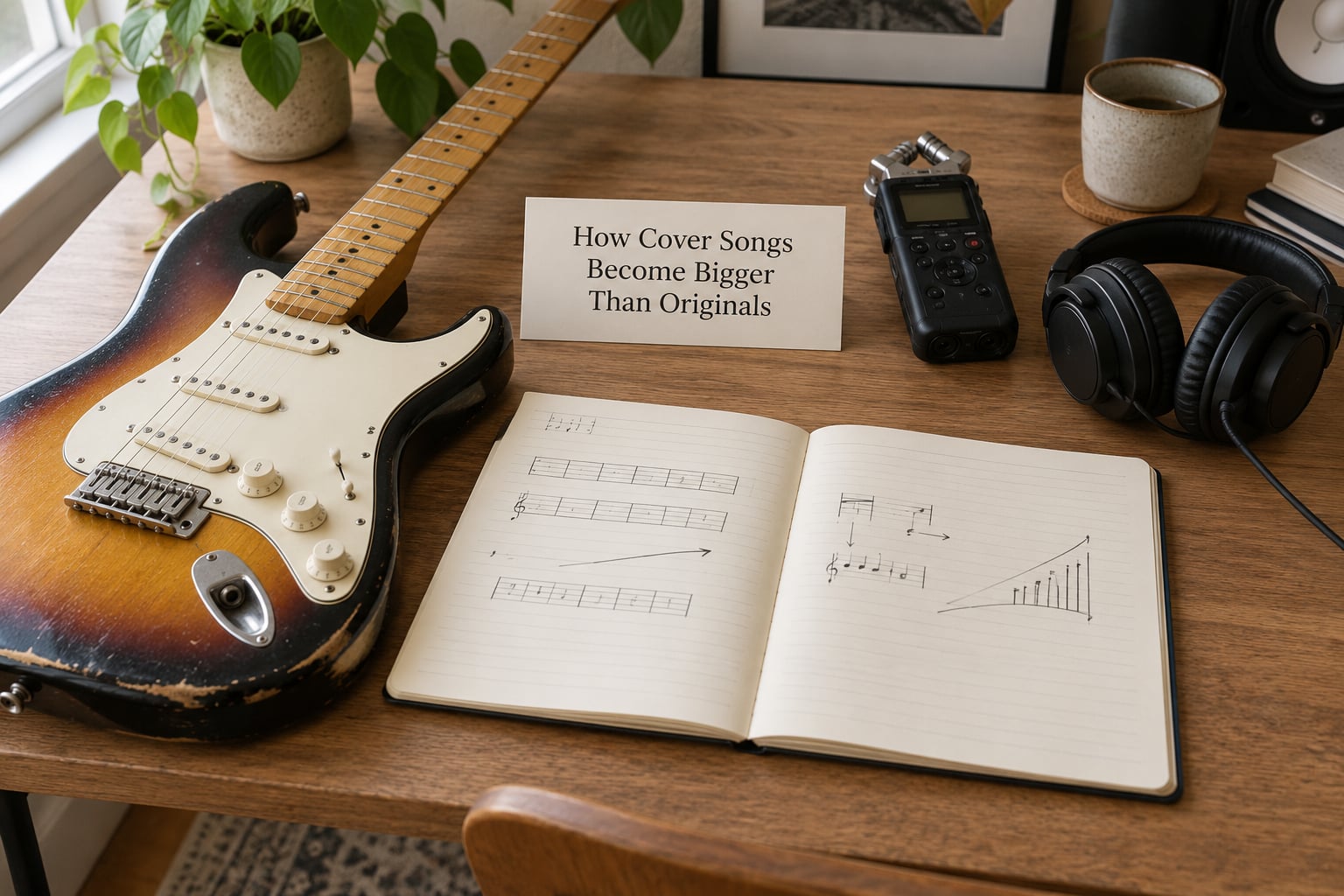
A cover becomes bigger than the original when it is delivered through a channel the original could not reach, in a shape the original did not attempt, at a moment when listeners were ready to receive it.
Strip that down and you get a short list of moving parts. Each one does something specific to the song:
| Force | What it changes | Example |
|---|---|---|
| Radio and format reach | Turns a song into something people hear without choosing | Elvis Presley’s “Hound Dog” |
| Performer fit | Makes the vocal match the song’s actual weight | Whitney Houston’s “I Will Always Love You” |
| Arrangement | Reveals structure the first version buried | Dylan’s reshaping of “All Along the Watchtower” |
| Genre transplant | Borrows a song for a fanbase that would never have found the original | Soft Cell’s “Tainted Love” |
| Media placement | Puts the song in a film, series or ad | UB40’s “Red Red Wine” in the UK |
| Short-form video | Rewards a version built for a clip rather than an album | Live-session cover culture |
| Timing | Catches a cycle the original release predated | UB40’s 1983 take on a 1967 Neil Diamond song |
There is also a legal reason covers keep happening, and it is the one nobody explains properly.
Why covers are cheap to make and who actually gets paid
In the US, a compulsory mechanical licence lets anyone record another songwriter’s song without asking permission, as long as the songwriter is paid. That single rule is why covers are cheap. A band can cut a standard for the cost of a rehearsal room and a week, with no negotiation and no permission slip.
The 2021 Music Modernization Act created the Mechanical Licensing Collective, which handles these digital mechanical licences in one place. Before that, songwriters or their agents handled the paperwork individually.
Two royalties need separating. The composition belongs to the songwriter and publisher, and covers generate a mechanical royalty for that. The master recording belongs to whoever made the record. When someone else covers your song, the original recording’s owner receives nothing from the cover itself, and the original performing artist usually earns no performance royalty either, because performing rights organisations pay the songwriters and publishers rather than the singers.
That split explains a complaint that shows up constantly in musician forums: the person whose song everyone knows is often the person nobody can name. Alan Merrill wrote and recorded “I Love Rock ‘n’ Roll” with the Arrows in the mid-70s, and he said plainly that Joan Jett’s version was the one everybody knew and, ironically, not the one that made him money.
The Seven Forces Behind a Breakout Cover

Every outsized cover I can think of is the product of at least three of these firing at once, not one cause working alone.
1. Instant recognizability
A cover inherits a finished song, so the listener has something to grab in the first second. That matters more than writers expect: unfamiliar material loses listeners before it gets a chance to impress them, while a known chorus is free promotion the coverer does not have to earn. A cover is the only form of music marketing that starts halfway through.
2. A better fit for the performer
The version that wins is usually the one whose vocalist could not have delivered the song any other way. Whitney Houston singing Dolly Parton’s “I Will Always Love You” was not a similarity, it was a match: the song had waited for a voice built to hold that final held note. When the fit is wrong you can hear it, and the cover disappears into the catalogue.
3. A stronger arrangement
Arrangement decides how much of the song a listener hears. A production that pushes everything forward can hide a lyric; one that strips to guitar and voice can expose a song that was buried under its own studio sound. Bob Dylan famously reshaped “All Along the Watchtower” in performance after hearing Jimi Hendrix’s version, and the song’s reputation changed with the arrangement rather than with the writing.
4. Fresh emotional meaning
A song changes when a different life reads the same words. Johnny Cash’s “Hurt” came to him through Trent Reznor, who gave up the song because it no longer fitted what he was writing. Cash sang it as a man looking backwards at damage he had caused, and the song stopped being about an abusive parent. The words did not change. Everything around them did.
5. Radio and media placement
Radio is the historical engine, and the 1950s are where the pattern starts. Black rhythm and blues records crossed over through white-owned radio, and covers were the mechanism: Big Mama Thornton’s “Hound Dog,” written by Jerry Leiber and Mike Stoller, was an R&B record, and Elvis Presley’s 1956 pop No. 1 was built on a song that already existed.
Film and television work the same way now. A song placed in a drama or an advertisement reaches people who were never going to seek it out.
6. Audience discovery
Covers cross demographic lines that the original could not. Blondie took “The Tide Is High” from the Paragons and turned a vocal-group record into a pop number one on both sides of the Atlantic. Chris Stein has said the band chose it deliberately, betting that a successful version of a song other people already knew would carry real weight.
Radio programmers do this too. When a format is unsure of a song, the safest play is the version the audience has already absorbed, even if a different recording is better.
7. Social and cultural timing
Timing decides whether a cover gets a second life or a footnote. UB40’s “Red Red Wine,” a Neil Diamond song Diamond had recorded in 1967 without a hit, reached the top of the UK chart in 1983 because the band put it in the hands of a ska-inflected audience that was buying that sound and had no way of reaching a 1967 folk-pop record. The song did not travel. The context did.
Timing also runs on long loops, which is why catalogues keep getting rediscovered. Songs built from durable melodic structures survive their era’s production and resurface when a style comes back around. Short-form video has accelerated that loop dramatically, since a cover built for fifteen seconds of chorus can now be discovered at a rate no radio format ever managed.
Does a Cover Version Need to Change the Song to Work?
No. Fidelity is not the goal, and it is rarely the reason a cover succeeds. What matters is that the song stays recognisable while something about it changes enough to be worth hearing.
Faithful covers
These keep melody, structure and lyrics intact and change only the delivery. They are the safest route for a debut or an unknown performer because the song is already proven, and they are how most working bands pay the bills.
Streamlined covers
Here the coverer keeps the song and drops most of the arrangement. Stripping a song to voice and guitar or voice and piano exposes weaknesses the original production had masked, which is a gamble but sometimes the whole point.
Adapted covers
Key changes, tempo changes and rewritten middle sections that let a different vocal range carry the song. These preserve the identity while fixing the parts that did not fit the new singer.
Genre-transplanted covers
The song is moved into another style entirely, and this is usually where the biggest commercial wins sit. Soft Cell’s “Tainted Love” moved a Gloria Jones soul record into synth-pop and opened the 1980s; Jon Bon Jovi’s small-town rock take on “Tainted Love” moved it again. A genre transplant borrows a song for a fanbase that would never have gone looking for the original, and that borrowed audience is usually bigger than the one the first recording had.
Forum threads on what makes a cover better land on this point more than anything else: listeners consistently credit covers that changed genre, not covers that merely changed singer.
Why Do Some Covers Still Fail to Match the Original?
Most covers do not outshoot the original. That is the honest baseline, and a story about exceptions should say so plainly.
- Weak performance. An unfamiliar voice without the technique to hold the song simply exposes that it is difficult.
- Needless change. Rewriting lyrics or restructuring for its own sake removes the reason listeners already liked it.
- Bad timing. A faithful cover released outside any trend has nothing working for it.
- No distribution. A technically excellent version with no radio, playlist or video support stays invisible no matter how good it is.
- Excessive reverence. Copying the original note for note produces a version with no reason to exist, since listeners can simply play the original.
There is a commercial reason too. A musician who writes originals and refuses to play covers gets passed over for paying gigs, which comes up again and again on r/musicians, where the argument is usually framed as financial necessity rather than artistic choice. Covering is how many bands stay solvent. Covering badly is still often the better business.
The failure rate matters for a second reason: it is what makes the successes mean anything. If every cover outsized its original, the interesting cases would be ordinary.
How to Tell Whether a Cover Has Genuinely Surpassed Its Original
Check five things, and check them separately. Ask about the year, the reach, the longevity, the live demand and the misattribution.
Most arguments online fail on the first test because nobody holds the years in their head. Here is the short list of documented cases, with the outcome stated only where it is well established.
| Cover | Cover artist | Original | Year | What happened |
|---|---|---|---|---|
| “Hound Dog” | Elvis Presley | Big Mama Thornton | 1956 | Pop No. 1 for a 1952 R&B record written by Leiber and Stoller |
| “Respect” | Aretha Franklin | Otis Redding | 1967 | Hot 100 No. 1 from Redding’s own composition and recording |
| “I Will Always Love You” | Whitney Houston | Dolly Parton | 1992 | No. 1 for Parton’s 1974 song, 15 weeks at the top |
| “The Tide Is High” | Blondie | The Paragons | 1980 | No. 1 in the US and UK; the Paragons’ version had not charted in the US |
| “Girls Just Wanna Have Fun” | Cyndi Lauper | Robert Hazard | 1983 | No. 1 from a song the writer had recorded himself in 1979 |
| “I Love Rock ‘n Roll” | Joan Jett | The Arrows | 1981 | No. 1, more than five years after Alan Merrill wrote and recorded it |
| “Red Red Wine” | UB40 | Neil Diamond | 1983 | UK No. 1 for a Diamond recording from 1967 |
| “Tainted Love” | Soft Cell | Gloria Jones | 1981 | UK No. 1 and the first chart topper of the year |
| “Blinded by the Light” | Manfred Mann’s Earth Band | Bruce Springsteen | 1976 | UK No. 1 for a Springsteen album track from 1973 |
| “I Fought the Law” | The Clash | Bobby Fuller | 1977 | A punk standard rather than a chart hit, from an original that did not chart |
Three patterns sit inside that list. Covers win when the coverer is already bigger than the song. They win when the coverer changes the style rather than the song. And they win when the original was recorded in a format that had not found its audience yet.
The fifth test is the one that settles most arguments in comments. Ask an audience which artist they think wrote the song. If they say the cover artist, the cover has genuinely taken over, no matter what the chart books say about the original’s week.
Frequently Asked Questions
How can a cover song become more popular than the original recording?
Because the cover arrives through a different channel, not because the song changed. A cover reaches a bigger audience when a larger performer fronts it, when radio or a playlist programs it repeatedly, when a film or short-form video places it, or when it moves into a genre that borrows a fanbase the original never had. The compulsory mechanical licence also makes covers cheap to record, so more of them exist to get lucky.
What is the most famous cover that outperformed the original?
Whitney Houston’s 1992 recording of Dolly Parton’s I Will Always Love You is the clearest case, spending 15 weeks at the top of the Billboard Hot 100 for a song Parton released in 1974 without that level of success. Buckley’s Hallelujah is the other one usually named, since Leonard Cohen’s own 1984 release did not become a hit and Cohen’s song is now known by Jeff Buckley’s vocal.
Why do listeners sometimes prefer a cover of a song?
Because distance helps. A song heard through someone else’s voice carries associations that belong to the performer rather than the writer, and those associations make it easier to picture. A familiar chorus also arrives pre-learned, so listeners can engage with the interpretation instead of the melody. On forums, listeners most often credit genre changes and vocal timbre, not fidelity.
Does a successful cover have to sound completely different?
No. Faithful covers succeed when the performer genuinely suits the song, which is why Houston’s I Will Always Love You works despite changing very little. The useful distinction is that a cover needs a reason to exist, and that reason can be a better voice rather than a different sound. A note-for-note copy with no added quality usually has nowhere to go.
Can the original artist benefit when their song becomes a popular cover?
Yes, in a limited way. The songwriter collects mechanical royalties from the cover through the Mechanical Licensing Collective in the US, plus performance royalties through collecting societies once radio and streaming play the cover. Performers of the original recording usually do not, because covers do not use the master and performance royalties go to writers and publishers.
What is the difference between a hit cover and the original becoming popular later?
A hit cover means a different performer recorded the song and that version drove the response. An original becoming popular later means the first recording itself grew, usually through a rediscovery, a compilation or a placement, without anyone re-recording it. Several covers a year go through that second route, which is easy to confuse with a cover because audiences often cannot identify which version they know.
Conclusion
How cover songs become bigger than the original is rarely about the writing. It is about delivery: who fronts it, what they do to it, where it gets played, and whether the moment was right. The seven forces above explain nearly every documented case, and they explain why so many covers fail, since remove the exposure and the fit and the arrangement and there is usually not much left.
Start with three questions when a cover surprises you. Did the performer change the arrangement or just the singer? Where did the audience hear it, and how often? And how well-known was the coverer compared with the song at the moment of release? Get those right and you will usually have the story without needing an opinion.