Learning how to write a metal album review comes down to one habit: describing what you actually heard, then defending the description. Listen more than once, name specific tracks and technical details, judge the record against a standard you state up front, and finish with a verdict a reader can argue with. A standard blog review runs 400 to 800 words.
That is the whole job. The rest of this guide breaks it into a repeatable process you can finish in an evening, including the vocabulary metal specifically demands and the mistakes that get a review ignored.
Table of Contents
- What You Need
- How to Write a Metal Album Review: Step-by-Step
- 1. Listen Before You Research
- 2. Identify the Album’s Core Direction
- 3. Build an Evidence Log
- 4. Write a Clear Thesis
- 5. Analyze the Music, Not Just the Tracks
- 6. Compare Without Overclaiming
- 7. End With a Fair Verdict
- A Skeleton You Can Fill In
- Common Mistakes
- Frequently Asked Questions
- How do I write an album review?
- How long should an album review be?
- Should I write a track-by-track review?
- Should I give an album a score?
- How do I review a band I love without sounding like a fanboy?
- What makes a metal review credible?
- Conclusion
What You Need
You need four things before you write a word, and none of them cost money.
The album, played at least twice. One listen tells you whether you like it. Two tells you what it is doing. Three is where you start hearing arrangements rather than a general mood.
Verified credits. Band member names, the producer, the mixing engineer, the label, the release date. Get these from the label’s own announcement or the liner notes, not from a wiki page you found halfway through an argument.
Context. Where the band came from, what they released before this, who they are usually compared to. Two or three prior records is enough to spot a pattern.
A stated standard. Decide what you are measuring the record against before you decide whether you like it. Metal Injection’s writer makes this explicit, noting that instrumental acts have to carry mood and meaning on the instruments alone, since they have no lyrics or vocal melody to fall back on. Say your standard out loud in the review and the verdict stops sounding arbitrary.
One more thing worth writing down: any stake you have. If the band is a favourite, if you know the members, or if you are in the band, say so in the first two sentences. Reviewers on Nine Circles open with a plain “full disclosure” line about loving the band in question, and readers treat that as honesty rather than weakness. Silence about a personal stake is what reads as bias.
How to Write a Metal Album Review: Step-by-Step
Here is the process in order. Most of the work happens before the first sentence, not after it.
1. Listen Before You Research
Give the album at least two complete, uninterrupted listens before you read a single press release. The first listen is for reaction. Write down the physical response: where you leaned in, where you checked your phone, which track you replayed, which one you skipped.
That reaction matters, but it is not a review. The temptation in the metal scene is to read five other people’s opinions first and then form your take, which almost always produces a review with no take in it. Read other reviews afterwards, not before.
The second listen should be active. Follow one thread only: the low end, the vocal performance, the songwriting, the lyrics. Following a single thread through a full record teaches you far more than three distracted passes.
2. Identify the Album’s Core Direction
Describe the record’s identity in one or two precise sentences before you evaluate anything. Name the subgenre, the influences the band has actually admitted to, the register, and the production approach.
Compare that to a review that says the album is “a brutal, atmospheric journey through darkness.” It sounds like every record ever made. A version with teeth: “Death metal in the vein of early Entombed, but built on long instrumental passages rather than short blasts, and mixed dry enough that the guitar tone does most of the work.”
If the band plays an instrumental record, hold it to a stated standard rather than quietly grading it against a vocal band. Nobody complains when a review of a drone record says the tones need variety, because the review said that was the measure.
3. Build an Evidence Log
Build an evidence log before you draft a metal album review, because memory is a poor editor. For each track worth mentioning, capture a short note with a timestamp: what happens musically, and what the band did that made you react.
Log material from several categories rather than one. Riffs and their repetition or variation. Melody and whether it hooks or just travels. Rhythm: tempo changes, blast beats, double bass, anything the drummer does that a normal rock drummer would not. Vocals: harsh, clean, growls, layered, and whether the range moves. Lyrics: subject, imagery, and whether the words are doing anything a photo of fog could not. Production: the mix, the low end, the master, and how the record sounds on headphones versus speakers.
Keep this log rough. Timestamps and fragments are enough, and building one is how you solve the problem writers describe constantly, which is being able to tell that something is good without knowing why.
4. Write a Clear Thesis
A review is an argument, and an argument has a claim. State in one sentence whether the album works, what it does most effectively, and where its central weakness sits.
Weak: “The Direction of Last Things is a solid album from Intronaut, though some songs drag.”
Stronger: “Intronaut have never played this fast and this precisely, and the record only loses its thread in the two back-to-back tracks that ask the listener to hold the same idea for four minutes.”
The second version gives a reader a reason to keep reading and a way to test your claim against their own listening. It also gives your verdict somewhere to land, which is why you write the thesis before the body rather than after.
5. Analyze the Music, Not Just the Tracks
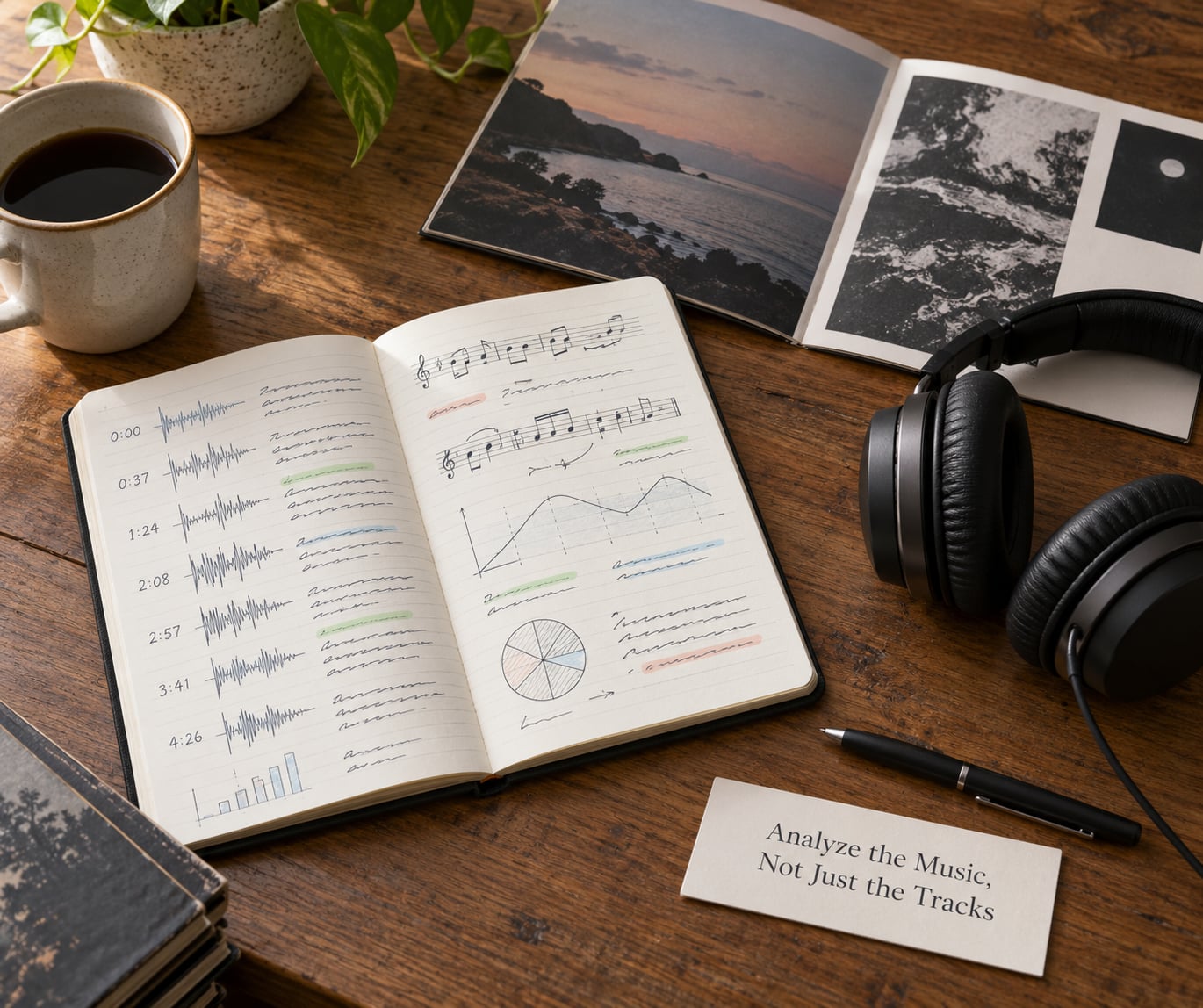
Recapping a running order is the most common failure in amateur music review writing, and it is worth naming why: a tracklist summary tells the reader what they already have on the shelf. Analysis tells them what to notice when they listen again.
Work across the record rather than through it. How do the songs relate to each other, where does the pacing sag, does the record have a shape or just a set of strong and weak tracks? If the second half repeats the first half’s ideas without developing them, that is a finding.
Use metal’s own vocabulary, because generic rock language flattens what makes the genre distinct. Riff-driven against melodic. Thrash tone against down-tuned heaviness. A wall of sound that supports the songs against one that buries them. Low end that supports the groove against low end that turns to mud on a phone speaker.
6. Compare Without Overclaiming
Comparison is the strongest tool in music criticism and the easiest to misuse. Two kinds are safe. Comparing this record to the band’s own earlier work is the most useful, because it shows growth, regression, or a deliberate change.
Comparing to a named peer is also safe, provided you describe what the two records actually share rather than asserting a causal influence. “Sounds like a slower, denser take on the same palette as their record from three years back” is an observation. “Sounds like the second wave of [city] sludge” is a claim about influence you cannot verify from the audio alone, and readers who know the scene will pull you on it.
Put your peer comparisons in their proper place: context, not the argument itself. The record is what is being judged. Everything else is a ruler.
7. End With a Fair Verdict
The verdict has four parts. The strongest achievement, the main limitation, who should hear the album, and whether you recommend it. Missing any one of them leaves the reader to finish your thinking for you.
A verdict that names a real weakness reads as trustworthy. Pure praise reads as a fan account, and pure dismissal reads as a grudge, and readers have learned to sort both into the same drawer.
Give a score only if the outlet expects one. If you do score, hold the scale steady: out of 10 is the metal convention, out of 5 leaves more room for tenths, and a letter grade is fine in print. Whichever you pick, do not let the number arrive before the argument. If your score is a surprise next to your reasoning, readers stop trusting both.
A Skeleton You Can Fill In
Use this structure and you will never stare at a blank page:
1. Disclosure and context, two or three sentences. 2. Thesis: what the record does and where it falls short. 3. Two to three named tracks with timestamps and specific observations. 4. Craft section: guitar tone, low end, drums, vocals, lyrics. 5. One comparison to earlier work. 6. Verdict: strength, weakness, who it is for, recommendation, optional score.
For a long-form retrospective, add a paragraph on why the record mattered at the time and whether that has held up, and be honest when the answer is no.
Common Mistakes
These are the six failures that get a review ignored, each with its fix.
Writing a press release. “Fans will be thrilled” and “a bold new chapter” tell the reader nothing. Fix: cut every sentence that would be equally true of the band’s next record and about six other bands.
Reviewing songs in isolation. Track commentary with no argument behind it becomes a tracklist with adjectives. Fix: write the thesis first, then include only the tracks that prove it.
Using empty genre labels. “Brutal”, “savage”, and “intense” are not analysis. Fix: describe the mechanic. A blast beat, a repeated two-note riff, a vocal that stays in one register for six minutes.
Over-focusing on one track. A ten-paragraph piece on the album’s best song is a song review wearing a disguise. Fix: the standout track is evidence for a claim about the record, not the subject of the review.
Assigning an unexplained score. Readers treat the number as the review. Fix: state your criteria, score against them, and treat a rounded 7 or 8 as perfectly respectable.
Sounding like a hype bot. Praise with no criticism attached is the fastest way to lose a comment section. Fix: find the real limitation and name it honestly. If you genuinely cannot find one, say what the record would need to prove next instead.
The single best training method, if you want one, costs nothing: read published reviews of albums you love, then read reviews of albums you dislike, and work out what job each sentence is doing. Negative reviews teach it faster, because a bad one is easy to spot. This is the advice that comes up most often in metal writing communities, and it holds up.
Frequently Asked Questions
How do I write an album review?
Listen to the record at least twice, research the band’s background and production credits, and write one sentence stating whether the album works and where its weakness sits. Then support that claim with named tracks, timestamps and specific musical observations. Finish with a verdict that names a real strength, a real limitation, and who should hear the record.
How long should an album review be?
A standard blog or site review runs 400 to 800 words. That is enough for a thesis, three or four tracks of evidence, a craft paragraph and a verdict. Go past 1,000 words only when you are writing a feature or a retrospective where the record’s place in a scene matters as much as the music.
Should I write a track-by-track review?
Only when every song earns its own paragraph. Most records do not, and a running-order summary is the most common weakness in amateur music review writing. Pick the three or four tracks that prove your argument and use them as evidence, then cover craft across the record as a whole.
Should I give an album a score?
Give a score if your publication expects one, and hold the same scale across every review you write. Out of 10 is the metal convention, out of 5 allows finer distinctions, and some outlets prefer no score at all. The number should never appear before the argument, and a mid-range score with real reasoning behind it reads as more honest than a nine.
How do I review a band I love without sounding like a fanboy?
Disclose it in the first two sentences, then hold the record to a standard you wrote down before listening. Name at least one real weakness and be specific about it. Readers on music forums and review sites consistently treat an acknowledged bias as honest and an unacknowledged one as a problem, so disclosure costs you very little.
What makes a metal review credible?
Checkable detail: named tracks, named producers, named earlier releases, and technical observations a reader could verify on their own system. Add a stated standard you are judging against, knowledge of the subgenre’s conventions, and a verdict with both a strength and a limitation. Specificity is what separates criticism from enthusiasm.
A note on where these get read: Encyclopaedia Metallum is the genre’s default home for short, structured user reviews, often broken into element-by-element notes with percentage sub-scores. Bandcamp pages, personal blogs and label press campaigns are the other common routes, and a first-listen review on your own site is still a reasonable place to start.
Conclusion
Start by listening twice, once for reaction and once for detail. Write down what you heard with timestamps before you decide what you think, then state your claim in a single sentence and prove it with three or four named moments. Whatever you conclude, make it specific enough that a listener can check you, and fair enough that they would trust you on the next record.