Learning how to start a metal vinyl collection comes down to three things: pick a handful of albums you already love, learn how to spot a playable copy before you pay for it, and set a budget you can keep. Buy records in the order you will actually play them, check the pressing on Discogs first, and store everything upright in anti-static sleeves away from heat. That is the whole method. Gear can wait until you know what you want to hear.
Metal is an unusually good candidate for a first vinyl collection. A lot of the classic catalogue was mastered in an era when nobody was chasing loudness targets, so the dynamics on a thrash record or a first-wave black metal LP breathe in a way compressed streaming masters flatten out. The scene also kept physical pressing alive through the lean years, which means well-made metal records still show up in shops at sane prices rather than as unplayed rarities.
The awkward part is the range of editions. The same album exists as a picture disc, a coloured repress, a numbered box set and a plain original, and a beginner can burn an entire budget on a copy that plays perfectly well without ever owning anything they love. Everything below is designed to prevent that.
Table of Contents
- What You Need
- Step-by-Step: Build a Metal Vinyl Collection
- 1. Choose Your Collecting Focus
- 2. Set a Budget: How to Start a Metal Vinyl Collection Without Overspending
- 3. Learn the Metal Vinyl Releases You Want
- 4. Inspect Records for Playable Condition
- 5. Buy from the Right Sources
- 6. Play, Clean, and Protect New Additions
- 7. Organize the Collection and Decide What to Add Next
- Common Mistakes
- Frequently Asked Questions
- Where should a beginner start when building a metal vinyl collection?
- How much should I spend on metal vinyl each month?
- Are new reissues as good as first pressings for a beginner?
- How do I store metal vinyl so gatefolds and inserts do not get ruined?
- How can I start a metal vinyl collection without feeling overwhelmed?
- Start With One Album You Will Play Often
What You Need
None of this is expensive, and most of it can wait until you have decided what you are collecting. The list below is what the first few months actually require.
- A budget with a cap. A monthly figure you set in advance, not a vague intention. Metal vinyl runs pricier on average than pop or rock because pressing runs are smaller and many releases come from specialist labels.
- A collecting focus. One subgenre, one era, one country or one band. Without it you will drift across five styles and end up with no shelf that makes sense.
- A way to listen. A turntable at minimum, plus something to hear it through. A belt-drive deck with built-in speakers covers the first months; a separate turntable and powered speakers is the upgrade most collectors make once they know they are serious.
- Storage that holds the format upright. Shelves or crates sized for 12-inch LPs, and a spot that is not above a radiator or in direct afternoon sun. Metal releases skew toward gatefolds, doubles and box sets, so plan for wider shelving than a pop collection needs.
- Sleeve protection. Outer protectors for anything with artwork you care about, and anti-static inner sleeves for the records themselves.
- Cleaning supplies. A soft carbon-fibre style brush, distilled water, high-strength isopropyl alcohol and lint-free cloths. A proper cleaning fluid is a fine substitute but it is not essential.
- A catalogue. A spreadsheet, a notebook or a collector database entry per record. This is the single cheapest habit in collecting and the one that stops duplicate buying.
A cartridge is worth mentioning separately. Moving-magnet models cover every normal need; moving-coil and premium stylus sets are an enthusiast upgrade and buying one on day one is the most common early overspend.
Step-by-Step: Build a Metal Vinyl Collection
Seven steps, in this order. Choosing focus before buying prevents most beginner mistakes, and inspecting before paying prevents the rest. The process takes about an afternoon of setup, then settles into a steady habit of one or two purchases a month.
1. Choose Your Collecting Focus
Narrow the field first. The whole metal catalogue is far too large to approach at once, and beginners who try often end up with twenty records they never play.
Pick one of four angles:
- Subgenre. Thrash, death, black, doom, power, grind, NWOBHM, metalcore. Choose one, learn its landmarks, then widen later.
- Era. The early 1980s wave, the late 1980s thrash era, the 1990s death and black explosion, or the current scene.
- Country. British and American heavy metal, German thrash, Scandinavian death and black, Brazilian heavy metal, Japanese and Chinese metal.
- Bands or labels. Start with five bands you love and follow their line of influence backwards.
Subgenre is the most useful filter for beginners because the sound tells you immediately whether a record fits. Ask for starter albums in a subgenre you enjoy and you will get the same four or five names back every time. Collectors on metal subreddits consistently describe albums like Napalm Death’s Fear, Emptiness, Despair, Opeth’s Still Life, Katatonia’s Dance of December Souls and Megadeth’s Peace Sells… but Who’s Buying? as records that pulled them into a style.
Classic landmarks are worth knowing too: Black Sabbath’s early records, Iron Maiden’s The Number of the Beast, Metallica’s Master of Puppets, Slayer’s Show No Mercy, Carcass’s Symphonies of Sickness, Motörhead’s Ace of Spades. Use them as reference points for what you already like, not as a homework list.
2. Set a Budget: How to Start a Metal Vinyl Collection Without Overspending
Split what you have into three piles before you buy anything: records you already know you want, records you are curious about, and money you are deliberately keeping aside for discoveries you cannot predict yet.
Start collectors usually do best buying small and often. Ten records bought deliberately will get played; forty records bought in a spree will not.
A few rules that keep a budget honest:
- Write the monthly figure down and stop when you reach it, even if a rarer copy of something you own appears.
- Spend more on condition and less on edition. A clean, unwarped copy of any pressing plays well; a worn copy of the rarest pressing does not.
- Treat the monthly money as a subscription to music, not an investment. Prices move, editions get reissued, and none of that is guaranteed.
- Leave the last third of your budget unspent for a year. Long-time collectors report finding their best copies in ordinary second-hand shops before they knew what they were looking at.
An album worth owning and an expensive collectible are two different purchases. The first is decided by whether you will play it. The second is decided by scarcity, and beginners consistently report that the scarcity route cost them more than it returned.
3. Learn the Metal Vinyl Releases You Want
Once you know which albums you want, learn what the versions are called. This is the part that saves money, because it stops you buying the same album twice by accident.
| Term | What it means | Worth it for a beginner? |
|---|---|---|
| Original pressing | Manufactured from the first production run of that edition, identified by a different matrix or runout etching | Only if the album and the sound interest you |
| First pressing | The first press of a specific album, whichever label issued it first | Rarely, at any budget |
| Reissue or repress | A later run of an earlier edition, usually identical audio | Yes, and often the sensible choice |
| Mastered for vinyl | An edition cut from the original tapes specifically for the format | Worth preferring when the price gap is small |
| Coloured, splatter or picture disc | Vinyl colour or format variation, usually on a standard audio cut | Collect if you like it, not for value |
Two tools do most of the identification work. The matrix number is etched into the runout groove near the label and changes with each mastering; a dead-wax mark tells you the mastering engineer. Discogs lists these details for nearly every metal release, along with the pressing history, country and label, and collectors there credit it for identifying which copy they own rather than for telling them what to pay.
Other useful details: a 12-inch LP runs at 33 rpm and a 7-inch single at 45 rpm, which is easy to read off the sleeve or the centre label. Standard pressings weigh roughly 140g, heavier editions 180g and above. Half-speed and direct-metal-master cuts are real but they are an enthusiast tier.
Not every variation deserves a slot in your collection. Two copies of the same album with identical audio are one album with a duplicate, however differently the sleeves look.
4. Inspect Records for Playable Condition
Used metal vinyl anxiety is mostly about damage you cannot see until the record spins. Here is a beginner-friendly pass to run before you commit.
The disc. Look at it in good light. Hairline scratches that do not catch a fingernail are cosmetic. Deep gouges, a dull sheen across the playing surface or visible warping in the sleeve are not. Press the disc gently in the centre of both edges: if it rocks or does not sit flat, skip it.
Runout and labels. Check that the label is intact and clean and that the runout etching has not been sanded or written over. Heavy scribbling on a metal record is usually cosmetic, but writing filled with a solvent can etch the groove.
The sleeve. Metal disproportionately comes in gatefolds, so check the spine and the fold seams for splits, and check corners for lift. Seam splits are the single most common structural failure in metal records and they get worse with heat.
Signals to walk away. Bulging or stiffened card, a musty smell, visible mould, a seam that opens when you hold the jacket, or a record that was clearly stored in a car. Damage from moisture and heat is usually not fixable.
Grading terms sellers use.
| Grade | What it means in practice |
|---|---|
| Near Mint (NM) | Looks unplayed, plays clean |
| Near Mint Minus (NM-) | One or two faint sleeve marks, vinyl plays perfectly |
| Very Good Plus (VG+) | Light signs of use, no playback problems |
| Very Good (VG) | Visible wear, some noise, plays through |
| Good Plus (G+) | Heavy wear, audible crackle, may skip |
The rule I use: if the record plays without skipping and the sleeve opens flat, the copy is fine for a music collection. Reserve graded, mint-condition pieces for the albums you actually want to grade and sell.
5. Buy from the Right Sources
Where you buy changes what you can verify before paying, so use a mix rather than one channel.
- Local record stores. The only place you can hold the record, check the sleeve and confirm it does not warp. Metal sections in the metal-leaning shops are also where the occasional unrecognised copy turns up.
- Record fairs and label sales. Bands and labels run their own tables with signed, coloured and limited copies. Good for editions, hard to compare against a baseline.
- Specialist metal retailers and metal label outlets. Reliable on edition accuracy, and the descriptions tend to be written by people who know the catalogue.
- Discogs, used and new. The strongest verification tool because listings show matrix numbers, pressing country and grading, and you can compare the same release across dozens of sellers.
- General marketplaces. Fine for new standard pressings, the weakest option for used copies: packaging arrives insufficient, and warping or splits show up after you have paid.
Questions worth asking a seller about a vintage metal LP: which country and label is this pressing, what does the runout read, has it been played and how, is there any writing or tape on the sleeve, do you accept returns, and was it stored indoors. On Discogs, check the pressing notes and read the two or three lowest reviews for that pressing rather than the highest one.
Keep the copy and its sleeve together, and do not assume shrink wrap means unplayed. It often means the record sat in a shop window for a decade.
6. Play, Clean, and Protect New Additions
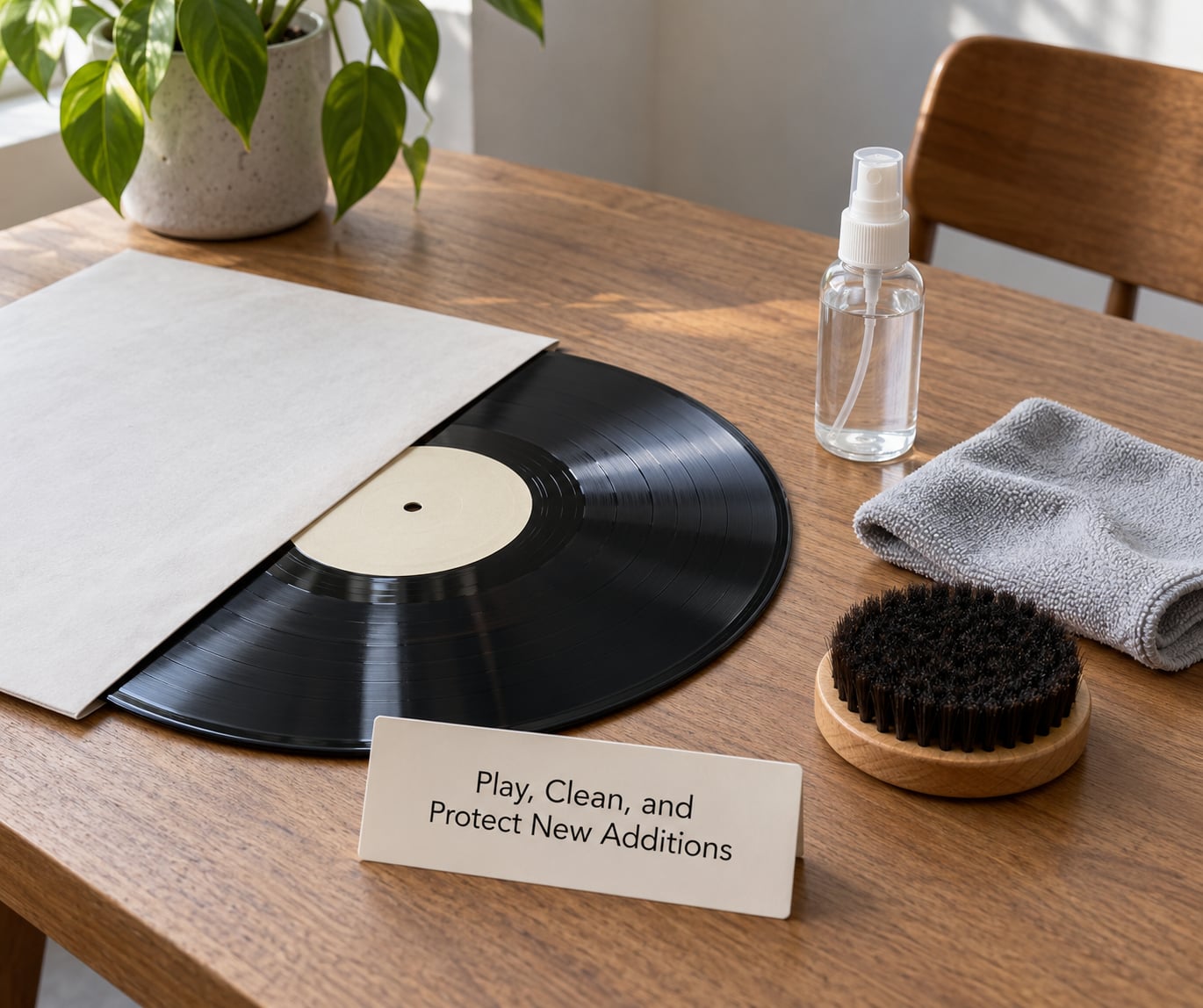
Metal records show dust and static sooner than most pop vinyl, and collectors on music forums single out heavy, loud records and smooth black pressings as the ones that need cleaning most often.
The first-play routine is simple:
- Handle the record by the edges only. Fingerprints on the playing surface are the fastest route to a crackly first impression.
- Brush the disc with the brush along the groove direction while it is on the turntable, with the anti-static side down, then reverse strokes with the brush lifted so the fibres do not snag.
- For a dirty record, dampen a lint-free cloth with distilled water and a little isopropyl alcohol, roughly one part alcohol to one part water, and wipe the surface in circular motions. Never flood the label area and never use household sprays.
- Start with a clean stylus and check alignment. A worn stylus makes poor records sound worse and damages new ones.
What not to use: dish soap, WD-40, household cleaners or warm tap water. Alcohol at that dilution cuts grime and evaporates cleanly; surfactants leave a film that attracts dust and can haze the surface permanently.
Storage is where most metal collections get damaged. Store records upright, never stacked flat in a pile for long periods, and use anti-static inner sleeves plus outer protectors. Keep them out of direct sunlight, off the floor, and away from heat sources. Aim for a cool, dry room around 35 to 50 percent relative humidity. Leave a little space above the shelf so you can slide an album out without dragging the sleeve edge across the stack.
7. Organize the Collection and Decide What to Add Next
Cataloguing takes fifteen minutes per ten records and saves real money afterwards. Track artist, album, release year, label, catalog number, format, pressing country and what you paid. Catalog number plus label identifies the exact edition, which is the field that tells you whether you already own a duplicate.
A first batch might look like this:
| Artist | Album | Edition note | Focus tag |
|---|---|---|---|
| Iron Maiden | The Number of the Beast | Any clean playable pressing | NWOBHM |
| Metallica | Master of Puppets | Later reissue is fine | Bay Area thrash |
| Megadeth | Peace Sells… but Who’s Buying? | First copy owned, no pressing preference | Thrash |
| Opeth | Still Life | Any pressing | Progressive death |
| Napalm Death | Fear, Emptiness, Despair | Check runout for wear | Grindcore |
Once the file is filled in, three things get easy. You can spot duplicates by album and catalog number. You can see which corner of the catalogue you have ignored. And you can build a short wish list, kept separate from what you already own, so the next shop visit has a purpose.
Balance matters more than depth early on. Five albums across five subgenres teaches you more about what you like than twenty from one band.
Common Mistakes
Almost every beginner mistake traces back to buying faster than you listen. These seven come up again and again, and each has a straightforward fix.
- Buying before researching. Fix: check the Discogs release list before every purchase over a modest sum. Five minutes there prevents buying the same album twice.
- Chasing variants you will not play. Fix: adopt a rule that you collect an album once, and only upgrade the pressing if the original copy has a genuine playback problem.
- Ignoring condition. Fix: use the inspection pass in step 4 every time, and remember that a warped or seam-split record does not get better by waiting.
- Overpaying for grading. Fix: graded mint copies are a market for a reason. If you are building a listening collection, VG+ plays perfectly well for a fraction of the cost.
- Storing flat or in a hot spot. Fix: upright, shaded, cool, with the outer edge of the shelf clear so sleeves never scrape.
- Cleaning with the wrong product. Fix: distilled water and alcohol, or a proper fluid. Nothing from the kitchen cupboard.
- Expanding faster than the listening habit. Fix: keep buying at the pace you can play. If there are unplayed albums on the shelf, pause new purchases until the queue clears.
Three maintenance habits cover most of the rest: clean records when they sound dirty rather than on a schedule, keep a wish list you actually update, and re-catalogue once a year. The annual pass is also when you notice which records get played and which have not moved in two years.
Frequently Asked Questions
Where should a beginner start when building a metal vinyl collection?
Start with five to ten albums you already love, chosen from one subgenre or one era, and buy clean playable copies rather than rare variants. Check the pressing and matrix number on Discogs before you pay, inspect the disc and sleeve in person when you can, and catalogue each record as it arrives. Widening to other styles comes naturally once those early records earn their shelf space.
How much should I spend on metal vinyl each month?
Set a figure you can live with and divide it into essentials, curiosities and money held back for surprises. Metal vinyl costs more on average than pop because pressing runs are smaller and many releases come from specialist labels, so a smaller monthly commitment buys fewer records but stays sustainable. Spend on condition rather than edition, and resist rebuying the same album in a different pressing.
Are new reissues as good as first pressings for a beginner?
For almost everyone starting out, yes. A reissue cut from the original tapes plays and sounds well, and the price difference is often large enough to buy several albums instead of one collectible copy. First pressings matter if you want the artwork and inserts from a specific era, or if you plan to grade and sell. Check the matrix number on Discogs so you know which edition you are actually buying.
How do I store metal vinyl so gatefolds and inserts do not get ruined?
Store records upright rather than in a flat pile, in anti-static inner sleeves with outer protectors on anything you care about. Metal releases come in gatefolds, doubles and box sets, so leave slack in the shelf and never force a sleeve in. Keep the collection out of direct sunlight and away from radiators, in a room around 35 to 50 percent humidity, and check fold seams periodically for splits.
How can I start a metal vinyl collection without feeling overwhelmed?
Limit yourself to one subgenre and one era for the first year, and keep the first batch small enough that you can play every record twice. Keep a written want list so browsing stops being a free-for-all, and log what you own by catalog number to avoid duplicates. Growth works better as a steady monthly habit than as a single large purchase you regret.
Start With One Album You Will Play Often
Pick the one album you would happily listen to on repeat, find a clean playable copy at a sensible price, and put it in your catalogue before you buy anything else. Learning how to start a metal vinyl collection works the same way as learning any other collecting habit: one good record, properly cared for, teaches you more than a shelf full of editions you never play.
Collections that last tend to grow out of listening rather than out of shopping. Play the record, notice what you like about it, follow the bands it points toward, and buy the next one. Do that a month at a time and in a year you will have something worth keeping.