
To headbang without neck pain, drive the movement from your whole body rather than your neck alone, keep the bend of your neck under about 75 degrees, flatten the angle as the tempo rises, and spend four weeks building neck strength before you go hard. Warm up first, work in short bursts, and stop the moment it hurts instead of pushing through it.
That is the whole answer, and it takes about four weeks to actually build. I have watched people throw their head straight back on every downbeat, feel great for the set, then spend the next morning unable to turn their head to check the mirror.
The next-morning soreness is the tell. It usually peaks about twelve hours later, which is why so many people assume they got away with it and then wake up to a headache and a locked-up upper back.
This guide covers what your neck is actually doing, the technique that spreads the load, a warm-up you can run in five minutes, a month-long conditioning plan, and what to do inside a mosh pit. Nothing here says stop headbanging. You are going to do it anyway, so let us do it well.
Table of Contents
What You Need
The honest answer is that no piece of gear makes a painful headbang safe. What you need is preparation, a bit of floor space, and about fifteen minutes of your attention before the first song.
- Headroom. Practice somewhere with a ceiling that is not low enough to matter. A garage with an exposed beam is how people end up in urgent care instead of the mosh pit.
- A soft surface or a mat. Concrete plus a whiplash swing is a bad combination. Carpet, a mat, or a lawn works fine for drills.
- Supportive shoes. Headbanging is bouncing, and bouncing lands on your heels. Flat, grippy shoes keep your knees from buckling on a chorus.
- Loose clothing. Tights, stiff denim collars and heavy bags restrict the torso rotation you want to drive the motion with.
- Water. Two people can share one bottle, but you need water. Dehydration tightens the upper trap, which is where most of the next-morning pain actually lives.
- Ten minutes, no phone. The warm-up in the next section is short. It only fails when people skip it.
If you have a history of neck problems, prior whiplash, or any existing shoulder issue, get cleared by a physiotherapist or sports-medicine clinician before you start adding volume. That is a reasonable ask, not a cop-out.
Step-by-Step: What Your Neck Is Doing and How to Move It
Headbanging injury is a specific mechanism, not vague strain. A 2008 study reported in the BMJ put instruments in the ears of headbangers, filmed them with high-speed cameras, and measured how far the head actually travels.
Two numbers from that work still get quoted: the neck reached roughly 75 degrees of flexion at the deepest point of the swing, and at tempos above 180 BPM the average angle dropped to around 45 degrees while the speed of the movement kept climbing. Angle down, speed up. That combination is the whole problem.
Here is why it hurts the day after. Each throw cycles the cervical spine through flexion and extension in under a second, back and forth, dozens of times. Repetitive fast movement is what triggers delayed-onset soreness, the same way a new exercise does, except your neck does not get a rest day between tracks.
Metal Injection quoted strength coach Nicole Dinn on the same mechanism, describing headbanger’s whiplash as rapid flexion and extension loading the cervical spine faster than the stabilisers can respond. Her advice was neck stabilisation work, posterior chain engagement and pre-concert preparation rather than anything about technique alone.
So the goal is not to remove the movement. It is to keep the neck near neutral, let the hips and torso carry the arc, and raise the tolerance of the muscles that hold your head still.
How do I warm up before headbanging?
Warm up the neck, the shoulders and the hips in that order, and do it before you are in the crowd, not after the first song. Cold stabilisers are the ones that fail.
- Neck rotation, slow. Turn your head left, hold two seconds, centre, turn right, hold two seconds. Five each side. Go as far as it is comfortable and no further.
- Side-of-neck stretch. Tilt your right ear toward your right shoulder, hand on the opposite side of your head for light weight only. Thirty seconds a side. No yanking.
- Chin tucks. Draw the chin straight back, as if making a double chin, and hold five seconds. Ten reps. This is the single best one for teaching the deep neck flexors to fire.
- Upper trapezius and rhomboid work. Shoulder rolls, ten backward, ten forward, then reach one arm across the chest and hold thirty seconds a side.
- Hip and ankle mobility. Ten bodyweight squats with a pause at the bottom, then ten calf raises. Your knees are the suspension for the head.
- Low-intensity rhythmic movement. Slow head nods to a mid-tempo track for two minutes. No throwing yet. You are raising blood flow and rehearsing the pattern.
Stop and reassess if you feel sharp pain, tingling, numbness, or dizziness during any of it. Dizziness during a warmup means something is wrong, not that you need to push harder. On the other side of that, mild stiffness that clears once you start moving is normal and worth working through gently.
How do I brace my neck and torso correctly?
A stable head position with a moving body underneath it is the target. Your neck should look like it is riding in a lift that rises and falls, not like a pendulum swinging from the ceiling.
Start with the head stacked over the shoulders, eyes roughly level with the horizon. Keep the jaw slightly open and unclenched, and keep the shoulders down and back instead of creeping up toward your ears. Tension in the jaw and traps carries straight into the neck, and it is the reason people who tense up get sore faster.
Then brace the midsection lightly, like bracing for a cough without sucking in your stomach hard. That lets the ribs and pelvis stay stacked while the torso moves.
Now push from the floor. Bend the knees, drop the hips slightly, and let the torso rise and fall on the bounce. The head goes up on the downbeat and returns to neutral on the space after it. If your neck is doing most of the travelling, your legs are too straight or your tempo is too fast.
Shoulders are allowed to move with the head. A small natural rotation through the upper chest is efficient, not cheating. What is inefficient is throwing the shoulders up and forward on every throw while the head goes back and down on its own.
How do I control the range of motion?
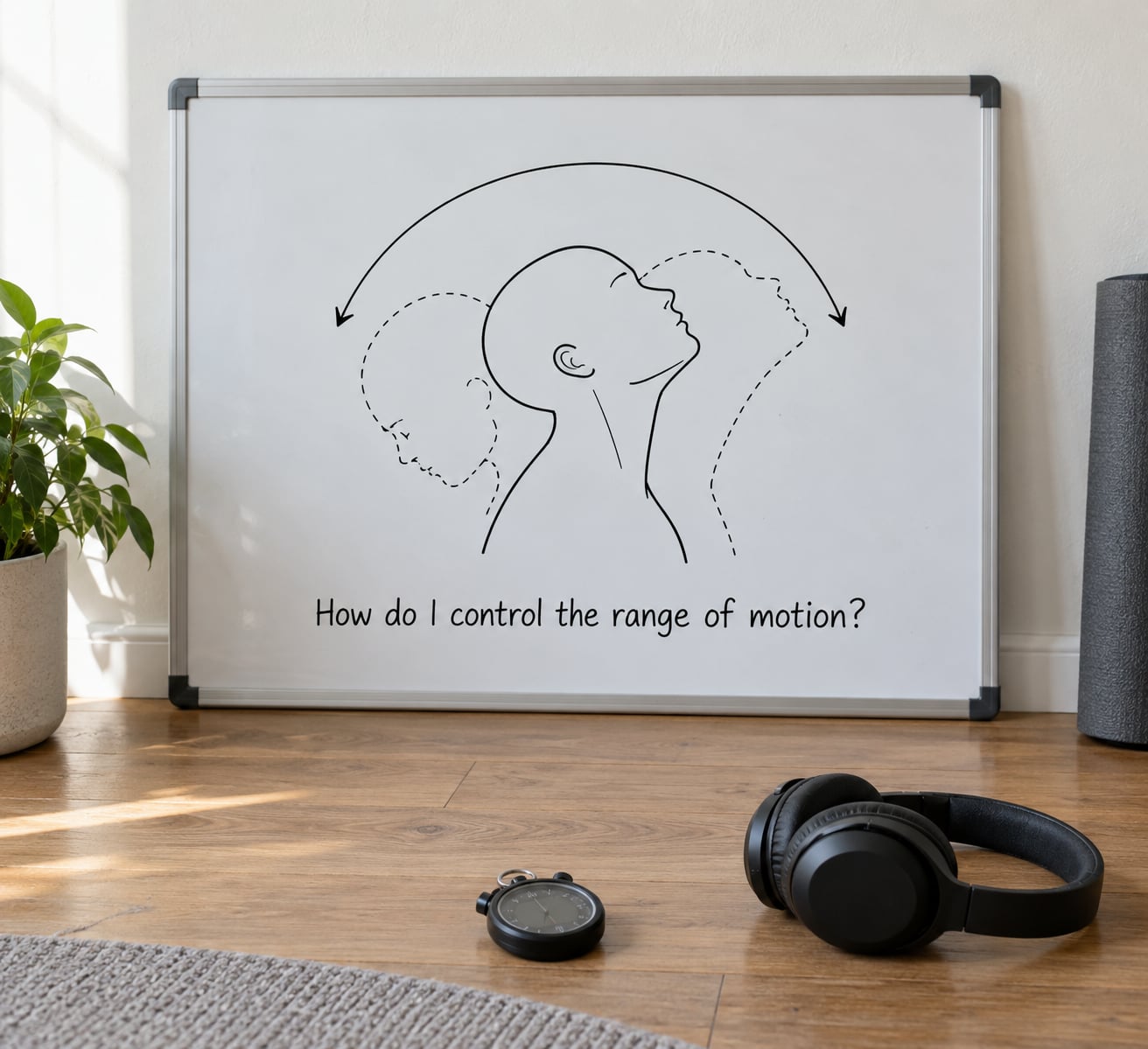
Control the range by keeping the swing short and shallow. The head travels up and down a few inches in time with the beat, and it returns to neutral between throws. Most of the motion you see from the floor is coming from the hips.
The most important rule is that the chin never drops sharply and the neck never snaps backwards past neutral. A forward chop with the chin tucking toward the chest loads the front of the cervical spine; a hard backward arch loads the back of it. Both extremes are where injuries come from, and both feel dramatic.
Tempo and angle trade against each other. As songs speed up, the safe angle gets smaller, not bigger.
| Tempo | Comfortable headbang | Watch out for |
|---|---|---|
| Under 100 BPM | Full range is fine, use it to build coordination | Bouncing too hard between beats |
| 100 to 140 BPM | Medium swing, hips driving, neck stays stacked | Chin tucking on every downbeat |
| 140 to 180 BPM | Shallow angle, roughly 45 degrees, head bangs every other beat | Forcing a swing on every beat |
| Over 180 BPM | Very shallow, more torso than neck, rest between tracks | Copying a fast band instead of your own ceiling |
On anything fast, the single most useful trick is to bang every other beat instead of every beat. Halving the frequency halves the load and the sound barely changes across a wall of guitars.
Practice the swing slowly, at half speed, in front of a mirror. You are checking that the head stays with the body and returns to neutral each time. Speed comes later, and only once the slow version looks clean.
How do I headbang without neck pain on fast, heavy tracks?
On fast, heavy music the honest answer is that you change the technique rather than trying harder. Drop to every other beat, cut the angle roughly in half, and let the torso do the travel.
Blast beats and double kicks are where people injure themselves, because they swing on every impact. Pick one hit per bar if that is all you can hold, and take the rest of the song at a shallower range. A crowd will not notice a quarter of the room taking a break on the fast track.
Prior practice that drops the tempo: pick a mid-tempo track, set the BPM down about 20 percent if you can, and rehearse the exact range you want to hold at full speed. Working out the shape slow is far more useful than flailing at full tempo.
Also alternate. If your festival set runs a deathcore band, a doom band and a black metal band in that order, you are asking your neck to absorb three completely different loads in ninety minutes. Put the heavy fast band earlier while you are fresh, or drop one track’s tempo rather than trying to match every recording.
How do I build headbanging endurance?
Endurance comes from the neck stabilisers and the hips, and it responds to progressive loading over weeks. The plan below is the answer to the question forum users keep asking: can you get stronger neck muscles in about a month? Usually yes, in the sense that most of the soreness disappears.
The routine is three items, done four or five days a week:
- Chin tucks. Five-second holds, ten reps, three sets.
- Isometric neck holds. Palm against the forehead, back and each side of the head. Press into your hand at about 20 percent of maximum for ten seconds, five per direction. Do not strain.
- Head resistance. A resistance band around the head, or a partner pushing gently, while you hold the head still and resist. Ten seconds, six reps.
Week 1: movement only, two minutes of slow nods per session. If you wake up sore, you did enough.
Week 2: add chin tucks and the three isometric holds at short duration. Five minutes of slow headbanging after.
Week 3: extend to ten-second holds and add the band work. Push your practice tempo up toward a real mid-tempo track.
Week 4: keep the same load, but practice in bursts. Thirty to forty seconds hard, two minutes resting, repeat. This mirrors a show far better than one long block.
The burst model matters as much as the strength work. Nobody bangs continuously for a set, so do not practice continuously either. A user in r/Metal trained their neck before a two-weekend festival run and reported being able to mosh and headbang again at a next-day sideshow with far less soreness than the first weekend, which is the pattern most people get when they build up properly first.
Increase one thing at a time, either duration or speed, never both in the same session. Sudden jumps are what turn a training plan into a few days of pain.
How do I headbang safely at a concert?
At a show the risk is split between your neck and your footing. A neck injury usually comes from the angle, and a head or back injury usually comes from the floor.
Take a spot slightly behind the first two or three rows if you want to actually move. Front rows mean people behind you swinging at head height with no idea you are there. Being at the back or on a side is not a lesser view, and it is where the people with bad technique get hit.
Keep your feet about shoulder width, knees soft, weight forward on the balls of your feet. If you are going to mosh, elbows in and hands open rather than swinging them at strangers. Two people who drop their weight together take a hit and stay up; two people who fight it go down.
If you get pulled into the pit, let it happen rather than locking your arms and resisting. Trying to hold your ground against a crowd of people is how you end up on your back. Keep your chin tucked and your arms covering your head and neck when you fall, because the landing, not the fall, is what hurts. There are accounts in r/Metallica of being dragged in and landing badly on the neck and back, and that is a different injury from technique.
Take breaks between bands. Two minutes of standing still, rolling the shoulders, and a few chin tucks resets the stabilisers far better than pushing through three more songs.
Alcohol deserves its own mention because it is a technique variable, not a footnote. It dulls the pain signal, so the feedback that tells you to stop arrives late, and it also changes your balance and reaction time on a crowded floor. One of the most consistent pieces of advice from clinicians and metal writers over the years is that people who headbang on alcohol overdo it without noticing. Bang harder sober, or bang less hard after a few drinks. Do not do the math where more numb equals less damage.
Not every show allows full-body movement. Seated or low-access viewing still works: nod, use the torso, and keep the neck amplitude small. A seated head nod through a breakdown gets you most of the release and none of the whiplash.
And long hair is not the enemy people think it is. The extra weight is trivial. What matters is that your hair is not whipping into your eyes on the downbeat, which drags the head off line and adds rotation you did not plan for. Tie it back for fast stuff, and let it go on the slow stuff.
Common Mistakes
Almost every painful headbang comes down to one of six habits. Each has a simple correction, and the corrections take a few sessions to become automatic.
Throwing the head straight back
The classic beginner move is to snap the head backward on the downbeat, usually with the chin lifted. That loads the back of the cervical spine through a fast extension, and it is where the 75-degree figure came from in the first place.
Fix: drive up from the hips with the head stacked over the shoulders, then return to neutral. The head travels a few inches, not an arc.
Holding your breath
Everyone holds their breath through a tense moment. Two full songs of that raises pressure in the neck and upper back and makes the whole body stiffer, which makes the next swing harsher.
Fix: exhale through the throw. Practice breathing out loud on a slow track until it feels dull.
Tensing the shoulders and jaw
Shoulders creeping up to the ears and a clenched jaw are two signs you are using muscle instead of structure. Both feed directly into the upper trap, which is where the next-morning pain lives.
Fix: lower shoulders deliberately before every track, keep the jaw loose, and shake the arms out between songs.
Copying extreme motion from a video
People watch a band that has been doing this for twenty-five years, then try to match them on their first night. The range, the tempo and the conditioning are all years of accumulated training, and the internet edit shows you the peak.
Fix: copy the body, not the neck. Their torso motion transfers to you even when their angle does not.
Practicing and dancing through pain
This is the biggest one. The soreness that arrives four hours later is a signal to adjust the session you just did, not something to train through.
Fix: if the next morning is worse than the day before, cut the session length or the tempo in half the next time. Progress that walks slowly is still progress.
Neglecting recovery
A sore neck two days in a row usually means there was no cool-down at all. Water, a hot bath, upper-back mobility work and foam rolling on the upper trap and rhomboids do more than people expect.
Fix: after a show, hydrate, spend ten minutes rolling the upper back and shoulders, then do a few gentle chin tucks before bed. Ice or a cold topical in the first hours, heat later if the muscles feel tight. Keep it simple and stop if it gets worse.
Is headbanging bad for your brain?
Headbanging has a bad reputation, and honest answers matter more than reassuring ones. In absolute terms, the risk is low, and no good evidence shows that ordinary headbanging causes brain damage in healthy people.
What the research has produced is a biomechanics study on neck motion, occasional case reports of blood vessel injury in people who headbanged heavily for decades, and a lot of loud social media. Rare outcomes get reported because they are striking. That does not make them likely.
The practical takeaway is that the neck is a structural concern, not a brain one. Keep the angle controlled, train the stabilisers, and skip the marathon sets at 3am. If you have a history of stroke, aneurysm or head injury, ask a doctor before you go hard.
When neck pain after a show is a red flag
A normal bangover is dull, symmetrical where your motion was symmetrical, and eases when you move your head through its range. It peaks within a day or so and settles down over a few days.
Get medical advice rather than toughing it out if you have severe or radiating pain, pain that shoots into the shoulder, arm or hand, numbness or tingling, a persistent headache, dizziness, nausea or vomiting, blurred vision, weakness in an arm, difficulty speaking, or neck pain that is still there after several days. A fall onto the neck during a show counts as its own reason to be checked, even if you felt fine at first.
I am not a clinician and this is not a diagnosis. If any of that applies to you, talk to a doctor or physiotherapist instead of reading forum threads.
Frequently Asked Questions
Can beginners headbang without hurting their neck?
Yes. Beginners should start with a slow rhythmic nod, a shallow angle and a bent-knee stance, then build up over several weeks. The neck injury risk comes from deep flexion, extension and high tempo rather than from headbanging itself. Warm up, keep the head stacked over the shoulders, bang every other beat on fast tracks, and stop when something feels sharp or off.
How often is it safe to practice headbanging?
Four or five short sessions a week suits most people, and consistency beats volume. Keep sessions to a few minutes and increase duration or speed by no more than about ten percent at a time. If you are sore the next morning from the last session, hold the same level for another week before adding load. Rest days are when the neck stabilisers actually adapt.
Should I headbang to fast or heavy metal?
You can, but the technique changes. Above roughly 180 BPM the safe neck angle drops toward 45 degrees while the speed keeps climbing, so shorten your swing and let the torso carry the motion. Bang every other beat instead of every beat, and take breaks between tracks. Practise the shape slow before you try it at speed, and do not reach for your maximum range on your first song.
What does a safe headbanging range of motion look like?
It looks small from the outside. Your head rises a few inches with the beat and returns to a neutral, stacked position between throws, with the chin neither tucked sharply forward nor arched backwards. Most of the visible travel should come from bent knees and a rising torso. A useful self-check is that your neck never travels more than roughly 75 degrees at any point, and less as the tempo climbs.
Why does my neck hurt after headbanging?
Because the movement repeats rapid flexion and extension of the cervical spine far faster than your stabilisers are used to handling. That produces delayed-onset muscle soreness in the neck, upper back and shoulders, which peaks about twelve hours later. It is the same mechanism as soreness after a new exercise. It eases faster with a good warmup, a shallower range, and neck strength work over the following weeks.
When should I stop headbanging and see a doctor?
Stop and get advice for severe or radiating neck pain, pain that travels into the arm or hand, numbness or tingling, a persistent headache, dizziness, nausea, blurred vision, or weakness. Also stop if you took a fall onto your neck during a show, or if ordinary soreness lasts more than a few days. Those are not the same as ordinary post-show muscle soreness, which should ease with gentle movement and rest.
Conclusion
Warm up your neck, shoulders and hips before the first song. Stand with bent knees and drive the swing from the floor so your head travels a few inches and returns to neutral. Keep the bend under about 75 degrees, halve it and halve the frequency as the tempo climbs, and practice in thirty-second bursts instead of long sets.
Do the four weeks of chin tucks, isometric holds and band work. That is what makes the technique hold up on the third day of a festival rather than the third song of a night.
And stop rather than push through it. Dull soreness that eases over a few days is your body adapting. Radiating pain, numbness, a lasting headache or dizziness is a different category, and a doctor or physiotherapist is the right call there, not another thread.