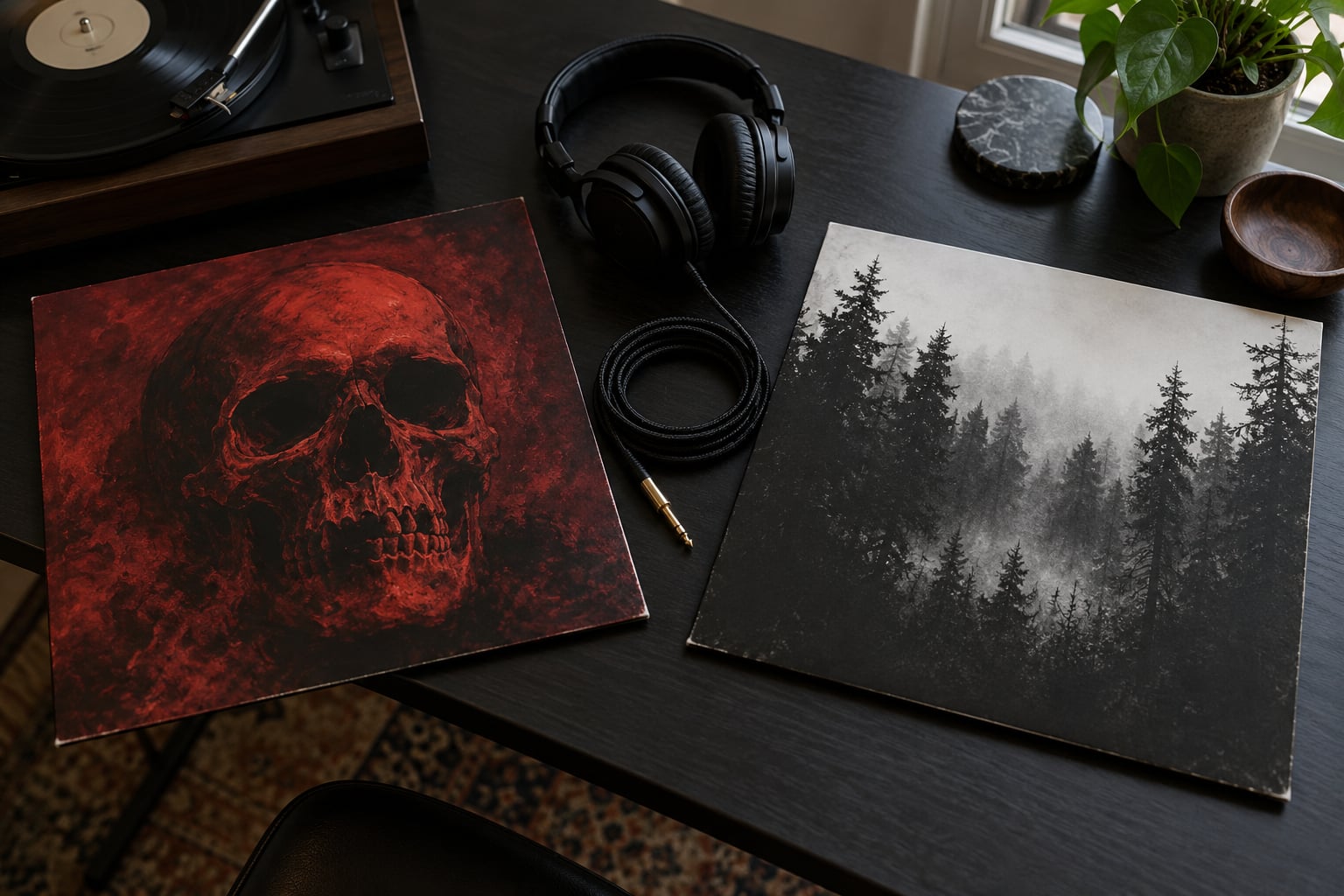
Black metal and death metal are two distinct extreme metal genres that differ in their sound, themes, and visual aesthetics. If you have been listening for a while and still cannot tell them apart, you probably picked up the short version of the explanation, which is only half right.
The difference between death metal and black metal comes down to three places: the voice, the guitar, and the production. Death metal leans on a low guttural growl, palm-muted down-tuned riffs, and a tight, punchy mix. Black metal leans on a high piercing shriek, fast tremolo-picked lines, and production that is often raw and lo-fi on purpose.
Everything else people lump into the difference is mostly shared. Both sit under the extreme metal umbrella. Both run fast, both use blast beats and low tunings, both come from underground scenes, and both overlap so much that plenty of revered bands are genuinely hard to file.
One thing worth fixing before anything else: black metal is not simply darker and heavier than death metal. That is the most common first impression, and it points listeners in exactly the wrong direction. Atmosphere is what separates the two more often than weight does.
Table of Contents
- Difference Between Death Metal and Black Metal at a Glance
- What Is Death Metal?
- What Is Black Metal?
- How Do Death Metal and Black Metal Sound Different?
- How Do the Vocals Differ?
- What Are the Main Themes and Visual Differences?
- Which Genre Is More Intense or Difficult to Listen To?
- Where Do Death Metal and Black Metal Overlap?
- How Can You Start Listening to Each Genre?
- Which Should You Choose?
- Frequently Asked Questions
- Conclusion: Start With Sound, Then Follow Your Taste
Difference Between Death Metal and Black Metal at a Glance
| Category | Death Metal | Black Metal |
|---|---|---|
| Roots | Early 1980s thrash and the 1983-1991 US scene, centred on Florida and California | Mid 1980s underground, then the early 1990s Norwegian second wave |
| Signature vocals | Low guttural growls, barks, low shrieks, shouted passages | High shrieks, rasps, croaks, barks, sometimes clean singing |
| Vocal placement | Front and centre, mixed forward and dry | Varies from buried and reverbed to dry and up front |
| Guitar approach | Palm-muted chug riffs, chugging rhythmic figures, occasional leads | Tremolo picking, single-note lines, arpeggiated patterns |
| Tuning | Usually low, often dropped flat or below | Usually low, occasionally dropped a full tone or more |
| Rhythm section | Blast beats, double kick, tight and mechanical | Blast beats, double kick, looser and more human |
| Typical tempo | Mid to fast, often relentless | Slow to mid for atmospheric styles, fast for raw and war metal |
| Production | Tight, punchy, clear, usually bottom-heavy | Hiss-heavy, flat, lo-fi, sometimes tracked cheaply on purpose |
| Common themes | Death, horror, gore, disease, mortality, despair | Occultism, anti-religious ideas, paganism, nature, misanthropy, philosophy |
| Imagery | Gore effects, horror art, brutality, medical or industrial imagery | Corpse paint, spikes and robes, stark black and white art, medieval and occult symbols |
| Live performance | Relentless physical energy, moshing, straightforward stagecraft | Deliberate theatre, slow headbanging, ritualised stage presence |
| Subgenre spread | Brutal, melodic, technical, deathcore, death-doom, slam | Raw, atmospheric, symphonic, blackgaze, war, depressive |
Read that table once and the rest of this guide mostly explains itself.
What Is Death Metal?
Death metal grew out of thrash metal in the mid 1980s. Possessed and Death in the US, and Xecutioner and Necrodaemon in Sweden, took thrash speed and pushed it further until the riffs became simpler, the tunings dropped, and the vocals turned into something no one had heard before.
The result is a genre built around rhythm. Guitarists rarely play fast melodies; they play palm-muted figures that lock with the kick drum, in a repeating pattern that creates weight rather than melody. The drummer usually plays blast beats, which is a sixteenth-note pattern spread across the whole kit, or a double kick pedal pattern on the floor tom.
What death metal sounds like
Listen for a riff that feels like it is being hammered rather than sung. Then listen underneath it for a low vocal that sits right in the same register as the guitar, as if the vocalist and the riff are one texture split into two parts.
The vocal is the fast identifier. Death metal vocals, usually called death growls, are produced from the throat rather than the chest. The singer speaks or shouts into the microphone while forcing air past tightened vocal cords, which produces a thick, rolling, animal noise.
Lyrically, the genre leans on death itself as its subject: horror, gore, disease, decay, fear, cruelty, and despair. Not every band stays there. Opeth writes about other things entirely, and Gorguts moved into abstract philosophical territory in the 1990s.
Death metal is also the more open of the two genres. It absorbs influences from punk, thrash, jazz, prog and ambient music, which is why melodic, technical and death-doom branches all sit comfortably inside it.
What Is Black Metal?
Black metal began in the mid 1980s in a small underground wave that few people witnessed, then got a second life in Norway between 1991 and 1993 with Mayhem, Burzum and Darkthrone. That period is when the sound, the imagery and the reputation were all set at once.
The musical idea was to strip metal back rather than pile onto it. Guitars play fast single-note tremolo lines or repeating arpeggios, the tone is thin and fizzy rather than thick, and the drums sit behind the guitars instead of in front. Production quality is often rough, and that is a choice, not a failure. More on that below.
What black metal sounds like
Listen for thin, watery guitars that flicker rather than punch, and for a voice that is either a very high shriek or a dry rasp sitting close to the microphone. Atmospheric black metal pulls in the opposite direction, slowing everything down into long droning passages with clean guitars and folk-style melody.
That spread is the key thing. Black metal is a wide door rather than a narrow one. Raw black metal, atmospheric black metal, symphonic black metal, blackgaze, war metal and depressive suicidal black metal all carry the name and sound nothing alike.
Thematically, the genre moved away from Satanism earlier than most people assume. Early and mid 1990s black metal dealt heavily with occultism and anti-religious provocation, but later waves turned toward paganism, Norse and Finnish mythology, nature, melancholy and philosophical darkness.
How Do Death Metal and Black Metal Sound Different?
Three things decide it almost every time: the guitar playing, the rhythm section, and the mix.
Guitar riffs decide most of it
Death metal riffs are rhythmic and chord-based. Notes are often muted with the palm and left to ring as a thick chord, repeating in a pattern that locks to the drums. Black metal riffs are melodic and single-note. The fretting hand picks the same note or a running line over and over, which creates that tremolo-picking texture.
If a riff has space between notes, you are probably hearing black metal. If it is a heavy repeating block with no space, you are probably hearing death metal.
Drums and tempo
Both genres use blast beats and double kick. Death metal drumming is typically tighter and more precisely locked, sometimes following a click track through long passages of the same tempo. Black metal drumming, particularly in the raw tradition, is looser and pushed harder against the guitars.
Tempo is less useful than people think. Brutal death metal runs at the same speed as raw black metal. Atmospheric black metal runs slow enough that it barely feels like extreme metal at all. If tempo were the dividing line, the genres would not work.
Production style
Death metal records are usually mixed to be clear and heavy. Every instrument is audible, the kick is huge, and the low end is deliberately boosted.
Black metal records often sound worse on purpose. Guitars hiss, the drums are thin, the mix is flat. Bands did this to record cheaply, to sound distant and inhuman, and to refuse the polish of thrash and death metal. The lo-fi look is an aesthetic, not a budget failure, and treating it as bad production misses the point.
Both ends of that spectrum exist in both genres, and the two sounds meet constantly in hybrid bands.
How Do the Vocals Differ?
Death metal vocals are lower, thicker and more consistent. A guttural growl is a controlled rasp that stays in roughly one register for minutes at a time, and barks are short, loud, heavily compressed shouts.
Black metal vocals have more options. The signature is a high shriek, produced in the nasal passages, that many newcomers describe as a pig squeal. That sits beside dry rasps, croaks, mid-range barks and, in atmospheric and symphonic work, genuinely sung clean vocals with a lot of reverb on them.
Neither vocal style belongs exclusively to one genre. Death metal bands shriek constantly, black metal bands growl, and the two together are common in hybrids. As a shortcut for a stranger’s record, the growl points toward death metal and the shriek points toward black metal.
What Are the Main Themes and Visual Differences?
Lyrical subjects differ more reliably than sound does in some cases, and less reliably in others.
Death metal usually writes about death itself: corpses, disease, torture, horror films, the body failing, and the general sense that everything is ending. Black metal writes about the occult, anti-clerical provocation, paganism and Norse mythology, wilderness and nature, national identity, and philosophical darkness. Misanthropy is common to both.
Visually, death metal leans on gore. Album art and stage visuals tend toward horror imagery, medical illustration, industrial scenes and brutal graphics. Black metal has its own set of symbols: corpse paint, black and white inverted covers, spikes, robes, medieval and occult symbols, and stark high-contrast photography.
Corpse paint is close to a black metal signature, though it is not exclusive to it. It comes from the early 1990s Norwegian scene, where it made visual sense alongside the music and now functions mostly as a genre marker.
None of this makes either genre dangerous or serious. It is artwork and lyrics. Bands and listeners vary enormously, and the theatrical side is a performance convention rather than a belief system.
Which Genre Is More Intense or Difficult to Listen To?
Death metal is usually harder to listen to for a newcomer, and the reason is physical. It is fast, relentless and evenly intense, with no room in most tracks to breathe. Black metal is often easier to sit with, because atmosphere gives you somewhere to rest.
Black metal can be far stranger though, and that strangeness is what trips people up. A hiss-heavy record in a flat mix, with vocals that seem to come from nowhere, is a genuinely unfamiliar experience even at moderate tempo.
So neither genre is automatically more extreme. Death metal wins on density, black metal wins on strangeness, and the exceptions on both sides are famous enough to name.
If you want an easy first listen, start with slower atmospheric black metal or melodic death metal. Both have space, both have clear structure, and both will tell you whether you like extreme metal at all before you commit to the faster ends of either genre.
Where Do Death Metal and Black Metal Overlap?
The two genres share a lot more than their reputation suggests. Both come from the extreme metal umbrella, both use low tunings, distorted guitars, blast beats and dark themes, and both grew in scenes that swapped demos and played small rooms.
The overlap has produced a set of hybrid styles that are more interesting than either parent genre.
Blackened death metal
Death metal with black metal’s tremolo picking, raw production and shrieked vocals. Necrophobic and early Immortal are the standard examples. Behemoth went further and became its own category over three decades.
War metal
Black metal built for combat imagery, with marching rhythms, detuned low tunings and no subtlety whatsoever. It is loud, fast and short. Think of it as black metal pushed further into absurdity.
Melodic death metal and death-doom
The other direction. Death metal that borrows black metal’s atmosphere and slow passages, often with clean vocals and long builds. Neither hybrid is a compromise; each is a distinct thing that neither parent genre covers well.
Bands that fit neatly in one category are the exception. If a band’s catalogue moves between styles across its career, that is normal, not indecisive.
How Can You Start Listening to Each Genre?
Most people come into extreme metal through a single famous band, then dig outward. That works, but it gives you one narrow corner of a big genre. Starting with two or three albums that sound different from each other teaches you the range faster.
Five albums to start with in death metal
- Death – Leprosy (1988). Fast, melodic and clean enough to follow on first listen. The best gateway into the genre.
- Entombed – Left Hand Path (1990). The Swedish sound: thick, dark, doom-leaning, and slower than you might expect.
- Carcass – Necroticism (1991). Technical, melodic and progressive without being inaccessible.
- Cannibal Corpse – Vile (1996). Relentless, perfectly produced, and a fair picture of the mainstream extreme end.
- Opeth – Ghost Reveries (2005). Death metal with long progressive songs, clean vocals and atmosphere. A good bridge if the fast side is not for you.
Five albums to start with in black metal
- Mayhem – De Mysteriis Dom Sathanas (1994). Raw, fast and famous. The obvious starting point, and worth hearing in the state it was originally recorded.
- Burzum – Aske (1988). Slow, long, quiet and extremely influential. Almost nothing like Mayhem.
- Immortal – At the Heart of Winter (1995). Mid-tempo, melodic and cold, with the clearest guitar lines in the genre.
- Emperor – In the Nightside Eclipse (1994). Atmospheric black metal with orchestral elements, and one of the most listenable black metal records ever made.
- Satyricon – Shadowthrone (1996). Progression into something darker and more controlled, with almost no shrieking.
In your first few tracks of any album, listen for the riff shape, the vocal placement, and how much space the production leaves you. Those three things tell you more than the genre label does.
Which Should You Choose?
Choose death metal if you want rhythm first. If you like riffs that lock with the kick drum, low vocals you can feel in your chest, and constant forward motion, that is the genre for you. It is also the wider of the two, so it will hold your attention longer without you having to hunt for new subgenres.
Choose black metal if you want atmosphere and texture first. If you prefer thin and eerie guitars over heavy ones, long slow builds over relentless speed, and records that sound like they were captured rather than produced, start there.
The aesthetic range runs wider on the other side, too. Atmospheric and symphonic work sits alongside war metal and corpse-paint theatrics, so you are more likely to find a corner that feels like it was made for you.
Then go and listen to both, because the overlap is where the good stuff is. Bands like Behemoth and Necrophobic sit across the line and reward anyone who arrives knowing both sides of it.
Frequently Asked Questions
Are death metal and black metal the same?
No. They are sibling subgenres of extreme metal that share low tunings, blast beats and dark themes, but diverge on the voice, the guitar playing and the production. Death metal uses guttural growls and palm-muted riffs with a tight mix. Black metal uses high shrieks and tremolo-picked lines, often with raw, lo-fi production.
What makes black metal different from death metal?
The three clearest markers are vocal register, guitar technique and mix. Black metal leans on high shrieks and rasps, single-note tremolo-picked lines and a thin, hiss-heavy production. Death metal leans on low guttural growls, palm-muted chug riffs and a clear, punchy, bottom-heavy mix. Tempo and subject matter are far less reliable markers.
Is black metal or death metal harder to listen to?
Death metal is usually harder for newcomers, mainly because it is relentlessly intense with little space to breathe. Black metal is often easier to sit with because atmosphere gives you somewhere to rest, though its rough production and thin tone can feel stranger than expected. Both have easy entry points if you pick the right records first.
Is death metal heavier than black metal?
Usually yes in terms of weight, because death metal mixes are deliberately bottom-heavy with a huge kick and thick low-tuned guitars. But black metal can be faster and more aggressive on a single track, and modern black metal mixes are often heavier than early raw recordings. Heaviness is not a reliable way to tell the genres apart.
Is black metal a Satanic genre?
Only in its earliest wave. The late 1980s and early 1990s scene dealt heavily with Satanism and anti-religious provocation, which produced a great deal of notoriety. Later bands moved toward paganism, Norse and Finnish mythology, nature and philosophical themes. Lyrics here are art and provocation, not a statement of belief.
Conclusion: Start With Sound, Then Follow Your Taste
The difference between death metal and black metal is simpler than most descriptions suggest. Death metal is rhythm-first: low growls, palm-muted chug riffs, tight production and steady forward motion. Black metal is texture-first: high shrieks, tremolo-picked lines, thin production and atmosphere, with far more variation between subgenres.
What to do first is easy. Put on one track that sits at the centre of each genre, compare them honestly, and then follow the element you actually enjoyed rather than the genre label attached to it.
If you liked the low voice and the riffs, go deeper into death metal. If you liked the hiss and the cold atmosphere, go deeper into black metal. If you liked both, you have plenty of hybrid bands to work through.