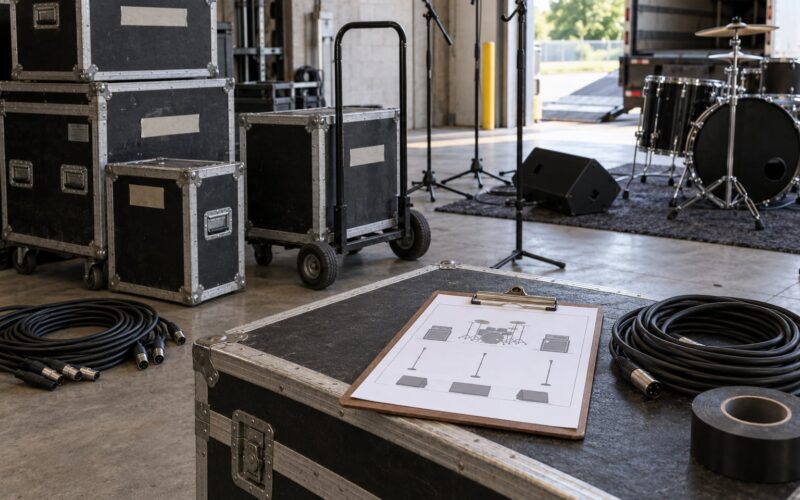
Budgeting a DIY tour comes down to one sheet: every cost the run can throw at you on one side, every dollar a date might pay on the other, and a break-even number for each show in the middle. If you know that number before you book a date, you can drop the shows that never clear it instead of finding out in a motel parking lot at midnight.
All figures below are in US dollars unless a different currency is named, and they are ranges rather than promises. Fuel, hotels and van hire have moved a lot in the last three years, which is why every tour guide worth reading states its assumptions. The ones here are simple: a four-piece band, a regional run, clubs rather than arenas.
If you take one idea from this, take the split between a survival tour and a profit tour. A survival tour is built to cover its costs and pay everyone a per diem, and for most first runs that is a good outcome. A profit tour is a different animal with different dates, and pretending the first run is the second is how bands end up eating the loss themselves.
Table of Contents
- What You Need
- Step-by-Step: How to Budget a DIY Tour
- 1. Define the Tour Format and Route First
- 2. How to Budget a DIY Tour Cost Line by Cost Line
- 3. Set Expected Income and Ticket Prices
- 4. Build the Break-Even Point
- 5. Ways to Cut Costs Without Cutting the Run
- 6. Track Spending and Set Kill Criteria During the Run
- Common Mistakes
- Treating a guarantee as profit
- Pricing tickets on what feels fair
- Leaving per diem and unpaid labour undefined
- Underestimating fuel and lodging
- Spending the promotion money too late
- Finding out the merch cut on the first night
- Leaving with no reserve and no exit
- Frequently Asked Questions
- How much should a DIY band budget per show?
- How do I calculate the break-even point for a tour?
- Should a DIY band use guaranteed money or a door split?
- How can an independent band reduce touring costs?
- How much should a band keep as an emergency fund?
- Is merchandise income realistic on a small tour?
What You Need
Most DIY budgets start with a fuel calculator and end with a shock. Six things need to exist before you open a spreadsheet, and five of them are about information rather than money.
- A route with dates attached. Not a map, an ordered list of cities with the nights you sleep in each one. Costs attach to nights, not to ambition.
- Written payment terms for every date. Guarantee amount or split percentage, when you get paid, whether the venue takes a merch cut, and whether the deal falls apart if the show is cancelled.
- Per-day cost assumptions, stated as ranges. Low, likely and worst case. A single number is a wish.
- A per-show income estimate for each date. Based on that room’s real recent history, not on the largest crowd you have ever played.
- A cash reserve ring-fenced before you leave. Money that is not part of the budget and not available for merch prints. It sits in a separate account and only gets touched when something breaks.
- A three-tab tracker. Plan, Actuals and Income. Two tabs is where the arguing starts.
One more thing helps more than any app: a mileage log. Start it on day one, note the date, the odometer reading and the purpose of the trip. Logged mileage is one of the cleanest deductions available to a working musician, and reconstructing it from memory three weeks after you get home is miserable.
Step-by-Step: How to Budget a DIY Tour
1. Define the Tour Format and Route First
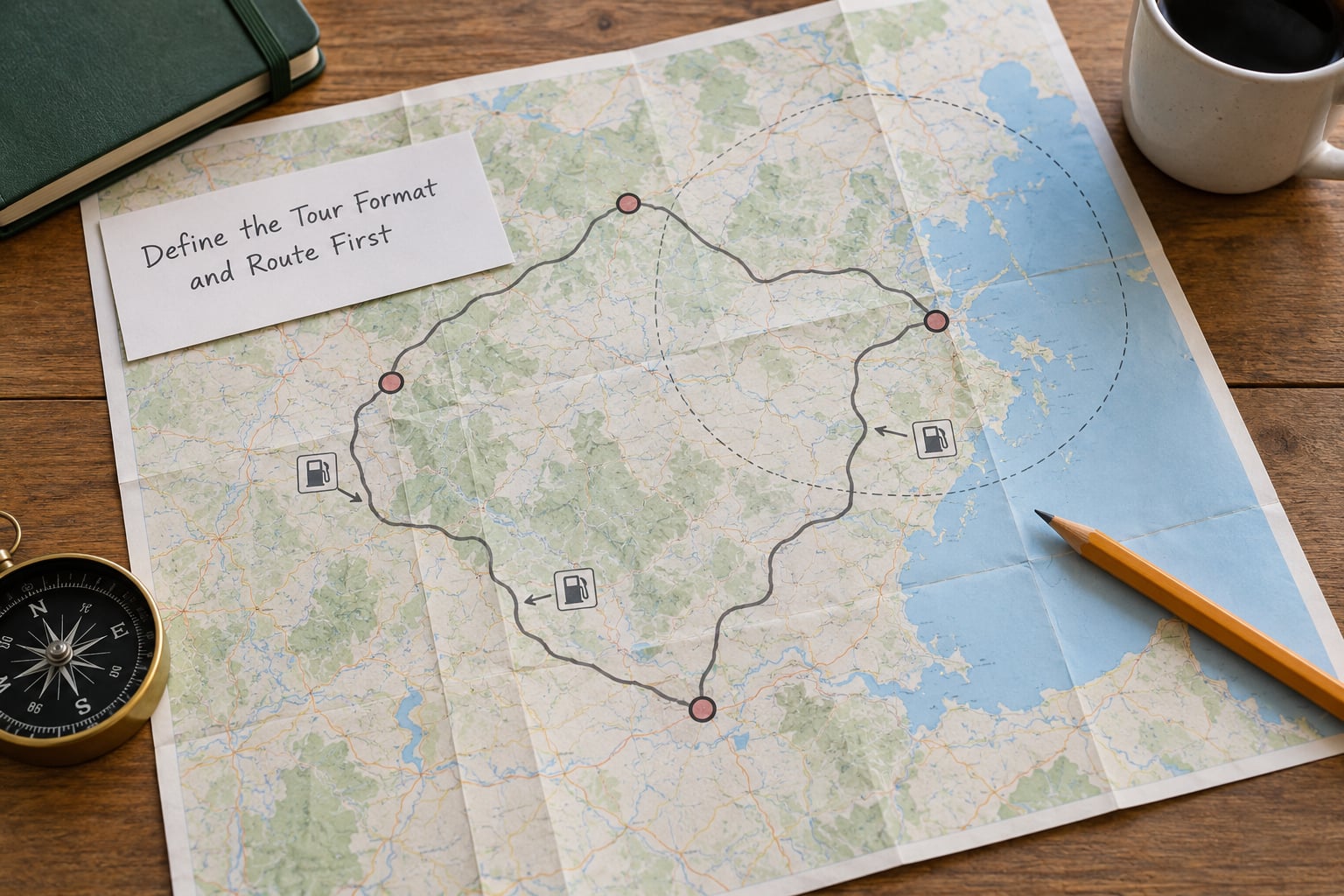
Fix the shape of the run before you fix any prices. Most first DIY tours land somewhere between eight and twelve dates over ten to fourteen days, inside a radius of roughly 250 to 400 miles from home. That radius is not arbitrary. Past it, your hotel bill, your fuel bill and your missed-sleep bill all climb while your guarantee stays flat.
Two rules keep a route honest. First, no more than two consecutive drive days, because the third one is where people get sick and gear gets broken. Second, one anchor date, a show in a bigger room or a festival support slot that pays well enough to carry the rest of the run. Bands in the DIY punk and metal scenes describe the same pattern constantly: the headlining or well-billed night subsidises the small rooms around it.
Build the itinerary backwards from the anchor. Work outwards in two directions so no member is stuck on the tail end doing nothing but driving, and settle any date whose guarantee cannot be estimated within about 20 percent of the same range as its neighbours.
2. How to Budget a DIY Tour Cost Line by Cost Line
Sort every cost into one of three buckets: fixed, per day, or per show. Fixed costs happen once (a van hire, a repair, a print run). Per-day costs repeat every morning. Per-show costs repeat per date, which lets you compare shows against each other honestly.
Add a buffer of 10 percent to every estimate, and add it once at the end rather than sprinkling it through the lines. It keeps the sheet readable when you revise it.
| Cost line | What to assume | Bucket | Notes |
|---|---|---|---|
| Vehicle purchase or van hire | Hire 110 to 190 per day, or amortise your own van over the run | Fixed or per day | Hire only if your own vehicle cannot handle the dates |
| Fuel | Total miles divided by real-world mpg, times local pump price | Per mile | The biggest single lever most bands never audit |
| Lodging | 2 rooms at 70 to 130 per night | Per day | One room for four in a 100 cap room is not always legal or comfortable |
| Food and per diem | 18 to 30 per person per day, paid on top of anything the venue feeds you | Per day | Write the rate down before leaving |
| Tolls and parking | 10 to 25 per day on an interstate-heavy route | Per day | Cash-only lots and loading zones add up |
| Backline and venue costs | 40 to 90 for backline rentals, plus any door charge or cash box fee | Per show | Ask who supplies the PA before booking |
| Sound engineer | 0 if the venue supplies one, 100 to 200 per show if it does not | Per show | Club dates often include it. Say so in the contract |
| Promotion | 300 to 600 total for posters, local listings and one video | Fixed | Spent before the first show, not during |
| Merch production | Per unit print cost times quantity, recovered at the table | Fixed | Inventory, not expense, but it is cash out of your pocket |
| Contingency reserve | 10 to 15 percent of everything above | Fixed | Not available for merch. Not for upgrades |
The fuel line deserves its own formula, because it is the one everybody guesses. Take total route miles, divide by the mileage you actually get with a loaded van and four people in it, multiply by the pump price on the route, then add 10 percent for the city driving nobody plans. A van that gets 13 mpg over 2,600 miles at 3.80 a gallon lands near 760 for fuel. The same route in a car getting 26 mpg costs about 380. That single difference is often larger than your entire food budget.
Whatever you do, measure your own vehicle’s mileage on a loaded run before you leave. The number on the badge is not the number in the sheet.
| Travel mode | Typical 2,600 mile, 10 date run | What it costs you instead |
|---|---|---|
| Own car | Lowest running cost, roughly 380 to 600 in fuel and upkeep | No room for gear or crew, and you stop when you need sleep |
| Own van | Fuel around 760 to 1,000, plus servicing and tyres | Repairs, and a breakdown with no backup vehicle |
| Hired van or camper | 1,300 to 2,400 for the run before fuel | Highest cash commitment, best per-day living conditions |
| Trains and short hops | Reasonable on dense European and UK circuits | Gear logistics, and awkward for a heavy backline |
| Flights | Only sensible for multi-region hops between clusters of dates | Bags, backline shipping, and the risk of a cancelled flight |
3. Set Expected Income and Ticket Prices
Work out what each date is likely to pay before you decide what a ticket should cost. Four income lines matter, and only two of them are guaranteed.
The guarantee is a flat fee whether anyone walks in or not. It is the only predictable money on the road, so treat the sum of your guarantees as your floor, not your income.
The door split is a percentage of the net door after the house charge and any door staff fee. Run the arithmetic honestly. With an 18 dollar advance and a 25 dollar door on a 100 cap room that sells 60 tickets, gross door is 645. Take out the house charge and the band share at 75 percent is often under 320 before a single mile of fuel. Splits are worth taking for a show in your own market where you will sell tickets yourself. Away from home they are a gamble, and the correct response is to price them out or drop them.
The hat is real money in small rooms and close to nothing in a big one. Assume 60 to 150 for a decent club night and nothing at all on a bad bill.
Merchandise is usually the second biggest line after the guarantee, and the only one where you set the margin. Details in the next section.
To set an advance price, subtract your expected merch profit per show from the income you need per show, then divide the rest by the number of tickets you are confident of selling. Add a small cushion, because a ticket that is priced one dollar under the market will sell out and cost you the show.
Research the room before you price it. Capacity, the last few bills, whether a support slot is drawing, and what the other three local bands charge. Bands that ask for numbers in writing and confirm the payment method before the run tend to get settled without drama. Bands that assume usually do not.
4. Build the Break-Even Point
Here is the whole method in one line: divide your total tour cost by your number of dates, and that is the minimum income each show has to produce.
A worked example, because the formula is easy and the judgement is not. Four people, ten dates, twelve days, 2,600 miles.
| Line | Assumption | Total |
|---|---|---|
| Fuel | 2,600 miles, 13 mpg, 3.80 a gallon | 760 |
| Lodging | 11 nights, 2 rooms at 95 | 2,090 |
| Food and per diem | 4 people at 25 for 12 days | 1,200 |
| Tolls and parking | 15 a day average | 180 |
| Backline | 3 shows at 60 | 180 |
| Promotion | Posters, listings, one video | 400 |
| Operating total | What the run costs to happen | 4,810 |
| Contingency reserve | 10 percent, held separately | 480 |
| Merch print run | 60 shirts printed, recovered at the table | 1,600 |
Break-even income per show is 4,810 divided by 10, which is 481. Now price the income. Three dates at a 300 guarantee gives 900. Five door splits in smaller rooms averaging 260 gives 1,300. The hat gives you maybe 100 across the run. Merch at 20 net sales per show, sold at an average 8 profit after print cost and any venue cut, adds 160 a night. Total income: 3,900 against a 4,810 cost.
That is a loss of about 910 before anyone takes a dollar home, and it is not unusual. It is exactly the outcome bands describe when they say DIY touring usually breaks even at best. The useful move is not despair, it is re-cutting the route. Cut the three weakest dates and the run is seven shows: operating cost falls to roughly 3,600 as lodging and fuel drop, break-even rises to 514 a night, and the same income drops to about 2,700. Still short. Raise the guarantee ask on the two worst rooms from a split to a flat 250, and the arithmetic starts closing.
That exercise, done on paper, is the entire point. Seven dates that pay is a good tour. Ten dates that do not is a band working two jobs to lose money.
5. Ways to Cut Costs Without Cutting the Run
Cost control is mostly a routing problem. The items below are genuinely different levers, not the same idea twice.
- Shorten the route radius. Every 100 miles of radius you remove cuts fuel and usually one hotel night. The show quality drops slightly; the survival odds jump.
- Offer the venue a shared hotel room block. Many rooms will take a block rate for eight to twelve people on a midweek. Get the rate in writing before the show is announced.
- Sleep in rotations. A floor at a friend’s place every fourth night costs nothing and is completely normal on regional DIY runs. Say out loud who is sleeping where, or nobody moves.
- Pre-sell merch before you leave. Pre-orders fund the print run itself, which converts 1,600 of inventory risk into part-collected cash. Post the table, ship from home, bring only what is already paid for.
- Promote directly to your own list. One well-shot video and targeted posts cost a fraction of printed posters and reach further than a stack of flyers in a record shop.
- Crowdfunding the specific gap. Fund the shortfall, not the dream. A campaign covering fuel and lodging is honest; one promising a record is a different ask and usually underperforms.
- Check what the venue already has. Backline, PA and an engineer are the three lines bands most often pay for twice.
- Sell the van idea before you buy it. If the per-mile difference between your car and a van is 300 on this route, hire for the two weeks rather than buying for the year.
6. Track Spending and Set Kill Criteria During the Run
The Actuals tab is where the plan either survives or dies. Three habits make it work.
Photograph every receipt the night you get it, then enter it with the date, the category and the amount. Separate estimated and actual columns, always. When they drift apart you learn something about the route that no amount of pre-tour planning would have told you.
Do a cash check before each show. Sixty seconds: what is in the account, what is owed, what does tomorrow need. Bands that get burned on the road usually did not run out of money suddenly. They ran out slowly, on tolls and replacement strings, while everyone was busy.
Set your kill criteria before you leave, in writing, where everyone can see them. Reasonable ones: two consecutive shows that miss their income estimate by more than 25 percent, a mechanical failure you cannot fix within 24 hours, or a venue cancelling after you have already driven to the city. Decide in advance which single date is the one you would drop to save the rest.
Post-tour, close the books properly. Total the real cost against the real income, log the mileage, list leftover merch as unsold inventory rather than a loss, and note the three dates that never made sense. That list is the routing plan for the next run, and it is worth more than anything you learned on the road.
Common Mistakes
These are the errors that show up in almost every post-mortem, and each one has a straightforward fix.
Treating a guarantee as profit
The guarantee covers the date. It does not cover the drive to the date, the night before, or the fuel home. Subtract per-show cost from the guarantee first, then look at what is left. The fix is arithmetic, not optimism.
Pricing tickets on what feels fair
A ten dollar ticket feels accessible, and accessible feels right. But the cost of the room does not care about your ethics. Set the price from the break-even number minus expected merch, then check it against the local market. If the number is uncomfortable, that is information about the room, not about the fans.
Leaving per diem and unpaid labour undefined
Unpaid rehearsal time, unpaid load-in, unpaid merch selling. This is the most common source of a band falling apart on the road, and it has nothing to do with money. Agree a daily per diem, agree who covers which costs, and agree what happens to merch money, before the first date. Bands that argue about it in month three usually stop touring in month four.
Underestimating fuel and lodging
Optimistic mileage and the cheapest room on the map are both fantasies. Measure your real loaded mpg, add 10 percent, and price two nights in a room you would actually be happy to sleep in.
Spending the promotion money too late
Posters in the week of the show reach nobody. Promotion budget goes out before the first date, spread across the run, with the local listings and the video done four to six weeks ahead. Bands that budget for it and then spend it in week two have already decided the empty rooms will be somebody else’s problem.
Finding out the merch cut on the first night
Commission and any tax added on top vary widely by room and by country, and they are discovered far too late. Ask before you commit to printing anything, and build the worst-case percentage into your profit-per-item calculation. Then, if it is high, sell click-and-collect through your own store and skip the venue’s table entirely.
Leaving with no reserve and no exit
A cancelled show after you have driven there leaves you out of pocket for fuel, food and a night you already paid for. Hold 10 to 15 percent in a separate account, write down the kill criteria, and agree in advance which date is expendable. Bands that go out with no reserve and no criteria rarely make it past the third date.
Frequently Asked Questions
How much should a DIY band budget per show?
Divide your total operating cost by your date count. In the ten-date example above, 4,810 in costs spread over ten shows gives a break-even of about 481 per show, which is the number each date has to produce in guarantee, split, hat and merch combined. Budget per show only after you know per-day costs, because several days are travel days with no income at all.
How do I calculate the break-even point for a tour?
Add fixed costs, per-day costs and per-show costs to get a total, then divide by the number of dates. That gives the minimum income per show. Subtract your expected merch profit per show from it, and what remains is the door and guarantee figure each date needs. When you budget a DIY tour this way, dates that cannot clear the number become obvious before you book them.
Should a DIY band use guaranteed money or a door split?
Guarantees for travel and for dates where you will not sell tickets yourself. Splits work in your home market on a bill you control, where the crowd is partly people you brought. Away from home, a split converts a good night into a gamble. Many bands mix the two: flat fees in unfamiliar cities, splits in cities where they have a mailing list.
How can an independent band reduce touring costs?
Shorten the route radius first, because it cuts fuel and hotel nights at once. Then ask the venue about a shared room block, plan for friends’ floors every fourth night, and pre-sell merchandise so the print run funds itself. Confirm what backline and sound the room already provides, and promote to your own mailing list rather than buying printed posters.
How much should a band keep as an emergency fund?
Ten to fifteen percent of the total tour cost, held in a separate account and treated as untouchable. It covers breakdowns, cancelled shows after you have travelled, and the small surprises that otherwise come out of somebody’s per diem. Bands in the DIY scene treat this as the one line item that is never a candidate for reallocation.
Is merchandise income realistic on a small tour?
On a small club run it is often the difference between losing money and breaking even, so yes, it is realistic, but it is a supplement rather than a plan. Net profit per unit after print cost and any venue commission commonly lands in single digits, which means twenty sales a night is doing real work. Pre-orders before the tour reduce the risk of printing shirts you then carry home.
Start with one weekend, not a two-week run. Cost four dates close to home, price them honestly, and see what the actual settle looks like at the end of the night. Bands that do that once tend to book their second run with a real break-even number instead of a feeling, and that single habit is the difference between touring and touring yourself broke.
If you are working out what to budget a DIY tour with right now, the first three things to write down are your real loaded mileage, your per diem, and the worst percentage any room on your route takes from merch. Everything else on the sheet follows from those three numbers.