A band crowdfunding campaign is a public page where you ask fans to fund one specific project — a record, a vinyl run, a tour, a van — and give them something in return that you deliver yourself. If you have never run one, this is how to run a band crowdfunding campaign without over-promising: pick a single goal, price it against real costs, build a short reward ladder you can genuinely ship, and promote it every single day until the deadline.
The order of those steps matters more than the platform you pick. Bands that treat it as “make a video, post the link, hope” tend to fail, and bands that do the preparation work raise money on small audiences. A debut artist on r/WeAreTheMusicMakers funded a record with almost no following by posting in small targeted subreddits and running open-mic nights for a month, then let the finished music bring the pledgers in. That is a repeatable plan, not a fluke.
Here is the full process, roughly six to ten weeks from first decision to a live campaign page, followed by three to six months of fulfillment once the money lands.
Table of Contents
- What You Need
- Step-by-Step: How to Run a Band Crowdfunding Campaign
- 1. Define What the Campaign Will Fund
- 2. Build a Realistic Budget and Funding Goal
- 3. Choose a Platform and Design the Payout Structure
- 4. Create a Campaign Page That Sounds Like the Band
- 5. Design Rewards That Fans Will Want
- 6. Launch and Promote the Band Crowdfunding Campaign
- 7. Manage the Campaign and Fulfill the Promise
- Common Mistakes
- Frequently Asked Questions
- Should a band use all-or-nothing or flexible crowdfunding?
- How much should a band raise on crowdfunding?
- Can a band use crowdfunding to fund touring?
- What rewards should a music crowdfunding campaign offer?
- What should a band do if a crowdfunding campaign misses its deadline?
- Conclusion
What You Need
Six things need to exist before you build the page, and skipping any of them shows up later as a campaign that stalls at 60 percent.
- A single, specific project. Not “we need money for music.” One record, one pressing, one tour, one van.
- A schedule. Recording dates, delivery dates for manufactured items, and the campaign length that fits them.
- An itemized cost list. Studio time, mixing, mastering, artwork, players, travel, lodging, fees, contingency.
- Campaign assets. A short video, photos, a logo, and enough finished music that a stranger can hear what they are backing.
- A payment platform that suits the project. All-or-nothing, flexible funding, or a direct-to-fan storefront.
- Rewards you can deliver without wrecking yourself. Usually three or four tiers, not a catalogue.
Most bands underestimate the rewards side more than the money side. A tier that looks like a nice idea on paper becomes a hundred hand-numbered packages and a lot of unpaid evenings. Count the labor before you promise it.
Step-by-Step: How to Run a Band Crowdfunding Campaign
The process has seven stages: define the project, cost it honestly, choose the platform, write the page, design rewards, launch with a schedule, then manage and fulfill. Preparation, realistic budgeting, and reliable delivery do most of the work — posting a link does almost none of it.
1. Define What the Campaign Will Fund
Turn a broad ambition into one campaign goal that a fan can repeat back to you after thirty seconds. “We are recording our debut full-length” lands. “We need help to keep the band going” does not.
The strongest goals are concrete and time-bound: finishing an album that has four songs already tracked, replacing a van that just died, pressing 300 copies of an EP that has no physical edition at all. A project fans can picture gets explained once, in every post, without you rewriting the pitch.
Ask yourself one uncomfortable question before you continue: does this project still deserve to happen if the campaign raises nothing? If the answer is no, the campaign is a request for charity, and that is a different thing to ask of people.
2. Build a Realistic Budget and Funding Goal
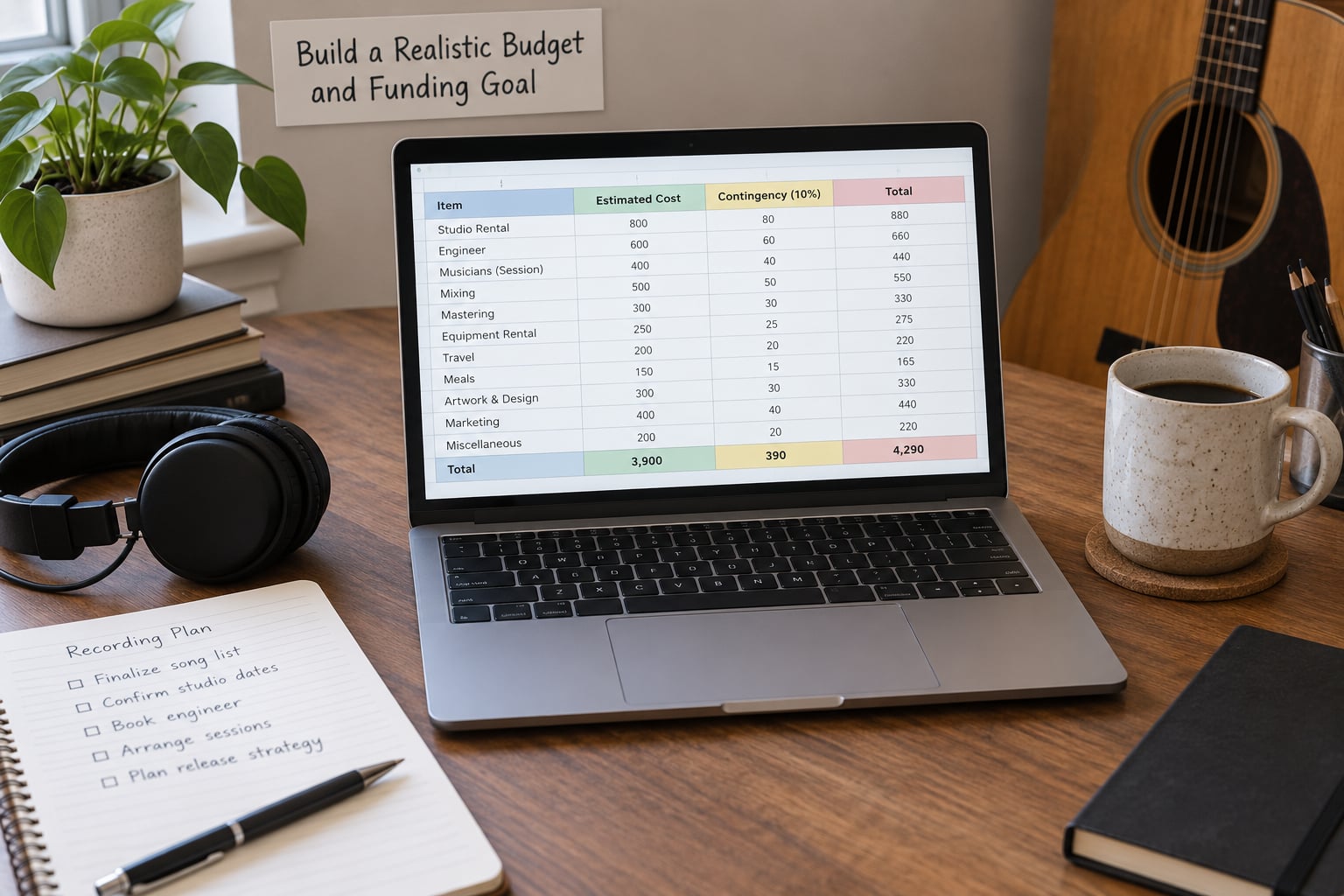
Build the budget from real quotes, not from what you hope the sessions will cost. Get the studio rate in writing, get a mastering quote, get the pressing quote including packaging and shipping, and get per-diem numbers for a tour. Then add the boring lines everybody forgets: platform and payment fees, sales tax or VAT on physical rewards, artwork, promo, and a contingency reserve of roughly ten percent.
A worked example helps. Say a four-song EP takes two days of studio time at 300 to 500 dollars a day, two days of mixing at a similar rate, mastering somewhere around 200 to 400 dollars, artwork and layout at 150 to 400 dollars, and a small physical run that lands near 800 dollars once you count discs, packaging, and postage. Add a travel line, platform fees, and a ten percent reserve, and a realistic fully loaded budget sits somewhere around 3,500 to 5,000 dollars depending on who does the work.
Now split that into two numbers. The minimum viable budget is the point where the project still comes out as promised — fewer studio days, digital-only rewards, a smaller pressing run. The preferred total is where it comes out the way you actually want it. Your goal is the minimum number, because a missed all-or-nothing goal refunds everyone and returns you to zero.
Set the goal there and list what the extra money buys above it. Stretch goals are the easiest way to raise more without raising your risk: “at 150 percent we add a second single,” or “at 200 percent we press a second color variant.”
3. Choose a Platform and Design the Payout Structure
Pick the funding model first, because it decides what happens to the money if you fall short. All-or-nothing means backers are charged only if you hit the goal, and everyone is refunded if you do not. Flexible funding means the money is yours either way, which lowers the risk but lowers the urgency — and some platforms only hold funds until after the campaign ends.
| Platform | Funding model | What you keep | Money arrives | Best for |
|---|---|---|---|---|
| Kickstarter | All-or-nothing | Platform fee plus payment processing, widely cited at 5 percent plus roughly 3 to 5 percent processing | About two weeks after the campaign ends | Big, deadline-driven launches where a clear goal drives pledges |
| Indiegogo | Flexible, with an all-or-nothing option | Platform fee plus payment processing | Rolling deposits, subject to reserve holds on early campaigns | Ongoing or evergreen projects that stay open after launch |
| GoFundMe | Flexible, no goal requirement | No platform fee, payment processing applies, optional tip prompt | Rolling deposits | Emergency repairs, medical or van costs, anything with no reward structure |
| Bandcamp or your own storefront | Direct pre-order | A percentage cut plus processing, varying by plan | On each sale | Shipping records and merch directly, without platform fees on a failed campaign |
| Patreon or similar recurring membership | Monthly commitments | Platform fee on each monthly payment | Monthly | Steady income between releases rather than a one-off spike |
Fees and payout schedules change, so confirm the current numbers on the platform before you publish rather than copying a table from an old article. Two details catch people out. First, payment processing is a percentage on top of the platform fee, so build it into the budget rather than discovering it later. Second, on all-or-nothing platforms backers are not charged until the campaign closes, which means some cards simply decline at the end. Assume a small percentage of pledges will fail and say so out loud in your updates.
Design the payout so you are never exposed twice. Backers funding a record are funding a record, not a stream of open-ended expenses. Campaigns that promise “this helps us survive” invite arguments later; campaigns that promise a specific finished object rarely do.
4. Create a Campaign Page That Sounds Like the Band
The page is a sales page, but written like a person talking to people who already care about the music. Four blocks work: what the project is, where the band is right now, what the money does, and what happens next.
Lead with the video, keep it under three minutes, and make it music-first. Show a rehearsal, a song being played, the room you are recording in. Bands on forums are blunt about what turns them off: a page with no music and no video is a dead page. A single well-recorded song demo beats a stack of glossy photos every time.
Then be specific. “Recording, mixing and mastering the full-length” is a summary. “Two days at the studio, mixed by a named engineer, mastered for vinyl and digital, with the finished record delivered to backers by a date you can hit” is a promise someone can evaluate. Put the funding goal and the deadline in the first screen of text, not in a footnote.
A short page checklist:
- The goal amount and campaign length appear immediately.
- Every cost line is itemized and the total matches the goal.
- At least one finished track is available to listen to on the page.
- The rewards list is visible without scrolling past a long essay.
- Shipping is stated plainly: what is included, what is extra, where you ship.
- The delivery estimate is honest, including manufacturing time.
Write the copy, then show it to three people outside the band. If they cannot describe what you are raising after reading it once, the page is not finished.
5. Design Rewards That Fans Will Want
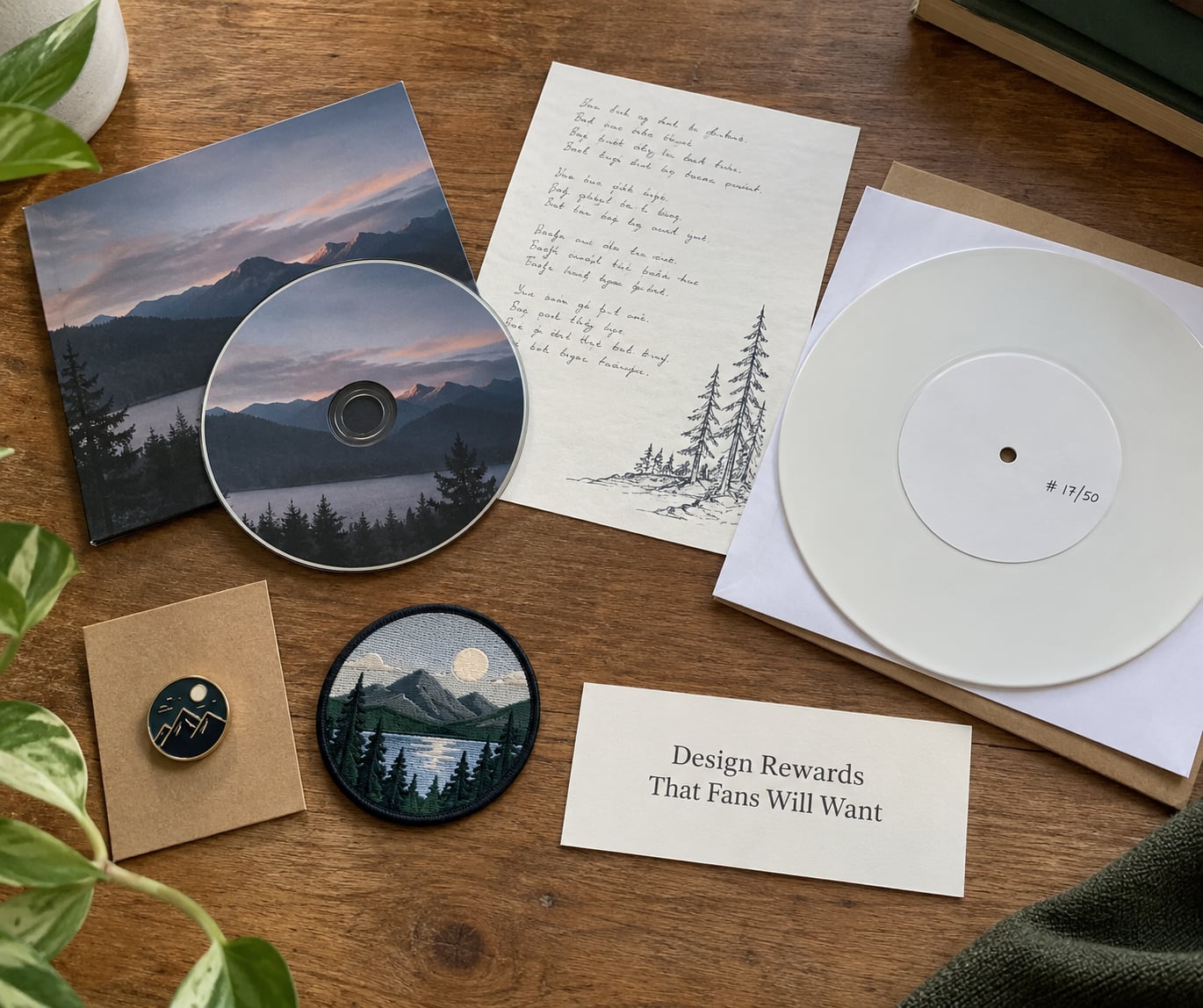
Build a short ladder with deliberate price spacing rather than a pile of options. Three or four tiers spaced widely apart let people pick their comfort level, and the gaps between tiers create natural upsells.
| Tier | Price band (US dollars) | Typical contents | Job it does |
|---|---|---|---|
| Digital | 10 to 15 | Demo track, stems, album on download, handwritten lyric sheet | Cheap entry that lets casual fans participate with no shipping cost to you |
| Signed | 25 to 40 | Signed physical copy, name in the liner notes, behind-the-scenes updates | Your workhorse tier and the one most backers choose |
| Limited | 55 to 80 | Hand-numbered edition, fabric patch, enamel pin, exclusive demo | Raises the average pledge and makes a finite quantity feel real |
| Premium | 150 and up | Signed and numbered vinyl, rehearsal-room visit, private listening party, name in the credits | Small audience, high margin, high labor — cap the quantity at a number you can handle |
Handmade and scarce rewards outperform generic merch. The artist mentioned in r/WeAreTheMusicMakers sold out a small run of hand-built CD covers inside the campaign itself, because the craft made the reward feel like the band’s actual labor rather than a printed item off a list.
Now do the arithmetic that nobody skips. Add the unit cost, the packaging, the postage, and the hours of work per package, then multiply by the realistic quantity. Limited vinyl usually means a long manufacturing window before anything ships at all, commonly three to six months from order to delivery, so the schedule has to absorb that. For anything digital, get the rights question right: if a guest player or a sample clearance is involved, you cannot sell that reward without permission.
One widely written-about tour van campaign raised about 21,000 dollars at an average pledge near 114 dollars per backer, well above the roughly 70 dollar average for music campaigns, and the difference was tier design rather than a bigger audience.
6. Launch and Promote the Band Crowdfunding Campaign
Promotion is a schedule, not a burst. Bands running a crowdfunding campaign in 2026 should assume the platform itself sends very little music traffic, and treat the campaign as something you drive to your own audience. Here is the calendar that keeps a six-week campaign from going quiet in week two.
| Phase | Timing | Key action | Who owns it |
|---|---|---|---|
| Pre-launch warm-up | 4 to 8 weeks before | Grow the list, release music, ask fans what rewards they want, film the video | One member, consistently |
| Launch week | Days 1 to 7 | Video on every channel, email the list first, post the page with a personal note | Whole band rotates |
| First quarter | Weeks 2 to 3 | Daily posts with different angles, one milestone update, one behind-the-scenes clip | Rotating member |
| Midpoint | Around 50 percent | Publish the honest percentage, announce the first stretch goal, push hardest | Whoever wrote the page |
| Final week | Last 7 days | Daily reminder posts, email blasts, direct messages to warm contacts | Whole band |
| Final 48 hours | End | Clear countdown, no new rewards, honest status update | One voice only |
The channels that matter are the ones you own: the email list, the band’s channels, and direct messages to people who have already bought something or come to a show. Social posts should not be identical sales pitches repeated eight times. Mix them: one post about the studio, one about a song, one about the budget, one about a specific backer, one about a deadline.
Local media is underrated. Radio segments, podcast appearances, and local press cost nothing and reach people who already like live music. Collaborators help too — another band with a real mailing list can send your campaign to people who will actually open it.
If you post in a forum or subreddit, ask for advice before you post the link. Musicians who dropped a bare campaign link into a music community got backlash for it; the ones who started a thread, explained the project, and let the music carry the click-through had a much better reception.
7. Manage the Campaign and Fulfill the Promise
A live campaign is a small operations job. Answer questions within a day, post an update every few days whether or not anything interesting happened, and thank people by name when you can. Bands that post meaningful updates through the final week hold attention; bands that post only the deadline post do not.
Post the real number. Saying “we are at 71 percent” tells a supporter exactly how urgent their contribution is, and it is honest in a way that vague encouragement is not. When something slips, say it early — a manufacturing delay announced in week two is a scheduling problem, and the same delay announced in week eight is a broken promise.
Then plan fulfillment as its own project with its own schedule: final recordings, mixing and mastering, manufacturing, packaging, shipping windows, and a clear way for backers to reach you. Industry reporting commonly puts the share of campaigns that miss their goal at around 60 percent, and of those that succeed, a meaningful chunk stumble on delivery rather than on funding. Budget time for hand-numbering, and decide now who owns each part of it.
Close the loop afterwards. One-time backers are the cheapest audience you will ever have, so move them to a mailing list, a Bandcamp page, or a membership tier once the campaign ends. Thank them properly, and the next campaign starts with a list instead of a cold page.
Common Mistakes
These are the failures that cost the most money, and every one of them is avoidable in a week of prep.
- Setting the goal at the number you wish for. Set it at the minimum viable budget and let stretch goals carry the ambition.
- Vague promises about where the money goes. Itemize it. Fans on music forums call out hidden use of funds as an instant credibility problem.
- Too many reward tiers. More than four adds fulfillment work and dilutes the choice. Cap limited quantities.
- Launching with no warm audience. Do four to eight weeks of list building and finished music first. Platform discovery is not a plan.
- Adding rewards in the final week. You cannot manufacture and ship something you designed on a Tuesday night.
- Hiding delays. Announce them early and keep the schedule you can control.
- Confusing a pre-order with a donation. Rewards are purchases with delivery expectations. Say what is included and when.
- Ignoring taxes and processing fees. Build them into the goal, not into a surprise in the payout.
- Underestimating manufacturing time. Vinyl and other pressed or fabricated items run long. Say so before a backer pledges.
Two habits catch more problems than any other tactic. Read the page out loud to someone who has never heard the band, and watch where they hesitate. Then talk to five potential supporters directly before launch and ask what they think the money is for, what they would pledge, and which reward they would actually want.
The answers are usually blunt and usually useful. If three people tell you the goal sounds unrealistic, it probably is.
Frequently Asked Questions
Should a band use all-or-nothing or flexible crowdfunding?
All-or-nothing suits bands with a clear deadline and a fully costed project, because it forces a real commitment from every backer and creates urgency on the final day. Flexible funding reduces risk when your costs are uncertain, since you keep whatever comes in even if the goal is missed. Bands financing a fixed deliverable like a record or a pressing usually do better with all-or-nothing, while emergency funds and open-ended projects fit flexible models better.
How much should a band raise on crowdfunding?
Raise the minimum amount that still delivers the project properly, not the amount you would love. Build the figure from written quotes for studio time, mixing, mastering, artwork, manufacturing, and shipping, then add platform and payment fees plus a contingency reserve of around ten percent. Bands with a few hundred engaged contacts should expect a raise sized to that list, not to a fantasy audience of strangers.
Can a band use crowdfunding to fund touring?
Yes, and tour-related projects are among the most straightforward to explain because the money maps to visible things: fuel, lodging, tolls, van repair, and per-diem. A widely written-about van campaign raised roughly 21,000 dollars at an average pledge near 114 dollars per backer. Set the goal from the actual route cost, state which expenses are covered, and decide in advance whether unspent money goes to a follow-up show or is refunded.
What rewards should a music crowdfunding campaign offer?
Offer three or four tiers spaced widely apart: a cheap digital download with no shipping cost, a signed physical copy in the middle, a hand-numbered limited edition above that, and one premium tier such as a listening party or rehearsal visit. Cap limited quantities at what you can hand-number in an evening. Skip generic merchandise and keep every reward tied to something only your band can make.
What should a band do if a crowdfunding campaign misses its deadline?
Close it politely, thank every backer personally, and refund promptly on an all-or-nothing platform — a fast refund is what earns you the right to try again. Do not launch an identical campaign immediately; instead write down where it stalled, then release the music in a cheaper form to stay in touch. The list and the trust you keep are worth more than the raise you missed.
Conclusion
Start with three things before you touch a campaign page. Choose one project specific enough that a fan can describe it after thirty seconds, cost it fully with written quotes plus fees and a ten percent reserve, and design three rewards you can actually deliver without losing the summer to hand-numbering.
Everything else — the video, the email list, the daily posts, the deadline pressure — is downstream of those three decisions. Bands that get them right can run a band crowdfunding campaign on a few hundred genuine supporters in 2026, and those that rush them end up refunding a page full of people they should have kept.