To grow a metal band following online, you need a defined sound and look, one place people can find everything about the band, a steady schedule of video and image content, and a way to capture the fans who actually show up. Nothing about that requires a budget or a label.
The realistic version is slower than most posts promise. A part-time band putting a few focused hours a week into this will usually need six to twelve months before online numbers move in a way that changes the band’s life — more listeners in the room, a mailing list that fills a support show, a label or booker who returns a message. Set that expectation now and the process becomes much less frustrating.
What follows is the system I would hand a new band, step by step, in the order that actually matters. Each step says what to do, why it works, and how to tell whether it is working, because most bands promote for a year without ever checking.
Table of Contents
- What You Need
- Step-by-Step: How to Grow a Metal Band Following Online
- 1. Define Your Band’s Identity and Ideal Listener Before You Promote
- 2. Build a Band Hub With a Website and an Email List
- 3. Build a Consistent Content Engine
- 4. Create Release Assets That Earn Clicks and Plays
- 5. Use Platform-Specific Promotion
- 6. Turn Listeners into Community
- 7. Build Relationships with Curators, Peers, and Press
- 8. Use Live and Short-Form Content to Reach New Fans
- 9. Measure Growth and Double Down
- A 90-Day Action Plan to Start This Week
- Common Mistakes
- Frequently Asked Questions
- How do I get my band popular?
- How long does it take to grow a metal band following online?
- Do metal bands pay for promotion, and is a small ad budget worth it?
- How do I get my music on Spotify playlists?
- Is it too late to start a metal band in your thirties?
- Conclusion
What You Need
The list is short, and you can assemble it in a week without spending anything beyond a few subscription fees. Here is what has to exist before you start promoting, because promotion built on missing pieces just spreads the gaps.
- A musical identity in one sentence. Not a genre tag, an actual description a friend could repeat. “Death metal with folk instrumentation and shouted gang vocals” beats “extreme metal.”
- A visual identity. Logo, two or three colors, one typeface, artwork templates you can reuse without asking anyone for help every release.
- A band hub. A single page or small site with discography, tour dates, bio, contact, and a mailing list signup. A link-in-bio page is fine to start.
- Release materials. Cover art at the correct sizes, a written description of the release, clean masters, and short-form clips cut from the songs.
- Distribution. A distributor that puts your music on streaming services without removing your rights, plus a Bandcamp page for direct sales.
- A content plan. A recurring schedule you can keep. Two posts a week beats five posts a week for one month, then nothing.
- Analytics access. Spotify for Artists and YouTube Studio are free. You also need a way to tag which link or post produced a stream.
Skip the parts you can rent later, like a manager or a music video. The seven items above are what you cannot buy your way past.
Step-by-Step: How to Grow a Metal Band Following Online
These are the nine steps, in order. The order matters more than the pace — each one gives the next one something to work with, and doing them out of sequence is how bands end up with a huge follower count and an empty room.
1. Define Your Band’s Identity and Ideal Listener Before You Promote
A defined identity is what makes a stranger in a recommendation feed understand you in three seconds, and it is the step most bands skip. Before you post anything, finish this sentence: “We make [specific kind of metal] for [specific kind of listener] who already likes [two or three bands].”
Name real comparable bands. If you cannot name three bands your music sits comfortably next to, you do not have a positioning yet, and no amount of content will fix that. Those three names also become your targeting, your playlist pitch language, and your filter for which press to contact.
How to tell it worked: three listeners who are not your friends describe your sound roughly the same way, using the same words you use. If they say “heavy” and you say “melodic death metal with a prog lean,” you are not done.
2. Build a Band Hub With a Website and an Email List
One page that holds everything you own, and a mailing list that reaches people without asking a platform’s permission, is the backbone of this whole system. Social posts and streams can disappear overnight; the list and the site are the two assets that keep working.
Your band hub needs a small number of pages, and nothing else:
- Home — one video, one sentence about who the band is, a play button, and the mailing list form above the fold.
- Music — every release, with an embedded player per track and links out to streaming and Bandcamp.
- Tour dates — dates, cities, venues, and a way to buy or RSVP.
- About / bio — three short paragraphs plus one photo.
- Press kit — high-resolution photos, artwork, logos, one-paragraph bio, longer bio, streaming links, and a contact email. This is the electronic press kit (EPK) and it is what you attach to every email.
- Contact — one booking email and one press email, kept separate.
For the mailing list, use a real signup form hosted by an email service, not a “type your email” post. Ask for nothing but the address on the first signup. The people who convert later are the ones who opted in when they had no reason to.
How to tell it worked: the site is live and mobile-readable, every post links back to it, and you can name the number of subscribers. Twenty-five real addresses is a meaningful milestone for a brand new band — those are people who gave you permission to email them.
3. Build a Consistent Content Engine
Most bands promote hard for three weeks around a release and then go quiet for four months. The fix is not more content; it is a content engine — a repeatable set of formats that you can produce without inventing an idea each time you sit down.
Formats that work for metal bands without a big budget:
- Riff breakdowns — thirty seconds of guitar, a caption explaining why the tuning or the rhythm works.
- Rehearsal-room clips — one song, one camera, honest sound. This is the most underrated format in heavy music.
- Gear walkthroughs — what amp, what pedals, what strings, what it cost to get the tone.
- Studio updates — the unglamorous parts of recording, including the takes that failed.
- Artwork reveals — the piece itself, plus the story behind it.
- Questions to the audience — the riff they’d want doubled, the cover they’d want to hear.
- Live footage — see step eight.
Pick two formats and one platform and keep a rhythm you can hold for eight weeks. Two posts a week is a real number for a band rehearsing twice a month.
How to tell it worked: you can look at eight consecutive weeks of posts and none of the weeks is empty. That is the whole bar at this stage.
4. Create Release Assets That Earn Clicks and Plays
A release is a two-week window, and the materials you prepare before the day decides how that window goes. Treat the artwork, the metadata, and the clips as part of the recording process, not as marketing you do afterwards.
Before each single or EP, you should have:
- Artwork at every required size — square, vertical, and the wide crop platforms crop into without cutting off the logo.
- Written metadata — genre tags, a one-line hook, a short description that says what the record actually sounds like, and correct credits and songwriter names. Wrong credits on a split release hurt everyone involved.
- A pre-save link — it collects the first-day plays that decide how the release is distributed afterward.
- Three to five clips — the hook, a riff, a lyric moment, one live take, one behind-the-scenes moment.
- A release post on your own channels — the newsletter and the site go out first, so the audience that signed up hears it before the algorithm decides.
Do the metadata while you still have the notes from recording. Three months later you will not remember which guest did which solo.
How to tell it worked: first-week streams are your normal baseline for a later release, and the weekly listener report shows listeners arriving from somewhere other than your own profile. If 90% of plays come from people who already follow you, the release did not travel.
5. Use Platform-Specific Promotion
The same caption pasted across five platforms is the most common waste of a band’s time. Each platform rewards a different format, and metal fans are spread across them rather than concentrated on one.
Here is roughly where metal listeners actually are, and what works on each:
| Platform | Audience | What works | Posting rhythm |
|---|---|---|---|
| YouTube | Listeners who search and binge; the oldest discovery engine in heavy music | Full songs, live sessions, riff breakdowns, gear videos | One video every 1 to 2 weeks |
| Fans who buy merch and attend shows | Reels from shows, studio photos, tour announcements | 3 to 4 feed posts a week | |
| TikTok | Cold listeners who do not follow you yet | Short hooks, drum fills, tuning deep-dives, sing-along moments | 4 to 5 a week while a track is running |
| Spotify and Apple Music | People who already play metal on repeat | Release quality, metadata, saves, editorial playlists | Every release, plus Release Radar timing |
| Bandcamp | Your most committed listeners | Direct support, physical and digital extras, liner notes, updates | Every release and every show |
| Discord | Your existing core, the fastest feedback loop you have | Listening parties, feedback requests, jam nights | Several times a week |
| Reddit and Facebook groups | Genre communities that reject link dumping | Genuine participation, answers, gear talk | Presence, not promotion |
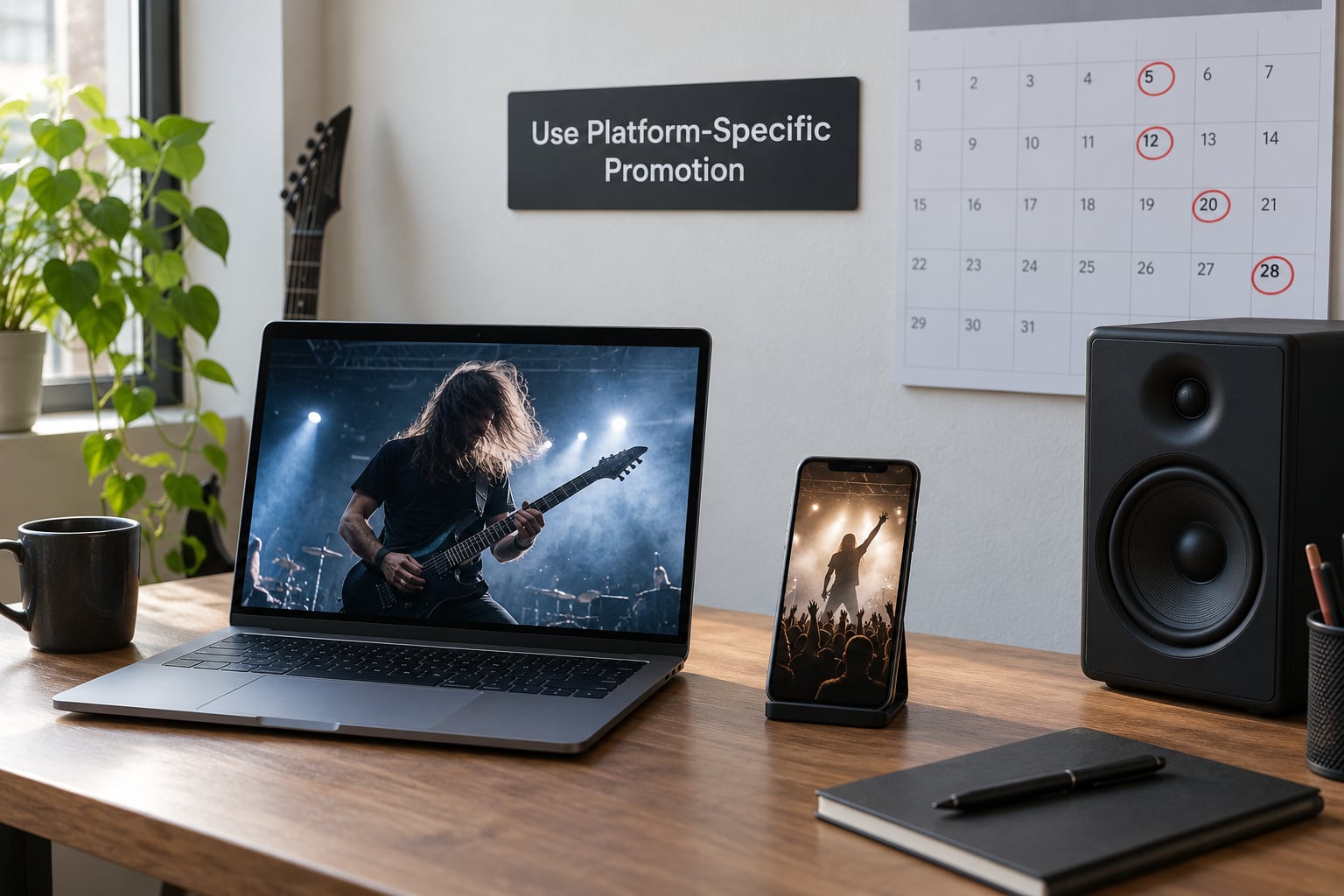
The platform question that comes up constantly is short-form video versus long tracks, and it deserves a straight answer. A seven-minute track will not perform as a single clip. What does work is cutting the song into its component moments: the riff, the drum fill, the vocal hook, the breakdown, the crowd. Post those as separate pieces and let the full track live on YouTube and streaming.
How to tell it worked: your best-performing post is not the one you expected when you made it. Track that for eight weeks and build more of whatever it was.
6. Turn Listeners into Community
One-way promotion caps out fast. The bands that grow slowly but steadily are the ones that give people a reason to come back, respond to, and tell other people about — and in metal that usually starts in a show, a practice room, or a group chat.
Ways to build it that do not feel like marketing:
- Reply to every comment for the first year. Not with a thank-you. With an actual answer.
- Spotlight fans. Repost someone’s cover of your song, their tattoo, their rig, their setlist.
- Ask for opinions. Which riff to double, which track to finish, whether the new logo reads better. People defend a decision they helped make.
- Run listening parties. A scheduled playback where you talk through the record while people listen. It works even with 12 people watching.
- Start a Discord server or a group chat. Set rules early, post a listening link on release day, keep it small and active.
- Cover requests. Fans get invested when they help pick what you play.
Being careful with self-promotion in metal communities is not optional. Bands that drop a link and leave get removed from places like r/Metal, r/metalcore and the genre-specific subreddits every week, and so do the accounts that repeat the behavior. Spend a few weeks answering other people’s questions first. After that, a link in the right place is welcome, because the community already knows who you are.
How to tell it worked: you can name thirty people who have commented, messaged, or shown up more than once. That is your actual fanbase. A follower count is not.
7. Build Relationships with Curators, Peers, and Press
One shared release with a band three times your size, or one slot on a playlist somebody genuinely curated, can reach more new listeners than a month of posting. It is slower than posting and it compounds, because metal press and playlists keep working for years after the initial send.
The process that works:
- Build a list of 40 outlets. Webzines and blogs covering your subgenre, plus the bigger names in metal music such as Metal Hammer, Kerrang!, Decibel and Blabbermouth. Note the writer who actually covers your kind of band, not just the masthead.
- Read what they publish. If a site never covers new bands in your lane, skip it. Pitching to the wrong outlet is the most common reason coverage never comes.
- Send one email — subject line naming the band, the song, and the genre in a few words; three sentences on why this fits their readers; a private streaming link; the EPK attached. No paragraph about how honored you are.
- Include the downloadable art and a fact sheet — formation date, hometown, lineup, label status, previous releases, live dates.
- Follow up once, ten days later. One line. Then stop.
Do the same for playlist curators and small podcasters who cover heavy music. Distinguish clearly between independent playlists (a person curating, you pitch the song) and paid placement services that sell guaranteed streams. Anyone who promises a specific number of streams for a fee is selling something inflated, and platforms detect and reverse it. That applies to bot-driven playlist adds too — they can get your numbers flagged, which hurts your reach.
How to tell it worked: you track replies, not sends. Ten percent reply rate is normal and healthy; zero replies after forty pitches means your pitch needs work, not that the scene is closed.
8. Use Live and Short-Form Content to Reach New Fans
A metal band generates more usable footage in one show than in three months of studio posts, and almost everyone underuses it. The show is also where your promotion is measured most honestly, because a person who bought a ticket is a person you reached.
Set a simple capture routine so this happens by default:
- One person shoots vertical video from the crowd for the whole set, audio from the board or from a nearby mic.
- One person shoots horizontal on stage for the full set.
- Twenty minutes of soundcheck, backstage, load-in and crowd reaction.
- After the show, upload the same night while people still care.
Then cut each show into pieces: one clip per song that has a moment, one long live session a month, one “tour diary” entry, one audience reaction shot. Keep the clip under a minute and put the song name in the caption so search works.
Use your streaming numbers to route your live dates. If most of your listeners are in one country, that is where you book first, because a touring band that shows up where the audience already is converts ticket sales at a fraction of the cost of a new territory.
How to tell it worked: clips from shows bring in people who were not following you before — check whether the profile visits on those posts come from your location.
9. Measure Growth and Double Down
Run a thirty-minute review on the first Monday of every month. Not more. Write down three numbers, compare them to last month, and change exactly one thing based on what you see.
The numbers worth tracking:
- Monthly listeners on streaming — trend matters more than any single day.
- Saves and playlist adds — these predict future listeners far better than plays.
- Email subscribers — the only number no algorithm can take from you.
- Tickets sold and merch sold per show — the honest conversion rate.
- Which posts brought sign-ups or streams — tag links so you can tell.
Ignore follower totals as a primary goal. Bands chasing a large following end up with a big number and an empty room on show night, which is a disappointment forum threads about this scene repeat constantly. Depth beats breadth: a thousand people who bought a shirt is worth more than 40,000 who scrolled.
How to tell it worked: you can point to one channel — a format, a platform, or an outlet — that consistently produces sign-ups or ticket sales, and you have moved your effort there.
A 90-Day Action Plan to Start This Week
The steps above only matter if they happen on a schedule. This is a workable version for a band with a few hours a week.
| Phase | Weeks | Goal | Tasks | Success metric |
|---|---|---|---|---|
| Foundation | 1 to 2 | Identity and hub live | Write the one-sentence description, name three comparable bands, build the page, set up the mailing list form, create the EPK | Site is live; 25 subscribers |
| Build | 3 to 6 | A repeatable posting rhythm | Two posts a week from two formats, release your first single with a pre-save, tag every link | Six straight weeks with no gaps |
| Reach | 7 to 10 | Outside attention | Forty curated pitches, three peer collaborations, one split release, join community spaces and contribute | Five replies to pitches; two collaborations released |
| Convert | 11 to 13 | Turn listeners into attendees | Announce shows with a clip, run a listening party, drop merch tied to the new track, run one small targeted ad | Email list grows, first out-of-region ticket sold |
Common Mistakes
Most of the failures I see are not strategy failures. They are the same handful of avoidable behaviors, and each has a straightforward fix.
Posting without a plan. Bands alternate between silence for two months and a burst of activity around a release. Fix: two posts a week on a fixed calendar, scheduled a month ahead. Volume is not the variable — continuity is.
Buying followers or plays. It produces a number that collapses, and the wrong audience never converts to tickets. Anyone selling guaranteed streams is reselling inflated inventory, which can get your releases flagged and reduce your reach. Fix: spend that money on one well-targeted video instead.
Dumping links in communities. Posting your link and leaving is the fastest way to be removed from the subreddits and groups where metal fans actually gather. Fix: participate for weeks before you ever mention your own band, and follow each sub’s self-promotion rule.
Copying another band’s roll-out. A strategy that worked for a band with a label, a publicist, and a tour is not the same strategy for a band with a rehearsal room and a day job. Fix: copy the structure and the cadence, not the budget.
Arguing with fans and with other bands. It is visible, it is permanent, and it costs you people who were rooting for you. Fix: one rule — respond once, calmly, then move on.
Changing direction every month. Sound, visual look, and platform focus all take longer than a month to settle. Fix: commit to a direction for two release cycles before judging it, and change one variable at a time so you know what worked.
Ignoring analytics. Bands check streaming dashboards obsessively and never check where those listeners actually came from. Fix: tag your links and write down three numbers a month.
Chasing every platform. Running nine accounts with a single bandmate on a phone is how good intentions go nowhere. Fix: three channels done properly beats nine channels abandoned.
Frequently Asked Questions
How do I get my band popular?
Popularity is a byproduct, not a target. Bands grow by defining their sound clearly, releasing music on a schedule, publishing video consistently, and keeping a mailing list. What looks like popularity from outside usually starts as thirty people who show up, buy a shirt, and tell a friend. Define your lane, pick three bands you sit next to, and give people a reason to return to you every few weeks.
How long does it take to grow a metal band following online?
For a part-time band with no label, six to twelve months of consistent effort is a fair window before numbers change your options. Some bands move faster from a strong single or a good tour break, and some take years. Judge progress by email subscribers, saves, and tickets sold per show rather than follower counts. Most bands that feel stuck have a content gap, not a platform problem.
Do metal bands pay for promotion, and is a small ad budget worth it?
Only after the organic basics work. Ads amplify something that already converts: a clip people watch to the end and a page that captures their email. Start small, target tightly by interest and lookalike rather than broad genre targeting, judge by cost per sign-up rather than by views, and expect the first few weeks to be a learning expense. Never buy streams or followers.
How do I get my music on Spotify playlists?
Claim Spotify for Artists, complete every field including a photo, credits, and a written description, then pitch unreleased tracks through the Spotify for Artists pitch tool at least a week before release. After that, growth comes from listeners saving the track, which feeds editorial and algorithmic playlists such as Discover Weekly and Release Radar. Skip any service selling guaranteed playlist placements or stream counts.
Is it too late to start a metal band in your thirties?
Age is not the limiting factor. What decides how far a band travels is consistent practice, a distinct sound, and the ability to keep showing up, and none of those are tied to a birthdate. What does change is your obligations, so plan honestly around a day job, family, and touring logistics. Plenty of the best-known bands in heavy music formed long after school ended. Start now and adjust the plan as life allows.
Conclusion
Start this week, in this order: write the one-sentence description of what your band is and who listens, get the page and the mailing list form live, and then publish two posts a week from two formats you can keep producing. Everything else — press pitching, collaborations, small ad spend — works better once those three pieces are running.
Give it six months of honest effort, review the numbers once a month, and change one thing at a time. Growth in 2026 moves at the speed of consistency, and that part you fully control.