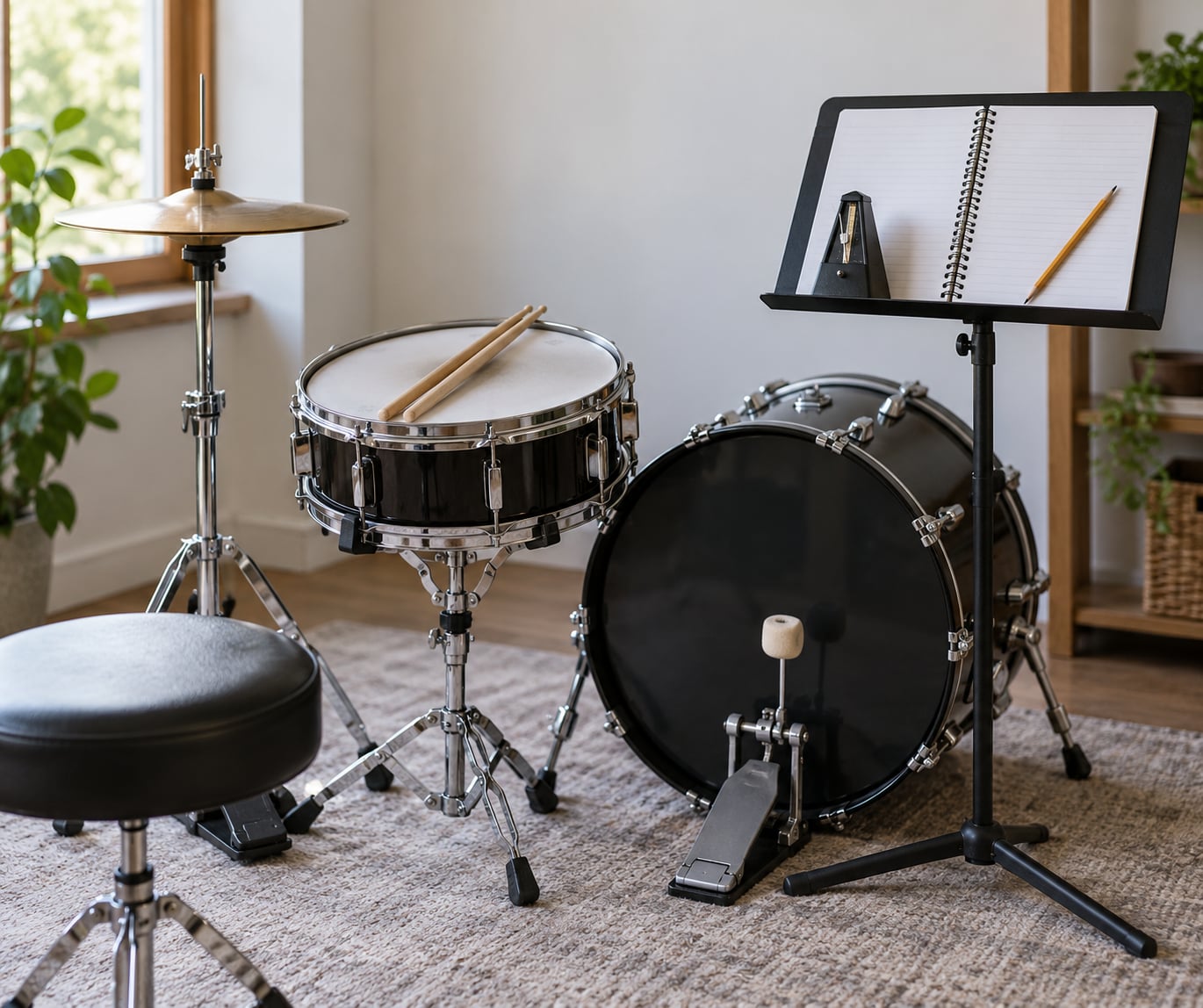
A blast beat is a drumming pattern where the hands keep a tight unison roll on the hi-hat while the snare and kick drum trade notes on alternating subdivisions, usually eighths or sixteenths, at very high speed. The result is the dense wall of sound extreme metal runs on. You do not need to be fast to start. You need a clean single stroke roll, steady eighth-note double bass, and a metronome.
Most drummers who struggle with blast beats are not trying hard enough. They play too fast on the first attempt, chase the tempo, and bury a good pattern into the floor. This guide walks through how to practice blast beats on a drum kit in six stages, with tempos, time limits and a clear sign for when to move on. Budget about six weeks of short daily sessions before you should expect a clean traditional blast in the 150 BPM range.
What You Need
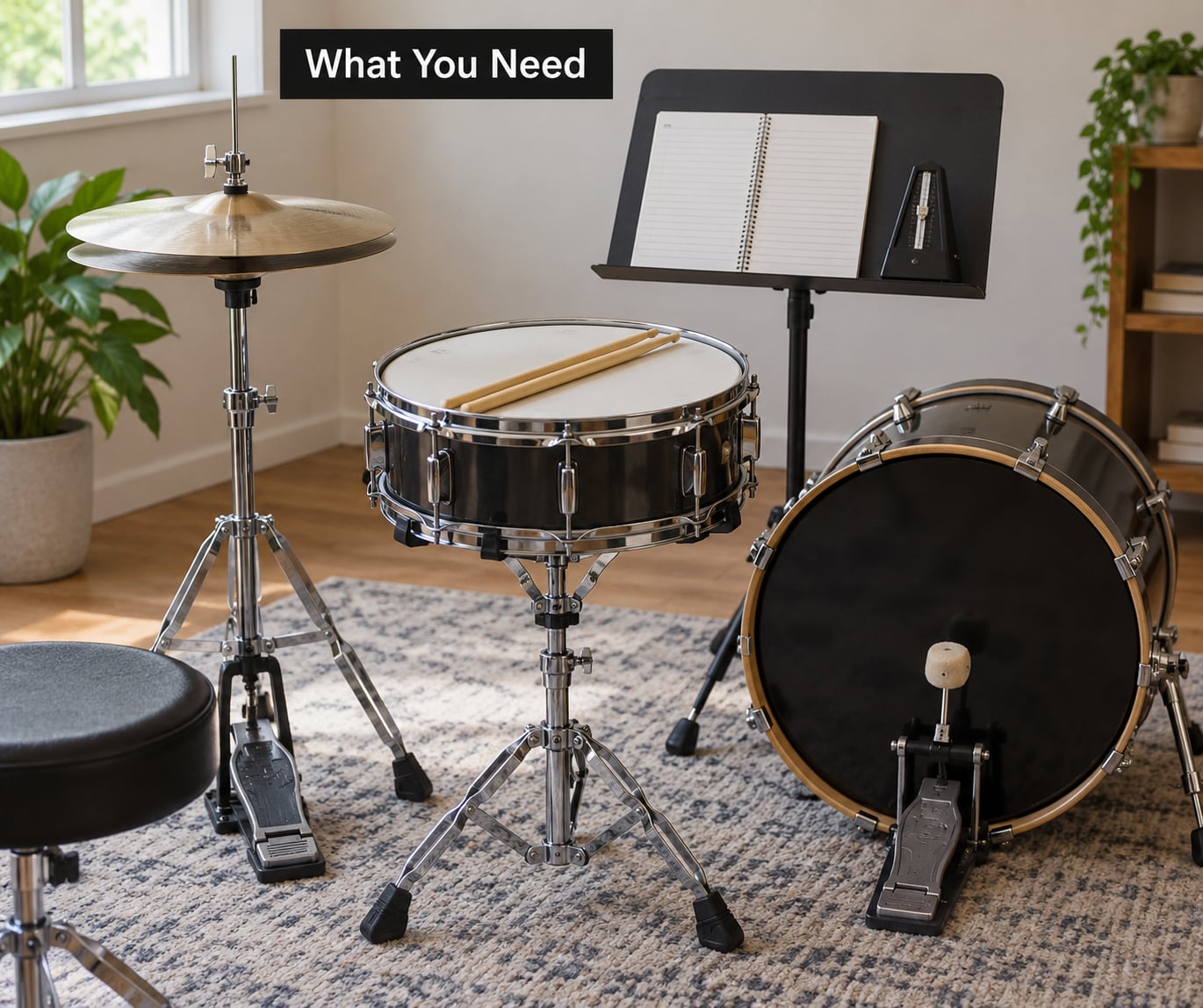
You need far less gear than the internet suggests. Here is the honest list.
- A drum kit or a practice pad. An acoustic kit is better for developing dynamics and cymbal control. A pad with a kick pedal and hi-hat is enough for the hand and foot work in the first month.
- Sticks. Your normal sticks. If they feel slippery or the rebound is dead, change them, but do not switch to heavy sticks to fix a timing problem. Heavier sticks slow you down and hide tension.
- A metronome. A phone app works. What matters is that it can play eighths or sixteenths as a click, not just a quarter-note pulse.
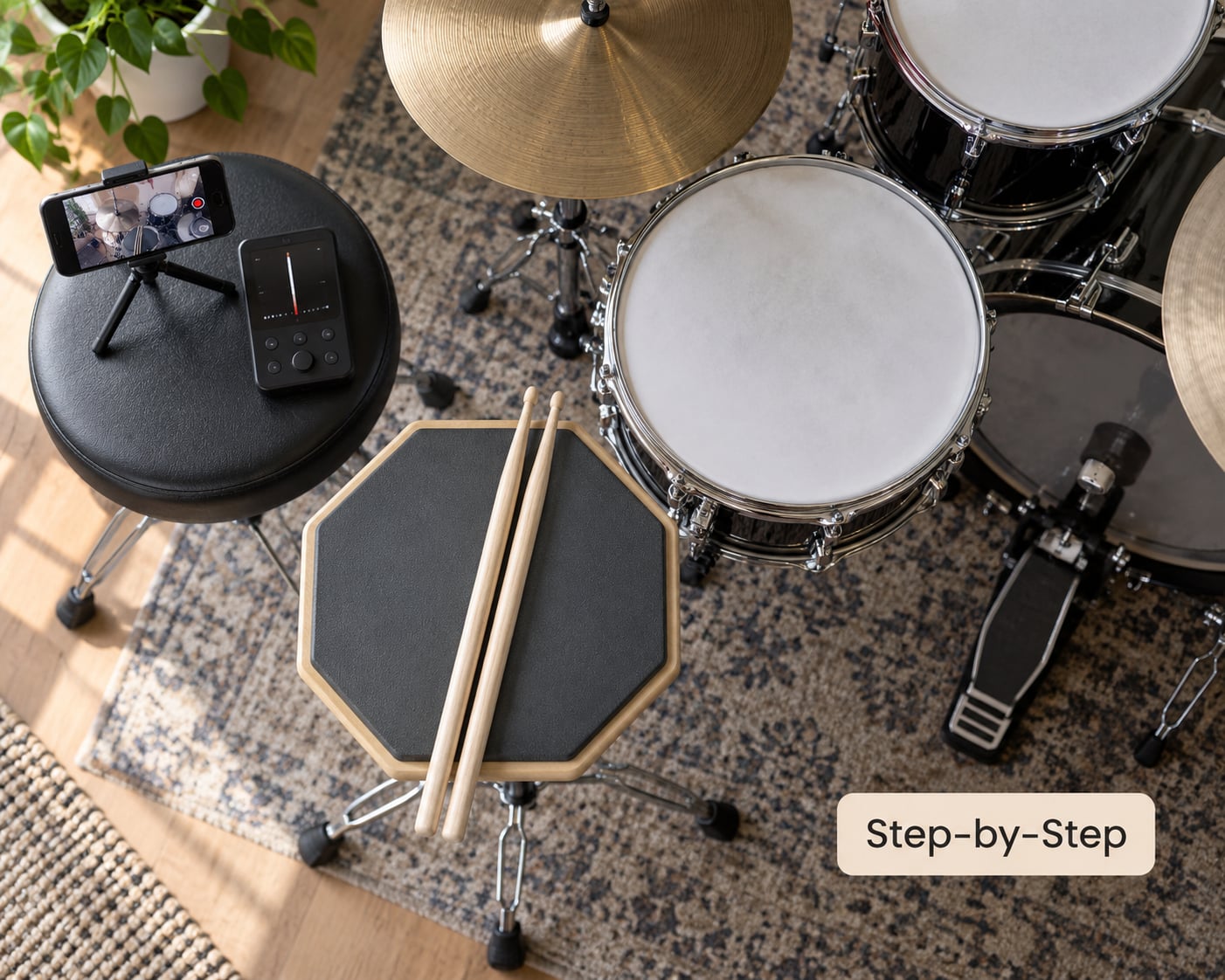
- A recording device. A phone on a music stand pointed at the kit. You cannot hear timing drift while you are playing it, and you will not believe how uneven you sound until you record it.
- A notebook or practice log. One line per session: date, tempo, time limit, what went wrong. This is the single biggest difference between practicing and progressing.
- Room hearing protection or a lower volume. If neighbours are the issue, foam plugs are cheap and worth it. You need to hear the kick and snare clearly at a low volume.
Sit at a height where your forearms are roughly parallel to the floor and your elbows sit just clear of your ribs. That position is the one you return to when fatigue pulls you out of it around minute two of a hard set.
Step-by-Step
Step 1: Check Your Starting Point
Before you touch a blast pattern, find out what you actually have. Play a simple eighth-note pattern for one minute at a comfortable tempo and record it.
Listen back for four things: does the timing drift late, does your stick height shrink as you tire, does the kick land behind or ahead of the hands, and does one side of your body rush the other. That recording is your baseline. You will compare against it every week.
Write down the tempo you played at. If you cannot hold a relaxed eighth-note pattern for a full minute without rushing, drop the tempo until you can. Rushing at a slow tempo is a tension habit, and it follows you up to 200 BPM if you do not break it now.
Step 2: Practice the Blast-Beat Building Blocks
A blast beat is three limbs interlocking, so practice the limbs apart first. Work through these in order and do not move on until each is clean.
- Single stroke roll. Hands only, alternating, at a steady eighth note for two minutes. Count out loud for the first minute. Your stroke should be small and even, with the tip of the stick bouncing off the head rather than a big full-arm swing.
- Eighth-note kick pattern. Kick only, no hands. Play a single kick on the downbeat, then the alternating pattern you will use in the blast, for one minute. Count the clicks out loud so your ear knows which subdivision each hit belongs to.
- Unison strokes with a static kick. Hands on eighths, kick playing a steady quarter note underneath. The point is to feel your hands and feet land as one unit, not three separate players.
- Hand-foot alternation. Hands on every other eighth, kick on the ones in between. This is the skeleton of the traditional blast, and it is where most coordination problems show up.
Move on when each block holds for the full time limit with no visible increase in shoulder height and no loss of evenness in the last fifteen seconds.
Step 3: Lock the Pattern to a Metronome
Now assemble the pattern. Start at 100 BPM and play the core eighth-note blast: hands on hi-hat eighths, snare on the down-eighths, kick on the up-eighths. Record every attempt.
Play it three times cleanly before you touch the tempo. Then raise it by 2 to 5 BPM and go again. That small jump is the whole method. Drummers who leap from 100 to 140 in a session build speed on top of a rushed groove, which is why they collapse later.
Drummers on r/drums and r/MetalDrums describe this same approach when they break through a plateau: hold the tempo until three clean reps, then nudge it. Community consensus puts a clean, usable traditional blast somewhere around 120 to 150 BPM for a practicing drummer, and that matches what you will hear in most early death metal records.
Step 4: Add Double-Bass Strokes Gradually
Eighth-note double bass is where beginner blast practice usually breaks down. The foot tries to match the hands and gives up somewhere around 140.
Add the double bass one subdivision at a time rather than all at once. Play the eighth-note blast as you have it, then add a second kick hit right after the first kick on the beat, leaving the off-beats alone. When that is clean, add the extra hit on the off-beat. When that is clean, you have a full sixteenth-note blast pattern and you are ready to push tempo.
Keep the feet loose. A common heel-up position, where the heel lifts and the toe pivots, uses less calf and ankle tension over a long set than heel-down. Whichever you use, keep the leg quiet and let the ankle do the work. If your kick is falling behind the hands, drop back to the simpler version and get it even again. Adding notes to an uneven pattern just builds unevenness faster.
Drummers in the r/MetalDrums beginner threads point at the same fix: lead the traditional blast with the foot rather than the hand. It feels backwards at first, but it puts the burden of the pattern where the weakness actually is and fixes a weak left foot as a side effect.
Step 5: Build Speed and Endurance
Speed and endurance are different things and they need different practice. Speed comes from short bursts at a tempo that is hard for you. Endurance comes from long, moderate holds.
For speed, use the Derek Roddy exercise system, which comes up more than anything else in the drum community for this exact job. The pattern is simple and the discipline is the point: play it for a full minute or two at a steady tempo rather than in short bursts. Commenters stress the same thing, that the exercise only works if you stay on it.
For endurance, play at a moderate tempo for a full minute without speeding up, then rest two minutes and do it again. Three or four holds in a session is plenty. A commonly recommended stamina drill is to play the pattern up around 270 BPM, but treat that as a controlled hold, not a performance tempo.
| Week | Tempo range | Daily minutes | Focus | Milestone to hit |
|---|---|---|---|---|
| Week 1 | 90 to 110 BPM | 20 | Building blocks and eighth-note blast | One clean minute with no drift |
| Week 2 | 110 to 135 BPM | 25 | Add sixteenth-note double bass gradually | Pattern holds for 30 seconds |
| Week 3 | 130 to 160 BPM | 25 | Short bursts, Roddy system, foot leading | Two clean minutes at 150 |
| Week 4 | 150 to 180 BPM | 30 | Play-along, dynamics, endurance holds | Even 16th blast for 60 seconds |
Rest days are part of the plan, not a break from it. Forearms build during recovery. If you feel tightness at the start of a session and it does not clear after a few minutes of warm-up, take the day off.
Step 6: Practice Musical Applications
Isolated exercises are scaffolding, not music. By week three you should be playing along to records, and the failure mode here is predictable: the wall collapses as soon as someone else is playing.
Pick one record and learn the whole song at a slow tempo, not just the blast section. Use early death metal as a reference point for a traditional blast, and grindcore or D-beat records if you want the skank or the -1 beat feel. Play along at half speed, with the record slowed down or with the drums in your headphones.
Then work on dynamics. A blast at full volume for the entire song is exhausting and musically flat. Play some of it quietly, push the cymbal wash, and let the kick accents carry. This is where hand-foot independence actually gets tested, because you are no longer able to hide behind maximum effort.
Finally, vary the accents. Accent the first and third beats, then the downbeats, then the snare notes. If the pattern stops sounding identical in every bar, you have learned a groove rather than a trick.
Common Mistakes
These are the errors that show up again and again, and the fix for each one.
Rushing the tempo
You speed up as you get tired, usually in the last fifteen seconds of a set. Play facing a metronome that clicks on the last sixteenth so a late hit is obvious, and drop the tempo a notch rather than pushing through. One clean minute at 120 is worth more than a messy attempt at 160.
Gripping too tightly
A death grip is a stress response to high speed, and it makes you slower. Loosen until the stick feels almost uncontrolled, then let the rebound bring it back. A matched grip sits low in the palm and gives the wrist an easy arc.
Using arm force for a small stroke
Big swings from the shoulder burn out in two minutes. Keep the motion in the fingers and wrist with a low stroke height, so the stick travels only a few inches between the head and the hi-hat. If you can hear the stick hitting the head hard, the stroke is too tall.
Sacrificing kick accuracy
Adding more kick notes to keep up with the hands is the single most common way beginners break a pattern. Cut the pattern back to the version you can play perfectly, add the extra kick hits one at a time, and only move up when the simple version is boring.
Practicing too long in one go
High-speed playing has a hard ceiling of about ten minutes before form degrades. Three or four short sets with real rest between them beat one long session. Drummers who get forearm cramp usually do not need more practice, they need shorter sets and more rest.
Ignoring dynamics
Practicing every note at maximum velocity trains you to play tired. Deliberately practice some passes quietly. It feels wrong and it is the thing that lets you play a whole song without blowing out.
Two specific problems come up so often they deserve their own answers. If the kick keeps falling behind the hands, the pattern is too dense for your current foot speed, so simplify to the alternation only and rebuild. If the pattern gets uneven at speed but is clean slow, it is tension rather than a coordination gap, so slow the tempo down by 10 BPM and relax the grip until evenness comes back. If unevenness sits on one side only, lead with that side on purpose for a few minutes each session.
Frequently Asked Questions
How long should I practice blast beats each day?
Twenty to thirty focused minutes, four or five days a week, beats one hour of unfocused playing. High-speed work has a short ceiling: after about ten minutes of hard blasting, your form degrades even if you do not feel it. Break your session into three or four sets of five minutes with two minutes of rest between them, and take a full rest day when your forearms feel tight.
How fast should a beginner blast beat be?
Around 120 to 150 BPM, played evenly for a full minute. That range is where most drummers develop a traditional blast that holds up in a real song, and it matches the tempo of a lot of early death metal. Speed above that comes later and comes from endurance work, not from chasing the metronome. If you cannot play a minute even at 120, slow down, not up.
Are blast beats hard to learn?
They are hard in a specific way. The pattern itself is simple, usually the same notes over and over, so coordination is not the obstacle. What takes time is holding perfect evenness at speed without tension, because the speed exposes every small unevenness in your stroke. Drummers who already have a solid single stroke roll and eighth-note double bass usually get a usable blast within four to six weeks of steady short sessions.
Is playing blast beats bad for my wrists and forearms?
Not inherently, but the way most people practice them is a problem. Long sessions at maximum effort with a tight grip are what cause forearm cramp and tendon irritation. Practice with a loose grip, small stroke heights, wrist-led motion and real rest between sets, and build up minutes gradually. Persistent pain, numbness or weakness is not a practice problem, so stop and see a doctor or a physical therapist.
Why does my kick drum fall behind my hands?
Usually the pattern is denser than your foot can comfortably play at that tempo, so the foot gives up partway through and drifts. Reduce the pattern to hand-foot alternation with no double bass, get that perfectly even, then add the second kick hit one subdivision at a time. Leading the pattern with the foot instead of the hand also helps, because it puts the burden where the weakness is.
Can I practice blast beats on an electronic drum kit?
Yes, and it is useful for the first four to six weeks because the kick and snare triggers give immediate feedback without the volume. The limitations are real: you will not develop cymbal wash, stick rebound feel or dynamics, and cheap pads respond poorly to fast alternating stick strokes. Practice pattern and timing on the pad, then move to an acoustic kit before you call a tempo milestone met.
Conclusion
Start tomorrow with the boring part: record one minute of an eighth-note pattern at a tempo you can hold, and listen to it before you change anything. That baseline recording tells you whether your problem is timing, tension, foot speed or endurance, and each one has a different fix.
From there the route is straightforward. Work the building blocks apart, assemble the pattern at 100 BPM, add double bass one subdivision at a time, and raise the metronome by 2 to 5 BPM only after three clean reps. Keep sessions to twenty or thirty focused minutes with real rest, and move up a week only when you meet the milestone rather than when the week ends. Follow that plan and this guide on how to practice blast beats on a drum kit will get you an even, tension-free traditional blast you can actually play in a song.