To know how to insure musical instruments, you itemise every piece of gear with its serial number and realistic replacement value, attach receipts or appraisals, then either schedule those items on your homeowners policy or buy a standalone instrument policy written for players. The whole process takes an afternoon of paperwork plus a few quote comparisons.
Most people get this wrong in the same way: they assume the policy they already pay for covers everything, then find out the sub-limit, the named-peril wording or the professional-use exclusion at the worst possible moment. Here is the short version before the detail.
- Check your existing cover first. Homeowners and renters policies usually cap instruments at a few thousand dollars in total, under named perils only, and often exclude anything used for paid work.
- Build a written inventory. Make, model, serial number, condition, purchase date and what it would cost to replace the same instrument today.
- Compare policy types, not just premiums. A scheduled personal property endorsement, a dedicated instrument policy and a commercial inland marine policy behave very differently when you file.
Table of Contents
- What You Need
- Step-by-Step: How to Insure Musical Instruments
- Step 1: Inventory and value every instrument
- Step 2: Check whether an existing policy already covers it
- Step 3: Compare the main types of instrument insurance
- Step 4: Set limits, deductibles and usage protections
- Step 5: Ask questions and compare the quote
- Step 6: Buy the policy and protect the evidence
- Step 7: Review coverage before gigs, travel and major changes
- Common Mistakes
- Frequently Asked Questions
- Does homeowners or renters insurance cover musical instruments?
- How much insurance should I have for my musical instruments?
- Do I need an appraisal to insure a guitar or other instrument?
- Will my instruments be covered while I am traveling or performing?
- What documents do I need to make an insurance claim?
- Is it cheaper to insure all my instruments under one policy?
- Start With One Task Today
What You Need
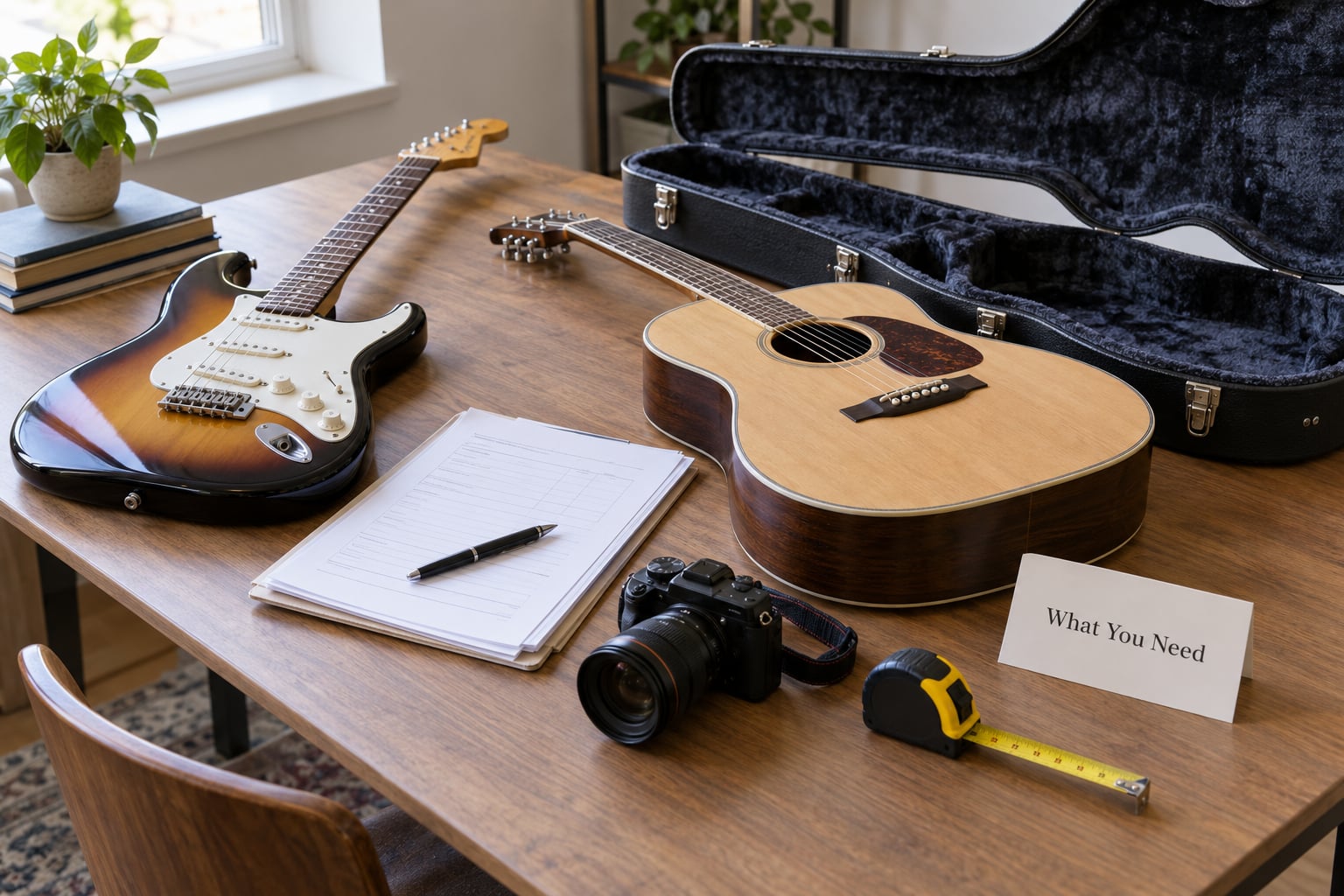
Gather these before you request a quote, because the underwriter will ask for most of them anyway and the answers set your premium.
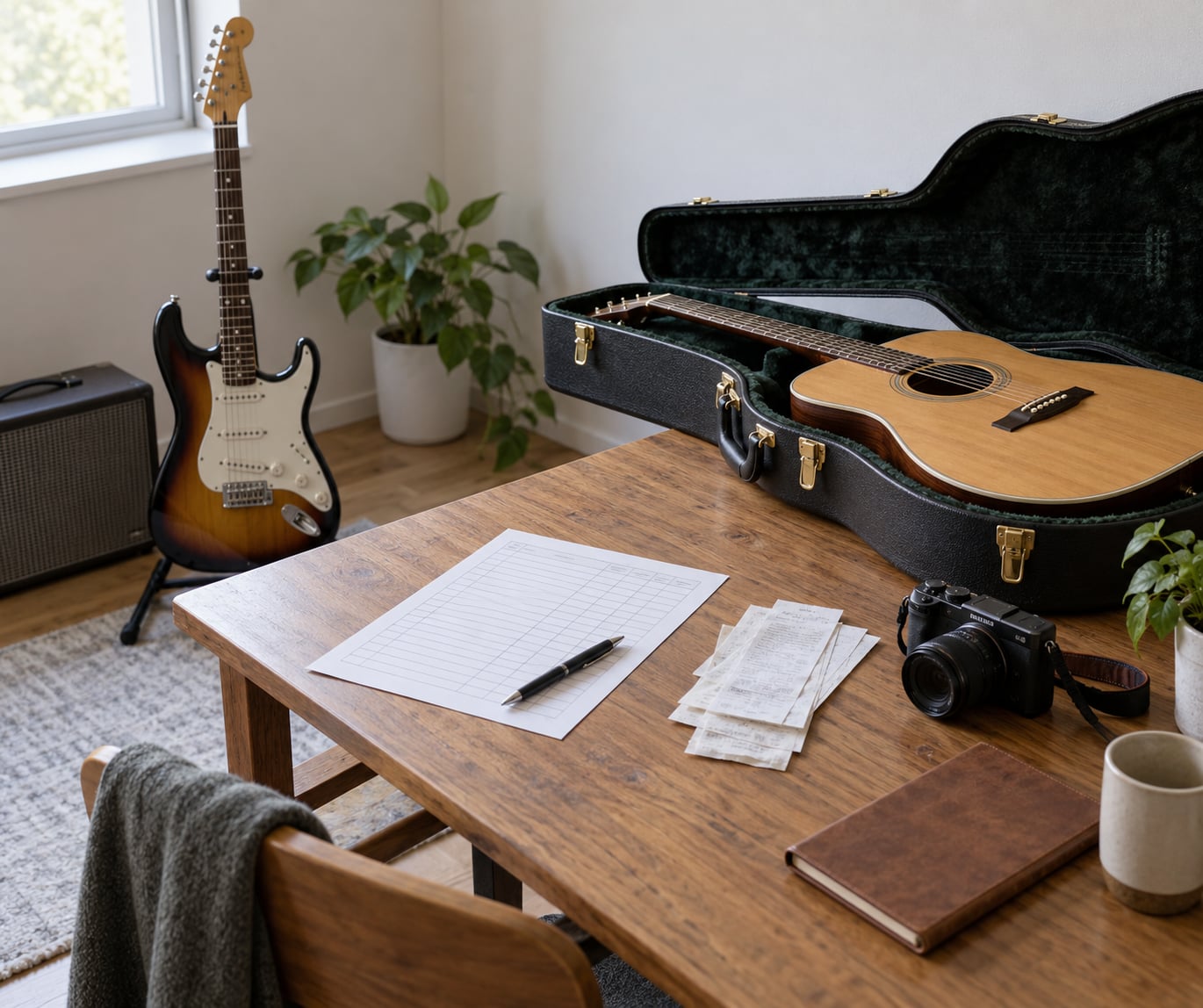
- Make, model and serial number for every instrument, including amps, cabinets, pedals, stands and cases worth insuring.
- Proof of purchase – the original invoice, receipt or a dated bank or card statement showing the transaction.
- Current replacement value – what the same model in the same condition costs now, not what you paid years ago.
- An independent appraisal for anything vintage, rare, professionally modified or hard to price second-hand.
- Your existing policy details – the declarations page from your homeowners or renters policy, with the personal property limit and deductible.
- Where the instruments live and travel – spare bedroom, climate-controlled unit, rehearsal space, van, flight cases, or a different state for half the year.
- How you actually use them – hobbyist, student, paid teacher, session player, touring musician, or a full-time working band.
Photograph everything while you are at it. Wide shot, serial number close-up, front and back, plus any damage that already exists. That single habit removes most of the argument from a later claim.
Step-by-Step: How to Insure Musical Instruments
There are seven moves between “I own some nice gear” and a policy that actually pays out. Work them in order; each one feeds the next.
Step 1: Inventory and value every instrument
Write a schedule with one line per item: description, make, model, serial number, year, condition, purchase date, and replacement value. Do this in a spreadsheet so you can update it after every purchase rather than rebuilding it at claim time.
Three valuation methods exist and they pay very differently. Retail price is what a new one costs today. Replacement cost is the realistic cost of buying the same instrument used in the same condition. An independent appraisal sets a defensible number for anything unusual. For a modern production guitar, a receipt is usually enough; forum players report that many insurers accept seller documentation and only want a formal appraisal above roughly 5,000 dollars of value.
Step 2: Check whether an existing policy already covers it
Pull out your declarations page and read the personal property section before buying anything new. Coverage C on a standard homeowners policy treats instruments as ordinary contents: named perils only, a sub-limit in the low thousands of dollars, off-premises cover often capped at about ten percent of the total personal property limit, and a deductible commonly between 1,000 and 2,500 dollars.
Then check the exclusions. Paid performances, paid teaching and recording for money are frequently excluded outright, and flood, earthquake and accidental damage such as a dropped instrument or a pet chewing a cable usually are not covered at all. A renters policy is generally even thinner. If your deductible is 2,000 dollars and the guitar is worth 900, the cover is decoration.
Step 3: Compare the main types of instrument insurance
There are three routes, and working out how to insure musical instruments properly comes down to one question: whether the gear is a hobby, a job, or a touring backline.
| Policy type | Paid gigs | Accidental damage | Transit and travel | Settlement basis | Best for |
|---|---|---|---|---|---|
| Homeowners endorsement or floater | Often excluded | No | Limited, off-premises capped | Actual cash value, sub-limited | Low-value hobby gear inside the home |
| Dedicated instrument policy | Usually included if declared | Yes | Worldwide, including air freight | Replacement cost or agreed value | Gigging players, teachers, collectors, studios |
| Commercial or inland marine | Yes | Yes | Worldwide, all shipping modes | Agreed value, per-item schedule | Touring bands, backline, PA and studio gear |
Inland marine is the policy written for property that travels for a living. It costs more and it pays more, and it is the only one of the three that treats a scheduled amplifier the same way it treats a 1959 solid body. A scheduled personal property endorsement – sometimes sold as a personal articles floater – sits between the other two and is worth a call to your existing carrier, but read the wording rather than trusting the sales pitch.
Step 4: Set limits, deductibles and usage protections
Set each limit at what it would actually cost to replace that specific item, not at a round number that feels generous. Then pick the highest deductible you can genuinely afford without wrecking the claim, because small instruments and high deductibles do not mix.
Next, confirm in writing that the policy covers the ways you use the gear: playing live, teaching, recording, rehearsing, sending an instrument to a luthier and flying it. Ask whether cases, bows, stands, pedals, cables, preamps and studio monitors are listed separately or included as accessories. Several specialist policies automatically cover newly acquired items up to a share of the policy limit for a window of days, which is handy after a big shop purchase.
Step 5: Ask questions and compare the quote
Quotes are hard to compare because the wording differs so much between carriers, and that is where most people trying to work out how to insure musical instruments get a bad deal. Ask every broker the same list.
- Is the settlement actual cash value or replacement cost?
- Can the policy be written on agreed value?
- What proof of ownership and value do you require, and at what value threshold?
- Is there a per-category or per-item sub-limit?
- Where does coverage apply geographically, and does flying count?
- What is excluded, especially professional use, wear, and pre-existing damage?
- What deductible applies, and is it waived for theft?
- What happens to the premium after a claim?
- How long is the policy term and what are the cancellation terms?
Quote at least three sources and read the declarations page of each, not just the summary. Pricing benchmarks in this market run around one percent of insured value per year for many hobby policies, and rates are quoted per 100 dollars of value, so a collection valued at 20,000 dollars might land somewhere in the low hundreds annually. That is a rough anchor, not a quote. Rates vary by state, by carrier and by how you describe your use of the gear.
Step 6: Buy the policy and protect the evidence
You have bound cover when the insurer confirms it in writing and sends you a declarations page listing each item, its value and the settlement basis. Save that PDF somewhere you will find it in a panic, and keep the evidence with it. Anyone who gets how to insure musical instruments right treats the paperwork as seriously as the policy itself.
Take photographs from multiple angles, store serial numbers in the same spreadsheet, and back everything up to the cloud. Receipts and appraisals belong in a folder that survives a flood – a scan in cloud storage and a paper copy in a bank box is the belt-and-braces version. Then update the schedule after every repair, upgrade, reissue or new instrument.
Step 7: Review coverage before gigs, travel and major changes
Contact the insurer before touring, moving house, storing instruments somewhere new, lending gear to another band, or playing a festival in another country. The pre-trip routine is short: check every case latch, photograph the loaded backline, note the flight or courier reference, and keep the claims phone number and policy number in your phone.
For one-off cover there is a second option most people never hear about. Short-term or per-shipment policies cover a single tour leg, a flight day or one shipment to a repair shop, and they are usually cheaper than buying an annual policy for gear you barely use. Multiple providers sell them for a few days at a time.
Common Mistakes
Almost every denied instrument claim traces back to one of these. Each has a straightforward fix.
- Undervaluing the gear. Insure what replacement costs, not what you paid. Fix: use today’s market price for an equivalent instrument.
- Missing serial numbers. A description without a serial number is hard to prove. Fix: photograph the serial plate for every item on the schedule.
- Assuming the homeowners policy covers everything. Named perils, sub-limits and the professional-use exclusion are real. Fix: read the exclusions page, then confirm the gap with a dedicated policy.
- Buying limits that are too low. Underinsuring to save a small premium is the worst trade available. Fix: total the replacement values and insure all of it.
- Ignoring travel exclusions. Gear on stage, in a van or in a hold locker is where losses cluster. Fix: buy transit cover or check the off-premises cap before the first tour.
- Forgetting gear that is not an instrument. Amps, cabinets, pedals, PA, studio monitors, microphones and interfaces are the ones left uninsured. Fix: schedule them on the same policy as named items.
- Leaving originals unbacked up. Fix: scan receipts and appraisals and store a copy off-site.
- Filing on the wrong policy out of caution. Claiming a small loss against a home policy can push the whole policy’s premiums up or trigger non-renewal. Fix: keep instrument claims on the instrument policy.
Before you close the process, confirm eight things: every instrument listed with its serial number, a current photo of each item, receipts or appraisals filed, limits set at replacement value, paid use declared in writing, transit and travel covered, deductible affordable, and the schedule updated after your last purchase.
Frequently Asked Questions
Does homeowners or renters insurance cover musical instruments?
Usually only partly. Homeowners Coverage C treats instruments as ordinary contents under named perils, with a sub-limit commonly in the low thousands of dollars and off-premises cover capped at a share of the total personal property limit. Renters policies are thinner still. Paid gigs, teaching, accidental damage, flood and earthquake are usually excluded.
How much insurance should I have for my musical instruments?
Enough to replace each item with the same instrument in the same condition today. Add the value of amps, pedals, cases and studio gear, then insure that total. A rough industry benchmark lands near one percent of insured value per year for hobby policies, but rates vary by state, carrier and declared use, so get three quotes.
Do I need an appraisal to insure a guitar or other instrument?
For modern retail gear, a receipt or dated proof of purchase is normally enough. An independent appraisal from a qualified musical instrument appraiser becomes necessary once the item is vintage, rare, professionally modified, or valued above the carrier’s threshold, which for some insurers sits around 5,000 dollars. Refresh it every three to five years.
Will my instruments be covered while I am traveling or performing?
That depends entirely on the policy wording. A home policy caps property away from the insured premises, often around ten percent of the personal property limit. Dedicated instrument policies can cover worldwide travel, air freight and courier shipping, but only if the wording says so. Confirm touring, flight and luthier-shipment cover in writing before the first show.
What documents do I need to make an insurance claim?
Bring the schedule showing the item and its value, the photograph set including the serial number, receipts or the appraisal, and dated evidence of ownership. Add a police report number for theft, and photos of the damage and the scene. Report the loss as soon as you find it, since late reporting is a common reason claims are disputed.
Is it cheaper to insure all my instruments under one policy?
Usually yes. One policy with a multi-item schedule is cheaper than several single-instrument policies, and it keeps your claims history in one place. Compare that against one homeowner endorsement only when the total value is genuinely low, because a deductible of 1,000 to 2,500 dollars can wipe out small claims entirely.
Start With One Task Today
Start by photographing every instrument and building the spreadsheet with serial numbers and current replacement values. That single afternoon tells you whether your existing policy comes close, and it is the evidence you will need whether you buy a floater, a dedicated instrument policy or a commercial inland marine policy afterwards. If you only remember one thing about how to insure musical instruments, remember that the inventory comes before the quote.
Rules and pricing for instrument insurance vary by country, state and carrier, so treat the figures here as benchmarks and read your own declarations page. If you use the gear for paid performances, say so in the quote – a declaration that turns out to be wrong at claim time is far more expensive than a slightly higher premium at renewal.