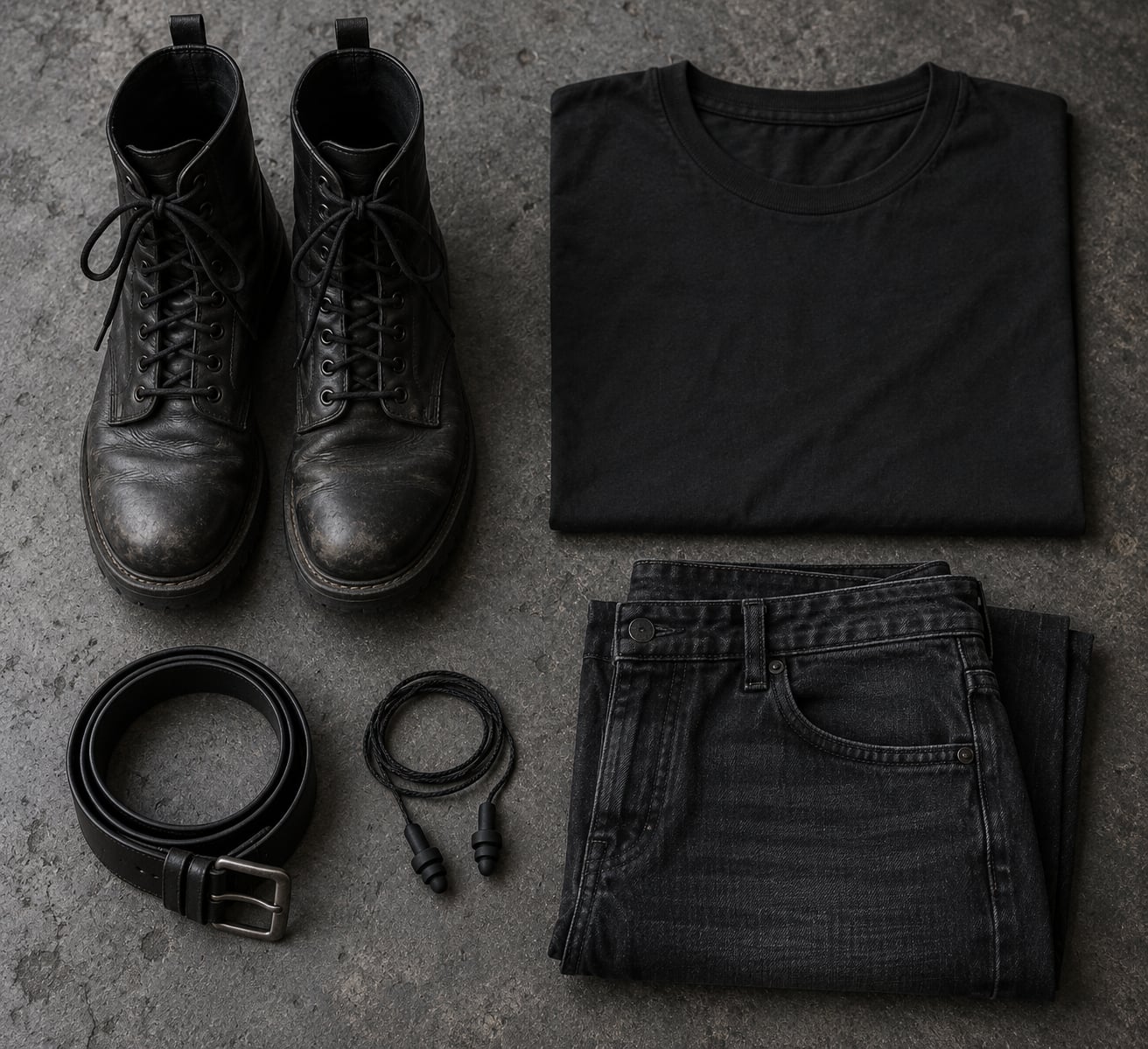
What to wear to a metal concert comes down to four things: a dark band tee, dark jeans or similar bottoms, boots you have already broken in, and a layer you can take off when the room heats up. Add a belt, zip your phone into a closed pocket, and you are dressed for the floor.
That is genuinely the whole uniform. There is no dress code and no one policing the door over your jeans. Regulars on concert forums repeat the same thing year after year: people go to shows to watch the band, not to inspect each other.
If you are nervous about looking out of place, read this guide in order. Pick your shoes first, because they decide whether the night is fun, then build the rest of the outfit around comfort and durability. Style matters, but it comes after not getting stepped on.
Table of Contents
- What You Need Before a Metal Concert
- Step-by-Step: What to Wear to a Metal Concert, Piece by Piece
- 1. Check the Venue, Weather, and Floor — It Decides What You Wear
- 2. Pick a Shirt With Your Style
- 3. Choose Bottoms That Survive the Night
- 4. Add Layers for Changing Temperatures
- 5. Finish With Supportive Footwear and Accessories
- What Not to Wear and What to Leave at Home
- Mosh Pit Etiquette Tied to What You Wear
- Outfit Builds by Body Type and Budget
- Common Mistakes and the Quick Fix
- Frequently Asked Questions
- Can I wear a shirt from a different metal band to a concert?
- What shoes are best for standing at a metal concert?
- How should I dress for an outdoor metal festival?
- Should I wear leather pants or black jeans?
- Is it safe to wear a band shirt or vest with patches?
- How do I avoid overheating inside a crowded metal venue?
What You Need Before a Metal Concert
Most people heading to their first metal show already own four of the five things they need. The list is short on purpose, because a metal concert outfit is built from basics rather than costume pieces.
- A tee: a band shirt, a vintage graphic tee, or a plain black shirt you are happy to sweat in.
- Bottoms: black jeans are the default, but cargo pants, work trousers, shorts and cut-offs all work depending on the season and the venue.
- Footwear: broken-in boots or sneakers with a thick sole. This is the one item worth spending real attention on.
- A layer: a denim vest, flannel, overshirt or hoodie for queues, outdoor stages and the walk home.
- A few small things: socks, a belt, earplugs, and somewhere safe for your wallet and phone.
What changes all of that is the room you are standing in. A 300-capacity club with no pit is a completely different outfit problem from an outdoor festival stage in July, and both are different from a seated theater show or a balcony with a rail in front of you.
| Venue type | What it does to your outfit | Best choices |
|---|---|---|
| Small indoor club, no pit | Hot, close quarters, little room to move, floor gets dusty | Breathable tee, relaxed jeans or shorts, sneakers, no heavy outerwear |
| Indoor club with a pit | Constant contact, floor debris, boots scuffed within an hour | Boots with thick soles, dark denim or cargo pants, zipped pockets |
| Large indoor arena | Long sets, big crowd, climate swings between queue and floor | Layered outfit you can strip down, boots or worn sneakers |
| Outdoor summer festival | Sun, rain, mud, grass, long days and campsites | Breathable fabrics, light layers, waterproof outerwear, boots that handle wet |
| Winter or outdoor theater show | Queue outdoors, then overheats indoors within minutes | Warm layer for the line that you can tie around your waist or hand to a friend |
| Seated, balcony or accessible viewing | No contact, more sitting, sometimes a step up from the floor | Anything you like, including a dress or a cleaner look |
Step-by-Step: What to Wear to a Metal Concert, Piece by Piece
1. Check the Venue, Weather, and Floor — It Decides What You Wear
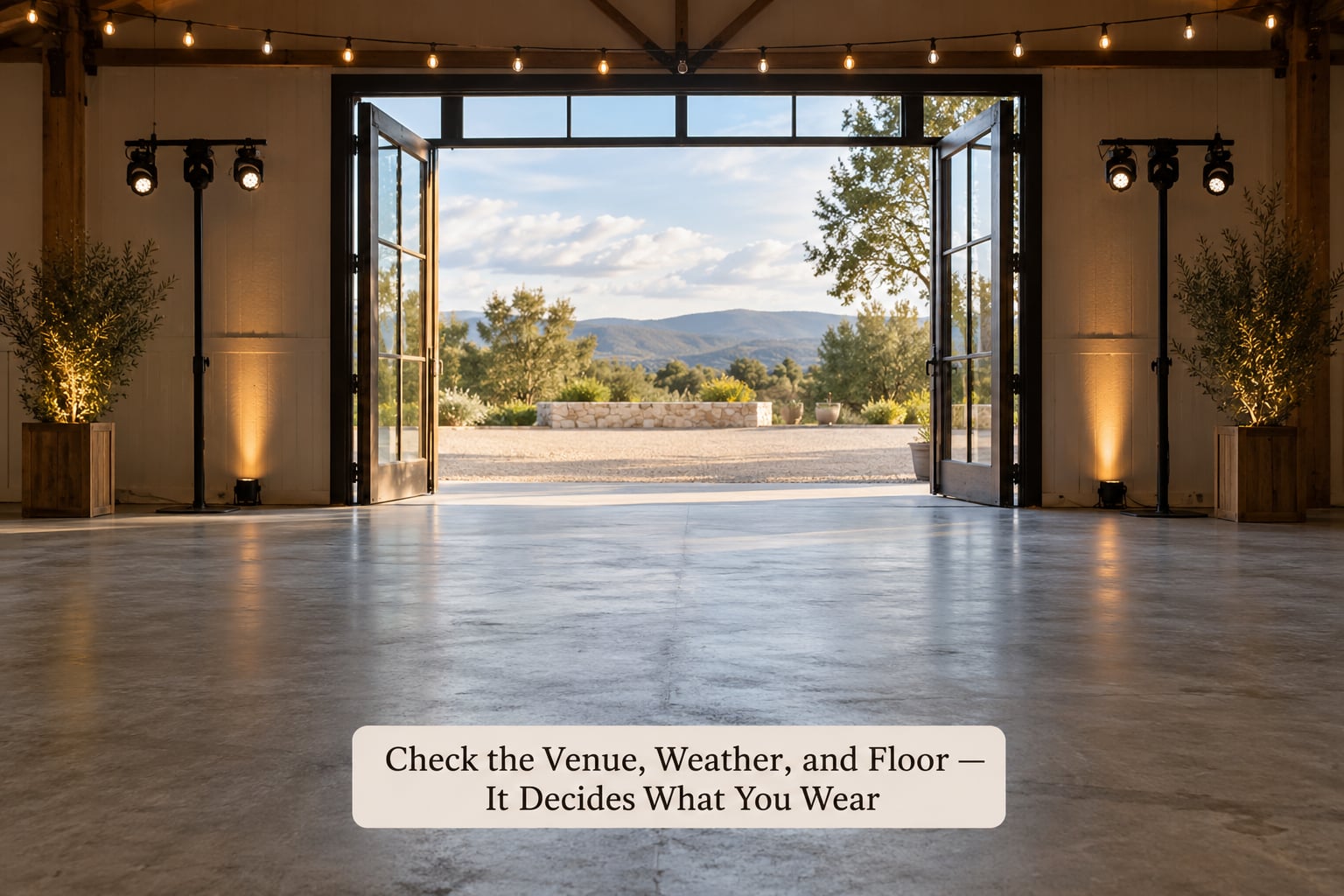
Start here before you open the wardrobe. General admission floors, seated balconies and festival fields put completely different demands on the same T-shirt. A packed standing floor in a small club generates real body heat from an early point in the queue, and dark cotton handles sweat far better than light colors that show every mark.
Ask three questions: is this indoors or out, is it hot or cold, and will I be on a floor where people are moving? Outdoor summer festival means breathable fabric, sun protection and shoes that tolerate mud. A winter show means a warm layer for the line that comes off once you are inside. A seated show with a rail means you can wear whatever you actually feel like.
One more practical check: some venues run bag checks at the door. A small crossbody bag is far easier to get through a search than a large tote, and it keeps your hands free.
2. Pick a Shirt With Your Style
The shirt is where people express themselves most, and where the scene has genuinely loosened up. A band tee is the traditional choice and still the safest default. Beyond that, a vintage graphic tee, a plain black tee or a sleeveless top all read as normal at a metal show.
Fit and fabric matter more than the print. Heavyweight cotton holds its shape and hides sweat marks better than thin material, and a shirt with a little room in the shoulders will not tear when a shoulder gets grabbed in the crowd. Sizing up one works for most body types and looks deliberate rather than borrowed.
Custom-cutting a tee at the sides, with ties or ruching, has become common in the scene. It looks great, but the same friend who admires the cut will also watch a seam let go halfway through a set, so check the stitching before you trim it yourself.
Flannel works as a shirt or as a layer, and a sleeveless cut is a good call in a hot room. Skip anything thin and sheer, and think twice about a brand new white shirt if you are near the pit.
3. Choose Bottoms That Survive the Night
Black jeans are the default because they read as intentional, hide dust and floor grime, and take a beating. Heavyweight denim is the version that keeps going; lighter stretch denim is fine if you are staying off the floor.
Are jeans okay for a rock concert? Absolutely. Skip rigid, non-stretch jeans that pinch when you bend or crouch, though, because a pit rewards deep knee bends. Cargo pants and work trousers bring more pocket space, which is genuinely useful for a wallet, a phone and earplug backups, and they read as practical rather than dated.
Leather pants are iconic and they hold their shape, but they are genuinely hot and they do not forgive sweat marks. Leather trousers are better for a cold outdoor show or a shorter set than for a three-hour club night in July.
Shorts and cut-offs are completely normal in summer, and for many people that is the most sensible answer. Loose breathable trousers work well too. The test is simple: can you raise your arms, crouch, and walk without thinking about the fabric?
4. Add Layers for Changing Temperatures
A metal show rarely holds one temperature. You queue outside, stand still for twenty minutes, then walk into a room packed with people, and the change happens in steps rather than all at once. Layers solve that better than any single heavy jacket.
A denim vest or a battle jacket with patches gives you the look without the heat, because you can undo the front when it warms up. Flannel tied around the waist works, and a lightweight overshirt over a sleeveless top handles a mild room without much weight.
For a cold outdoor stage, bring a proper layer. You will end up carrying it, so plan for that: tuck the sleeves into the waistband, roll it into a shape you can hold in one hand, or hand it to someone who came with you. A hoodie is easy to carry and doubles as something for the cold walk to the car afterwards.
5. Finish With Supportive Footwear and Accessories
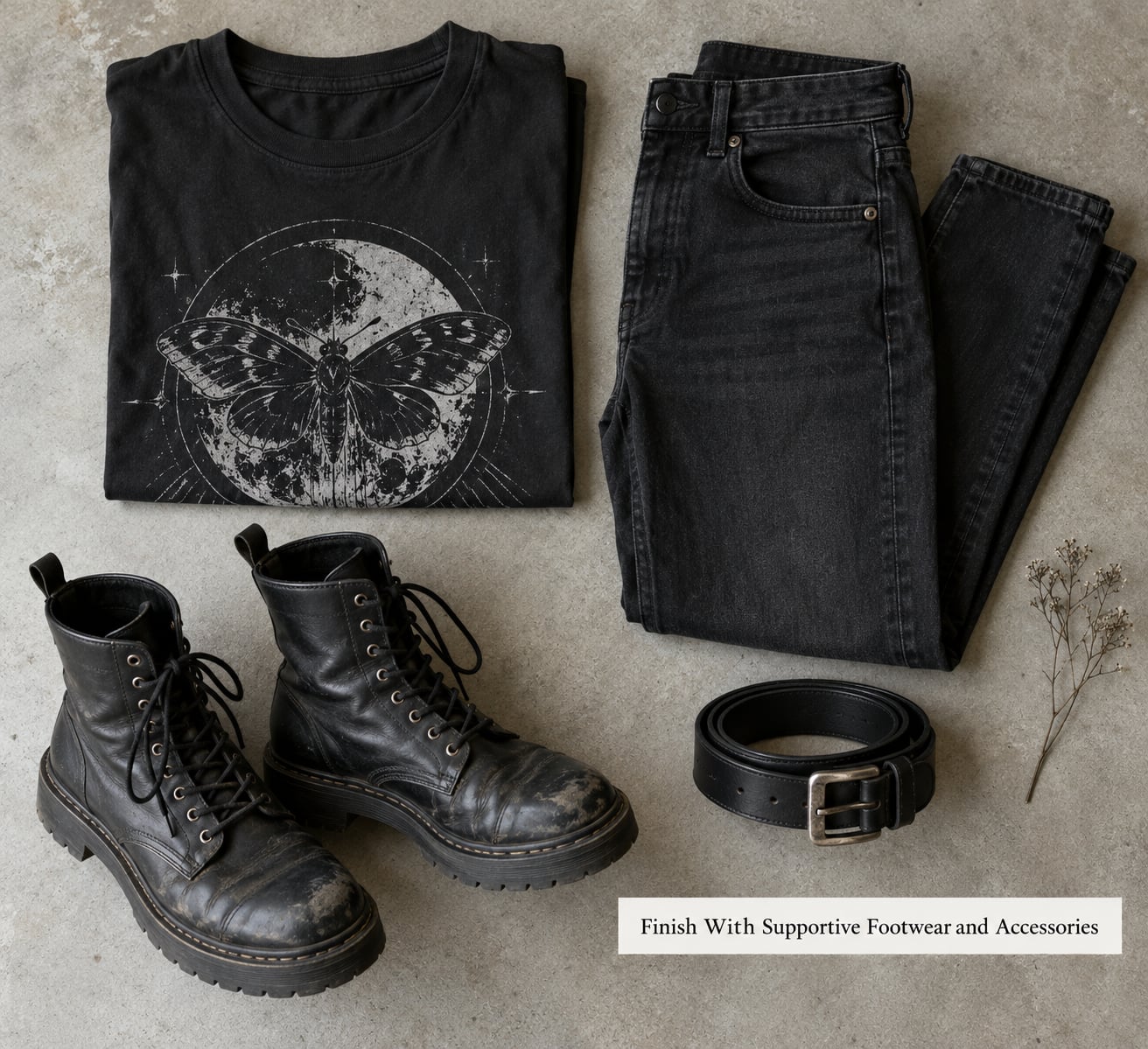
This is the decision that decides the night. What you wear to a metal concert fails or succeeds at the ankles. Thick-soled boots with a raised toe protect your feet and support your ankles when a floor full of people moves in circles around you.
Break them in before the show. New boots are the single most common first-show mistake, and blister-prone feet end the night early. Wear the pair around the house for a week or two first, then double-knot the laces so they do not work loose mid-set, which is exactly how they tend to go.
Sneakers are completely fine if they are worn in, have a decent sole and do not have loose laces. Canvas low-tops with a worn-in fit survive most pits. Flip flops do not, and thin, flat, tight shoes offer no protection at all.
Wear two pairs of socks and make them moisture-wicking, with a thicker pair underneath if your boots are new. A sturdy belt keeps the outfit together, and one or two understated pieces of jewelry are fine. Anything that swings, jingles or has a chain on it is a hazard to the people around you rather than a style choice, so leave it at home.
What Not to Wear and What to Leave at Home
A short list saves a lot of trouble. Swing chains, bullet belts and long necklaces can catch on hands in a pit. Flip flops and thin, strappy shoes come apart or get stepped on. Delicate fabrics, silk, and anything open at the back tears easily. And skip costume pieces that block your vision or your arms: a spiked shoulder harness looks fierce standing still and is genuinely awkward when 200 people are moving.
New leather is worth a mention too. It looks sharp and it is miserable until it breaks in, and it holds heat. Everyone is better served by a jacket that has already been worn a hundred times.
Mosh Pit Etiquette Tied to What You Wear
Outfit choices and floor manners are the same topic. The number one rule in a mosh pit is that you never lift or drop a person with their feet off the ground without them clearly asking for it. Pick people up by the waist or legs, elbows in, and look where you are stepping.
Arrive with secure pockets. A wallet in a back pocket will end up on the floor, so move it to the front or into a closed zip pocket. Zip your phone in or keep it in a bag that closes. Never swing your arms outward once a circle pit starts moving, and leave enough room that a fall has somewhere to land.
If you are not going into the pit, nothing here applies. Plenty of people watch metal shows from the side of the room, from a balcony, or from a seat, and their outfits are just outfits.
Outfit Builds by Body Type and Budget
Nothing about this look requires a specific body. What you want is a fit that lets you move and a proportion that works with your frame.
- Straightforward build: black jeans, band tee, boots, denim vest. Works as-is, needs nothing else.
- Layered build for a hot room: sleeveless top, loose cargo trousers, worn sneakers, overshirt tied at the waist.
- Feminine-leaning build: black cut-off shorts over opaque tights, or a fitted tee with a long skirt that stops above the knee, paired with knee-high boots or chunky sneakers.
- Curvy and plus-size build: a straight-cut denim jacket, a longer tee over leggings, straight-leg jeans or an A-line skirt with boots. Longer hems and straighter cuts avoid catching on anything.
- Budget build: one band tee, one pair of dark jeans and one pair of broken-in boots is the entire outfit, and every piece can come from a thrift store.
Common Mistakes and the Quick Fix
Nearly every bad metal concert outfit comes down to a handful of avoidable choices. These are the ones that come up most.
Wearing brand new shoes. The fix is simple: wear the boots or sneakers you already own, and walk them in before the show rather than after.
Choosing rigid, non-stretch jeans. A pit full of people bending and turning will punish stiff denim at the knee. Stretch denim, cargo pants or trousers with some give will hold up better.
Overvaluing distressing. Pre-ripped and pre-faded jeans look deliberate, but extreme distressing weakens the fabric at exactly the seam most likely to tear. Distressing you did yourself, on a shirt you do not mind losing, is a different idea entirely.
Wearing another venue’s logo. Supporting a different band or a different scene is completely normal and nobody minds. Wasting the night over it is the bigger problem.
Costume pieces that restrict movement. Spiked shoulder armor, long hanging chains, and anything that covers your face or blocks your arms will hurt you more than the crowd will.
Too much loose jewelry. Keep it to small, fixed pieces. Swinging metal in a crowd is a hazard for strangers, and you will lose it.
Quick Tips by Budget and Music Style
Different corners of the scene dress differently, and matching the room you are walking into is easy once you know the shorthand.
- Thrash metal: band tee, straight jeans, worn sneakers. Laid-back and practical, nothing fussy.
- Traditional metal: black tee or sleeveless top, black jeans, boots, and one vintage detail such as a patch vest.
- Death metal: dark or monochrome palette, plain black tee, black jeans, boots, minimal jewelry. Grooming style varies widely and is not expected of anyone.
- Hardcore and metalcore: shorts or cut-offs over leggings, band tee, sneakers or boots, light outerwear. Younger crowds here often dress for heat because shows are physically intense.
- Doom and stoner metal: relaxed fit, flannel or a work shirt, cutoff shorts or loose jeans, sturdy boots. Comfort is the whole aesthetic.
- Power metal: cleaner and more put-together than most corners of the scene. Jeans or trousers work, and a fitted tee with a denim or leather jacket reads well.
- Gothic metal: all-black layers, fitted silhouettes, boots, dark accessories. The one rule is that black should be layered thoughtfully rather than simply worn hot.
- Budget, vintage or clean-looking: dark jeans, a plain tee, boots, one well-cut jacket. Nobody will ask whether it is on sale or second-hand.
Frequently Asked Questions
Can I wear a shirt from a different metal band to a concert?
Yes, and most people do. Bands share fans, so a Metallica shirt at a power metal show is completely normal. The only people who care are a tiny handful online. If the shirt is a different genre entirely, like pop or country, expect some friendly teasing in the queue and nothing worse than that.
What shoes are best for standing at a metal concert?
Thick-soled boots with a raised toe give you the most protection and ankle support on a crowded floor. Broken-in sneakers with a solid sole and a good grip work nearly as well. Avoid flip flops, thin flats and brand new shoes you have not walked in. Double-knot your laces so they do not come loose mid-set.
How should I dress for an outdoor metal festival?
Prioritize function. Wear breathable layers, boots that handle mud and wet grass, and a waterproof jacket you can stow in a bag once the sun comes out. Bring a wide-brim hat, sunscreen and a water container. Campsites mean evening temperature drops, so pack one warm layer for after the last set as well.
Should I wear leather pants or black jeans?
Black jeans are the safer default: cooler, cheaper to clean and they hide dust and floor grime. Leather pants hold their shape and look sharper, but they run hot, show sweat and take time to break in. Choose leather for a cold outdoor show or a shorter set, and dark denim for a long, hot club night.
Is it safe to wear a band shirt or vest with patches?
A cotton vest or denim vest with patches is fine, though pins and needles can snag or scratch. Skip anything with long chains, loose studs or dangling hardware, and keep patch edges flat. Wear it over a tee rather than as a bare base layer, since a thin shoulder seam is the first thing to go in a dense floor.
How do I avoid overheating inside a crowded metal venue?
Wear one layer you can remove and tie around your waist or hand to a friend, and choose darker, breathable cotton over leather or synthetics. Drink water before the doors and again at the break, and take a short break near the back of the room if you feel lightheaded. Overheating is usually about pacing, not clothing.
Start with the shoes. Pick the pair you have already broken in, make sure the laces stay tight, then build the rest around dark, comfortable basics you do not mind ruining. Once that is sorted, wear whatever makes you feel like yourself, because the band, not your jeans, is what you are actually there for.