Content warning: this article discusses censored metal artwork involving graphic violence, sexual violence, religious imagery and self-harm. Images are described in context rather than reproduced.
Censorship rarely banned a metal band’s entire career in the United States. What it did was specific and traceable: stickers were printed on sleeves, albums were pulled from specific national markets, artwork was airbrushed or replaced with generic alternatives, and decades later streaming platforms substituted blurred versions of covers the bands had spent thousands of dollars on. Understanding how censorship affected metal album covers means separating four very different pressures that people routinely lump together.
Table of Contents
- How Did Censorship Change Metal Album Art?
- Who Controlled Album-Cover Censorship in the United States?
- Which Metal and Hard Rock Covers Were Refused or Restricted?
- How Labels Altered Covers to Survive Censorship
- Not every replacement cover was caused by censorship
- Why Did Censorship Differ Between the US and Europe?
- How Did Artists Respond to Pressure?
- How Did Censorship Become Part of Metal’s Visual Identity?
- What Can Collectors Look For in Censored Metal Releases?
- Frequently Asked Questions
- Did the PMRC ban metal albums in the United States?
- Why do some metal albums have different covers by country?
- What is the difference between a censored release and a later reissue?
- Did warning labels make an album illegal?
- How can collectors identify the first edition of a censored metal album?
- What Was the Biggest Lasting Change?
How Did Censorship Change Metal Album Art?
Censorship changed metal album art through four outcomes: warning stickers printed on sleeves, outright refusals to carry or distribute a release in a given country, replaced or edited artwork issued in specific markets, and artist-led self-censorship before anyone objected. The sleeve that survived was usually a negotiation between a label, a distributor, a retail chain and sometimes a court, not a verdict from a single censor.
It helps to separate three legal and commercial layers. US music censorship in the 1980s and 1990s was voluntary industry self-regulation, which is why the result was a sticker and not a ban. National obscenity and classification law in Germany, Australia and elsewhere operated at a different level, where a specific release could be refused an export licence or a classification. Retailer refusal sits in between: no law involved, but a chain or mall store decides the album is not worth the risk of carrying.
The fourth layer arrived later. Streaming platforms moderate catalogue artwork retrospectively, which means a cover printed uncensored in 1992 can appear blurred today without anyone in 1992 having done anything about it.
Who Controlled Album-Cover Censorship in the United States?
No single group controlled US album-art decisions. The Parents Music Resource Center supplied political pressure, the Senate committee supplied the stage, the RIAA supplied the compromise, and retailers supplied the veto that actually kept albums off shelves.
| Gatekeeper | Pressure applied | Typical response |
|---|---|---|
| Parents Music Resource Center | Public campaigns, letters, boycotts, Senate testimony | Named songs and albums; pushed for warnings and behind-the-counter placement |
| Senate Commerce Committee | Hearings, televised coverage, threats of federal labelling law | Publicity for the campaign; no ban resulted |
| RIAA and record labels | Commercial risk of alienating retailers and radio | Voluntary warning label, mostly using sleeve space the band did not design |
| Retailers and mall chains | Local ordinance risk and store policy | Refused to carry or moved certain titles behind the counter |
| Distributors | Market-by-market customs and classification rules | Created regional variants rather than abandon a release |
| Radio programmers | Station policy on explicit product | Skip or rotate tracks from flagged releases |
| Parents and school boards | Household purchasing and moral complaints | Withdrew records, banned albums locally, wrote to retailers |
| Artists and bands | Direct control over their own image | Refused to alter art, issued alternates, or publicised the dispute |
The important structural point is that only one of these rows involved the state, and the state row produced no censorship at all. That is the single fact most often missed in retellings of the 1985 hearings.
Which Metal and Hard Rock Covers Were Refused or Restricted?
Below are the metal and hard rock releases most often cited, with the claimed concern, the actual outcome and the market involved. A label on a pressure list is not the same as a legal ban, and the table keeps those apart.
| Release | Year | Claimed concern | Outcome | Market and alternate edition |
|---|---|---|---|---|
| Black Sabbath, Black Sabbath | 1970 | Satanic subject matter in songs and imagery | No ban; drove parental protest and local school bans | US; song titles altered on some early pressings |
| Venom, Welcome to Hell | 1981 | Occult themes, sinister cover | Named on the Filthy Fifteen in 1985 for a different track | US pressure list, not a prohibition |
| Mercyful Fate, Melissa | 1987 | Satanic themes, ritual imagery | Named on the Filthy Fifteen | US pressure list |
| Celtic Frost, To Mega Therion | 1987 | Inverted cross motif, occult theme | No prohibition; became the visual shorthand critics attacked | Europe; widely distributed |
| W.A.S.P., W.A.S.P. | 1984 | Explicit lyrics and sexual subject matter | Named on the Filthy Fifteen | US pressure list; cover art itself unaltered |
| Def Leppard, Pyromania | 1983 | Explicit lyrics; sleeve depicted a woman’s semi-naked back | Named on the Filthy Fifteen | US pressure list; sleeve released unchanged |
| Judas Priest, Eat Me Alive | 1985 | Explicit song content, cover showing a woman in a vulnerable pose | Named on the Filthy Fifteen; sleeve featured in hearings | US pressure list |
| Napalm Death, Scum | 1987 | Artwork pushing beyond what distributors would carry | Label and distributor friction; multiple later cover variants | UK and Europe; alternate art on reissues |
| Cannibal Corpse, Butchered at Birth | 1991 | Graphic butchered-carcass cover art | Restricted by German authorities; censored variant produced | Germany; alternate cover issued |
| Cannibal Corpse, Tomb of the Mutilated | 1992 | Extreme gore imagery | A censored alternate cover exists for the original release | US and Europe; alternate art in circulation |
| Mayhem, Dawn of the Black Hearts | 1995 | Graphic photograph of a dead body | Restricted in several countries; some reissues and digital editions blur portions | Multiple markets; blurred variants on reissues |
| Slayer, Christ Illusion | 2006 | Religious imagery criticised as blasphemous | Court-ordered removal in Brazil; Slayer won the case; US Supreme Court declined to hear the appeal | Brazil; separate alternate cover art issued |
| Behemoth, The Satanist | 2015 | Church protests, death threats, venue cancellations | No government ban; sustained pressure and several cancelled dates | Europe and North America; original art retained |
Two of those rows need extra care. The Filthy Fifteen was a list of songs compiled from comments by members of the PMRC, released to press in 1985 as a pressure device; it carried no legal force and no federal labelling scheme ever passed. The Slayer case is the opposite extreme, a genuine court order, in one country, against one release.
Mayhem’s Dawn of the Black Hearts is worth a second look because it shows how the story gets retold. Most physical releases still carry the original photograph. Blurred versions appear on certain reissues and on digital storefronts, so a fan comparing their vinyl to their streaming library can see two different covers for the same record without either being wrong.
How Labels Altered Covers to Survive Censorship
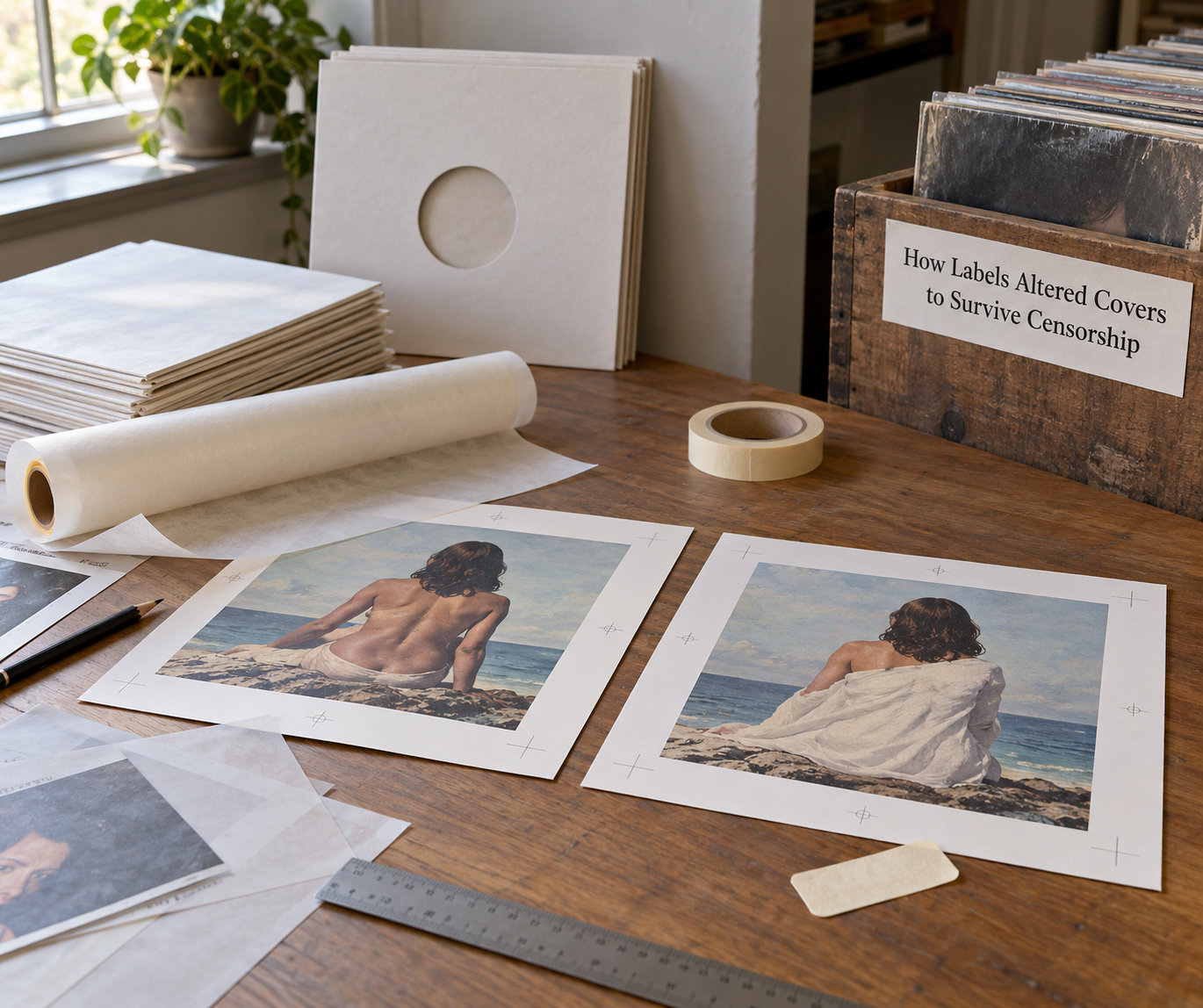
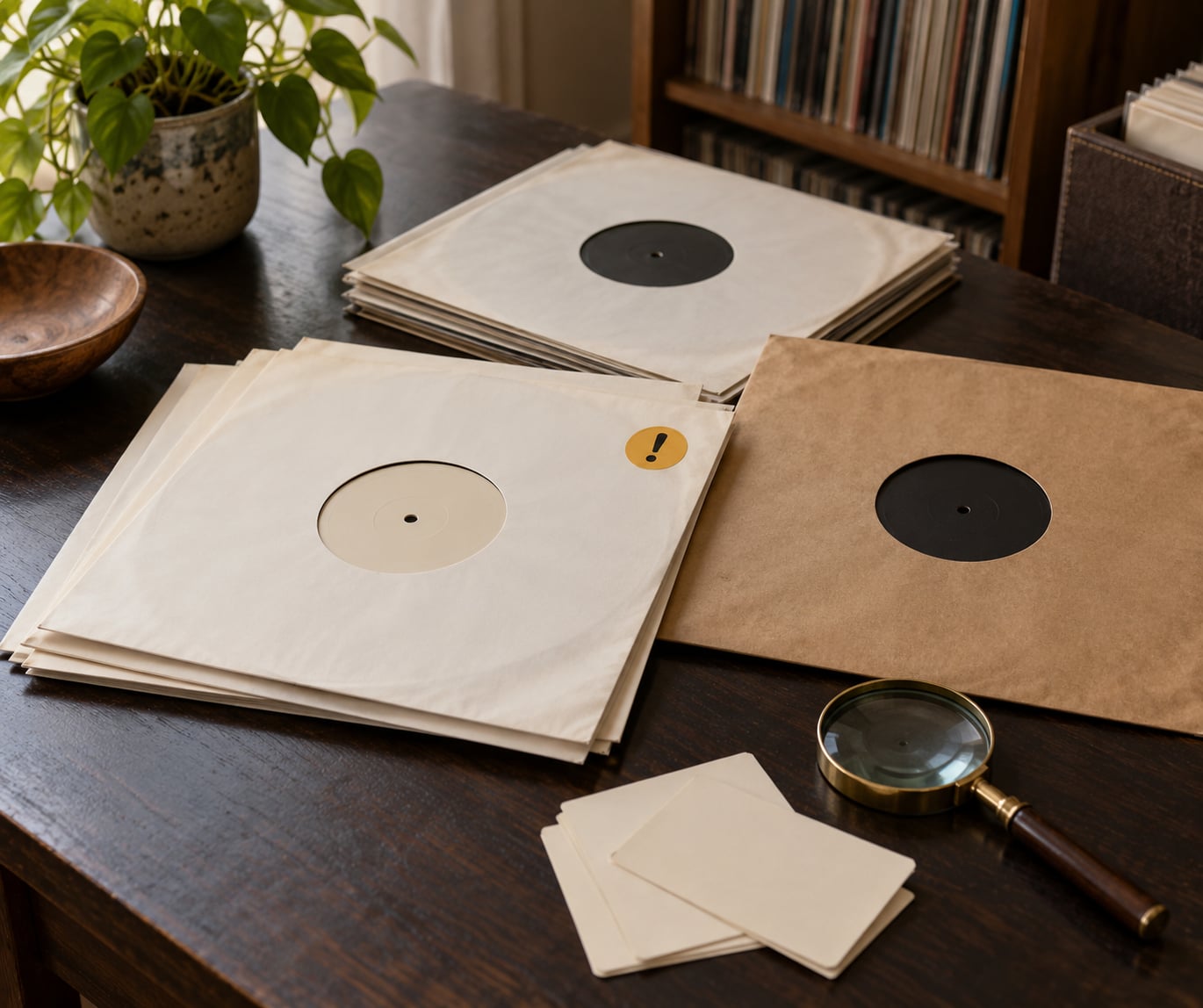
When a sleeve had to change, the label had a short list of options and each one left a trace. The most common was the warning sticker, applied over existing art so the design never changed. Next came the obscured sleeve: the record came in a brown paper bag, a plain white inner sleeve, or a die-cut hole cut over the offending detail.
Airbrushing was less common in metal than in mainstream pop but did happen, particularly on figures where a single detail triggered the objection. Cropping did the same job with a paper knife, removing a band member’s torso from a gatefold without touching the rest of the layout.
Substitution was the heavy option. A label would commission or license an alternative image, print it as the sleeve, and keep the provocative version for markets where it was legal. That produces the paired original-and-alternate releases collectors now hunt, and it also produces genuine confusion, because the alternative cover is often the one most people first saw.
Labels also removed tracks. A censored variant with fewer songs was cheaper to justify to a nervous retailer than a fight over a single square inch of artwork, and several regional editions exist for that reason rather than because of the cover.
Not every replacement cover was caused by censorship
This is where collector folklore does most damage. Bands and labels redesign sleeves constantly for ordinary commercial reasons: an artist leaves, a tour is announced, a remaster adds a bonus disc, a reissue gets a new gatefold. A different cover is not by itself evidence of a ban, and the claim that a specific sleeve was “the censored one” needs a catalog number or a documented statement behind it.
Why Did Censorship Differ Between the US and Europe?
US pressure produced stickers because the system was voluntary and the outcome was a negotiated label everyone could display without admitting fault. Germany produced actual prohibitions because the statutory machinery existed to classify media as harmful to minors, and because US parental labels were read as a signal that content warranted stricter treatment.
Australia combined national classification with state-level offences against publishing material deemed offensive, which gave local authorities power over specific covers. The United Kingdom had no classification board covering recorded music, so pressure there came through retailer policy and obscenity law rather than a sticker regime.
That produced a practical result: the same record often carried its original art in one country and an edited or substituted sleeve in another. Import rules also meant genuine pressings varied by destination, so a European edition is not automatically the censored one, and an American edition is not automatically the original.
Simplifying this into “Europe is permissive, America is strict” gets it backwards more often than it gets it right. Germany, Brazil and Australia all issued formal restrictions on named metal releases. What differed was the mechanism, not the amount of moral pressure.
How Did Artists Respond to Pressure?
Bands responded in roughly five ways, and the record on which one they chose is well documented for some of them and mostly rumour for others.
Negotiation produced the most visible outcome: the Parental Advisory label itself. Frank Zappa testified before the Senate Commerce Committee in September 1985 and argued that the label was designed to be applied to a record sleeve regardless of content, which would make it meaningless. He then released Frank Zappa Meets the Mothers of Prevention in the same year with a parody label on the sleeve, alongside a physical insert, turning the compromise into the joke it was.
Parody followed quickly. Megadeth put a parody of the warning sticker on So Far, So Good… So What! and released an EP titled after the PMRC. NOFX issued an EP built around the campaign’s demands. Danzig contributed a track to a benefit compilation responding to the hearings. Sonic Youth ran a cartoon parodying the campaign in a music video, and Rage Against the Machine taped flyers over their instruments at a 1992 festival as a direct action protest.
Metallica’s Master of Puppets carried a stop-sign parody of the warning sticker on some pressings, mocking the labelling system from inside a release that the campaign’s own logic would have flagged.
Refusal was the third response and the rarest. Slayer did not replace the Christ Illusion artwork for the Brazilian case; the band fought the order and won, then issued separate alternate art for some markets rather than abandon the original image. Behemoth kept the same cover through death threats and cancelled dates in 2015, which is arguably the strongest documented refusal in this whole history because nothing was withdrawn.
Self-censorship is the hardest category to evidence, because by definition it leaves no complaint behind. Where a band has said publicly that it altered art to keep a release on shelves, that counts. Where a collector assumes the softer image was a concession, that is an assumption and should be labelled as one.
How Did Censorship Become Part of Metal’s Visual Identity?
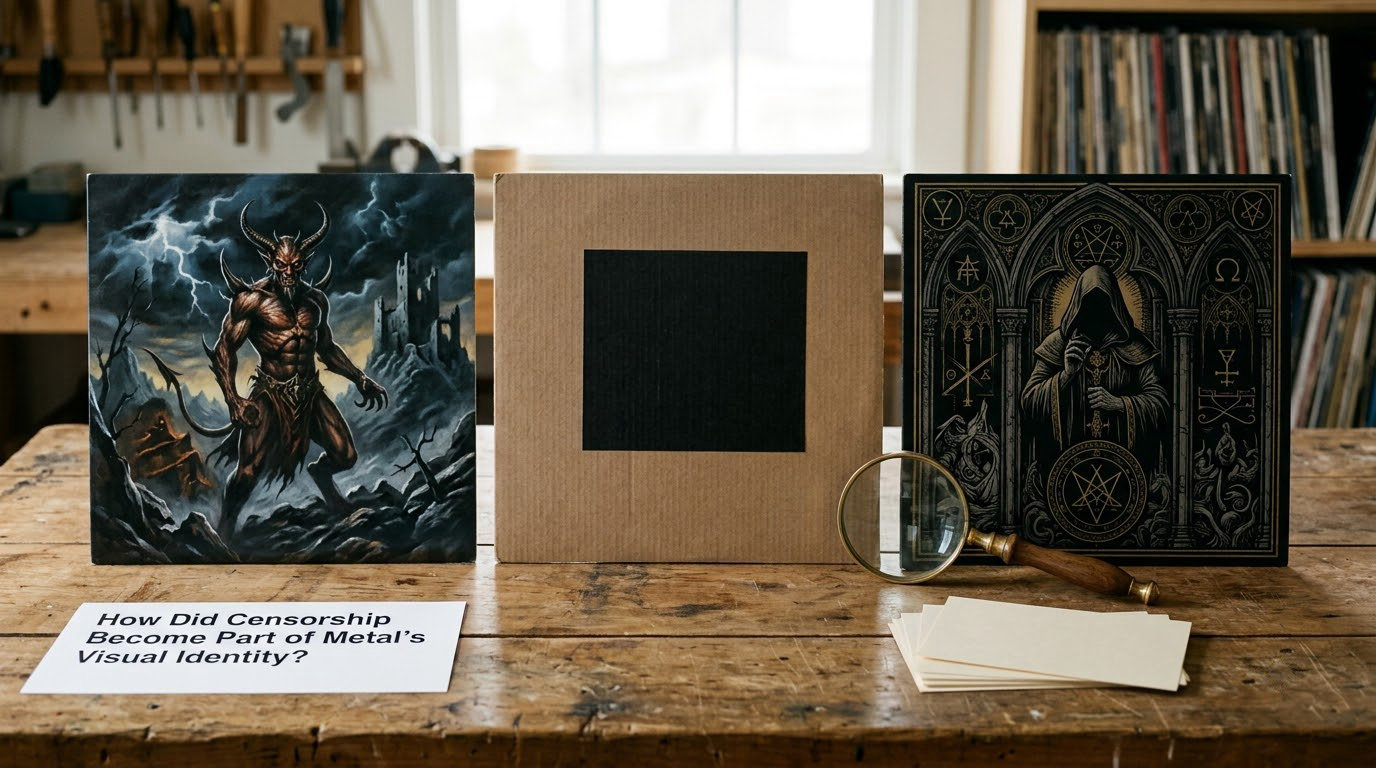
Censorship became part of metal’s visual identity in an odd way: the warning sticker itself became a badge. Once parents, schools and retailers treated a sleeve as a reason for concern, the sleeve stopped being a liability and started being a signal that the record was worth a second look.
The forbidden-fruit effect is the part people argue about on music forums, and it is genuinely contested. Collectors on r/vinyl and r/MetalForTheMasses tend to treat the banned pressing as the authentic object and the censored sleeve as the lesser one. Others on the same forums point out that the stereotype cost the genre mainstream audiences, and that headlines about shock imagery shaped how parents and radio programmers treated everything that followed.
What is not contested is the collecting consequence. An original sleeve, a censored variant and an alternate-art pressing are three distinct objects with three distinct catalog entries, and buyers reliably mis-price them because they arrive with no markings that explain which is which.
Digital storefronts added a new wrinkle. Collectors regularly raise the same complaint: the streaming version of an album shows blurred or substituted artwork while the vinyl sold the same week carries the original. Region-locked stores make it worse, since the art a listener sees depends on where the account was created.
What Can Collectors Look For in Censored Metal Releases?
A censored or alternate edition is usually identifiable from the sleeve, the labels and the paperwork together. Any one clue on its own is a guess.
- Catalog number and country code. A German issue carries a German label and catalog prefix, an Australian issue carries an Australian one. A censored variant usually has its own catalog number rather than sharing the original.
- Sticker, obelisk or overprint. The Parental Advisory obelisk is the earliest design; the circular logo replaced it in 1990 and was revised in 1996. Parody stickers and label-defining overprints are separate issues.
- Sleeve construction. A brown paper outer, a plain white inner sleeve or a die-cut window are physical evidence of an obscured cover, and they survive better than any sticker.
- Matrix and runout etchings. Different plants and different years produce different etchings even on visually identical sleeves. This is how you separate two pressings that look the same.
- Track listing differences. Editions with fewer songs were often trimmed for retailer compliance, which changes the back cover and the catalog entry.
- Promo markings. Strike-through of the price, white labels and sample markings identify promotional copies, which are a different collecting category rather than a censored edition.
- Evidence of the order. A newspaper report, a court document or a band statement naming the release and the country is worth more than any amount of visual inference.
Two warnings on the subject. A dramatic alternative image does not prove censorship, and it does not date the release by itself. And bootlegs sold specifically to provide unaltered artwork are a real market, but they carry no provenance and should be valued as reproductions rather than as first pressings.
Frequently Asked Questions
Did the PMRC ban metal albums in the United States?
No. The Parents Music Resource Center campaigned for warnings and retailer restrictions, and its 1985 Filthy Fifteen list was a public pressure device naming songs, not albums. The Senate Commerce Committee hearings produced no ban and no federal labelling law passed. What followed was a voluntary industry sticker that labels applied themselves, which is why most metal covers reached stores through the 1980s unchanged.
Why do some metal albums have different covers by country?
Because distribution was regional. Germany, Australia and Brazil applied classification and obscenity rules that could refuse an export licence or order removal, so labels printed alternative sleeves for those markets while keeping the original elsewhere. Import rules also meant genuine pressings varied by destination, so a European edition is not automatically the censored one and an American edition is not automatically the original.
What is the difference between a censored release and a later reissue?
A censored release was altered at the time of manufacture, either by an added sticker, an obscured sleeve or entirely different artwork, and it has its own catalog number. A later reissue is a new pressing of a title years afterward, often remastered with bonus tracks and sometimes with newly altered artwork. Blurred artwork appearing only on recent reissues or streaming versions is a reissue phenomenon, not a 1990s censorship event.
Did warning labels make an album illegal?
No. The Parental Advisory sticker was a voluntary industry measure, introduced in 1985 and redesigned in 1990 and again in 1996. It made no album illegal and gave no authority the power to remove one. Its practical effect was commercial and social: some retailers moved flagged titles behind the counter, and some parents withheld purchases. That indirect effect, rather than any legal power, is what changed metal sleeves.
How can collectors identify the first edition of a censored metal album?
Start with the country of manufacture on the catalog number, then compare sleeve construction, since a brown paper outer or die-cut window is physical evidence an obscured cover existed. Check the matrix and runout etching to separate pressings that look identical, and confirm that a track was actually removed rather than renamed. Finally, look for a dated report, court document or band statement naming the release and country, because visual inference alone cannot date a ban.
What Was the Biggest Lasting Change?
The first thing to understand is that censorship usually changed a particular release in a particular market, not a band’s entire visual identity. Almost no metal band was silenced by any of this. What was silenced was specific covers, in specific countries, at specific moments.
So start by checking whether a release you think was censored was actually named in a documented order, and in which jurisdiction. Then compare the edition-specific artwork rather than assuming the dramatic image is the banned one. Every few years the answer shifts anyway, because the platforms now moderating old artwork are making new decisions about sleeves that were legal when they were printed.