
Heavy metal music is popular because it delivers emotional intensity few genres match, rewards careful listening with real musical complexity, and gives listeners a community that identifies itself by the music. It suits guitar playing, sounds enormous live, and keeps splitting into subgenres so there is always something new. That mix of feeling, craft and belonging explains why heavy metal music is so popular fifty years after four teenagers in Birmingham invented it.
Metal also survives where plenty of genre fashions do not. Fans keep buying records for a band they discovered at fourteen, they travel for festival weekends, and they pass the whole thing down to their kids. That kind of loyalty is rare, and it is the honest answer underneath all the cultural noise.
Table of Contents
- What Makes Heavy Metal Music So Popular?
- Why heavy metal music is so popular across generations
- How Does Heavy Metal Create Emotional Impact?
- Why Does Metal Build Such a Strong Community?
- How Has Metal’s Musical Variety Helped It Stay Relevant?
- Why Do Heavy Metal Fans Value Albums and Concerts?
- How Has Metal Influenced Other Music and Culture?
- Why Does Metal Keep Attracting New Listeners?
- What Challenges Does Heavy Metal Face Today?
- Frequently Asked Questions
- What is heavy metal music, and why is it so popular?
- Is heavy metal one musical style or many subgenres?
- When did heavy metal become popular?
- Why do people listen to heavy metal music?
- How can beginners discover heavy metal without feeling overwhelmed?
- Why do metal fans attend concerts and festivals?
- Conclusion: Start With the Music That Speaks to You
What Makes Heavy Metal Music So Popular?
Four things keep heavy metal music in demand: it makes listeners feel something quickly, it rewards people who play an instrument, it functions as a social badge, and it treats the album as an artwork rather than a single released. Add a live scene that is unusually communal and you have a genre that can lose mainstream radio and still grow.
It is worth separating the reasons out, because the lazy version of this question stops at “angry music.” That gets a handful of listeners and explains almost none of the audience.
Why heavy metal music is so popular across generations
Metal changes shape every decade without losing its core audience, because the core is a method rather than a sound. A slow, dissonant doom record and a fast, precise technical death record come from the same instinct: play something that takes work. Listeners who grow out of one branch usually find another.
Streaming has also helped. A huge back catalogue that once sat in specialist shops is now one search away, which quietly ended the discovery problem that metal had for thirty years.
How Does Heavy Metal Create Emotional Impact?
Metal works physically before it works intellectually. Downtuned guitars, distorted low frequencies and loud cymbals produce the amplitude and high-frequency content that research on arousal links with frisson and physical excitement. The body reacts first, and the brain reads that reaction as significance.
Vocals then give the wall of sound a point of view. Clean singing, growl and shriek are all used, but the pattern repeats across the genre: a verse that holds back, a chorus that breaks open, a solo or breakdown that stretches time. The tension is built on purpose and it is released on schedule.
The results show up in listener psychology. A well-known study out of the University of Westminster, published in Psychology of Aesthetics, Creativity, and the Arts, surveyed 414 participants against ten tracks across several genres and tied musical preference to the Big Five personality traits. People who chose metal scored higher on openness to experience and on the need for uniqueness, and lower on self-esteem than listeners who chose lighter pop. Fans describe the same thing in plain terms on metal forums: the music dwarfs the problem for a few minutes.
That is the catharsis argument, and it has a practical use. Picky guitar tones are the easy part; the reason the format suits stress, workouts and long commutes is that it gives anger and restlessness somewhere to go that does not involve anybody getting hurt.
Why Does Metal Build Such a Strong Community?
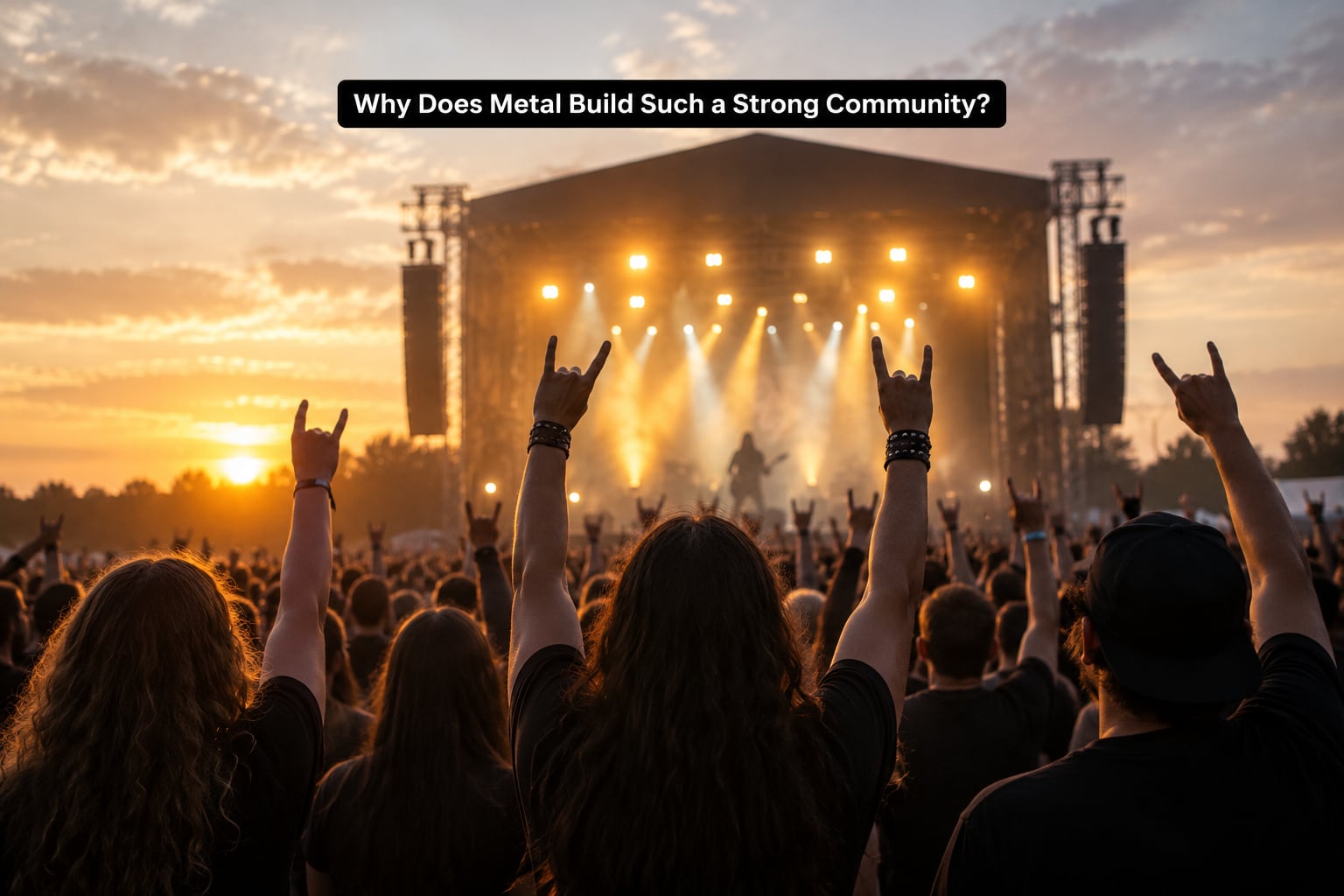
Metal is one of the few genres where belonging is partly physical. Mosh pits, wall of death circles, chant-alongs and stage dives turn a crowd of strangers into a single moving unit for an hour. Fans who have stood in one describe the aftermath as the opposite of what they expected: people helping each other up, quiet campers, unusually patient queues.
Outside the venue the same thing runs on text. Subreddits like r/heavymetal, r/MetalForTheMasses, r/PowerMetal and r/Metalcore keep long-running threads on records, line-ups and grief. In those discussions people argue about genre boundaries with a passion that outsiders read as hostility and insiders read as care.
Then there is the age range. Metal fans span teenagers, parents, engineers and retirees, and the fandom is generational: the person who saw a band on a festival stage in 1986 now has children who found them through a playlist. Loyalty across decades is not a marketing artifact. It is what happens when a music keeps working on you.
How Has Metal’s Musical Variety Helped It Stay Relevant?
No other genre has spawned metal’s number of branches. Traditional heavy metal kept the major-key riffs and the gallop. The New Wave of British Heavy Metal tightened the songs and added speed, which fed thrash. Thrash split into death metal, black metal and groove metal. Doom went the opposite way, slower and heavier. Power metal traded heaviness for melody and long-form composition.
From the 1990s onward the map widened again: industrial, gothic, nu metal, metalcore, progressive metal, folk metal and the crossover with electronic and hip-hop production. Each branch arrived with its own scene, its own festivals and its own audience.
That fragmentation is usually described as a weakness, and it is the reason the genre keeps finding new listeners. New fans usually enter through whichever branch sits closest to music they already like, then work backwards through the history.
Why Do Heavy Metal Fans Value Albums and Concerts?
Metal treats the full-length album as the main event, which encourages repeat listening and buying. Cover art is a serious discipline, lyrics get printed and studied, and a tour is treated as the moment the songs finally arrive at full size.
That habit feeds a healthy collector economy. Vinyl, limited pressings and coloured variants give listeners a reason to own the same album several times over, and catalogue titles that sold modestly in the eighties now move steadily.
Live is where the argument gets made. Bands have been playing festivals at volume for fifty years, and the audience is unusually participatory: people travel for days, watch the whole lineup, and post the setlist afterward. For many fans a good show outranks the record itself.
How Has Metal Influenced Other Music and Culture?
Metal’s fingerprints show up well outside the genre. Guitar tone and downtuning shaped grunge and much alternative rock; the punk ethos of doing it yourself in a garage came out of the same DIY circuit that produced the earliest bands.
Later, metal production crossed into hip-hop and electronic music, with producers pulling in double kicks, clipped vocal chops and the low end that metal had normalised. It also feeds film and television scoring, video games, tattoos and clothing. The all-black outfit is still the fastest visual shorthand in rock.
Crossover also runs the other way. Bands like Ghost, Sleep Token and Jinjer reach audiences who would not sit through a death metal album, and those listeners sometimes backtrack into the heavier end. Every one of those entry points adds a fan.
Why Does Metal Keep Attracting New Listeners?
Discovery is the easy part now. Album playlists, recommendation systems and video clips push a modern metal track to someone who never asked for it, and short, striking performances travel well on social platforms. A fan who finds one song in a fifteen-second clip goes looking for the record.
Global scenes matter just as much. Finland, Sweden, Japan, Brazil, Germany and the United States have all built large metal infrastructures, and India, South Korea, Iran and South Africa have scenes that mostly run underground but keep producing bands. Larger audiences mean more touring, more coverage and more new acts.
Live attendance keeps rising alongside streaming. Live Nation reported heavy rock and metal attendance up 14 percent in 2026, with metal making up roughly 13 percent of arena and venue attendance, while global on-demand audio listening has continued to climb year on year. Younger listeners meet the classics through the bands that cite them, not through a 1985 compilation.
What Challenges Does Heavy Metal Face Today?
Metal is not a problem-free genre, and pretending otherwise loses the reader’s trust. Streaming rewards volume over loyalty, so a scene with hundreds of bands per week can push its best acts out of sight. Touring has become expensive, and festival economics are tight enough that several well-known events have folded.
Ticket prices are the loudest complaint in fan forums. Venue closures hurt cities that had only one metal room. And the audience skews male, which has historically made metal spaces hostile to women and non-binary listeners, a real problem that scene organisers are working on rather than something you can explain away.
Content fatigue is the other strain. There is far more metal released every month than any one person can hear, which is exactly why discovery now depends on curation.
Frequently Asked Questions
What is heavy metal music, and why is it so popular?
Heavy metal is guitar-driven music built on distorted riffs, strong rhythm sections and vocals that range from clean singing to screams and growls. It is popular because it delivers emotional release quickly, rewards listeners who pay attention, and gives fans a strong sense of community and identity. Add a durable live and festival scene and metal keeps growing even without mainstream radio play.
Is heavy metal one musical style or many subgenres?
Many. Heavy metal has branched into traditional metal, the New Wave of British Heavy Metal, thrash, death, black, doom, power, progressive, industrial, gothic, folk and metalcore, among others. They share a commitment to guitar weight and album craft, but the playing, vocals and production can be wildly different. Treating metal as a single sound is why newcomers often feel lost.
When did heavy metal become popular?
Heavy metal took shape in the late 1960s and early 1970s, with Black Sabbath widely credited as the first heavy metal band. It expanded through the 1980s with the New Wave of British Heavy Metal and the thrash explosion, peaked as a mainstream commercial force around 1985 to 1990, and has grown steadily in niches and on stage ever since.
Why do people listen to heavy metal music?
Listeners usually give a mix of reasons: catharsis and stress relief, motivation while working out or concentrating, focus on technically demanding playing, a preference for heavy low frequencies, and the sense of belonging that comes with a shared subculture. Research also links metal preference with high openness to experience and a strong need for uniqueness.
How can beginners discover heavy metal without feeling overwhelmed?
Pick one entry point rather than the whole catalogue. Classic heavy metal, doom or a well-known thrash record is an easy start, then branch outward through one band at a time. Use curated playlists, read one album guide, and watch a festival stream before digging into extreme subgenres. Going slow is normal here, and nobody expects a new listener to know the history on day one.
Why do metal fans attend concerts and festivals?
Because metal sounds its best at full volume with a crowd. Long guitars, weight and volume that a home system cannot reproduce, plus participatory rituals like moshing and chanting, make the show feel like a shared event rather than background music. Festivals also offer multiple stages across a single weekend, which is how many fans discover their next favourite band.
Conclusion: Start With the Music That Speaks to You
Heavy metal music is popular for reasons that reach further than volume. It delivers feeling fast, it takes listening seriously, it splits endlessly so new fans can enter from wherever they already stand, and it builds a community that stays loyal for decades. None of that requires you to be a guitarist or a festival regular.
Start simply: pick one subgenre, listen to one album end to end, then follow one band you liked into a second record. If you want the history and the scene explained properly, our band histories and subgenre guides cover where each style came from and who is pushing it forward now.