Knowing how to survive your first mosh pit comes down to three avoidable things: broken glasses or lost contacts, going down without anyone noticing, and dehydration. Prep for those three and the realistic outcome is bruises, a sore shoulder and a good story, not a hospital trip. Most first-timers are far more nervous about it than it turns out to be.
The nerves are normal, though. Nobody walks into a floor area knowing what the rules are, because nobody tells you beforehand. That gap is exactly what this guide fills: what to bring, where to stand, how to move, how to say no, and how to get out when you have had enough.
Table of Contents
- What You Need to Survive Your First Mosh Pit
- Step-by-Step: Your First Mosh Pit, Start to Finish
- 1. Check the Venue Before the Band Plays
- 2. Choose a Beginner-Friendly Position
- 3. Set Your Boundaries Before the Music Starts
- 4. How to Survive the Movement and Keep Your Balance
- 5. Protect Your Head, Face, and Ribs
- 6. Take Breaks and Watch for Warning Signs
- 7. Leave Calmly When You Want To
- Common Mistakes First-Timers Make
- Frequently Asked Questions
- Is it normal to be scared of a mosh pit for the first time?
- What should I wear to a mosh pit as a beginner?
- How old do you have to be to enter a mosh pit?
- Can I bring my phone or bag into a mosh pit?
- What should I do if I feel trapped or someone touches me without permission?
- What should I do if I lose my balance in the crowd?
- Start at the Back, Not the Front
What You Need to Survive Your First Mosh Pit
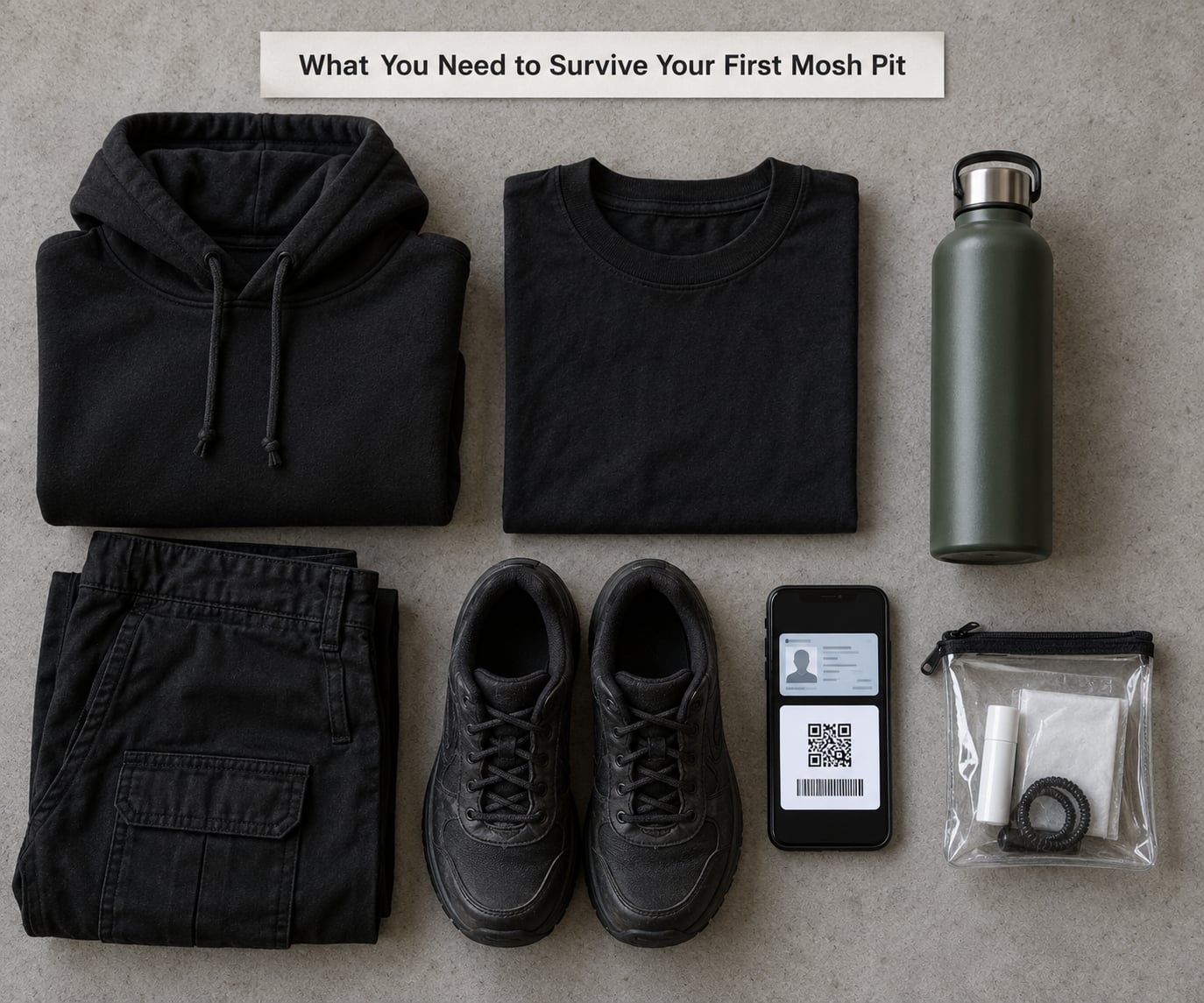
Very little, honestly. Everything below is either something you already own or something you can decide about in five minutes before the doors open.
- Broken-in, closed-toe shoes. New trainers have never been tested on a floor that gets stomped on. Thin canvas shoes and anything with a wooden sole are a bad idea because they slide when you land on them.
- Clothes you will not mind ruining. Expect a stretched collar, a scuffed elbow and possibly a blood spatter you cannot explain. Skip anything white, new or expensive.
- Your ticket and ID on your phone. The phone stays in a pocket, on silent, and you accept that it may not come out again until the set ends. If you wear glasses, this is the moment to switch to contacts for the night.
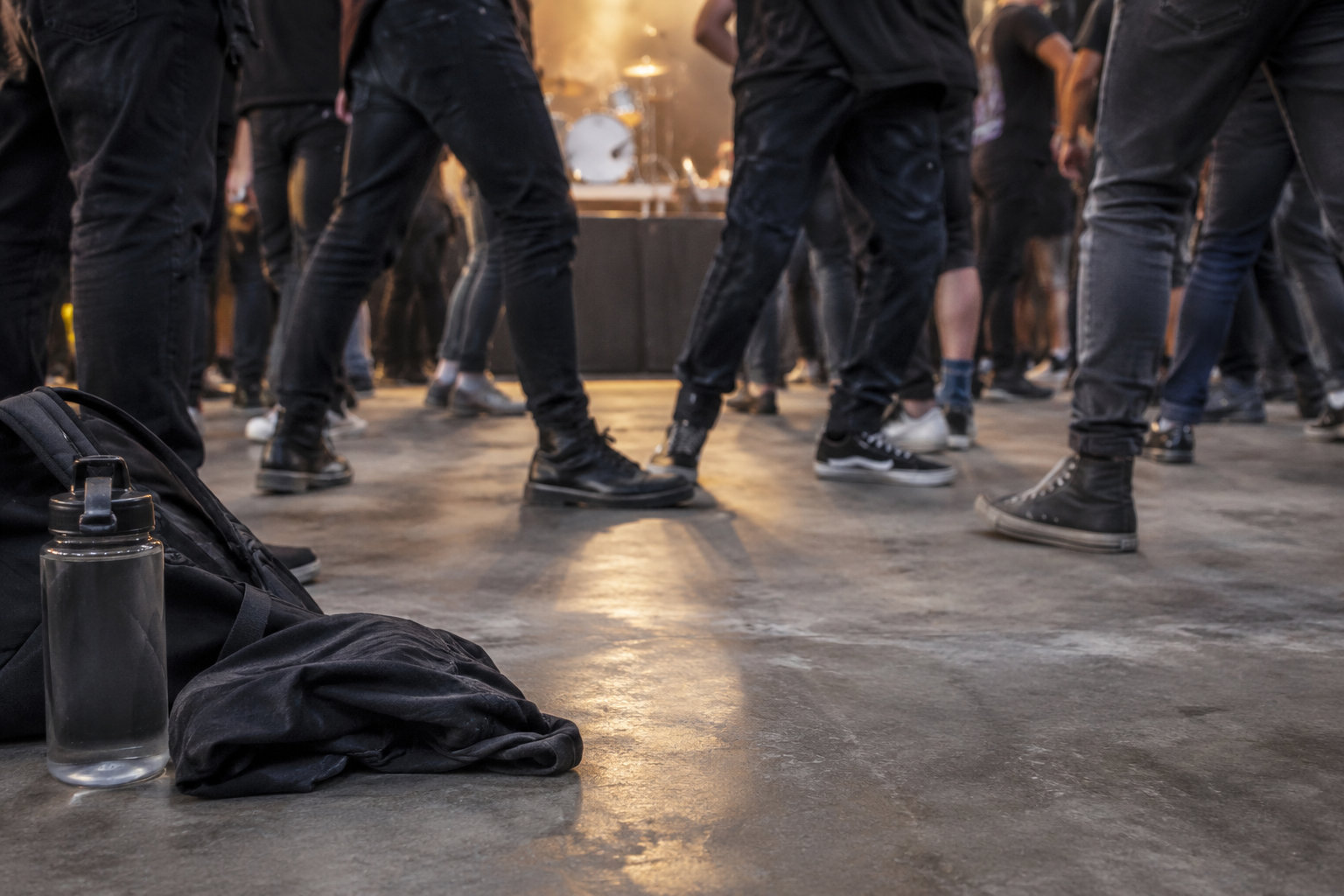
- Water you can reach instantly. A bottle held in one hand, or bought from the bar. People who put water in a backpack at a show learn later that they cannot get to it when they need it.
- A mental map of the room. Know where two exits are, where the barrier is, where first aid sits, and where the toilets are before the floor fills up.
Optional rather than essential: ear protection if loud shows bother you, a well-fitting cap that will not fly off, a friend who is happy to stand at the edge with you, and pain relief for the morning after.
Leave the hat that only just fits, the sunglasses, the lanyard, the bag of any size, and any drink you are still holding when the pit forms. The pit does not announce itself before it starts.
Step-by-Step: Your First Mosh Pit, Start to Finish
1. Check the Venue Before the Band Plays
Walk the floor in the first twenty minutes while there is still space. Most venues have at least two ways out, and picking one now means you are not hunting for it later with your heart hammering.
Look for the barrier line, the security positions and any first-aid point. Festival pits have medical tents at the edge; club shows usually have staff somewhere nearby. Knowing where they are matters more than you would think.
Read the venue’s own rules, because they always outrank anything you have read online. Some rooms will not allow moshing in front of the mixing desk, and a few will stop the show outright if a pit gets unsafe.
2. Choose a Beginner-Friendly Position
Start at the rear or the side rather than the front. The density of a pit is what causes most of the knocking about, so the further back you start, the more space you have to feel how the movement works before you are in the thick of it.
Pick a spot with a visible route out, and avoid ground that will not stay stable all night, plus barriers, speaker stacks, stairs and any dead end where the crowd can compress against a wall. Falling into a corner is how people get stepped on.
Pit styles differ, too. A circle pit moves as one ring. A two-step pit keeps the same formation but locks arms with the person beside you, which regulars say feels much safer. A wall of death opens and closes and is the most intense. A push pit is mostly shoving with very little direction. Beginners usually do fine in a circle pit and should think twice about a wall of death on day one.
3. Set Your Boundaries Before the Music Starts
Decide in advance what contact is acceptable to you. Shoulder-to-shoulder pushing is what moshing is. An elbow to the face is not, and you are allowed to treat that as a line rather than a misunderstanding.
Lock your pockets, tuck your phone screen-side in, and take off anything hanging from a belt loop. Then pick a signal with whoever you came with: a flat raised palm means you want out, a tap on the shoulder means follow.
Nobody owes the pit a performance. Being pulled into a circle you did not agree to is a normal thing that happens to new people, and simply stepping away from the puller ends it.
4. How to Survive the Movement and Keep Your Balance
Stand with your feet a little wider than your shoulders and keep your weight low. Regulars use their arms to brace against the bodies pushing into them, absorbing pressure instead of fighting it.
Keep your elbows in rather than swinging them. Short, controlled movement in the direction of the circle reads as moshing; throwing elbows or fists at people reads as starting something, and it gets you removed fast.
Watch the floor. A dropped phone, a spilled drink or a broken glass bottle underfoot causes more falls than any amount of pushing. If you lose your footing, step out toward the edge rather than trying to regain your balance inside dense movement.
5. Protect Your Head, Face, and Ribs
Surviving your first mosh pit without a concussion is mostly about your head and your ribs. Never lift an arm into a dense crowd, and never use your head as a weapon deliberately. If someone in front of you goes down, stop moving until they are up.
Do not raise a loose arm to celebrate a song. People behind you cannot see the elbow coming, and a broken nose from a stranger’s joy is the most common facial injury reported in pit threads.
Ear protection or a properly fitted cap can take the edge off, though neither makes you invulnerable. If you wear braces, mouthguard users are the ones who thank me later.
6. Take Breaks and Watch for Warning Signs
Get water and get air between songs, not during them. Dizziness, blurred vision, a headache that builds, numbness, shallow breathing, chest pain or a sense that you cannot get a full breath in are all reasons to step out now and sit down.
The failure mode people describe in threads is not the shoving. It is staying in when the body is already asking them to stop, and passing out in a crowd where nobody notices for a few seconds.
Tell the person you came with, or flag a member of staff or a pit medic. If symptoms do not settle with rest and water, get proper medical advice rather than pressing on through the rest of the bill.
7. Leave Calmly When You Want To
Leaving early, or leaving at all, is the most normal decision in the pit. Nobody has ever been laughed at for stepping out.
Move toward the nearest open route rather than pushing back through the densest part of the circle. Do not turn your back on the flow and try to walk against it. Once you reach thinner air, keep walking to the edge and watch from there.
The worst time to decide is during the encore, when the whole floor moves forward at once. If you are going, go a song early.
Common Mistakes First-Timers Make
Almost every bad first-show story comes down to one of these.
- Arriving at the front of the floor early. Early means you absorb the entire opening surge with no idea what it feels like yet. Arrive, watch a song, then decide.
- Standing in the wrong spot. Corners, the barrier crease, dead ends and low ceilings are the places people get trapped. Pick open floor with a clear exit behind you.
- Wearing brand-new shoes. The floor is covered in grit and broken glass that no concert cleaning removed. Break the shoes in first.
- Carrying a bag, or leaving pockets unsecured. Phones get crushed, drinks get thrown, and a bag turns into a hazard for everyone around you.
- Trying to out-mosh the front row. Nobody in the pit is watching whether you are tough enough. Copy the movement around you instead of inventing your own.
- Ignoring pain. Sharp pain that does not fade within a minute, or pain that changes how you breathe, is not something to push through.
- Assuming every venue allows unrestricted movement. Some rooms cap the pit size, put staff in it, or cut the floor time during certain songs. Venue rules are not optional.
Two habits cover most of the list at once: go with a companion, and agree in advance that either of you can call the exit at any moment without explaining.
Frequently Asked Questions
Is it normal to be scared of a mosh pit for the first time?
Yes. Almost everyone is nervous before the first one, and the nerves usually come from not knowing the rules rather than from danger. Watch one song from the edge, see how people behave, and notice that almost nobody is fighting. Most people who planned to bail end up dipping in for a song or two, and those who stay in have a great time. Being scared and going anyway is fine; so is staying at the edge.
What should I wear to a mosh pit as a beginner?
Closed-toe shoes you have already broken in, and clothes you do not mind losing to friction and other people’s elbows. Skip anything white, new or expensive. Avoid thin canvas shoes and wooden soles because they slide on a sticky floor. Lace them properly, tuck your phone screen-side into a pocket, and leave the loose hat at home. If you wear glasses, contacts for the night are far safer than frames.
How old do you have to be to enter a mosh pit?
There is no universal age rule for a mosh pit itself, because a pit is just the open floor in front of a stage. Age limits come from the venue instead, and they differ by country, by city and by whether alcohol is served. Bar-based clubs commonly restrict entry to adults, while all-ages venues may require younger fans to be accompanied. Check the venue listing before you travel, and take the room’s own policy over anything you read online.
Can I bring my phone or bag into a mosh pit?
Bring the phone, leave the bag. Your ticket and ID on your phone stay in a zipped or deep pocket on silent, and you may not get the screen out again until the set ends. Bags of any size are a bad idea in a moving crowd, and so is carrying an open drink, since a thrown cup gets someone removed from the venue. A refillable bottle in one hand is the one container that works.
What should I do if I feel trapped or someone touches me without permission?
Say no out loud, firmly and once. Moshing is shoulder-to-shoulder pushing, not grabbing, and a flat raised palm is a signal people recognise. If someone keeps pulling you into the movement you are not part of, step away from them rather than pushing back, because pushing escalates it. Move toward the edge along the flow of the pit, and if you cannot get free, wave a member of staff or a pit monitor into view.
What should I do if I lose my balance in the crowd?
Step out toward the edge immediately rather than trying to regain your footing where you are. Getting low and turning your back into the movement is what leads to people landing on top of you. Shout clearly that you are down so the people nearest you can slow down, and let the pit move over you rather than trying to stand up into it. Once you are upright, get water and sit down for a song before deciding whether to go back in.
Start at the Back, Not the Front
If you do one thing differently on your first night, stand a few rows back on open floor with a clear exit behind you, and watch the first fast song from there. That single decision removes most of what first-timers worry about.
Everything past that is judgement: wide stance, arms bracing, water in hand, and a clear line out. Go in for a song, see how it feels, and leave when you have had enough. The whole point is that you go home wanting to do it again.