Knowing how to practice with a metronome effectively comes down to three habits: start slower than feels necessary, raise the click only after several clean repetitions, and then take the click away until you feel the pulse from inside. Ten focused minutes a day will do more for your timing than an hour of noodling on Saturday. Below is a step-by-step method you can run tomorrow, written for guitar, bass, piano, drums and voice.
The reason a click works at all is simple. It never wavers, never rushes the hard bar and never drags the easy one, so your ear has something honest to measure itself against. Play along to a recording and your drift goes unnoticed, because the track never reacts to you. The metronome reacts every single beat.
Last reviewed in 2026, with the BPM ranges and drill timings checked against what working players actually report doing in practice rooms.
Table of Contents
- What You Need
- Step-by-Step: How to Practice with a Metronome Effectively
- 1. Set Up the Metronome and Choose a Starting Tempo
- 2. Practice the Pulse Before Adding Difficulty
- 3. Isolate Trouble Spots and Check Your Accuracy
- 4. Work with Subdivisions and Rhythmic Variations
- 5. Increase the Tempo Gradually
- 6. Practice Dynamics, Phrasing, and Musical Expression
- 7. Finish with a Full-Section Performance and Review
- Common Mistakes
- Starting too fast, then blaming yourself
- Treating the metronome as punishment
- Only ever practising the downbeat
- Raising tempo after one clean run
- Ignoring musicality
- Never recording or reviewing
- Why you desync with the click
- Frequently Asked Questions
- Why can’t I play with a metronome?
- How long should you practice with a metronome?
- How fast should I increase metronome tempo?
- Do metronomes help with ADHD?
- How do you practice speaking or singing with a metronome?
- Should I use a metronome for everything?
- Conclusion
What You Need
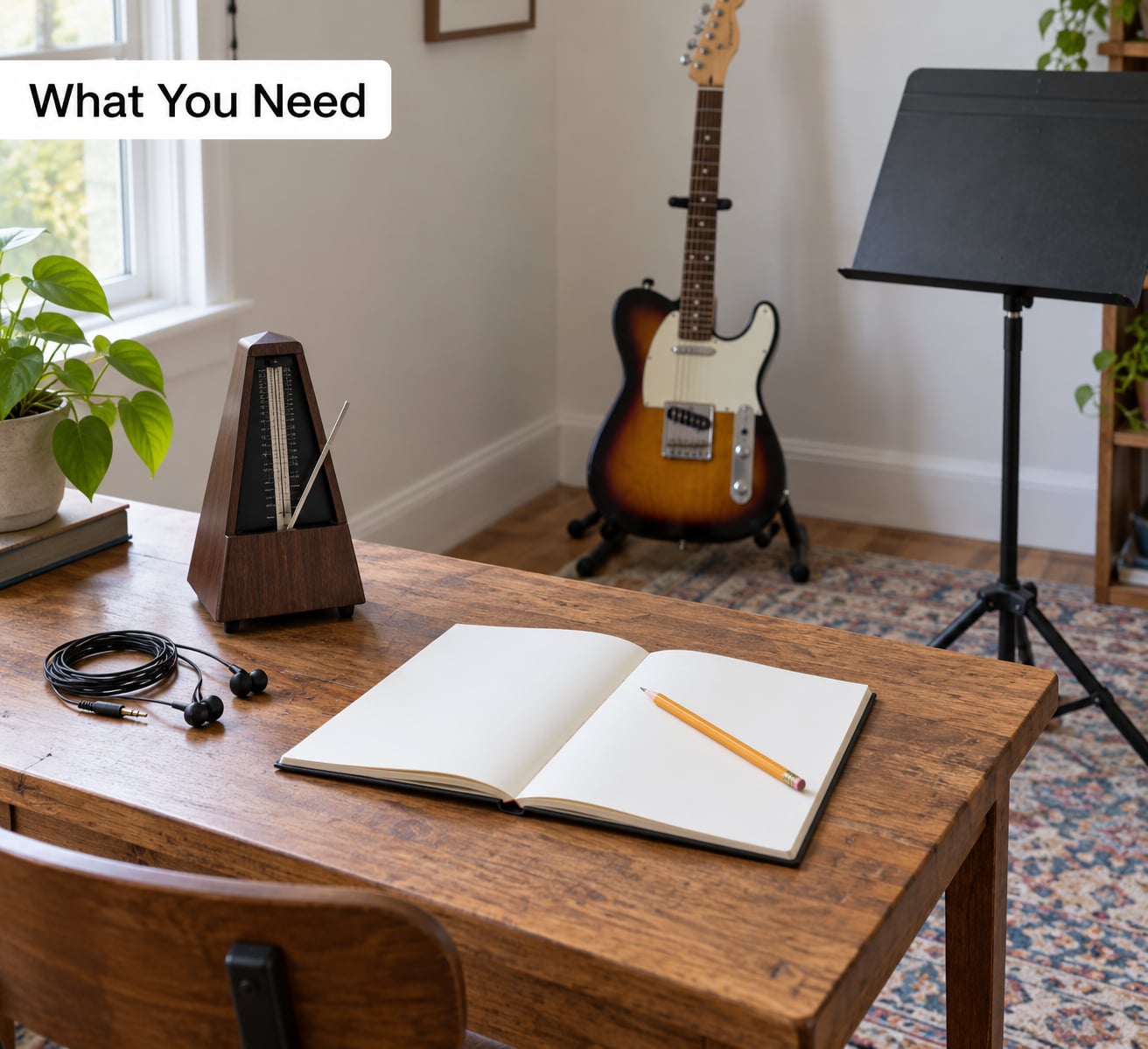
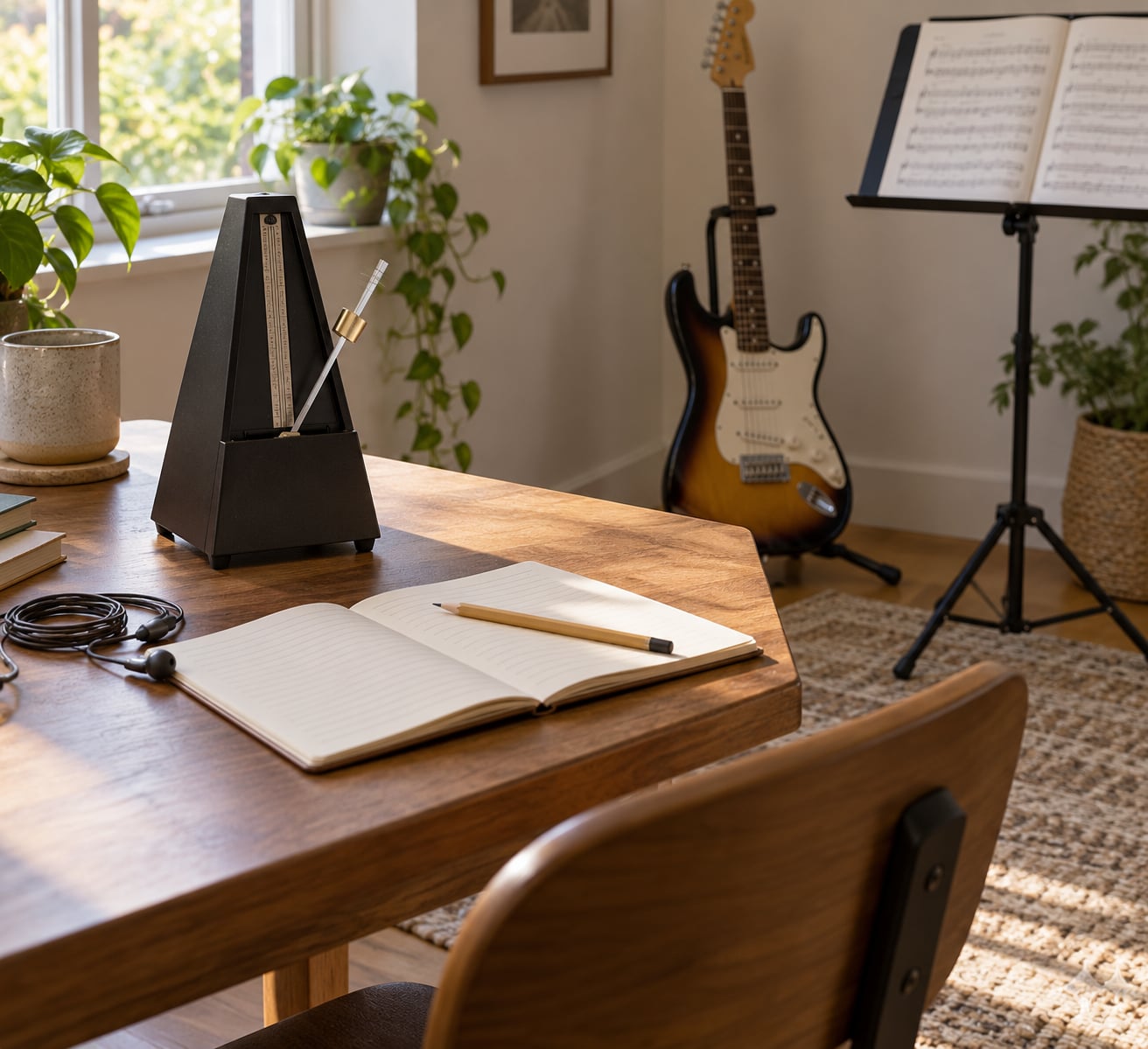
The equipment list is short, and most of it you already own. The one thing you cannot skip is a click you can always hear.
- A metronome that sits louder than your playing. Play a chord or a fill, then raise the click until it cuts through without becoming painful. If it disappears the moment you dig in, the click is useless at that setting.
- A phone app or a small digital unit. Both are fine. The feature that matters is a volume control that goes high enough to sit over an amplified or distorted instrument.
- Your instrument, in playable condition. Fresh strings, a rested fretting hand, and a chair you can sit in for twenty minutes.
- A music stand so your eyes stay on the page instead of on your hands.
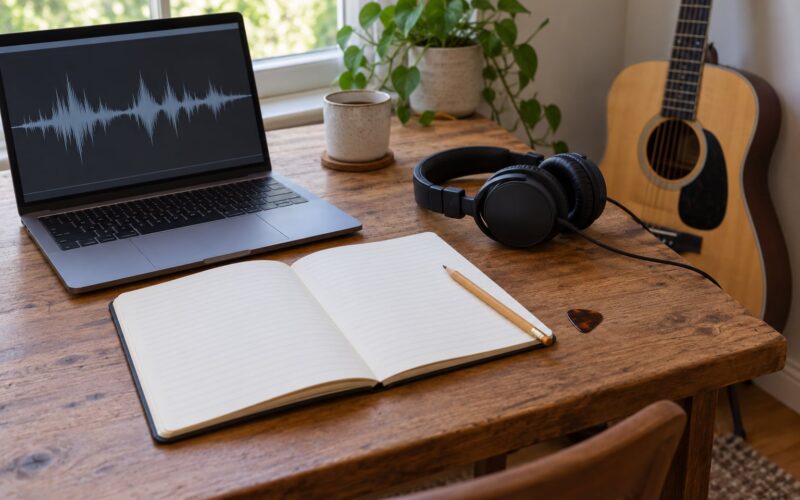
- A notebook or a voice recorder app. You need somewhere to log the tempo you finished at and what broke down.
- Headphones or earbuds, optional. Useful when a single-ear fit lets you keep one ear on your own playing and one on the click.
Beyond that, tap tempo and a visual pulse option are worth having if your metronome offers them. Tap tempo lets you set the speed by clapping along to a record instead of hunting through numbers, and a visual pulse gives you something to watch in loud rooms where a click is wasted.
Step-by-Step: How to Practice with a Metronome Effectively
1. Set Up the Metronome and Choose a Starting Tempo
Pick a tempo where you can play the passage cleanly, three bars in a row, with no dropped notes. For a first pass at a hard riff, that often means somewhere around 50 to 60 BPM, which feels insultingly slow until you notice how few mistakes you are making.
Set it in a simple time signature, usually 4/4, and turn on the accent so beat one sounds different from the rest. That accent is how you find the downbeat without thinking about it. Play one bar of clicks and count them out loud before you touch the instrument.
If the music itself is in a fast meter, that is fine. Work in 4/4 at the slow tempo first, then move the click back to the real meter once the notes are clean.
2. Practice the Pulse Before Adding Difficulty
Tap your foot or clap along with the click for a full minute before you play anything. Then say the subdivisions out loud: one-and-two-and-three-and-four-and. This feels silly and it works, because most timing problems are not note problems, they are pulse problems.
Sing or hum the line first. Guitarists hum the riff, pianists sing the melody, drummers whisper the stick pattern. Once your voice is landing on the same beat as the click, the fingers usually follow within a day or two.
3. Isolate Trouble Spots and Check Your Accuracy
Take the two worst bars and loop nothing else. Set the click to a tempo you would not normally use, work one beat at a time until that beat is solid, then reconnect the bars. A Piano World thread on the topic still gets quoted for exactly this: take the two hardest measures, work them a beat at a time, then drop back down and play them again in context.
Record a take and listen back. Recording exposes two things your ear will not catch live: rushing, which is almost always in the hard passage, and dragging, which hides in the easy one where you relax.
When you drift mid-session, do not stop and restart from the top. Realign on the next downbeat and keep going. Restarting teaches you that drift is a failure, and it stops you ever hearing how fast you recover.
4. Work with Subdivisions and Rhythmic Variations
Once the pulse holds, subdivide. Play quarter notes against the click, then eighth notes, then sixteenth notes, each at the same slow tempo. The click stays on quarters while your notes get denser, which is how drummers and guitarists build clean fast passages without accelerating.
From there, vary the rhythm rather than the speed. Try triplets against straight quarters, rests on the downbeat so you have to feel where beat one is, accents on the off-beats, and a swung feel. Odd meters work the same way: tap out 3/4, 5/4 or 7/8 as plain clicks first so you know where the downbeat lives before you add notes.
The gap click is the best internal-pulse test nobody thinks to run. Play two bars with the click, then two bars in silence, then one bar of click and four of silence. When the silence stretches, your pulse has to hold it, and that is the actual skill.
5. Increase the Tempo Gradually
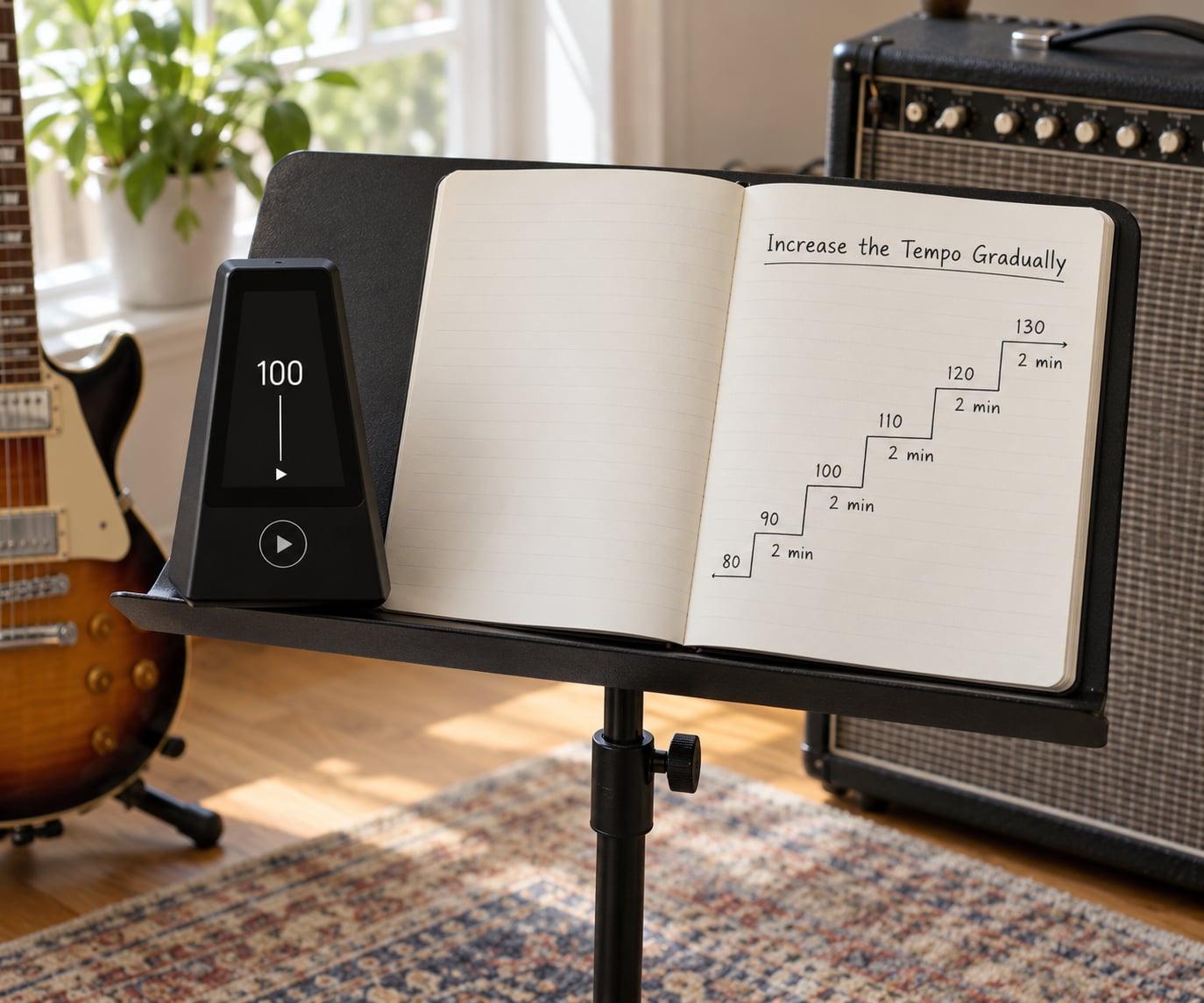
Raise the click only after the passage survives. The rule most experienced players land on is a small increment after a set number of flawless repetitions, and the ladder changes as the tempo climbs. Practicing with a metronome effectively means treating the click as a measuring tool rather than a scoreboard.
- Under 60 BPM: five clean repetitions with no mistakes, then add 5 BPM. If accuracy breaks, drop 10 BPM and rebuild.
- 60 to 100 BPM: four repetitions of 8 to 12 bars, then add 5 BPM or roughly 5 percent. If accuracy breaks, hold the same tempo for two more passes.
- 100 to 140 BPM: three repetitions including the hardest bar, then add 5 to 10 percent. If accuracy breaks, slow to 80 percent and re-embed the motion.
- Above 140 BPM: two full repetitions of the section, then add 5 BPM. If accuracy breaks, stop, drop below the click and practise without it.
- Stuck for several sessions: no increase at all. Drop back and rebuild the motion before pushing again.
Tempo is a byproduct of clean motion, not a target you grind toward. Guitar Tricks players say it plainly: if you are pushing hard and getting nowhere, drop below the click and re-embed the fingering and picking without it.
For fast lead work, use short bursts. Play one beat at a time as fast as you can stay clean, drop to a comfortable tempo for a full pass, then repeat. For alternate picking and downstroke speed, isolate the pick stroke, keep the wrist loose, and let the click sit on every beat rather than every sixteenth.
6. Practice Dynamics, Phrasing, and Musical Expression
A metronome should sharpen your musicality, not flatten it. At your target tempo, play the passage twice: once flat and even, once with dynamics, articulation and phrasing that actually sound like the record.
Then test the internal pulse by playing a phrase with the click lowered or muted and rejoining it on the next downbeat. If you can hold the space for eight bars, your time is starting to live in your body rather than in the speaker.
7. Finish with a Full-Section Performance and Review
Close the session by playing the whole song or the whole section at your target tempo, then record it. A full-length take is where drift shows up that short loops hide.
A simple twenty-minute session looks like this:
- 3 minutes: tap the pulse and speak subdivisions at 50 to 60 BPM
- 7 minutes: the problem section, slow and clean, raising tempo only on clean reps
- 4 minutes: subdivisions, eighths and sixteenths at the same tempo
- 3 minutes: gap click, two bars of click and two of silence
- 3 minutes: one full performance at target tempo, recorded
Then write three lines in the notebook: the tempo you finished at, what broke down, and the tempo you start from next time. That log is how progress becomes visible over weeks instead of feeling like nothing changed.
Common Mistakes
Starting too fast, then blaming yourself
The fix is unglamorous: start at 50 to 60 BPM, play three bars perfectly, and only then think about speed. Beginners who jump to a fast setting conclude they have no rhythm, when in fact they are playing faster than they can read.
Treating the metronome as punishment
If the click annoys you, you will tune it out within a week. Keep it low and pleasant, keep sessions short, and use it on the hardest two bars rather than on everything. A metronome used happily for ten minutes beats one resented for an hour.
Only ever practising the downbeat
Feeling the quarter note is easy. Everything interesting happens between the clicks, so subdivide from the first session instead of saving it for when the simple version works.
Raising tempo after one clean run
One clean pass is luck. Practicing with a metronome effectively is mostly the discipline of not raising the click early. Keep reps at three to five at higher speeds, add 5 BPM or about 5 percent, and resist the urge to push every single attempt.
Ignoring musicality
Drilling the same lick with no dynamics produces accurate, lifeless playing. Alternate takes: one mechanical for accuracy, one expressive at the same tempo.
Never recording or reviewing
You cannot hear your own drift while you are inside it. Ten seconds of recording at the end of a session catches more timing problems than an hour of playing.
Why you desync with the click
This is the most common complaint, and it has a short list of causes:
- The click is quieter than your playing, so you are technically guessing. Turn it up.
- You are at a tempo you cannot play cleanly. Drop to 50 to 60 BPM.
- You have no subdivision yet. Count one-and-two-and out loud for a minute.
- You rush the hard bars and drag the easy ones. Slow down until both feel identical.
- You tense up against the click. Slow practice with a relaxed hand fixes more speed problems than any tempo increase.
And keep this in mind: a metronome will not fix your ear for pitch, teach you theory, or teach you how to play with other people. Those need recordings, a teacher, and a rehearsal room. Forum players are split on whether the click damages feel, and the consensus is that it does not, provided you also play without it.
Frequently Asked Questions
Why can’t I play with a metronome?
Usually the click is quieter than your playing, or the tempo is above what you can play cleanly. Raise the click until it sits over your instrument, drop to 50-60 BPM, and count subdivisions out loud. Rushing hard bars and dragging easy ones is normal and visible on a recording. When you drift, realign on the next downbeat instead of restarting.
How long should you practice with a metronome?
Ten to twenty focused minutes a day beats a long occasional session. Break the time into pulse warm-up, slow clean work on the problem section, subdivision work, a short gap-click block, and one recorded full pass at target tempo. The metronome block is part of practice, not the whole of it, so keep time for tone, feel and repertoire too.
How fast should I increase metronome tempo?
Raise the click by 5 BPM or about 5 percent, and only after three to five flawless repetitions of the passage. Below 60 BPM you can afford 5 BPM steps; above 140 BPM stay at 5 BPM and only raise it twice per session. When accuracy breaks, drop back, repeat at the same tempo, and treat a multi-session plateau as a signal to rebuild motion below the click.
Do metronomes help with ADHD?
A metronome is not a treatment for attention issues, but a steady external pulse can act as an attentional anchor. Players who struggle with focus often do better with five to ten minute blocks, a visual or haptic pulse instead of an audible click, the unit placed in their field of view, and the click volume kept low so it does not demand ear focus.
How do you practice speaking or singing with a metronome?
Set the click at your natural speaking pace, tap the beat with a foot on stressed syllables, and speak a 30 to 60 second passage. Record it, check whether you speed up at the ends of sentences, then slow the click by 5 to 10 percent and repeat. The same method works for singing phrases, learning a monologue, and rehearsing a presentation.
Should I use a metronome for everything?
No. Use it for technical work: clean chords, scales, rudiments, difficult passages, odd time signatures, and full-section performance checks. Skip it for pitch work, theory, free-time phrasing, and playing with a band, where a human drummer already supplies the pulse. A short metronome block inside a normal practice session is more useful than a metronome-only session.
Conclusion
Start with the boring version. Set the click to a tempo slow enough that three bars come out clean, accent beat one, and play the two bars that frustrate you. Record one take before you raise anything, raise the click by 5 BPM only after the passage earns it, and log the number in a notebook.
Do that for ten minutes a day and the click gradually stops being something you follow. It becomes something you carry, and that is the whole point of practicing with a metronome effectively.