How to build arm endurance for drumming is mostly a question of efficient strokes, off-kit forearm work, and a gradual rise in on-kit volume that lets your body adapt. Skip the first one and the other two become a way to get tired more slowly.
By arm endurance I mean the ability to play at a steady, relaxed intensity for the length of a rehearsal or a full set without your forearms, wrists, and shoulders tightening until your hands slow down on their own. Most drummers lose a set in the second hour for exactly this reason, not because they lack strength.
The work is boring in the best way. You build it over weeks, mostly on a pad, mostly at moderate volume, and you track what you can actually do rather than how hard it felt.
Metal drumming is where this shows up hardest, because double-bass patterns and blast beats ask more of the forearms per minute than almost anything else in rock. The same program works for funk, jazz, or metal, though the tempo targets change.
Table of Contents
- What You Need
- Step-by-Step: How to Build Arm Endurance for Drumming
- 1. Establish a Clean, Efficient Stroke
- 2. Build Local Muscular Endurance
- 3. Gradually Increase Stroke Speed
- 4. Practice Sustained Patterns Without Holding Tension
- 5. Add Controlled Resistance Work
- 6. Train Your Stamina, Not Just Your Arms
- 7. Use a Repeatable Weekly Progression
- Common Mistakes
- Gripping the sticks too hard
- Practising through pain
- Raising tempo or volume too fast
- Training only with endurance drills
- Skipping rest between sets and rest days
- Worrying about bulky arms
- Frequently Asked Questions
- How do I stop my arms getting tired when I play drums?
- How long does it take to build arm endurance for drumming?
- What are the best forearm exercises for drummers?
- Is hand and wrist pain normal when I practise drums?
- Should drummers lift weights, and will it make my arms slow?
- How long should a drummer practise each day, and when should I take a rest day?
- Conclusion
What You Need
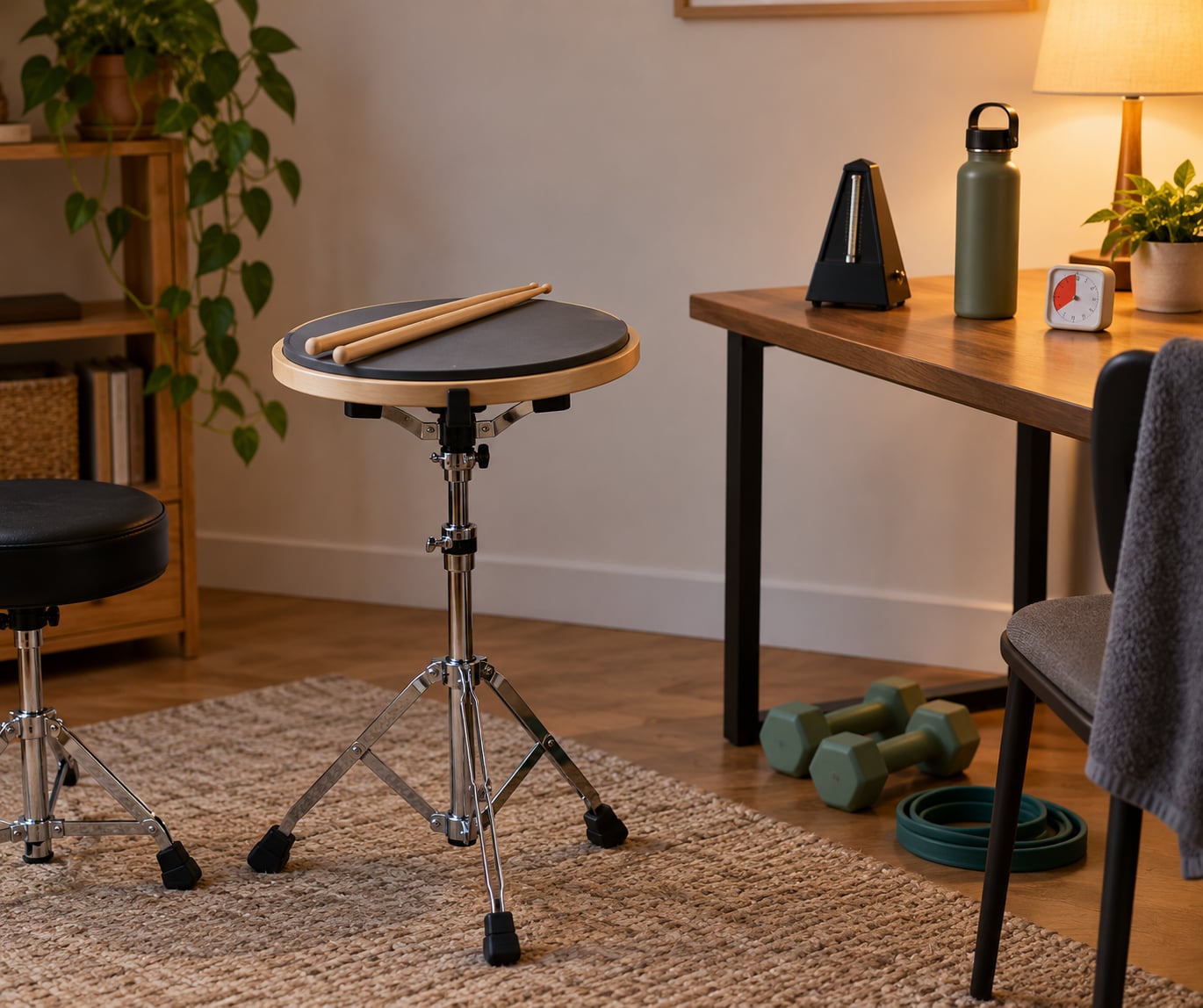
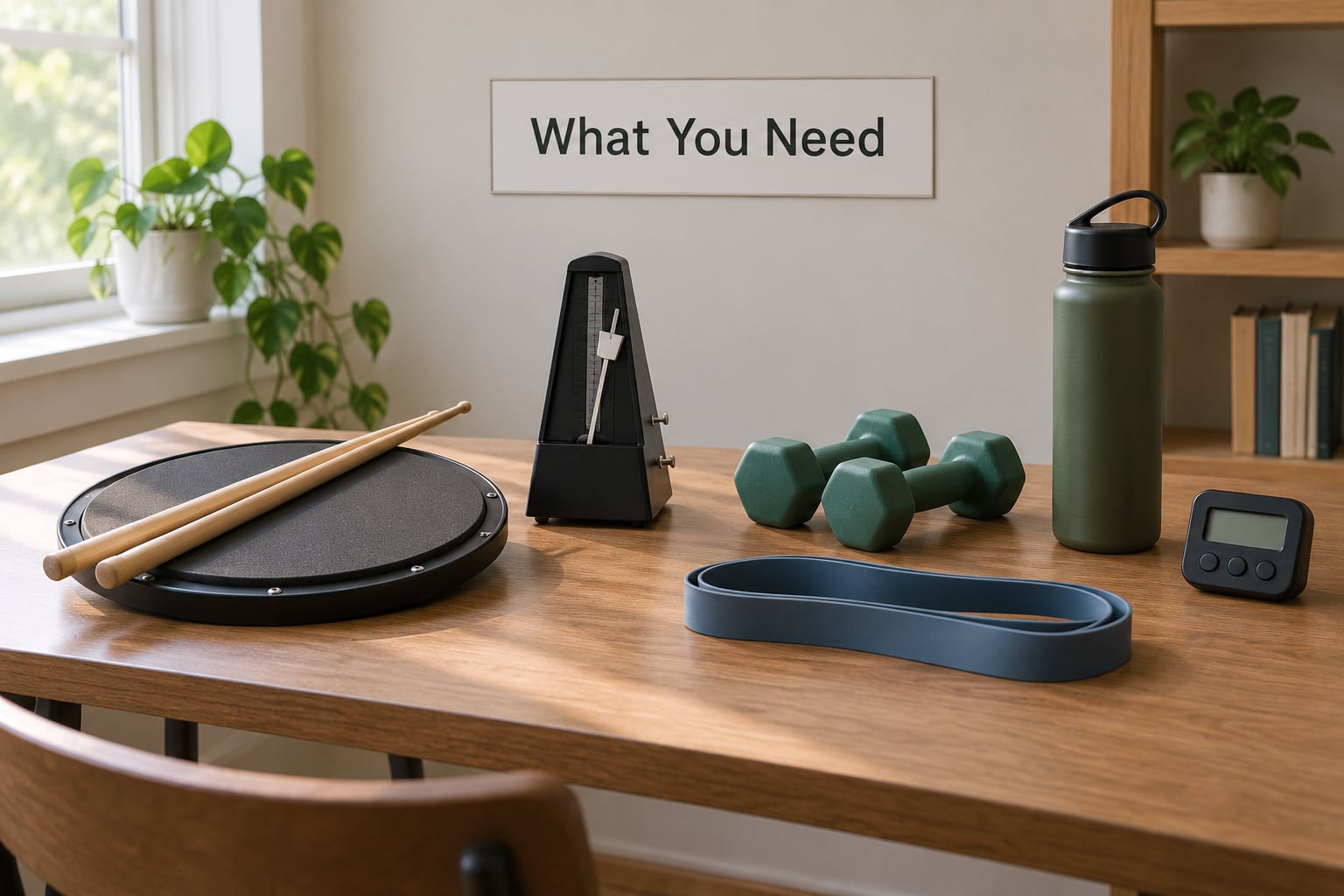
You need very little to start: a practice pad, a metronome, and a way to time a set. Everything else is optional but useful once the first four weeks feel easy.
- A practice pad for volume and repetition without drum shells or cymbals. A heavy pad with some give is better for endurance work than a thin, hard one.
- A metronome, ideally one you can program with tempo increases. Endurance work is tempo work.
- Light dumbbells or a resistance band for two or three short off-kit sessions a week. Household weights are fine at this stage.
- A timer or a phone stopwatch so your endurance sets are measured, not guessed.
- A water bottle and somewhere with enough elbow room to swing without hitting a wall.
A decent pair of sticks matters more than people expect. A standard 5A is roughly 47 to 52 grams a stick, a 7A sits around 54 to 56 grams, and artist models run heavier, some up near 70 grams. Heavier sticks are a real endurance tax, so drop back a weight while you are building rather than adding it.
Before any of it, set your throne so your upper arms hang roughly parallel to the floor and your elbows sit near a 90-degree seated angle. Bad seating turns a wrist problem into a shoulder and back problem, and you will blame your arms for it.
Step-by-Step: How to Build Arm Endurance for Drumming
The system below runs in order and each step depends on the one before it. A drummer who starts at step five ends up strong, tight, and still tired at minute forty.
1. Establish a Clean, Efficient Stroke
Relaxed grip and an assisted rebound cost less energy than an arm swing, so this step decides everything that follows. Hold the stick in the fingers rather than clamping with the palm, and let the stick come back up on its own between strokes instead of lifting it with the arm.
Run a simple test: play steady eighth notes at a comfortable tempo for two minutes and have someone watch your hands, or record a phone clip. Your wrists should stay loose, the stick should never be forced upward, and the hands should not squeeze harder as the minutes pass.
If your shoulders start bouncing by minute two, your stroke is an arm movement. Drop the stroke height, slow the tempo, and rebuild from there.
2. Build Local Muscular Endurance
Short, frequent sets on a pad train the forearm flexors, extensors, and the small interossei between the metacarpals far better than one long session does. Think of it as teaching the forearms to hold a moderate load for a long time rather than to produce a peak.
A workable starting protocol: five rounds of two minutes of moderate single-stroke and para-diddle work, with 60 to 90 seconds of rest between rounds. The tempo is whatever keeps your stroke relaxed and even, usually somewhere in the 90 to 110 range for most drummers.
Rest here is part of the workout, not wasted time. If your stroke degrades in the last 20 seconds of a round, the round was too long or too fast. Cut it back until you can finish clean.
3. Gradually Increase Stroke Speed
A tempo ladder is the cleanest way to build arm endurance without wrecking technique. Climb in small increments and stop climbing the moment evenness breaks down.
Hold a tempo when the notes are landing evenly and your forearms feel warm rather than tight. Add a small increase when the level is comfortable and the volume stays controlled. Repeat the previous level when you can hit it but the next step feels like a jump, and drop back a level whenever the stroke starts to fall apart.
For metal playing, keep at least half of your ladder work under 120 bpm, even if your songs live at 200. Speed built on a shaky foundation is what technique collapses on, and the arms collapse first.
4. Practice Sustained Patterns Without Holding Tension
Long-duration work is where most drummers discover how much tension they were carrying without noticing. Aim for a 10-to-20-minute set using patterns you would actually play: alternating sticking, accents, ghost notes, and dynamics changes rather than one endless roll.
Use one rule for the whole set: if the space between your shoulders drops or your forearms harden, you are bracing, so drop the intensity for the remainder of that set. Feeling fatigued while still technically in control is the target state. Feeling tight, fast, and uncontrolled means the set is over.
One line from a drummer on r/drums says it better than most coaching text: play with the wrist rather than the arm, and keep efficiency of motion front of mind.
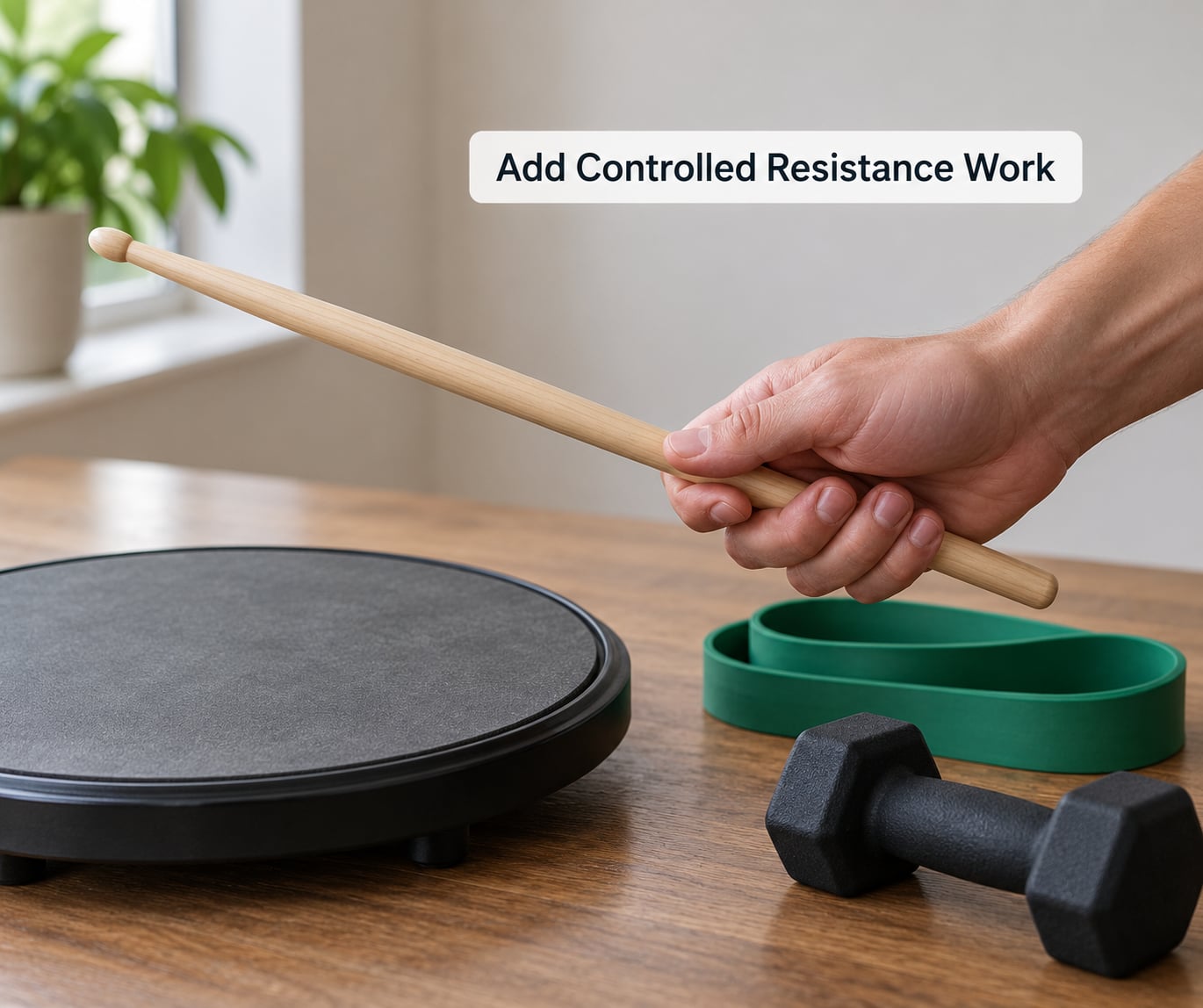
5. Add Controlled Resistance Work
Light resistance work builds the grip and forearms that the kit alone will not. Do it two or three short sessions a week, separate from hard playing, and use rep schemes that favour endurance over size.
| Exercise | Primary muscle | Sets x reps | Notes |
|---|---|---|---|
| Band or light dumbbell pronation and supination | Forearm rotators, pronators and supinators | 3 x 12 each direction | Slow, full range of rotation |
| Wrist roller with light sticks or a light bar | Wrist flexors and extensors | 3 x 30 seconds | Forearms level, no shrugging |
| Reverse curl | Biceps and brachioradialis | 3 x 12 | Keep the elbows pinned at your sides |
| Hammer grip hold or plate squeeze | Grip and interossei | 3 x 20 to 30 seconds | Build to roughly 60 seconds over weeks |
| Overhead triceps extension | Triceps | 3 x 12 | Light weight, controlled at the top |
| Farmer carry with a dumbbell in each hand | Grip, traps, upper back | 3 x 40 steps | Stay tall, shoulders down |
Do not do resistance work right before a demanding drumming session. Conditioning advice from drumming communities is consistent: combine cardio, especially HIIT, with muscle-endurance resistance work for arms, calves, shoulders, and back. That combination is what carries a drummer through a two-hour set, not any single lift.
6. Train Your Stamina, Not Just Your Arms
Arms fail faster when the rest of the body is bracing around them. Keep the upper body tall, breathe between phrases instead of holding your breath, and let the shoulders and ribcage move with the playing rather than staying locked in one position.
Build a base with zone 2 cardio a couple of times a week and short HIIT sessions when you can recover from them. Cardio work supports drumming endurance because a two-hour set is a cardiovascular event that happens to be played with sticks.
Recovery counts as training. Sleep, food, and water do more for your third song than anything you can do in the warm-up, and a drummer on tour who is short on sleep will feel it in the forearms first.
7. Use a Repeatable Weekly Progression
Consistency across weeks is what produces the change, so write the week down and repeat it. A workable split looks like this.
| Day | Focus | On-kit work | Off-kit work |
|---|---|---|---|
| Day 1 | Technique and efficiency | 20 minutes of controlled stroke work plus rudiments at moderate tempo | None |
| Day 2 | Endurance | Two to three 10-to-20-minute sustained sets with rest between them | Forearm and grip routine, 20 minutes |
| Day 3 | Rest | Short, easy playing only if you want it | Mobility work, light cardio |
| Day 4 | Tempo ladder | Ladder work in short blocks with full recovery between levels | Cardio, zone 2 or short intervals |
| Day 5 | Full-transitions practice | Play real songs start to finish and log how long you stayed clean | None |
| Day 6 | Endurance and hands | One long pad session, then stop while you are still fresh | Forearm and grip routine, 20 minutes |
| Day 7 | Full rest | None | None |
Increase duration or difficulty only after three or four sessions in a row where your control held up at the end. If you are adding something every week regardless of how the last week felt, that is not progression, that is a countdown.
The 80/20 version of this: about 80 percent of your drilling should reinforce technique you already own, and the remaining 20 percent should attack whatever actually limits you. For most drummers chasing speed, that limiter is endurance.
Common Mistakes
Almost every stalled arm-endurance program comes down to one of a handful of mistakes, and each has a straightforward fix.
Gripping the sticks too hard
A death grip is the most common and the least obvious. You burn continuous isometric tension in your forearm flexors and grip for every stroke, and the harder you squeeze the faster you tire. Loosen the hold so the stick is controlled by the fingers, and re-check with the two-minute test in step one.
Practising through pain
Fatigue and injury feel similar at first, and confusing them is how careers end. Ordinary fatigue is a broad, dull tiredness that clears with rest within a day. Stop playing and see a doctor if you notice numbness or tingling that does not go away when you stop, sharp pain at a specific point, a sudden loss of grip strength, or symptoms that are still there 48 hours later.
Raising tempo or volume too fast
Endurance adapts over weeks, not sessions. Climb one step on the ladder and stay there until it is boring. The temptation to jump straight to your gig tempo is exactly what produces the wall where technique falls apart.
Training only with endurance drills
If every session is a long set, you are teaching fatigue tolerance and nothing else. Mix short, fast, precise work with the long sets. Warm-ups make you feel ready, but they do not build stamina on their own, so do not let a good warm-up replace the actual endurance work.
Skipping rest between sets and rest days
Overtraining is the thing drummers worry about most, and they are right to. The forearm is a tendon-heavy area and tendons adapt more slowly than muscle. Keep the full rest day in the schedule and keep the reps in the off-kit work high and the weight light.
Worrying about bulky arms
This one comes up constantly and it is mostly unfounded. High-rep, low-load work builds capacity, not size. Drummers who get noticeably bigger are usually doing heavy low-rep work, and the fix is the rep scheme, not avoiding the gym.
Frequently Asked Questions
How do I stop my arms getting tired when I play drums?
Drummers stay fresh through stroke efficiency rather than brute strength. Keep a relaxed grip, let the stick rebound into the next stroke instead of lifting it with the arm, and keep the motion in the wrist and fingers. Minimal grip tension means each hit costs less energy, so you can play longer before the forearms fail. Efficient technique also lowers your injury risk.
How long does it take to build arm endurance for drumming?
Most drummers notice a real difference in four to six weeks of consistent work, and a solid change in playing shape over three months. The early gains come almost entirely from better efficiency rather than new muscle capacity, which is why the first two weeks feel faster than anything after them. Keep logging set length and control so you can see progress rather than guessing at it.
What are the best forearm exercises for drummers?
Focus on the muscles that hold the stick and rotate the forearm: band pronation and supination, wrist rollers, reverse curls, and holds that build grip without crushing. Do these two or three times a week with high reps and light weight, keeping resistance work away from the days you play hardest. Rotator cuff and scapular work matters too if you play upright and your shoulders ache.
Is hand and wrist pain normal when I practise drums?
A little general tiredness after a long session is normal and clears with rest. Numbness, tingling, sharp localised pain, or weakness that shows up as a grip problem is not normal and should not be pushed through. Stop playing, and see a doctor or a physiotherapist if it persists beyond a day or two. An early tendon problem is much easier to deal with than a long one.
Should drummers lift weights, and will it make my arms slow?
Yes, with the right rep scheme. High-rep, low-load work builds the endurance you want without adding bulk, and heavier low-rep training is what actually makes arms feel slow. Keep sessions short, leave a couple of reps in reserve, and skip heavy arm work in the 48 hours before a demanding rehearsal or show. Many working drummers do far better on stage with some strength work behind them.
How long should a drummer practise each day, and when should I take a rest day?
For endurance work, several shorter sessions beat one long one. Around 45 to 60 minutes of focused playing on four or five days a week, split into technique blocks, tempo work, and one endurance set, is plenty. Take at least one full rest day a week and use 60 to 90 seconds of rest between hard sets. Tendons recover more slowly than muscle, and that is where drumming injuries actually start.
Conclusion
Start where most drummers skip: build a relaxed, efficient stroke and prove it with two minutes of even playing before you add anything else. Then track your workload, keep the weekly split, and add time or resistance only after several clean sessions in a row. Endurance arrives slowly and then arrives all at once, and every step above is built to keep it that way as 2026 goes on.