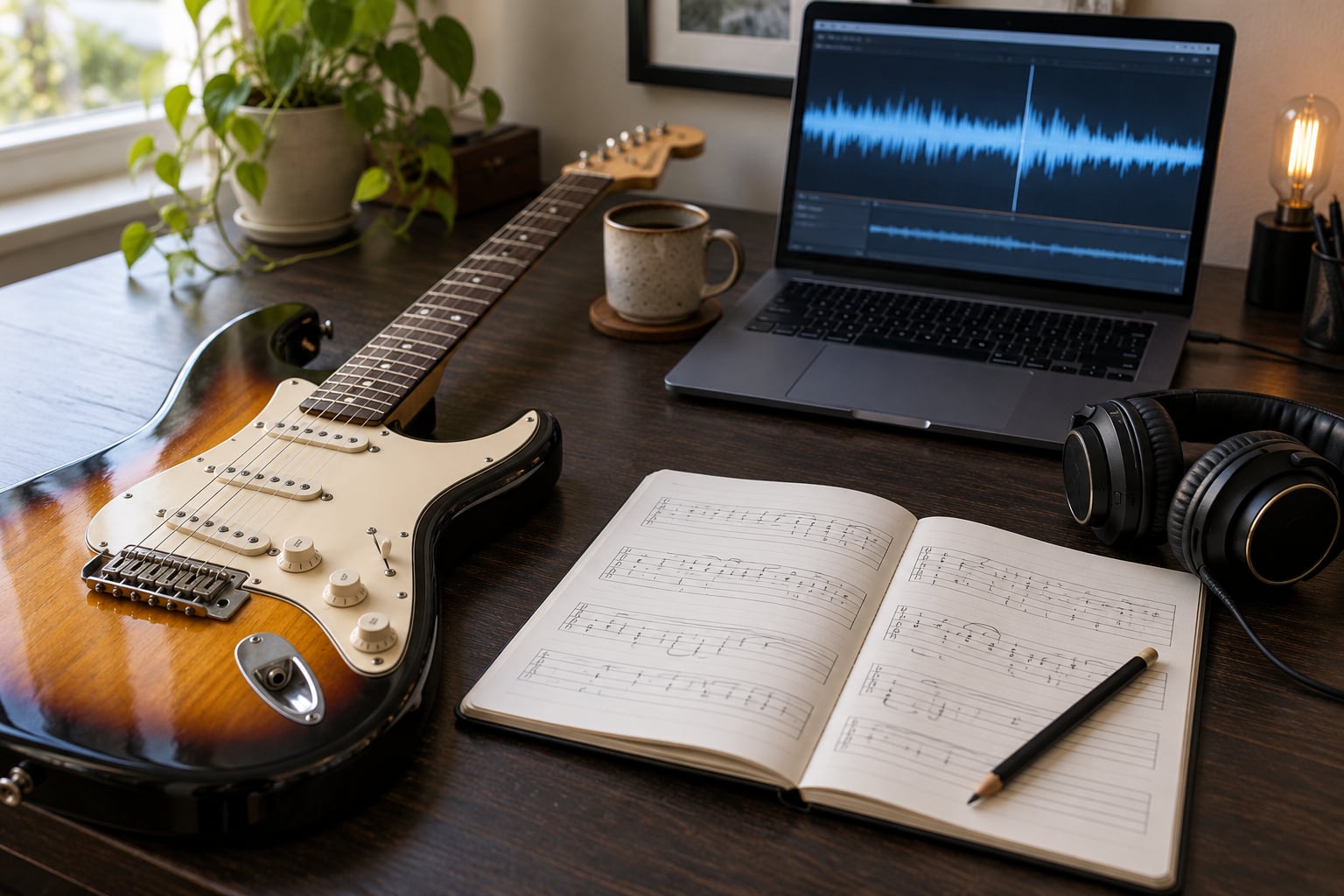
Learning how to transcribe a metal solo comes down to one habit: work in short phrases, start well under the recorded speed, and write down what you hear before you try to make sense of it. Most of the difficulty is not the guitar playing, it is the distortion smearing pitch, the palm mutes swallowing sustain, and the tuning being something other than standard. Get those three things handled and the rest is patient note-taking.
A useful transcription takes anywhere from 45 minutes to several sessions, depending on how dense the solo is. Set aside one short sitting rather than an evening, and the whole thing stops feeling like homework.
Table of Contents
- What You Need
- How to Transcribe a Metal Solo Step by Step
- Common Mistakes
- Frequently Asked Questions
- Should I write a metal solo in standard notation or tablature?
- How do I transcribe a solo when the distortion hides the notes?
- Do I need to know music theory to transcribe a metal solo?
- What is the best way to slow down a fast guitar solo?
- How do I decide whether a note is a bend, slide, or vibrato?
- Can transcription software accurately transcribe a heavy metal solo?
- Conclusion
What You Need
You need five things, and only one of them costs money you might not have planned on: a source recording, a way to play it back slowly and repeat a section on demand, a guitar set to the right tuning, some way to write the notes down, and a way to record your own playing for comparison.
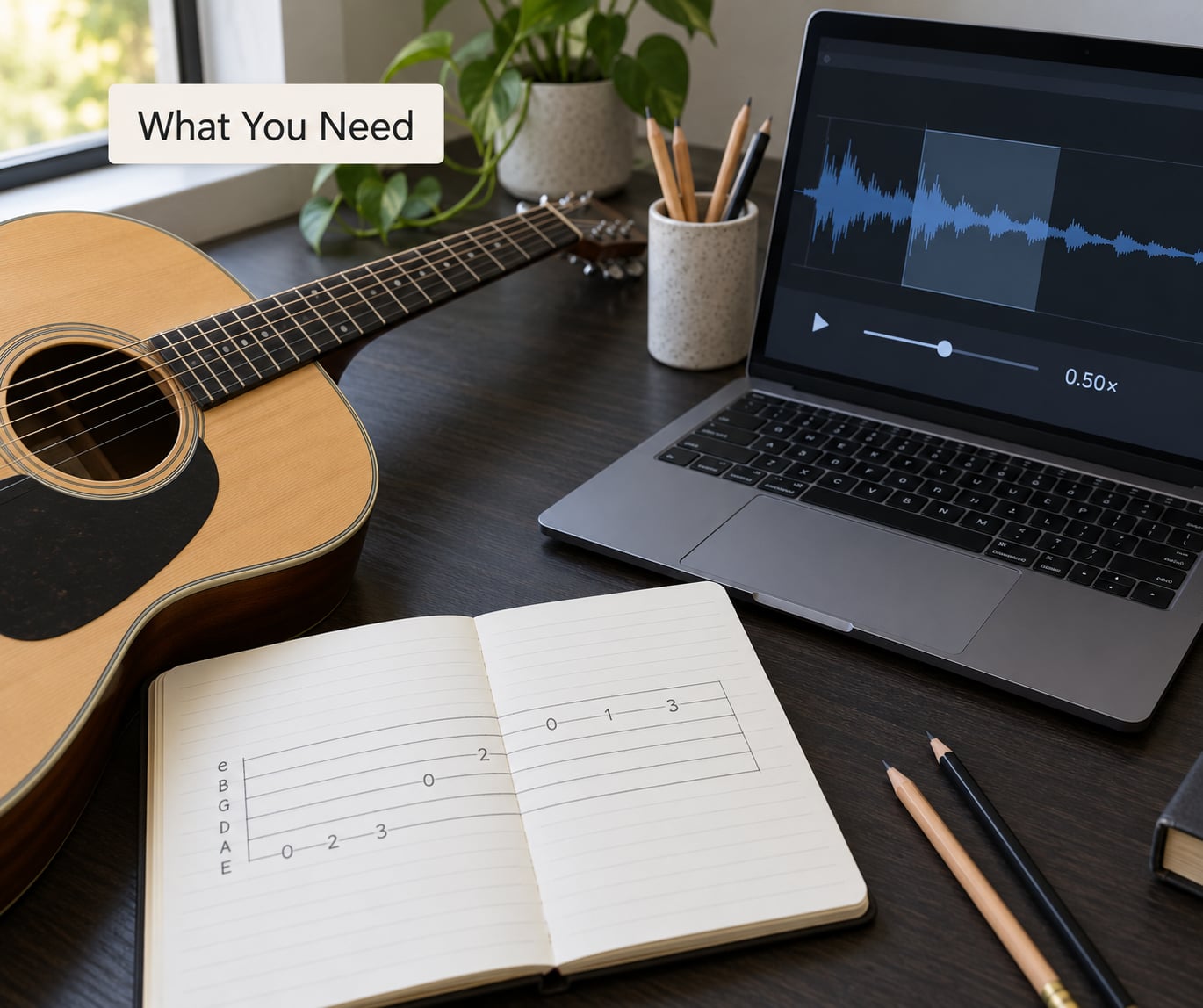
- A reliable source track. A studio version beats a live version or a cover almost every time, because the tempo is steady and the mix is balanced. Download it so playback is not at the mercy of a video buffering mid-phrase.
- Headphones or nearfield speakers. Headphones keep the bass guitar out of the way; speakers help you judge whether you have correctly placed a note. Use what lets you hear the lead guitar separate from everything else.
- Your guitar, retuned. Metal leans on drop tunings and extended-range instruments, so have a tuner ready and expect to change the low string before you write anything.
- Notation or tab software. For playing back what you wrote, a program like Guitar Pro, Soundslice, Noteflight or MuseScore gives you looping and playback at any tempo. A plain notebook works fine for ear training.
- A slow-down and looping method. A DAW such as Audacity, a dedicated transcribing tool, or a video player with variable speed covers this. What matters is pitch-preserved slowdown plus an A-B loop of a few bars.
If you only pick two, make them the looping player and the notation software. Everything else you can improvise around.
How to Transcribe a Metal Solo Step by Step
The order matters. Listening first, mapping second, notation third, checking fourth, refining last. If you try to capture every note while the track is running at full speed, you end up with a page of guesses that feel productive and teach you nothing.
1. Hear the Structure Before the Notes
Before you write a single pitch, play the solo three or four times and describe it out loud. Find the tempo, the time signature, where the solo enters and leaves, and which bars repeat. Identify the tonal centre from the riff underneath rather than the solo itself, since the lead often sits in a mode the opening chords do not.
Listen for what the solo is doing, not just which notes it plays. Is it fast and alternate-picked, is it legato and slurred, is it a blues-influenced line bending between beats? Naming the technique changes what you listen for on the next pass.
Mark the phrase boundaries. A four-bar phrase that repeats three times is three chances to check your work, and it is far easier than one sixteen-bar line you have to hold in your head.
2. Choose a Transcription Format
Pick the format that matches what you will actually do with the transcription, because that decides the format you should write in.
- Guitar tablature shows string and fret numbers. It is the fastest thing to write and the easiest to play back from, and for a metal lead that is nearly always the right default.
- Standard notation shows pitch and rhythm precisely. Choose it if you play in a band with a reader, if you want the rhythm locked down, or if you are building sight-reading skill.
- Rhythm-and-frets notes give you the count and the chord shape without a full chart. Useful for a quick lead sheet or for a section you only need as a reminder.
- A hybrid is the honest answer for many guitarists: tab for the pitch, plus standard notation above it for the rhythm you are least sure about.
Whichever you choose, add a legend for the techniques. Mark palm mutes, slide direction, pre-bend and vibrato so you remember the articulation when you come back to the page a week later.
3. Slow the Recording Down Gradually
Drop the playback speed until the phrase is easier than you think it needs to be, then work your way back up. Most players stall because they sit at 90 percent speed where the notes are nearly legible but not quite.
Loop two to four bars and rehearse the loop itself, not the whole run. Use pitch-preserved slowdown so the notes keep their actual pitch, since pitch-shifting algorithms can make a bend sound like it lands somewhere else. Loop, play it, stop, and write what you played.
Keep returning to the original speed before you move on. A transcription you can only play at 60 percent has not captured the feel yet.
4. Map the First and Last Notes of Each Phrase
Finding the first and last note of each phrase gives you the frame that everything else hangs on. Those two notes are usually the strongest or longest in the phrase, which makes them much easier to identify than anything running through the middle.
Also anchor on rests and position shifts. A sudden gap tells you the previous phrase ended and the next one starts somewhere new on the fretboard, which is usually where the shift would naturally happen anyway.
Once the first and last notes are placed, you can fill the space between them by listening to intervals rather than hunting for absolutes. Ask what the second note is relative to the first: a whole step up, a minor third, a repeat. Ear training for metal guitarists works best when it is trained as interval recognition.
5. Transcribe Rhythms, Rests, and Articulation
Write the rhythm before you write the pitches. Tap it out on your thigh or your guitar body first, then notate the durations and rests as sixteenths or eighths with empty strings, and only then fill in the fret numbers.
This matters more in metal than in most genres because so much of it is rhythmic. Palm-muted chugging, syncopated accents, gallop figures and tremolo-picked runs are patterns first and melodies second. If you capture the durations and the accent marks, the pitches usually follow quickly.
Notate what changes the sound: palm mute, staccato or accented notes, let ring, where the vibrato starts, and which notes are hammered on or pulled off. Those marks are what make a transcription feel like the record rather than a list of frets.
6. Add Bends, Slides, and Alternate Takes
Pitch movement is where metal transcriptions usually get written as something unplayable. A bend that gets written as a straight note loses the entire point of the line, so mark every bend, even approximately.
Write the destination note and then add the bend marking, rather than trying to write the exact amount of bend in cents. Where a recording is ambiguous, notate the clearest playable interpretation and move on; the goal is a line that sounds like the record when you play it.
Two-finger grace notes, slide-in squeals, reverse bends and quick hammer-on and pull-off pairs all need a symbol or a written note next to the notation. When a phrase is genuinely unclear, write your best guess and circle it. Revisiting it later with fresh ears fixes these faster than staring does.
7. Check, Play, and Refine the Transcription
Play your version back at a slow tempo and record it. Then play the original at the same tempo. Any difference you can hear on that comparison is a note you need to fix, and it is the only accuracy check that does not lie.
Build speed back gradually, around five percent at a time, and stop when the line starts falling apart rather than pushing through with errors. A solo you can play cleanly at 80 percent will reach full speed faster than one you drilled at full tempo with mistakes baked in.
Somewhere in that process you will start hearing the fretboard behind the notes. That is the real return on transcription: phrasing, vocabulary and scale shapes you can reuse in your own playing instead of only in that one solo.
Common Mistakes
Almost every stuck transcription comes from one of a handful of habits. Here is what goes wrong and the fix.
- Transcribing at full speed. You catch the shape and nothing else. Fix: start at 60 percent and earn your way back up.
- Hunting isolated notes. A single note in a blur is unidentifiable. Fix: work the first and last note of a phrase, then the notes between them.
- Inconsistent string and fret choices. The same pitch written on three different strings mid-phrase makes the line unplayable and hides the pattern. Fix: keep one position per phrase unless the original clearly shifts.
- Ignoring rhythm and articulation. You get every pitch right and still sound nothing like the record. Fix: write durations, rests and accents before pitches.
- Treating a polished studio note as one performance. Doubled tracks, comping and quantised timing hide the human part. Fix: write what a good player could reproduce, and check against the version you are actually using.
- Not confirming the tuning. Every fret number you write afterward is wrong. Fix: check the low string and open chord tones before you start.
One more worth naming: notating a solo that is beyond your current playing level. You can transcribe anything, but if the result cannot be played at a slow tempo with clean rhythm, you are practising errors rather than the line. Learn the rhythm first and leave the speed out of it for now.
Frequently Asked Questions
Should I write a metal solo in standard notation or tablature?
Write it in tablature unless you specifically need to share it with a reader or are training sight-reading. Tab is faster to write, easier to play back, and shows string choice, which matters for metal phrasing and economy picking. Standard notation earns its place when rhythm is the hard part or when another musician has to read it without playing it. Many guitarists keep both, with tab below and notation above.
How do I transcribe a solo when the distortion hides the notes?
Start by lowering the track a few decibels and boosting the midrange around the guitar’s fundamental, where distortion smearing is least severe. Slow the playback until individual attacks separate, and listen to the very start of each note rather than its tail. Trackers and clean versions of the same track also work well for locating pitch. If a note stays unreadable, write the nearest pitch you can hear and mark it for a second pass.
Do I need to know music theory to transcribe a metal solo?
You need very little to get started: the tuning, the key or tonal centre, and enough interval recognition to tell a minor third from a major third. You do not need to analyse modes to transcribe accurately. Theory becomes useful afterwards, when you look at which scale or mode the line was built from and start borrowing its shapes. Write the notes first, name the pattern afterwards.
What is the best way to slow down a fast guitar solo?
Use a tool that slows the audio without changing pitch, then set an A-B loop of two to four bars so you can repeat a phrase without hunting for it. A DAW gives you the most control and lets you automate a slow build-up in tempo. Dedicated transcribing software and variable-speed video players work fine too. Whatever you use, the combination of pitch-preserved slowdown and looping matters far more than which program it is.
How do I decide whether a note is a bend, slide, or vibrato?
Play the passage at half speed and hold the note. A bend rises to a new pitch and holds there, so you will hear the pitch climb and settle. A slide moves between two fretted pitches, so it lands on a defined note with no wobble. Vibrato oscillates around a steady pitch without leaving it. If you cannot tell, write the closest fretted note and mark it, then check it against a slower pass later.
Can transcription software accurately transcribe a heavy metal solo?
Not fully. Pitch-detection software handles clean, monophonic, evenly articulated lines reasonably well, and it can give you a starting draft for the note positions. It struggles with palm mutes, tremolo picking, bends, slides, grace notes and anything buried in a dense mix, which describes a lot of metal. Treat any automated output as a rough skeleton and correct it by ear rather than trusting the rhythm or technique markings.
Conclusion
Start with the tuning check and four bars of the easiest phrase in the solo, at about 60 percent speed. Write the rhythm before the frets, anchor the phrase with its first and last note, and play your version back against the record before you call it done.
One phrase done properly teaches more than a page of guesses, and the tempo will come back on its own once the notes are right. Build from there, and the phrases you transcribe slowly become the vocabulary you reach for when you improvise.