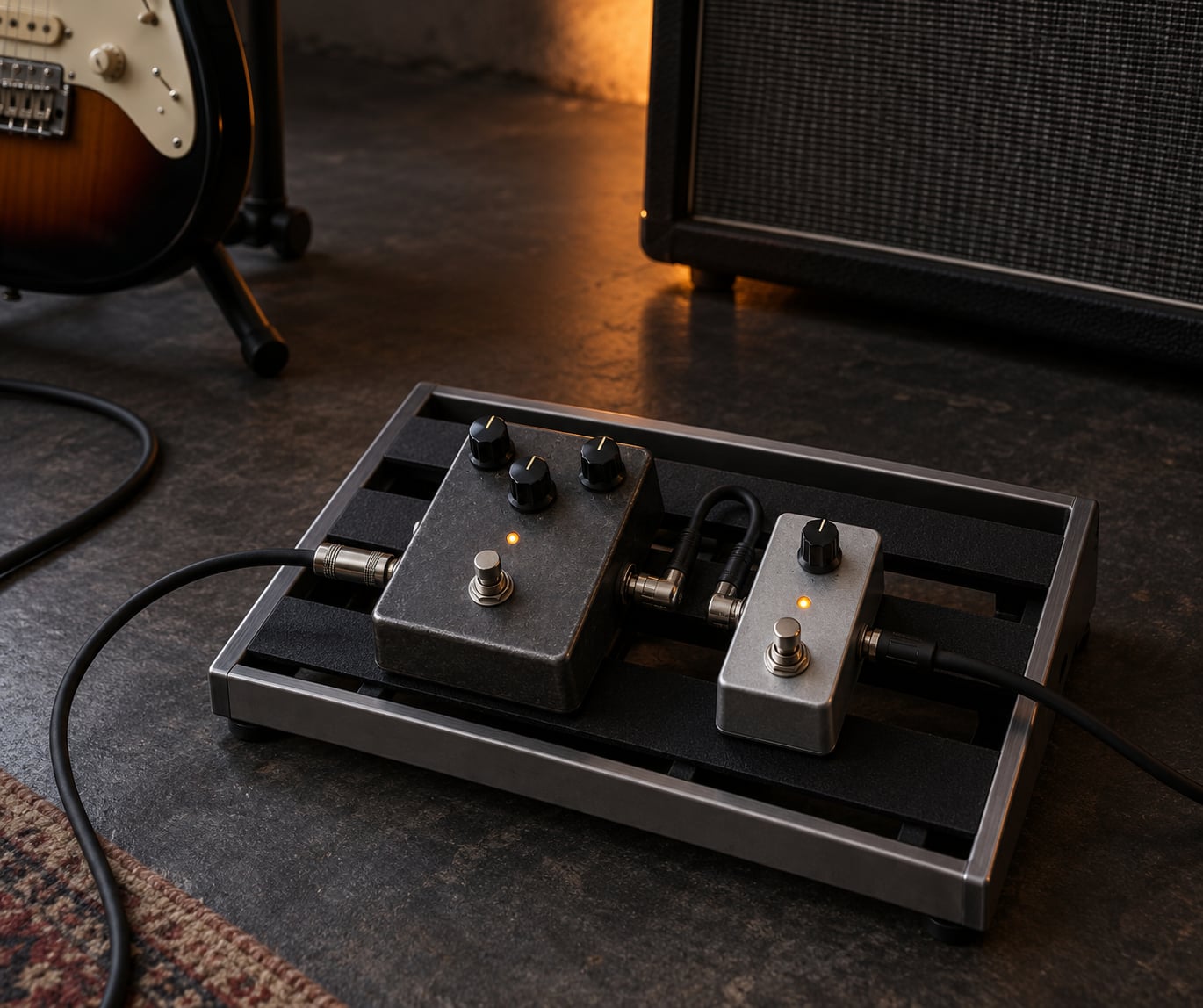
A distortion pedal boosts your guitar signal, then deliberately flattens the tops and bottoms of the waveform so it generates extra harmonics, compression and sustain. That clipping happens inside the pedal, before your amplifier ever sees the signal, which is exactly why it lets a metal guitarist reach a high-gain tone without turning an amp up to room-damaging levels. Here is how distortion pedals work for metal guitarists, from the circuit inside the box to the placement in your chain.
Table of Contents
- How Distortion Pedals Work for Metal Guitarists
- Which major distortion types should a metal guitarist know?
- Why Gain Staging Matters for a Metal Pedal Chain
- What metal settings get the most from a distortion pedal?
- Where should a distortion pedal sit in the guitar signal chain?
- How do distortion pedals interact with the guitar and amplifier?
- How can you make a distorted metal tone clearer and tighter?
- What should you look for when choosing a distortion pedal?
- How to test and tune a distortion pedal in the room
- Frequently Asked Questions
- Do distortion pedals get louder when the gain is turned up?
- Is a distortion pedal better than using a high-gain amplifier?
- Should distortion pedals be placed before or after an overdrive pedal?
- Why does a distortion pedal sound quieter once the amp gain is raised?
- What is the difference between distortion, overdrive, and fuzz?
- Do metal guitarists need a noise gate after a distortion pedal?
- Conclusion
How Distortion Pedals Work for Metal Guitarists
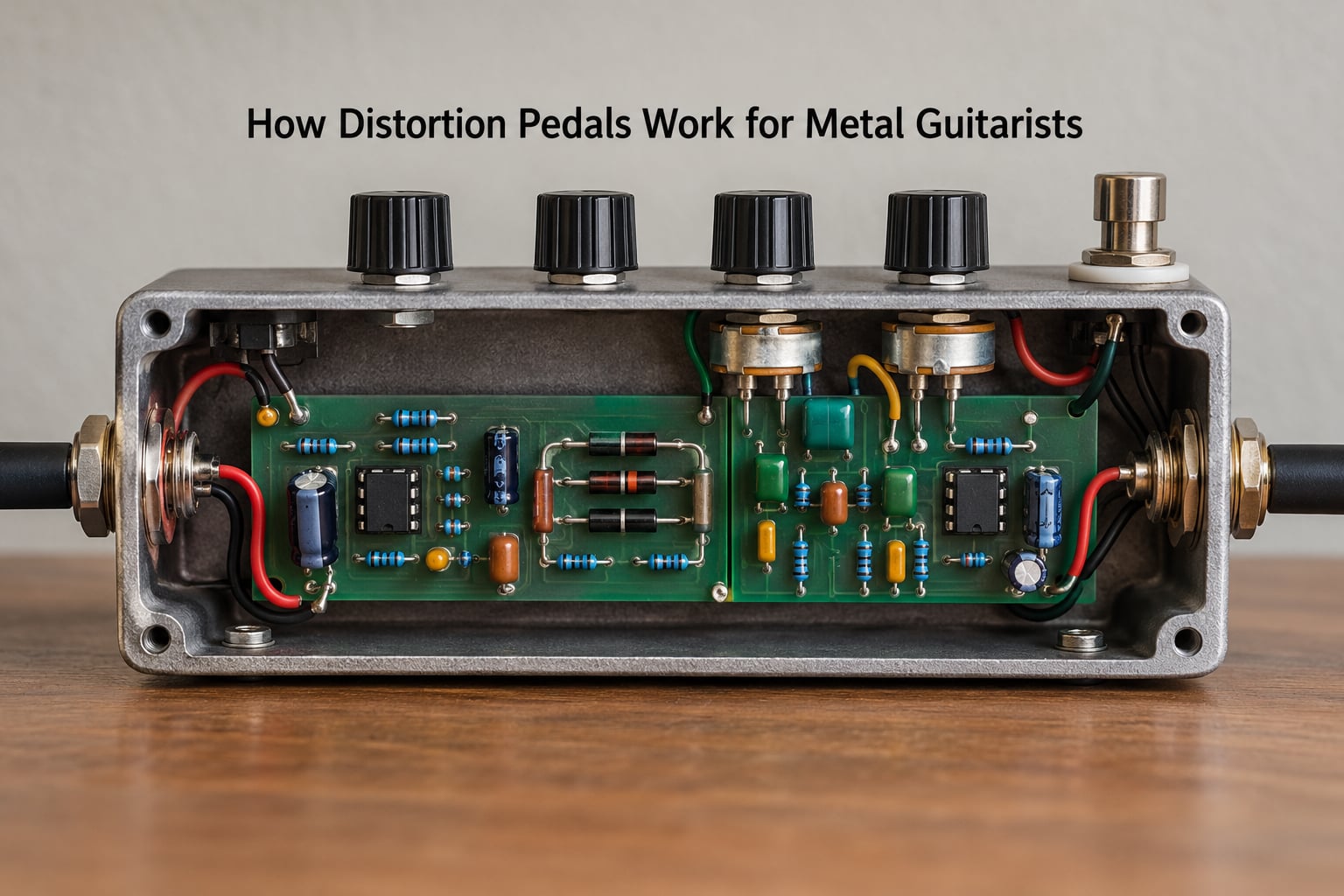
Every distortion pedal, however fancy, runs the same five stages in the same order. Once you can name them, you can read any pedal manual, forum thread or product page and know which part is being described.
- Input and buffer. The signal arrives through the input jack, usually through a buffer that keeps the signal stable and lowers the impedance the rest of the circuit works against. On true bypass designs the signal can also skip the circuit entirely when the pedal is off.
- Pre-amp gain stage. One or more gain stages multiply the signal voltage. This is what pushes the waveform toward the clipping threshold, and a second gain stage is what separates modern high-gain pedals from older single-stage designs.
- Clipping stage. The amplified signal hits a component that refuses to pass any more: a diode junction, a saturated transistor or an op-amp running out of supply voltage. The waveform loses its peaks and valleys and fills in with harmonics.
- Tone stack. Resistors and capacitors shape frequency content after the clipping, usually through a tone control or a bass-mid-treble EQ, sometimes with an added mid hump or low cut.
- Output stage. A final gain stage sets how much signal reaches the cable, then it goes to your amplifier, interface or cab sim.
What metal guitarists should know about how distortion pedals work
Clipping is the whole trick, and it does two things at once. It adds harmonics the clean signal never contained, which is the growl and edge you hear, and it compresses the signal, which squashes the difference between a hard palm mute and a soft open chord.
That second effect is the one players get wrong. Turn the gain up and the tone gets more harmonically dense but also quieter and flatter, because the compressor spends headroom keeping peaks under control. More gain is not more volume, and r/Line6Helix regulars say the same thing about digital rigs: more gain is not more sound.
Distortion, overdrive and fuzz all clip a signal, but in different circuits and to different extremes. Overdrive lets mild clipping happen and then relies on the amp to break up further, distortion clips hard inside the box, and fuzz pushes a pair of transistors so far into saturation that the waveform approaches a square.
How the main distortion controls shape the sound
The gain control sets how far past the clipping threshold the signal travels, and how far it travels decides the texture. Just past the edge, you get the crunchy, harmonically rich low-gain distortion that suits thrash and early death metal. Well past it, the tone turns compressed and smooth, which is where leads and modern low end live.
The level control is the output volume and nothing else. It never adds gain to the circuit, so it can be turned down while keeping the same tone, which is how you use a pedal to pre-saturate a clean or barely-broken amplifier.
Tone controls vary more between designs than the gain and level knobs do. A single tone pot is usually a passive high-pass filter that dulls everything above a set frequency as you turn it down. A three-band EQ gives you more control, but a mid boost and a mid scoop sound nothing alike, and a bass control on a high-gain pedal is often a low cut in disguise that tightens the low end for palm-mute work.
Tighter, attack, focus and air controls appear on high-gain models and usually change how the clipped signal is filtered before output. Agate switches between different clipping diodes or engages a gate. Knob labels vary from brand to brand, so treat any written setting advice as a starting point rather than a promise.
Which major distortion types should a metal guitarist know?
Four clipping circuits cover almost every distortion pedal you will meet, and each one lands on the same waveform problem with a different personality.
| Clipping type | Texture | Gain range | Response to cleanup | Metal use |
|---|---|---|---|---|
| Diode clipping | Hard, bright, compressed, plenty of upper harmonics | High | Volume drops noticeably as you roll the guitar back | Thrash, modern rhythm, palm-mute riffs |
| Transistor saturation | Smooth, rounded, softer clipping edge | Medium to high | Relatively forgiving | Blended modern tones, stacked drive |
| Op-amp clipping | Transparent to aggressive, wide range from the same circuit | Low to high | Tracks the input closely | Overdrive and everything from clean boost to crush |
| Fuzz circuit | Squashed, gated, octave-like, heavily compressed | Extreme | Collapses when the signal drops | Tone-as-gain layering under a saturated amp |
Comparing the same three pedals most beginners conflate:
| Overdrive | Distortion | Fuzz | |
|---|---|---|---|
| Where clipping happens | Partly in the pedal, more in the amp | Inside the pedal | Inside the pedal, pushed hard |
| Typical role | Boost, amp breakup, mid push | Full high-gain voice | Tone shaping and saturation layer |
| Amplifier | Needs a responsive amp | Works into clean or moderate gain | Needs an amp that tolerates a hot input |
Why Gain Staging Matters for a Metal Pedal Chain
Gain staging is simply how much signal each stage in your chain receives before it hands off to the next one. It decides whether your pedal clips gently, whether your amplifier clips at all, and how much noise floor you inherit.
A distortion pedal into a clean amplifier is straightforward: the pedal does all the saturation and the amp just makes it loud. Raise the amplifier’s input gain and you add a second clipping stage, which thickens the tone but squeezes the dynamics until the palm mute and the lead sound nearly identical.
An overdrive set as a boost is the opposite case. It adds little distortion itself but lifts the signal, cuts some low end and pushes the amplifier’s preamp harder, so the amp’s own voicing does the saturating. r/Djent players describe it exactly that way: the boost makes the amp clip harder while trimming the low end, which is why it tightens the tone instead of fattening it.
Stacking a distortion pedal into an overdrive that is already clipping does produce more gain, but the second stage mostly compresses the first. The usual result is mush with less note definition, not a bigger sound. Turn each stage down a little and give the amplifier more input signal instead.
Power supply matters more than most players expect. A 9V supply leaves less headroom, so the signal clips sooner and harder, which reads as tighter and more compressed. Running the same pedal at 18V gives the circuit room to breathe, and regulars on r/guitarpedals point to the different clipping character that produces. Verify the voltage on the pedal or its manual before swapping supplies.
What metal settings get the most from a distortion pedal?
Start from a fixed order of operations, because the order changes what each control can achieve. Set the level to unity with your amplifier at moderate gain, set the tone controls to neutral, then raise gain until you are just past the point where the note stops sounding clean.
From there, work in small steps: cut a little low end for definition on palm mutes, pull the upper mids back if it is getting fizzy, then push a mid hump slightly if it feels thin in a full mix. Make one change, play a riff you know, and listen. Guitarists usually dial three things at once and then have no idea which one caused the problem.
| Metal style | Pedal approach | Amplifier approach |
|---|---|---|
| Thrash | Moderate gain, mid-forward, bright | Clean or lightly broken in, boost for leads |
| Death metal | High gain, tight low cut, aggressive upper mids | Medium gain, gate after the pedal |
| Black metal | Slightly lower gain for definition, minimal tone shaping | Crunch channel, low noise floor |
| Modern metal | High gain with a mid scoop and steep low cut | Boost into a high-gain channel |
| Doom and sludge | Low gain, plenty of level, heavy bass | Cleans up or barely touches the amp’s gain |
Where should a distortion pedal sit in the guitar signal chain?
Position decides where the clipping happens relative to your amp and every other pedal, and that changes attack, sustain and clarity. Order the pedalboard so the stages that shape tone come before the stages that add time.
- Tuner first. It needs the raw signal to read pitch accurately.
- Noise gate next. Gating before the gain stages catches the quietest signal and controls the noise floor of everything downstream.
- Boost and overdrive. These raise the level into the amp or into the next clipping stage, and a mid-humped overdrive tightens a high-gain amp rather than adding harmonics of its own.
- Distortion. This is the main clipping stage, so it usually sits late in the chain, after boosts that drive it harder.
- Cab sim or amp. If you are running a cab simulator, it belongs at the end of the gain section so nothing re-clips after it.
- Delay and reverb last. Time-based effects should receive the fully shaped tone so repeats and washes carry the same distortion as the dry signal.
A distortion pedal placed before an overdrive sees a hot input and clamps down, producing a compressed, one-dimensional tone. Placed after a clean boost, it receives more signal and clips harder at the same knob setting. If your palm mutes lose definition in a band mix, moving the distortion stage behind a boost is usually the first thing worth trying.
How do distortion pedals interact with the guitar and amplifier?
The same pedal sounds different on different guitars because the pickup output sets how hard the first gain stage is driven. High-output humbuckers push a pedal into clipping earlier, which raises the gain and lowers the perceived level; single coils need the knob opened further.
The guitar volume control does real work here. Turning it back reduces the signal into the pedal, so a distortion circuit unclips and cleans up more like an overdrive. Many players use that to check the gain staging of a tone rather than reaching for another pedal.
Cable capacitance and the pedal’s input impedance roll off high frequencies on longer cables with lower impedance settings, which dulls the top end. Higher impedance inputs preserve more sparkle and are worth considering in a live rig.
On the amplifier side, input gain decides how hard the preamp saturates, and the EQ location changes the result completely. A preamp EQ acts before saturation, so pulling the bass back there tightens the low end before it muddies, which is different from pulling bass down on the master volume, which only removes bass from the output. Cabinet voicing sets the final character, and it is the one thing a pedal cannot replicate on its own.
How can you make a distorted metal tone clearer and tighter?
Fizzy, thin high-gain tone is the most repeated complaint on guitar forums, and it is nearly always a frequency problem plus too much gain.
Start by cutting some gain, not by cutting volume. Half a turn back on the gain knob usually removes the fizz faster than any EQ move, because those upper harmonics are the first thing that thins out. Then reduce the amplifier’s presence or upper-mid control slightly rather than reaching for the pedal’s tone knob, which often dulls the whole signal.
For muddy bass, use a low cut on the guitar’s or amplifier’s preamp EQ and listen to palm mutes alone. If the low end is the problem after clipping, a gate placed before the gain stages will help more than tightening after.
For harsh clipping, reduce the signal reaching the pedal by turning the guitar volume down a little, or reduce the boost driving it. That trades a small amount of gain for a rounder clip. Raising the supply voltage does something similar with less noise, if your pedal accepts it.
For noise, check the gain order first. A gate that sits after the distortion stage is cleaning up noise that was already amplified, and if its threshold is set too high it will chop the ends off sustain. Move it earlier in the chain, lower the threshold until it just closes on silence, then raise it slightly.
For sustain and clarity together, take a second gain stage out of the picture rather than adding a third. Two clipping stages give a thicker tone, while three usually give less definition than two.
What should you look for when choosing a distortion pedal?
Start with the clipping design, because it sets the ceiling on the texture. Diode clipping suits bright rhythm work, op-amp circuits cover the widest range from clean boost to crush, and a dual-clipping design gives you two independent gain stages for rhythm and lead.
Look at the control set next. A pedal with level, tone and a gate covers most needs, while bass, mid and treble controls give far more room to fit a band mix. A low cut or tight control matters more for palm-mute definition than another tone knob does.
Then check the things that limit you in practice: physical size on the board, whether it needs a 9V or 18V supply, whether a separate power supply is required, and whether it has enough output level to drive your amplifier’s input.
Finally, match it to your rig. Into a clean amplifier, almost any distortion pedal works. Into a high-gain amp, a mid-humped overdrive boost or a low-gain transparent pedal gives you more usable range than a pedal that is already saturated. Buy for the amp you actually have, not the amp in the demo video.
How to test and tune a distortion pedal in the room
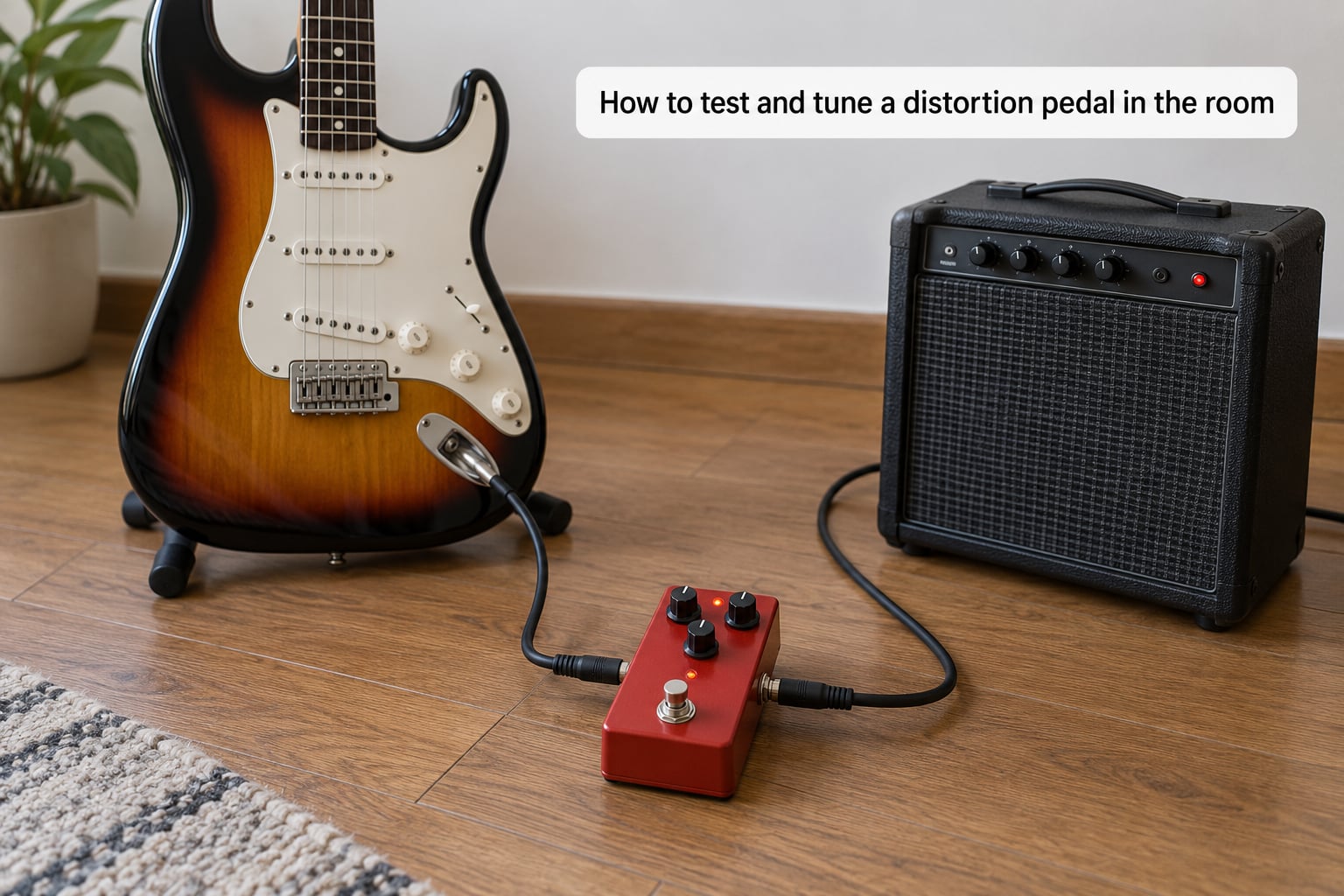
A pedal that sounds enormous in a shop will disappoint at home, so judge it in context and at realistic volume.
- Start with the amplifier on a moderate gain channel and the pedal at unity level.
- Play riffs you already know, not single notes, because low-end definition only shows up in chords.
- Set the gain just past clean, then change one control at a time.
- Compare against your amp’s own distortion by unplugging the pedal, so you hear what the pedal is actually adding.
- Write down every setting, then check the same tone at bedroom volume and at stage volume.
If the tone changes character between those two volumes, the problem is usually the amplifier, not the pedal. Record the settings so you can return to them after a power cycle or a new cable.
Frequently Asked Questions
Do distortion pedals get louder when the gain is turned up?
Usually the opposite. As gain rises, the clipping stage compresses the signal harder, so the output level drops even as the tone gets more harmonically dense. Turn the level knob up to compensate, or accept the quieter output, because chasing volume with gain is what flattens the picking dynamics.
Is a distortion pedal better than using a high-gain amplifier?
Neither is better in general. A pedal gives a full high-gain voice into a clean or lightly broken amplifier and lets you practise at low volume. A high-gain amplifier adds power-amp feel, cabinet voicing and dynamics that a pedal cannot fully replicate. Many players use both: the amplifier for the base tone, the pedal for leads.
Should distortion pedals be placed before or after an overdrive pedal?
Put clean overdrives before the distortion so they act as boosts, and put an already-clipping overdrive after the distortion if you want the softer stage to shape what comes out. Placing distortion first makes it receive an already-hot signal and clamp into a compressed, one-dimensional tone. Move the stages around if palm mutes lose definition.
Why does a distortion pedal sound quieter once the amp gain is raised?
Raising the amplifier’s input gain adds another clipping stage and more compression, and compression reduces the peak level of the signal. The amplifier is also being pushed harder for the same knob setting. Pull the preamp gain back or raise the pedal’s level so the amp works at the point where your tone lives.
What is the difference between distortion, overdrive, and fuzz?
All three clip the waveform, but the amount and the location differ. Overdrive clips gently in the pedal and relies on the amplifier to break up further. Distortion clips hard inside the pedal and works into a clean amp. Fuzz drives transistors so deep into saturation that the waveform becomes nearly square and collapses when the signal drops.
Do metal guitarists need a noise gate after a distortion pedal?
Most players end up with one, because high-gain circuits amplify every hum and hiss in the signal. A pedal with a gate switched in handles the basics. An external gate placed before the gain stages cleans up more with less loss, but set the threshold too high and it will cut the ends off sustain and make the tone feel clipped and lifeless.
Conclusion
The mental model is short: a distortion pedal amplifies your signal, clips it on purpose, and shapes the result before handing it to your amplifier. Everything that confuses people, from fizzy tones to tones that get quieter as the gain goes up, comes from that one mechanism.
Start with moderate gain. Set the pedal’s level before touching anything on the amplifier. Change the tone and the clipping one small step at a time, and check the result against a riff rather than a single note. If you remember only one thing, remember that more gain is not more volume, and chasing it is what flattens your tone.