Fast downpicking is mostly a motion problem, not a strength problem. To play fast downpicking riffs you shrink the distance the pick travels, contact the string with the pick tip only, anchor the pick against your index knuckle, and raise tempo in short bursts rather than ramping a metronome until you fail.
Most players stall for the same three reasons: the stroke is too large, the pick grabs too much string, and the practice method bakes mistakes in at high speed. Fix those and a riff that felt impossible at 150 BPM becomes ordinary at 200.
Table of Contents
- What You Need
- Step-by-Step: Building Fast Downpicking Control
- Common Mistakes
- Frequently Asked Questions
- Should I use a thin or thick pick for fast downpicking riffs?
- Is downpicking harder than alternate picking?
- How long should I practice fast downpicking each day?
- Should I use a metronome when learning a fast riff?
- How do I stop string noise while downpicking quickly?
- What is the best way to increase speed without losing accuracy?
- Where to start next
What You Need
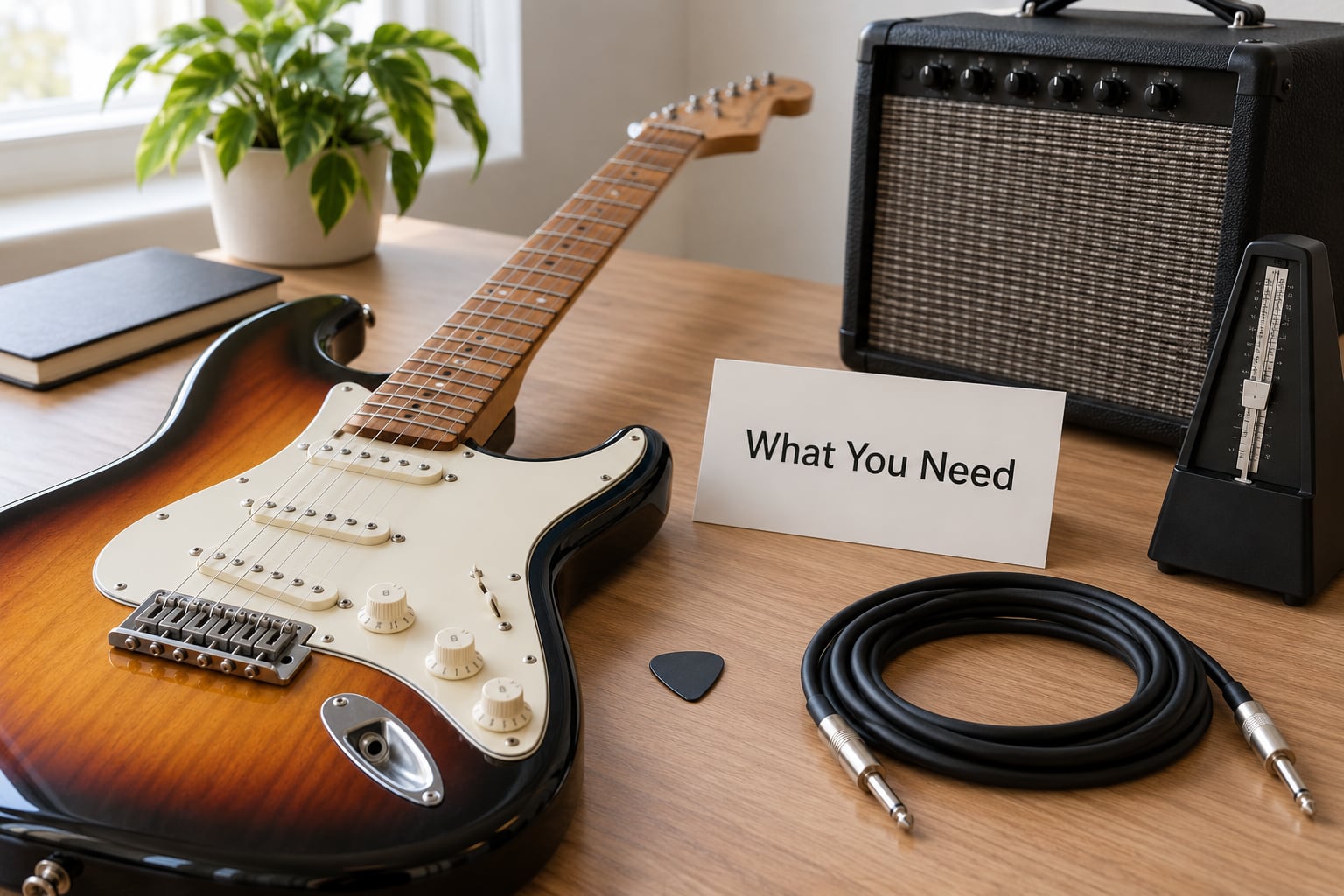
You need far less gear than most players assume. A guitar you can play comfortably, one pick, and a metronome cover everything in this guide.
- Guitar: Any electric with a decent bridge pickup works. Slightly shorter scale lengths and lighter string gauges are easier on a fast picking hand, so a baritone or a 24.75-inch scale can be kinder to a beginner than a 25.5-inch standard.
- Pick: Start with a thin pick, roughly 0.5 to 0.7 mm. A thinner pick twists less on contact and moves faster through a string. Thicker picks feel louder at low tempo but slow you down at high tempo.
- Strings: Lighter gauges bend and pluck faster. That is a genuine trade-off: light strings speed up the picking hand and make tone thinner, so gauge choice is about what you want to sound like, not a rule.
- Amplifier: Any amp with enough clarity to hear each note individually. High gain can mask a sloppy attack, so a clean or low-gain setting is more useful for technique work.
- Metronome: A physical one is fine. Most phone apps also record, which brings us to the next item.
- Phone recorder: Record a 30-second riff once a week. It shows tension and uneven volume faster than anything you feel in the moment.
On acoustic guitar, the mechanics are identical, but the pick will dig into the nylon and the strings resist more, so expect to work at a lower tempo for the first few weeks. Practising with no amp at all is also legitimate. Many players do their whole fast-downpicking session unplugged, because the goal is an even attack and unplugged you hear every uneven note immediately.
Step-by-Step: Building Fast Downpicking Control
Work through these in order. Each step assumes the previous one is clean, and skipping ahead is how players end up fast and sloppy.
Step 1: Set a Comfortable Starting Tempo
Pick a tempo where every downstroke is clean and equal, not one that feels difficult. That is your starting point, and it is usually 30 to 50 BPM below what you can already almost play.
Set the metronome to eighth notes if the riff is in 16ths. Slow enough that you never rush the last sixteenth of each bar. Play for two minutes, stop, and record it. That recording is your baseline, and comparing against it in four weeks tells you more than how tired your arm feels.
Step 2: Keep the Downstroke Relaxed and Consistent
A relaxed hand is a symptom of efficient motion, not an instruction you can follow directly. “Relax” tells you nothing about what to change. Here is the mechanism instead.
The downstroke only has to travel far enough to clear the string, usually a couple of centimetres. Every extra millimetre is distance you must accelerate through and decelerate from, and that is what builds tension. Move less and the hand relaxes as a side effect.
Three details do most of the work:
- Pick depth: set the pick on the string and pull down only until it clears the plane of the string. Do not drive it toward the floor.
- Pick angle: tilt the pick slightly so only the tip crosses the string, roughly 1 to 2 mm of contact rather than the full width. Less contact means less friction and a faster stroke.
- Grip: a relaxed grip means the thumb and index finger hold the pick firmly enough that it will not move, while the middle and ring fingers stay loose. Over-gripping is the most common source of that white-knuckle feeling at high tempo.
Keep the return stroke above the string. The pick travels back up without touching anything, and the moment it grazes the string on the way up you get doubled or missing notes.
Step 3: Practice the Picking Pattern Accurately
Rhythm first, speed second. Almost every fast riff breaks into a small number of patterns, and drilling the pattern in isolation is far quicker than drilling the whole riff.
- Repeated single string: the master of Puppets opening riff is the classic example. Keep the pick moving up and down in a tiny range, with the upstroke staying clear of the string.
- String changes on the downstroke: alternate between two strings and only bring the upstroke back as far as the next string requires. Cutting the return travel in half is often where the extra notes per minute come from.
- Pedal note plus melody: common in melodic death metal. The pedal note repeats, so you are changing strings on some notes and not others. Mark which notes change strings in your tab.
- Doubles and accents: when the riff needs two hits on one string in a row, decide now whether you use two downstrokes or a downstroke plus a rake. Decide once and keep it.
Slow is the correct tempo here. If you cannot get all sixteen notes in the bar landing exactly on the grid, you do not have a speed problem yet, you have a timing problem.
Step 4: Add Muting and Note Control
Muting is what makes fast downpicking sound tight rather than fuzzy. Two habits handle most of it.
In the picking hand, rest the edge of the palm on the bridge near the neck pickup so the strings stop dead. In the fretting hand, barely touch the string with the side of the index finger. That light touch kills the harmonic without needing real pressure, and it stops sympathetic ringing from blurring fast passages.
Practice muted and unmuted. Muted passages have a different resistance in the pick because the string barely moves, so a tempo that is easy palm muted can fall apart the moment you let the notes ring.
Step 5: Increase Speed Gradually
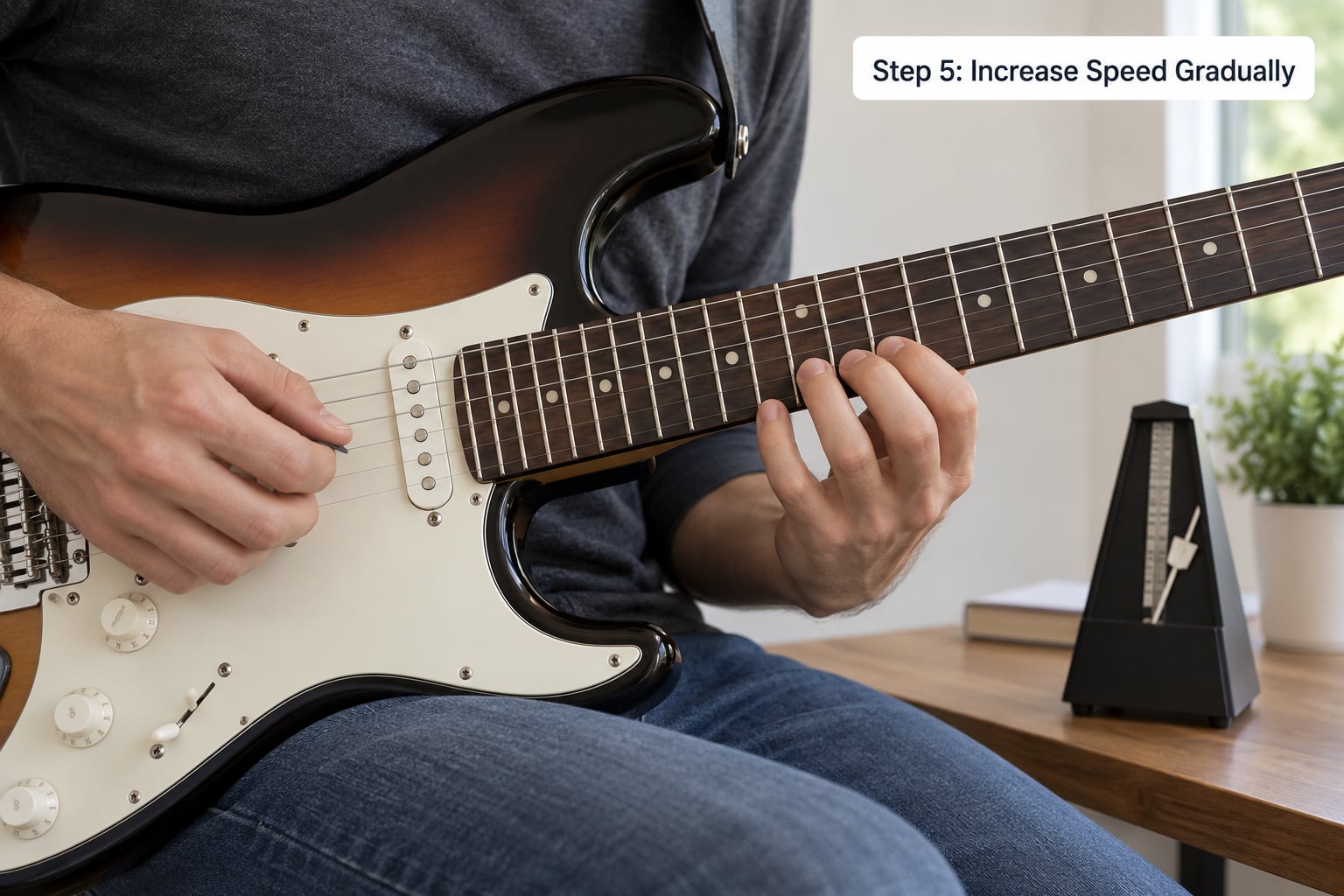
Bumping the metronome two BPM every repetition looks disciplined and teaches you to play badly. Instead, use bursts: play two notes at your target tempo, rest for two beats, play three notes, rest, then four.
Work that way until the burst is clean, then raise the tempo and start the ladder again at two notes. Players who use this method report it is where they stop cramping, because the hand gets real rest between bursts instead of grinding out another two minutes at maximum effort.
A rule that experienced players keep repeating: play the riff at about 70% of your maximum for ten minutes, then stop for the day. Muscle and tendon adaptation happens between sessions, not during them. Daily practice helps you clean up an existing motion, while actual speed most often arrives after a day or two off.
Step 6: Play the Riff with Expression
A clean but lifeless downpicked part still does not sound right. Add accents on the first sixteenth of each beat, drop the volume slightly on the last sixteenth of every other bar, and let the ringing notes open up while the muted ones stay clipped.
Vibrato at speed is a separate skill and often the first thing to go when a player focuses purely on speed. Keep the fretting hand loose enough to vibrate between phrases even while the picking hand stays precise.
Put it together at full tempo with the backing track, then with a metronome, then without either. Play along with the record if you can. If it sits behind the beat at speed, slow it down until it sits in front, then build back.
Common Mistakes
Picking too hard. Force does not create speed, it only creates fatigue and sore skin. Drop the volume of every note by half at the same tempo. If it still sounds loud, you were using force that you no longer need.
Drifting behind the beat. Almost always a sign that the last note of the bar is being rushed to catch up. Practise with two beats of rest after every four sixteenths and place each note deliberately.
Breaking down on string changes. The stroke gets bigger as it reaches across strings. Angle the pick more for the far string and shrink the return travel on the upstroke until the two movements match in size.
Unwanted string noise. The upstroke is catching the string on its way back. Watch a slow video of your picking hand, or film the pick edge-on against a light background and look for it grazing the string on the return.
Ramping tempo too fast. If the last three attempts each ended in the same spot, you are practising failure. Drop back 15 BPM, play it perfectly, and come back next session.
Frequently Asked Questions
Should I use a thin or thick pick for fast downpicking riffs?
Use a thin pick, roughly 0.5 to 0.7 mm, while you are building speed. A thinner pick bends less on contact, so the stroke starts and stops faster and the pick is far less likely to twist out of your fingers. Thicker picks sound louder and warmer at slow tempos, which is why many players keep one for riffs and swap down when a passage gets fast. If you already own a thin pick, that is the one to practise with.
Is downpicking harder than alternate picking?
In raw notes per minute, yes. Alternate picking uses two strokes for every note, so your hand only has to move half as far per note. Downpicking asks for a larger motion rate but a smaller stroke, which is why it is easier on the string and easier to make tight and consistent. It is harder to reach extreme speed but far easier to control, which is why thrash and death metal rhythm parts are almost all downpicked.
How long should I practice fast downpicking each day?
Twenty focused minutes beats an hour of unfocused picking. Most players make progress with short daily sessions on one specific pattern, plus rest days, rather than long sessions that end with tension. Practise at about 70% of your maximum speed, stop when the motion starts to fall apart, and do not push through a cramping forearm. Tendons adapt between sessions, not during them.
Should I use a metronome when learning a fast riff?
Yes, but set it below the song tempo first. Learn the riff at half or two-thirds speed with the metronome on eighth notes so every sixteenth lands on the grid, then raise the tempo in small steps. Turning the metronome on only when you fail is a common habit, but drilling the exact rhythm slowly removes the rushing that causes most breakdowns at speed.
How do I stop string noise while downpicking quickly?
Two fixes cover most cases. First, keep the pick tip on top of the string and let the upstroke return above it rather than through it, which needs a smaller return motion. Second, mute deliberately: rest the picking-hand edge on the bridge and lightly touch the strings with the side of the index finger. If noise persists, film your picking hand and look for the pick grazing the string on the way back up.
What is the best way to increase speed without losing accuracy?
Shrink the motion before you raise the tempo. A downstroke only needs to travel far enough to clear the string, so a few centimetres is plenty. Practise with bursts of two, three and four notes separated by rests, raise the tempo, then rebuild the bursts from two notes. This keeps accuracy intact and gives the hand genuine recovery between bursts, which is where most players stop cramping.
Where to start next
Pick one riff you can play at about 70% of tempo, and this week spend two 20-minute sessions on bursts of two, three and four notes. Record it on day one and again on day seven. The difference between those two recordings is the whole method in action.