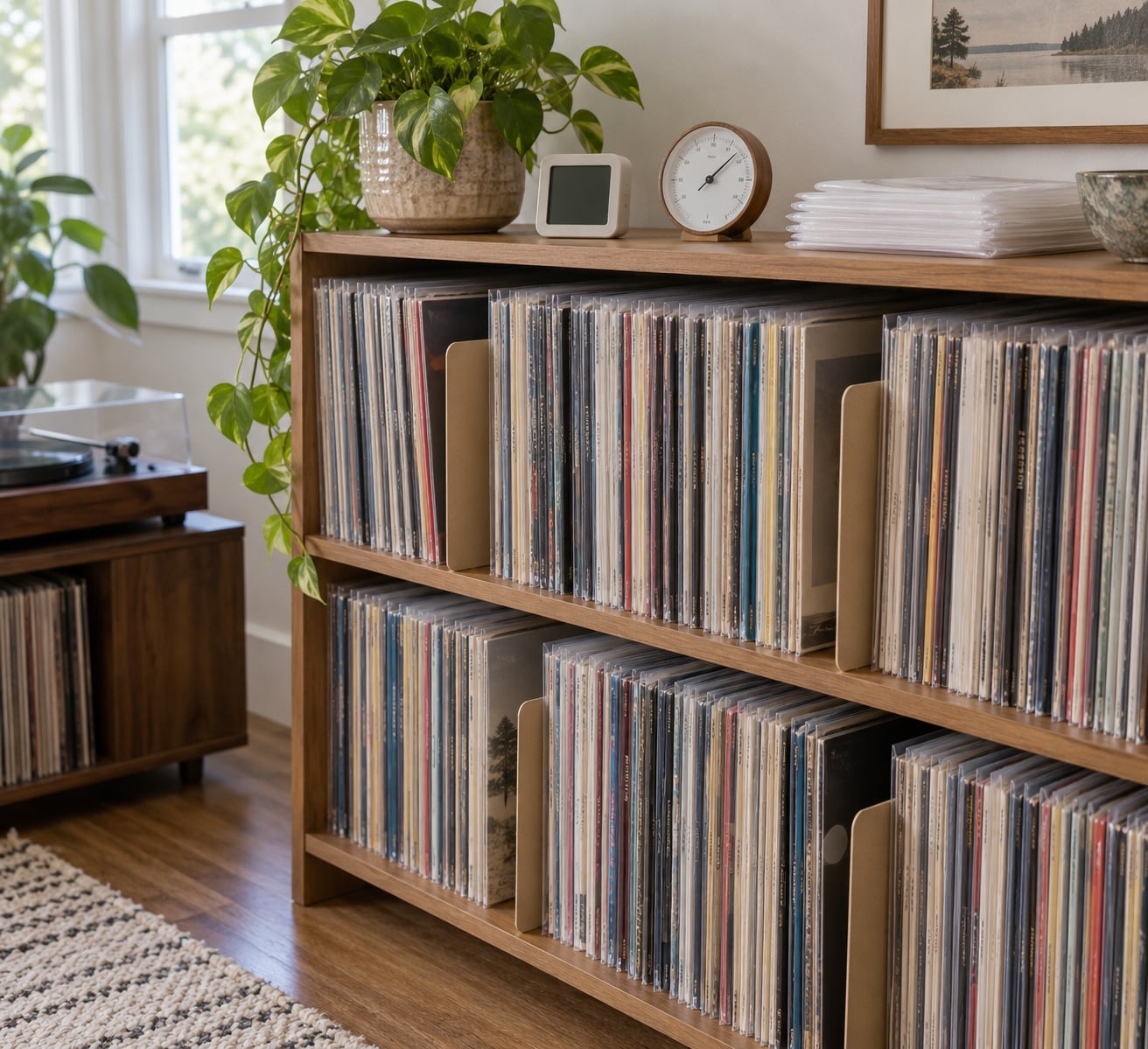
Store vinyl records upright, in a cool, dry room kept at roughly 65-70°F (18-21°C) and 40-55% relative humidity, with every record in an anti-static inner sleeve and a protective outer sleeve. Learn how to store vinyl records properly and a shelf of a few hundred LPs will still play cleanly decades from now; get it wrong and the usual casualties are warped discs, split jacket seams and covers that crumble at the edges.
The setup takes an afternoon. Keeping it takes about ten minutes a month, mostly checking a hygrometer and dusting the top of the shelf. Nearly all the damage collectors worry about comes from four things: heat, pressure, moisture and neglect.
Table of Contents
What You Need
You do not need a purpose-built archive to do this well. You need somewhere stable to put the shelf, the right layers of paper and plastic around each record, and a way to keep an eye on the room.
- A sturdy shelf or cube unit. Solid, flat-based and not overloaded. A cube unit sized for 12-inch LPs works well, as does any bookcase with shelves deeper than the jacket plus an inch or two of clearance.
- Anti-static inner sleeves. Polyethylene (PE) or anti-static HDPE liners, the type sold as rice paper sleeves. Skip the plain paper sleeves records ship in.
- Outer sleeves. Clear 4-5 mil resealable bags. Thickness matters more than brand; thin 2-3 mil sleeves tear when you slide a record in and out.
- Dividers. Cardboard or plastic shelf dividers so records stand up on their own instead of tipping into each other.
- A cleaning kit. A carbon fibre brush, an antistatic mat or gun, a soft microfibre cloth, and access to distilled water if you wet clean.
- A thermometer and hygrometer. Cheap combined units are enough. Put one on the shelf, not in another room.
- A dehumidifier for anywhere that runs above 55% relative humidity, and archival boxes with acid-free dividers for anything leaving the house.
- Labels and a pen or a small inventory app, so you can find one record without pulling out ninety.
Skip buying all of this at once. Shelves and dividers first, then sleeves, then cleaning gear once you know how much dust your actual room produces.
Step-by-Step: How to Store Vinyl Records Properly
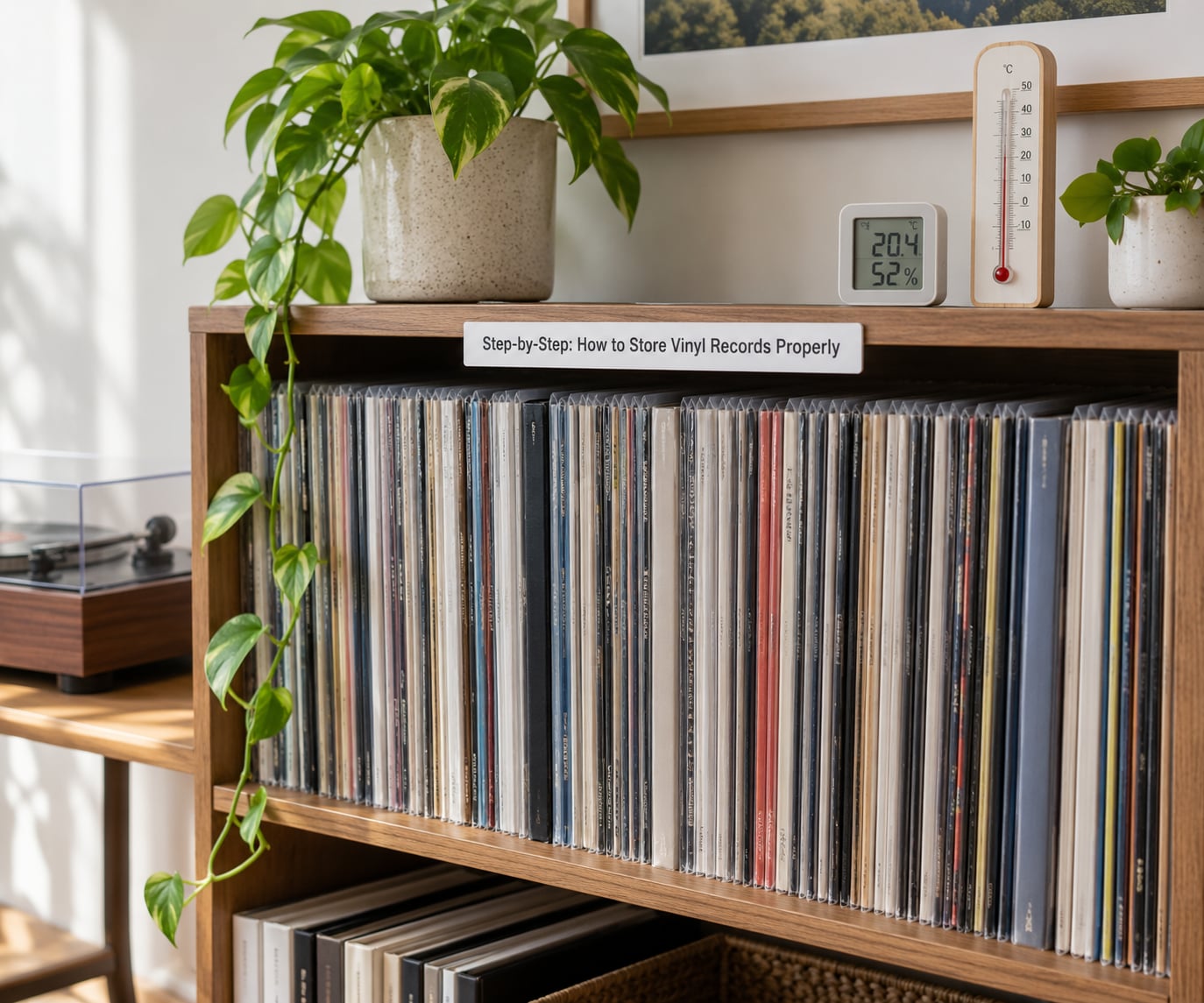
Work through these five steps once, then keep checking them. Each one removes a specific failure mode, and each gives you an obvious signal that it worked.
Step 1: Pick the Room: Where to Store Vinyl Records Properly
Choose an interior room with stable conditions, not the most convenient empty space. Sunlight through a window fades jacket artwork and heats the vinyl directly, radiators and vents cook records slowly, and exterior walls swing between hot and cold with the season outside.
Basements, garages and attics are the three rooms collectors most often regret. Here is how the common locations compare.
| Location | Risk | Why |
|---|---|---|
| Attic | Severe | Summer heat can exceed 120°F, which permanently flattens records resting on anything |
| Garage | Severe | Uninsulated, so temperature swings daily and pests are common |
| Unfinished basement | High | Damp, flood risk and poor airflow encourage mould on sleeves |
| Interior shelf or bookcase | Low | Stable temperature, no direct light, easy to check monthly |
| Climate-controlled storage unit | Low | Holds temperature and humidity, but you cannot check it as often |
You will know step one worked when a hygrometer on the shelf reads between 40% and 55% through January and July. If it swings well outside that band, move the collection before you adjust anything else about it.
Step 2: Prepare and Inspect Each Record
Pull every record out and look at it in decent light. You are checking four things: grit on the surface, scratches that reach the groove, bowing in the disc, and damage to the jacket.
A record is warped when a light held flat against it shows a crescent-shaped gap, or when a disc will not sit flat on a level surface. Check the jacket seam by flexing it gently along the glued edges; a crack there is a seam split, and it usually means the jacket was squeezed or the record moved inside it in the mail.
Handle discs by the edges with two clean hands, or better, support the label area with one hand and the edge with the other. Fingers on the grooves are how you add scratch marks that follow the playing surface.
You will know step two worked when every record sits flat on the shelf without rocking, and no jacket creases when you slide it back in.
If you already own a warped record, the fix is simple enough to do at home. Sandwich it between two flat pieces of glass or heavy acrylic, set it on a level surface in a room at normal temperature, and put about ten pounds of weight evenly on top. Leave it a few days. For light bowing in a warm room, sitting the disc on its edge between two flat surfaces overnight is often enough.
That works because a warp is stored tension, not a broken groove. If the disc stays bowed after several attempts, or the skipping it causes runs through the whole track, the damage is permanent. Warm it slightly above room temperature for a few minutes before you judge it; a cold record hides warping that a warm one shows plainly.
Step 3: Clean the Record and Sleeves
Cleaning before storage is not optional housekeeping. New pressings arrive coated in a mold release agent that dulls the sound and traps dust, and second-hand records usually carry decades of it. Wet cleaning with distilled water removes the coating, the dirt and the static charge in one pass, which is why collectors prefer it to dry brushing alone.
For a quick clean, run a carbon fibre brush along the grooves in a single direction away from the centre, with the record turning. Never apply household cleaner, water or a wet cloth directly to the disc; if you wet clean, use a proper record cleaning fluid or distilled water with a record cleaning machine, working from the label outward.
The jackets need less. Wipe cardboard covers and booklets with a dry microfibre cloth, and go over the labels and hype sheets gently. Paper does not like moisture, so never use a damp cloth on a jacket.
Then take the felt off your turntable mat if you have one. Felt holds a static charge, and collectors who swapped to a plain antistatic mat report seeing immediate improvement in dust pickup.
You will know step three worked when the record looks matte-clean under a lamp and no dust lands on it after a few days in the sleeve. A sensible cadence is every five to ten plays, plus a full wet clean before you file anything new away for the season.
Step 4: Use the Right Sleeves and Shelving
The sleeve stack is the part collectors argue about most, and the argument is about a mechanism worth knowing. Plain paper inner sleeves shed fibres onto the vinyl. Static electricity, which builds up whenever a record slides in and out of a dry sleeve, then pulls those loose fibres and dust straight onto the grooves. That is why a record can look clean on Monday and be speckled again by Wednesday, and why cleaning alone does not fix it.
The upgrade is a polyethylene inner sleeve, often sold as an anti-static HDPE liner. Put the record in the liner first, then the liner goes into the jacket, and both go into the outer sleeve. Sleeve openings all face upward, so you can slide the record out without lifting it over the top edge and dragging the vinyl across the jacket corner.
| Sleeve material | Anti-static | Transparency | Durability | Mould risk | Best for |
|---|---|---|---|---|---|
| Paper | No | Opaque | Tears when wet | High | Shipping only, replaced before shelving |
| Poly-lined paper | Partly | Opaque | Moderate | Medium | Budget upgrade where you want paper feel |
| Polyethylene (PE) / HDPE | Yes | Frosted or clear | High | Low | Inner sleeves, the default choice |
| Polypropylene (PP) | Yes | Very clear | High | Low | Display, so jacket art reads clearly |
| PVC | Yes | Very clear | Degrades over years | Low | Short-term display only |
The myth that PVC outer sleeves are always the premium choice is worth clearing up. PVC is rigid and easy to seal, but it breaks down over time and can bond to the jacket, leaving a film and residue that is difficult to remove. Polypropylene or polyethylene sleeves stay clean and separable for decades.
On the shelf, stand records upright like books. Fill from the wall outwards and pack them snug, not tight, so each one holds itself up without being squeezed; a shelf half full will fall over, and a shelf packed hard will bend jackets and crush sleeve corners. Leave the front row forward so nothing can lean.
Add a divider every twelve inches or so if the records lean toward the front. And check the shelf itself: cube units sag when overloaded or when they are not sitting on a perfectly flat base, which is a far more common cause of sag than a faulty unit. If a shelf bows, take some weight off it.
For records going into boxes, pack them upright, never flat, and fill the gaps with acid-free tissue or sealed sleeves so nothing shifts in transit. That is also the packing method to use when you move: crate or box upright, double-box anything valuable, keep the boxes vertical in the vehicle, and never leave a box sitting in a hot car.
Sealed, unplayed records get the same treatment with two additions. Keep the shrink wrap on, since it slows off-gassing of the jacket, and store them upright in the same cool room rather than anywhere warmer just because they will not be played. Heat is the one thing that damages a sealed record faster than anything you do with it.
Seven-inch singles and EPs work fine on the same shelves if you use a narrower divider spacing or a small crate, since they are shorter and will fall backwards in a full LP row. Many collectors keep 45s in their own sorted crate by artist and year.
You will know step four worked when you can slide any record out with two fingers, the sleeve corner does not crumple, and the row stands straight on its own.
Step 5: Maintain Conditions and Keep the Collection Stable
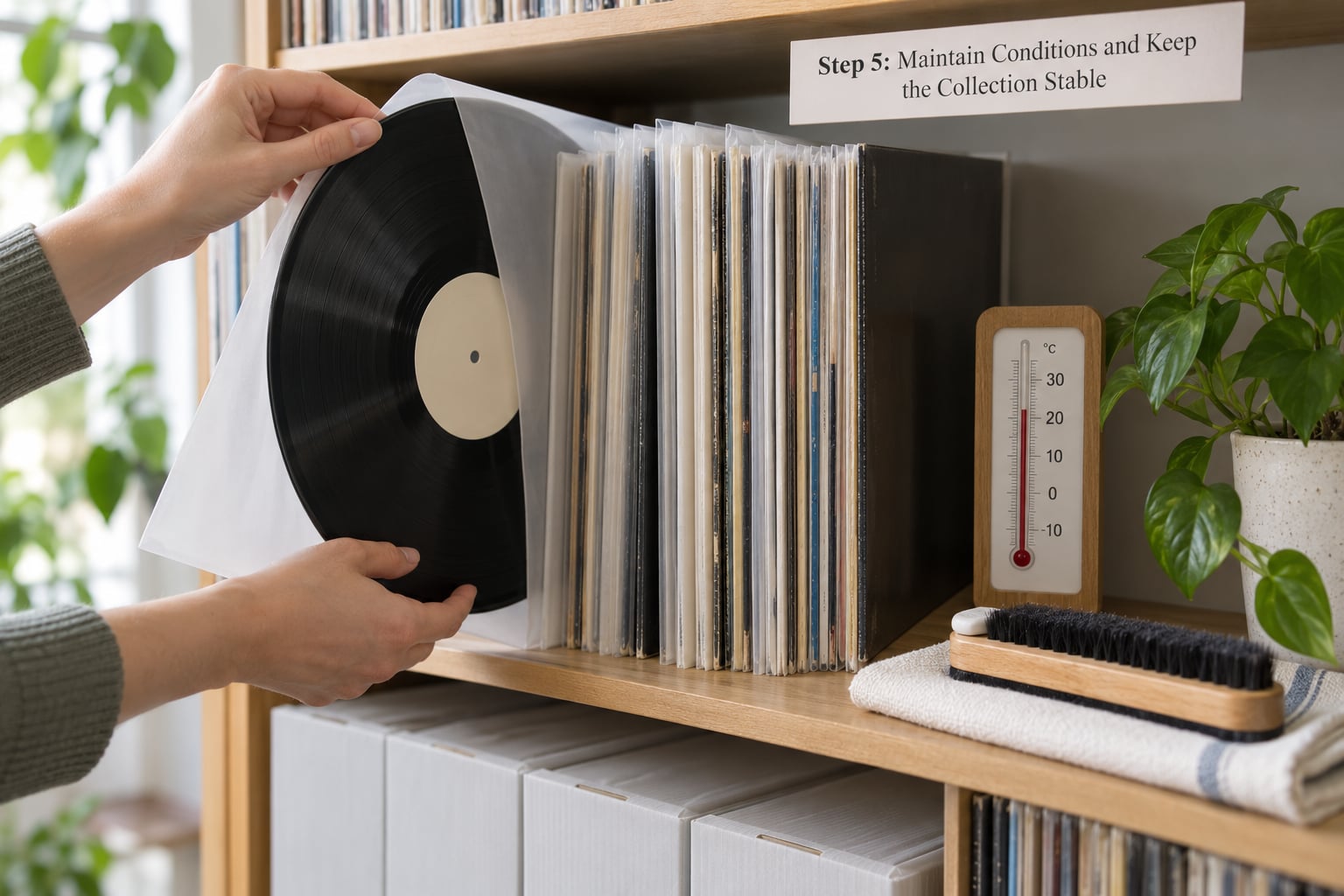
A good setup still needs watching. Put a monthly reminder in your calendar to glance at the hygrometer and the front row of each shelf.
Look for three things. Rising humidity means mould risk, so run a dehumidifier or move the shelf. A new gap or lean in a row means records were pulled and not pushed back in. Shifting shelf boards or a squeak when you load one mean you are close to the load limit and it is time to spread the collection across a second unit.
Check for pests twice a year if the shelf is in a basement, garage-adjacent room or an older building. Silverfish and booklice love the cardboard in jackets, and a single small sighting is worth acting on immediately.
Keep a simple list of the collection, whether that is a spreadsheet, a notes app or photographs of every shelf with a written index beside it. It takes an hour and it is what makes an insurance claim after a flood, fire or theft survivable, because you can prove what you owned.
You will know step five worked when a month passes with the hygrometer steady and no shelf needing adjustment.
Common Mistakes
Almost every damaged collection traces back to one of the following.
- Stacking records flat. The bottom records in a stack take constant weight and slowly warp, and jacket corners take the abrasion. Fix: store every record upright, including in boxes.
- Leaning at an angle. A leaning row puts steady sideways pressure on the edge discs, and the ones at the bottom warp first. Fix: pack snug, add dividers, keep rows vertical.
- Using a basement, garage or attic for convenience. Fix: move the collection indoors. If that is genuinely impossible, use a climate-controlled facility and put silica gel or a dehumidifier in every box.
- Keeping the paper inner sleeves records ship in. Fix: switch to anti-static PE or HDPE liners, one per record. Vinyl Engine collectors describe the paper sleeves as hopeless once you know what they are doing to the vinyl.
- Touching the grooves. Fix: handle by the edges, or support the label and one edge. Clean fingerprints need a wet clean to remove, not a brush.
- Over-packing a shelf or crate. Bending jackets and crushing sleeve corners lead to seam splits. Fix: leave room for your hand, and never compress a box shut.
- Under-filling a shelf. A row with air in it falls over and takes damage with it. Fix: fill to snug with dividers, and use a bookend or a candle-weight if a section stays light.
- Never checking the room. Fix: monthly hygrometer check and a look at the front row. It is the cheapest protection there is.
- Treating PVC outer sleeves as permanent. Fix: replace with PP or PE sleeves every few years, or at the first sign of cloudiness or stickiness at the jacket edge.
Two more worth naming: storing records where you can see them in direct sunlight all afternoon, and buying records online that arrive with the disc shifted inside the jacket. That second one is a seam split waiting to happen, so open new deliveries at the door and push the record back into place.
Frequently Asked Questions
Is it better to store vinyl records flat or upright?
Upright, always. Stacking records flat puts constant weight on the discs at the bottom of the pile, which bows them over time, and the edges rub inside their jackets. Leaning is nearly as bad because it presses on the edge of each disc. Stand records like books on a shelf, packed snug but not compressed, with a divider every foot or so. Boxes of records get packed upright too, for the same reason.
Is it okay to store vinyl records in the garage?
Only in a climate-controlled facility, and even then it is a compromise. Garages swing from freezing to well over 100 degrees Fahrenheit across a day and night, and that heat is what permanently warps vinyl. Pests and damp are the other problem. If the garage is genuinely your only option, put records in sealed archival boxes with silica gel, keep them off the floor and away from the walls, and check the humidity whenever you can.
What temperature and humidity should vinyl records be stored at?
Aim for 65-70 degrees Fahrenheit, which is 18-21 degrees Celsius, and 40-55% relative humidity. What matters more than the exact number is stability: a room that stays in that band year round beats a perfect one that swings. Vinyl is PVC, a rigid plastic that softens as it heats, so sustained warmth causes the permanent bowing collectors call warping. Above roughly 60% humidity, sleeves and jackets start picking up mould.
What is the best way to store vinyl records long-term?
Clean first, sleeve properly, then shelve upright in a stable interior room. Put each record in an anti-static polyethylene inner sleeve, add the jacket, and slide both into a 4-5 mil resealable outer sleeve. Store them upright at 65-70 degrees Fahrenheit and 40-55% humidity with no direct light. Pack boxes upright with dividers and no empty space, add silica gel to anything stored long-term, and check the hygrometer monthly.
How do you fix a warped vinyl record?
Put the record between two flat pieces of glass or heavy acrylic, place it on a level surface, and rest about ten pounds of weight evenly on top. A mild warp often relaxes over a few days. You can also sandwich the disc on its edge between two flat surfaces overnight in a normally heated room. Warm the record a few minutes above room temperature before testing it, since a cold disc hides the bow. Persistent skipping means the warp is permanent.
How long do vinyl records last in storage?
Stored upright in a cool, dry, dark room, well-sleeved records last indefinitely. There is no fixed expiry date, and vinyl does not have a shelf life the way film does. Problems come from conditions rather than time: heat causes warping, humidity causes mould on paper sleeves, and pressure causes seam splits. Check the collection a few times a year, replace any inner sleeve that has torn, and expect a well-kept pressing to sound as good in forty years as it does now.
Conclusion
Start with the room, because nothing else matters if the shelf is in a garage. Pick an interior spot that holds steady around 65-70°F and 40-55% relative humidity, then stand every record upright with a divider every foot.
Next, clean what you own and throw out every paper inner sleeve, replacing them with anti-static polyethylene liners and 4-5 mil outer sleeves. That single change fixes the dust that keeps reappearing on records you have already cleaned.
Finally, put a hygrometer on the shelf and check it once a month. Ten minutes of attention a year is the whole difference between a collection that stays playable and one that warps, fades and moulds in a decade. That is how to store vinyl records properly in 2026, and for the next forty years after it.