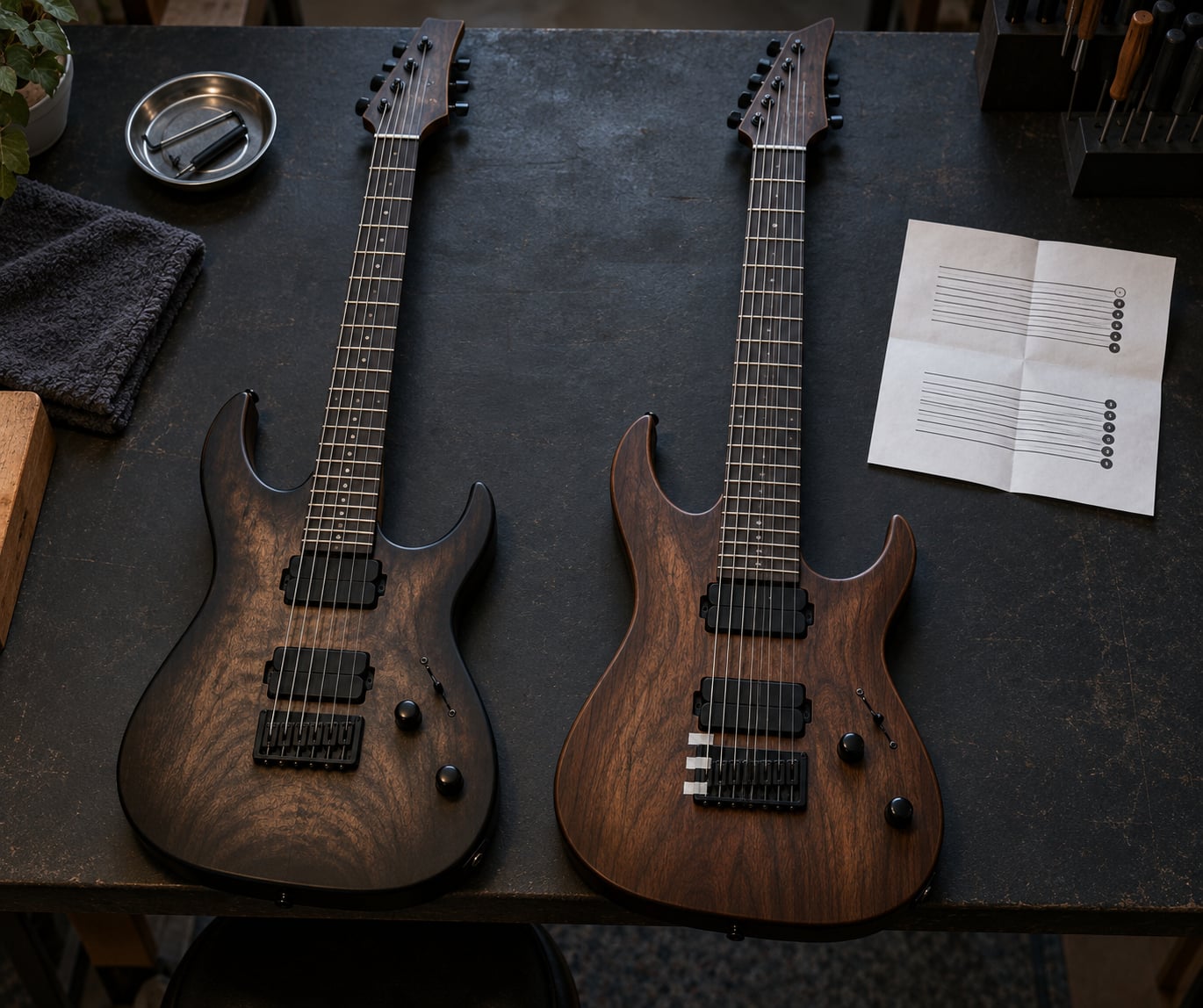
If you are wondering why metal guitarists use seven string guitars, the short answer is range. The seventh string adds a full fourth below the standard low E, so you can play low riffs without retuning and without giving up the top of the fretboard. The usual arrangement is a low B next to the standard six strings, tuned B1-E2-A2-D3-G3-B3-E4. Everything a six-string can play, a seven-string plays too. What changes is what becomes possible underneath it.
That is the whole argument, and it is worth saying plainly because the instrument gets wrapped in more mythology than it deserves. The seven-string is not a metal accessory. Russian folk players, Brazilian baixaria players, jazz guitarists and classical players all had extended-range guitars long before a single nu-metal record came out. What metal did was push the seventh string into the mainstream and then keep pushing it lower.
If you want the short version before the details:
- The seventh string is usually a low B, a perfect fourth below the standard low E.
- It adds low-end weight you cannot get by tuning a six-string down, because the string stays the same length.
- Drop tunings such as drop A and drop G# then let you go lower still without losing the fingering you already know.
- Low-root riffs, one-finger power chords and low pedal tones become comfortable instead of awkward.
- You keep high soloing access, which is the part a down-tuned six-string gives away.
- It costs you width, weight, some chord shapes and a chunk of cash. Plenty of players never need one.
I have watched this question get argued for twenty years on gear forums and it is still usually answered with “because low.” The better answer is about what a down-tuned six-string costs you, and that only makes sense once you know how the extra string changes the range.
Table of Contents
- Why Metal Guitarists Adopt Seven-String Guitars
- How the Extra String Changes the Guitar’s Range
- What Lower Notes Add to Chords and Solos
- How Seven-String Guitar Tunings Work
- What Changes About Playing Technique
- Which Metal Styles Benefit Most from Seven Strings
- Are Seven-String Guitars Better Than Six-String Guitars
- What to Consider Before Buying or Switching
- Frequently Asked Questions
- Do metal guitarists only use seven-string guitars because they need very low notes?
- Is a seven-string guitar harder to play than a six-string guitar?
- Does a seven-string guitar have the same range as a bass guitar?
- What is the most common seven-string guitar tuning?
- Can you play normal six-string songs on a seven-string guitar?
- Does using a seven-string guitar make a guitarist better at metal?
Why Metal Guitarists Adopt Seven-String Guitars
A seven-string guitar is a normal fretted electric with one more string than usual, normally placed below the low E, and it exists so a guitarist can go lower without going shorter on the other end of the neck.
There are two ways to build one. The common method widens the fingerboard and neck so the seventh string is fretted like every other one. That is what almost every metal guitar is. The other method leaves the seventh string unfretted as a floating bass string, which you cannot play notes on, and you will find it on Russian, Brazilian and classical instruments instead.
The range math is simple. A standard six-string opens at E2-A2-D3-G3-B3-E4. A seven-string opens at B1-E2-A2-D3-G3-B3-E4. That extra B1 is a fifth below where a down-tuned six-string stops, and a full fourth below its lowest open string.
Metal took the instrument seriously at a specific moment. Steve Vai pushed it into the mainstream with the Ibanez UV7 in 1988, and Korn’s 1994 debut album put it in front of tens of millions of listeners at exactly the moment the nu-metal sound was being defined. The stigma that followed is worth knowing about. Munky and Head were reportedly told early on that a seven-string could not be used for riffing, which is precisely the opposite of what happened next.
Why Metal Guitarists Use Seven String Guitars for Low-End Riffs
Low riffs work best when the root note sits under everything else, close enough to the other strings that you can hear it connect. On a six-string tuned to standard, that means avoiding the bottom two or three frets, which is why so many rhythm parts live in the middle of the neck instead.
Put a low B under that and the root has somewhere to live. Riffs that a guitarist once wrote on the 5th string at the 7th fret can be played on the 7th string at the 3rd fret with the same shape, and the whole part drops an octave without changing any fingering.
Power chords change too. On a seven-string you can fret a whole two-note power chord shape with one finger on the added string, which gives the lowest voice a thickness a fretted fifth never has. That one-finger voicing is the sound people are describing when they say a seven-string has more weight.
Pedal tones get easier as well. Holding a low note under a moving upper part is awkward on a six-string because there is nowhere to put your thumb. On a seven-string it is just the bottom string, and that is why low pedal tones show up so often in technical and death metal.
How the Extra String Changes the Guitar’s Range
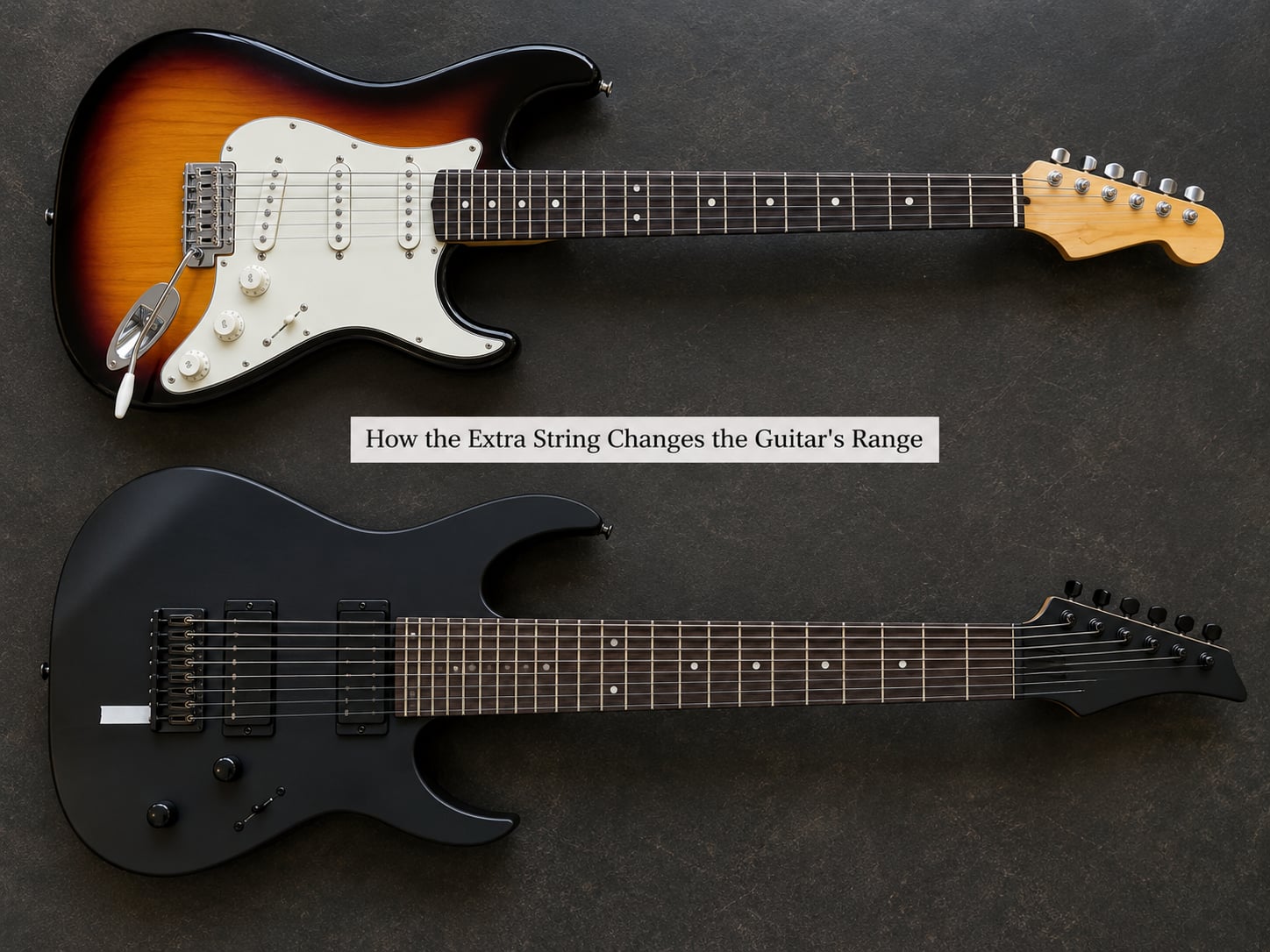
The extra string widens the usable range by a fourth at the bottom and leaves the top of the fretboard untouched, and it does that by adding scale length, not just by adding a string.
| Instrument and tuning | Lowest open note | Open string notes | Typical scale length | Lowest fretted note |
|---|---|---|---|---|
| Six-string, standard | E2 | E2 A2 D3 G3 B3 E4 | 25 inch | E1 |
| Seven-string, standard low B | B1 | B1 E2 A2 D3 G3 B3 E4 | 25.5 to 26.5 inch | B0 |
| Seven-string, drop A | A1 | A1 E2 A2 D3 G3 B3 E4 | 26.5 to 27 inch | A0 |
| Seven-string, drop G sharp | G sharp 1 | G sharp 1 D2 G2 C3 F3 B3 E4 | 26.5 to 27 inch | G sharp 0 |
| Eight-string, drop F sharp | F sharp 1 | F sharp 1 C2 F2 B flat 2 E flat 3 A flat 3 D4 | 27 inch and up | F sharp 0 |
Read the last column across and you get the argument in one line. A standard six-string reaches E1 when you hit the 22nd fret. A seven-string reaches B0 in the same place, and an eight-string goes to F sharp 0. Each added string is a fourth of new floor while the ceiling stays exactly where it was.
That extra span is also why seven-strings are built longer than six-strings. More range under a stretched string means the string has to be stiffer, and a stiff string buzzes against the frets unless the scale length is there to hold it clear. You cannot just bolt a low B onto a 25 inch six-string body and expect it to behave.
What Lower Notes Add to Chords and Solos
Low notes add a bass voice to the same instrument, which changes what a chord can do, not just how low it goes.
A power chord built on the added string has a real fundamental under it, so the chord is fuller and it carries further in a mix. Same shape, same hands, much more weight. The same holds for any voicing: moving a riff or a chord down onto the low string moves it into a register where it occupies a different part of the frequency spectrum instead of piling on top of the bass.
It also opens up inversions. A progression you could only play in one position on a six-string can often be revoiced so the bass moves in a useful line, which changes how the part sits under the drums.
For lead players the value is interval distance. A minor sixth between two notes is a small stretch on a single string in a low register and an easy reach across two strings higher up. Guitarists who write in wide intervals and tremolo picking, or who want a low note to land as an accent at the end of a solo, get options a six-string does not offer.
And there is the non-metal case, which players on acoustic and fingerstyle forums make constantly. A seven-string lets one person cover bass line, chords and melody at once. It is the reason a single player can sound like a trio without a bassist in the room.
How Seven-String Guitar Tunings Work
Drop tuning lowers only the lowest string and leaves the intervals between the other six in their standard relationship, which is why every standard shape and riff you already know still works when you drop.
That is the whole difference from down-tuning. Tuning a six-string down a whole step moves every string by the same interval, so all your shapes move with it and the neck ends up a different length to your hands. Drop tuning on a seven-string leaves the guitar recognisably the same guitar.
Go lower still and the scale length matters. A 25.5 inch seven-string is happy at standard low B and workable at drop A. Drop G sharp and drop F sharp want 26.5 or 27 inches, because a slacker string at that pitch will rattle against the frets no matter how carefully it is set up.
| Tuning | Lowest string | Shape | Strength | Tradeoff |
|---|---|---|---|---|
| Standard low B | B1 | Same as six-string plus a fourth below | All standard vocabulary works, wide melodic range | Not the heaviest sound available |
| Drop D | D2 | Sixth string dropped, rest untouched | Slight thickening with zero learning curve | Almost too subtle to notice |
| Drop C | C2 | Whole step below the sixth string | Thicker low end, still familiar shapes | Needs a longer scale to stay clean |
| Drop B | B1 | Sixth string dropped two steps | Fuller chords, easier low-root riffs | Heavier strings, more fretting pressure |
| Drop A | A1 | Sixth string dropped a minor third | Thick, defined low end without loose strings | Longer scale, bigger build |
| Drop G sharp | G sharp 1 | Sixth string dropped a fourth | Weight that cuts through a full band | String changes, buzzing if setup is neglected |
| Drop F sharp | F sharp 1 | Sixth string dropped a fifth | Very heavy, modern extreme-metal weight | Requires 27 inch or longer and thick gauges |
So why do drop tunings sound heavier, when it is only one string that moved? Two reasons. First, the low string is carrying a pitch well below where anything in a standard guitar sits, and low frequencies dominate how a mix is perceived, so the band gets bigger before the guitarist even plays. Second, and this is the part that gets missed, a low B on a 26.5 inch neck is a stiff string under real tension. The same B on a 25 inch six-string is slack, and a slack string is a thin, undefined fundamental. Same pitch, different note.
What Changes About Playing Technique
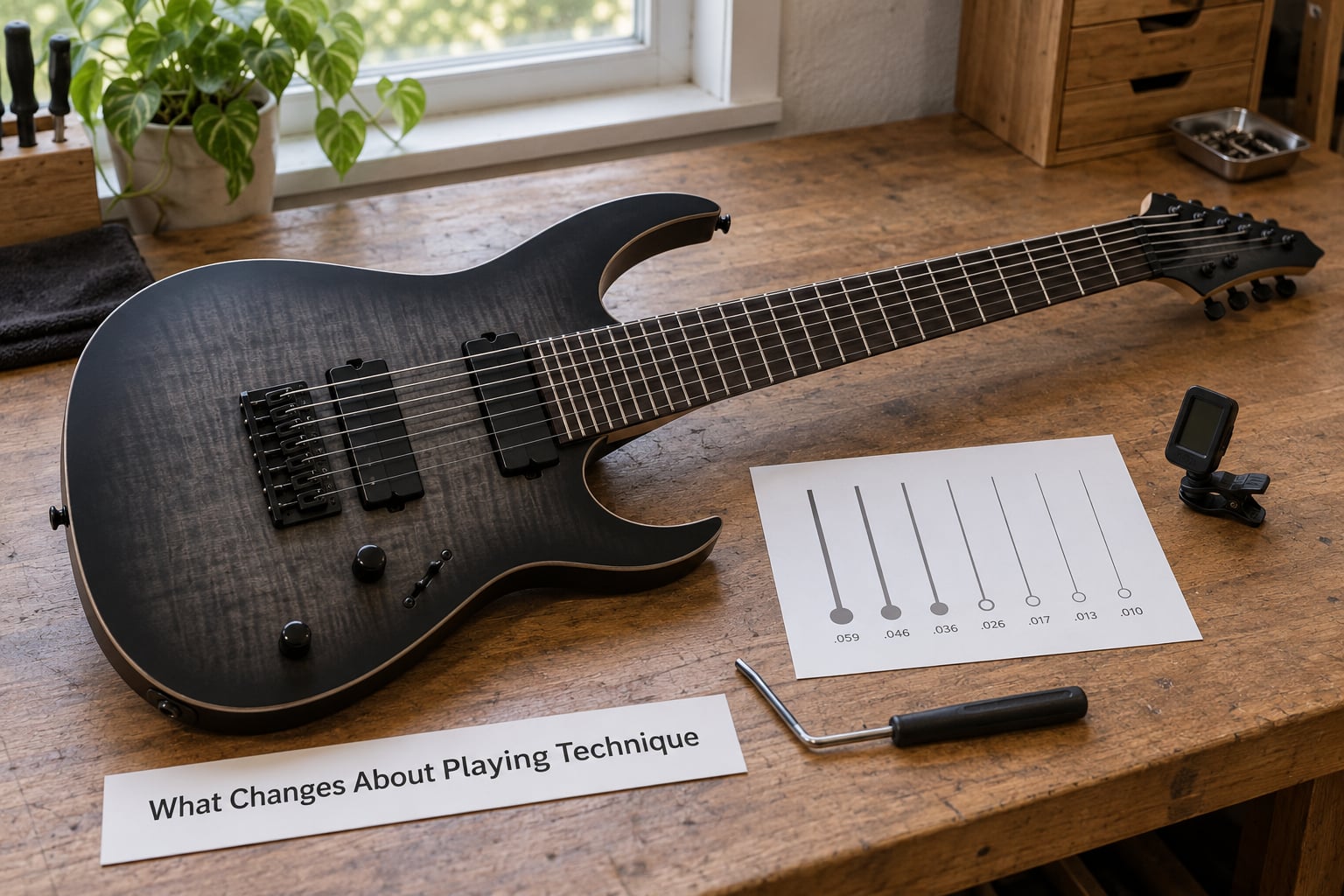
Playing a seven-string feels wider, heavier and slightly stiffer than a six-string, mostly because of scale length and string tension rather than the extra string itself.
| Scale length | Feels like | Comfortable down to | Suits |
|---|---|---|---|
| 25 inch | Standard six-string, fastest | Standard low B | Players who want a familiar neck and mostly play low B |
| 25.5 inch | Slightly longer, still nimble | Standard low B, some drop A | General metal, technical playing, the most common choice |
| 26.5 inch | Noticeably longer, more solid | Drop A, drop G sharp | Modern low-tuned riffing, the most common modern choice |
| 27 inch | Long, wide, slow-moving | Drop G sharp, drop F sharp | Djent and extreme low tuning |
Scale length is the number that determines how low a string can go before it buzzes or goes slack, and it is the single most useful spec to know when comparing two seven-strings.
A few practical things change. The neck is wider, so a standard chord grip does not fit the same way, and full six-string chord shapes become a genuine stretch across the added string. Fretting the low string takes more pressure, and players moving from a six-string usually need a lighter gauge or a slightly higher action to keep it clean. Alternate picking gets tighter because the extra string sits at a different angle, so the pick path needs a small adjustment rather than a wholesale change.
Muting changes most of all. A six-string sits on your thigh or against your body. A wide seven-string often has to sit on the lower bout, and if you do not mute the low string with your picking-hand side it will ring through the whole riff. Players report that this adjustment takes longer than switching to drop tunings does.
String changes are also a real routine change. Seven-string sets are costlier and take longer, and moving between drop A and drop G sharp means a string change rather than a tuner twist.
Which Metal Styles Benefit Most from Seven Strings
Death metal, extreme metal, technical metal, djent and progressive metal lean hardest on seven-strings, because their riffs and chord work are written in the register the instrument adds.
Death and extreme metal put the low string under pedal tones and root notes almost continuously, which is the most direct match between style and instrument. Djent relies on low-root riffs played with a hard attack, where the thickness of the bottom voice is the entire point. Technical and progressive metal use the extra span for wide-interval lead lines and for chords voiced further down the neck than a six-string allows. Modern metal generally sits a step below where nu metal did, and the tunings moved with it.
It is worth saying the instrument is a production choice, not a genre requirement. Some of the heaviest bands in the world are firmly six-string. Slipknot, for instance, are best known for six-string instruments and their signature models, and the same goes for a good share of thrash, groove and punk-leaning metal. Plenty of players own both and reach for whichever the song needs.
Are Seven-String Guitars Better Than Six-String Guitars
Neither is better in general. A seven-string wins on range and low-end definition, and a six-string wins on weight, price, chord vocabulary and the sheer number of songs you can play without thinking about it.
On tone, the seven-string is not automatically thicker. Its advantage shows up when a low string is actually being played; strum a clean six-string part on a seven-string and the difference is much smaller than the marketing suggests. On range, the seven-string wins outright, since a standard six-string cannot reach a low A no matter what you do to the tuning.
On ergonomics the six-string wins comfortably. It is narrower, lighter, cheaper to string and set up, and every scale, chord and tutorial you have ever learned applies without adjustment. Tuning flexibility favours the seven-string, since you can drop it in seconds where a six-string needs a full restring and a setup to change pitch.
For a player who does not regularly write or perform low-register material, a six-string is the better instrument. That covers most beginners, most blues and jazz players, and a large share of metal players who work in standard tuning.
What to Consider Before Buying or Switching
Decide by how low you intend to go and by what you are already used to, because those two answers narrow the choice quickly.
Standard low B only? A 25.5 inch seven-string is the safest buy, and it will feel closest to a familiar guitar. Drop A and below? Look at 26.5 inch, because that is where the low string stops buzzing without a fight. Drop G sharp and lower? 27 inch and up, with a setup that suits a serious string gauge.
String gauge matters more than most buyers expect. Moving from a light set to a heavy set is the single biggest adjustment in feel, and it is what usually causes buzzing complaints. Pick a gauge that suits the tuning you will actually live in rather than the lowest tuning you might visit once.
A few other specs worth checking: bridge design and how it handles string tension at low pitches, nut width, whether the neck is multi-laminate or one-piece (multi-laminate tends to be stiffer and more stable in heavy gauges), pickup configuration and whether the neck pickup covers the added string, and how many frets there are. Twenty-four frets at 26.5 inches puts the highest fret somewhere near where a standard six-string reaches, which is a nice check on how the two ends compare.
Borrow one first if you can. An hour with somebody else’s seven-string tells you more about whether you want to live with the width than any specification will. And go to a shop for a proper setup, not a string change, because a low-tuned seven-string needs relief and truss rod adjustment that a standard six-string never will.
Frequently Asked Questions
Do metal guitarists only use seven-string guitars because they need very low notes?
Low register is the reason, but it is not the only benefit. The added string also gives low-root power chords a real fundamental underneath, opens up chord inversions you cannot voice on a six-string, and widens the interval distances available for lead playing. It also means one instrument covers both a low riff and a high solo in the same song, with no retuning between them.
Is a seven-string guitar harder to play than a six-string guitar?
For the first few weeks, noticeably. The neck is wider, the scale is longer, and full six-string chord shapes have to be reworked around the added string. Fretting the low string takes more pressure and muting takes practice. Players coming from a six-string usually find alternate picking comes back fastest, and the shapes feel normal within a few months of steady playing.
Does a seven-string guitar have the same range as a bass guitar?
No, though it overlaps more than most people expect. A four-string bass in standard tuning opens at E1. A seven-string in standard low B opens at B1, so its range already reaches below a standard bass and extends far above it. In drop A it goes lower still. The overlap is what lets one guitarist cover both a bass part and chords in a solo setting.
What is the most common seven-string guitar tuning?
Standard low B, with the strings tuned B1-E2-A2-D3-G3-B3-E4, is the most common and is what most players start on. Progressive and technical players often stay there because every standard shape still works. For heavier riffs, drop A is the most common single step below, followed by drop G sharp and drop F sharp in bands that want more weight.
Can you play normal six-string songs on a seven-string guitar?
Yes, because every note a six-string can play exists on a seven-string. The shapes are the same and the upper six strings are tuned identically to standard. What changes is the extra string underneath, which makes open six-string chord shapes awkward unless you mute it, and some full six-string grips do not fit across the wider neck. Songs with wide stretches need reshaping, not relearning.
Does using a seven-string guitar make a guitarist better at metal?
Not on its own. What improves is the range of things you can write, and range pushes you into better practice: muting discipline, left-hand strength, and learning to hear where a part belongs. Plenty of excellent metal guitarists play six-strings only. The instrument helps when the music you want to write lives below the standard low E, and it is just a wider stick to hold otherwise.
The honest summary is that a seven-string is range you can hear. The seventh string puts a low B under the standard six, drop tunings take that string lower without disturbing the shapes you already know, and a longer scale length keeps the low end tight instead of slack. That is what lets a rhythm part sit under the band, a chord carry weight, and a high solo happen in the same song on the same instrument.
If you are starting out, learn on a six-string. The shapes, the fretting, the muting and the songs are all easier there, and none of that knowledge is wasted. Move to a seven-string when you hear a riff you cannot currently play, which is the honest reason most players get there.
And when you do, decide the tuning first. The tuning decides the scale length, the scale length decides the gauge, and the gauge decides how the instrument feels under your hands. Get that chain right in a shop, with a proper setup, and the width stops being the thing you notice.