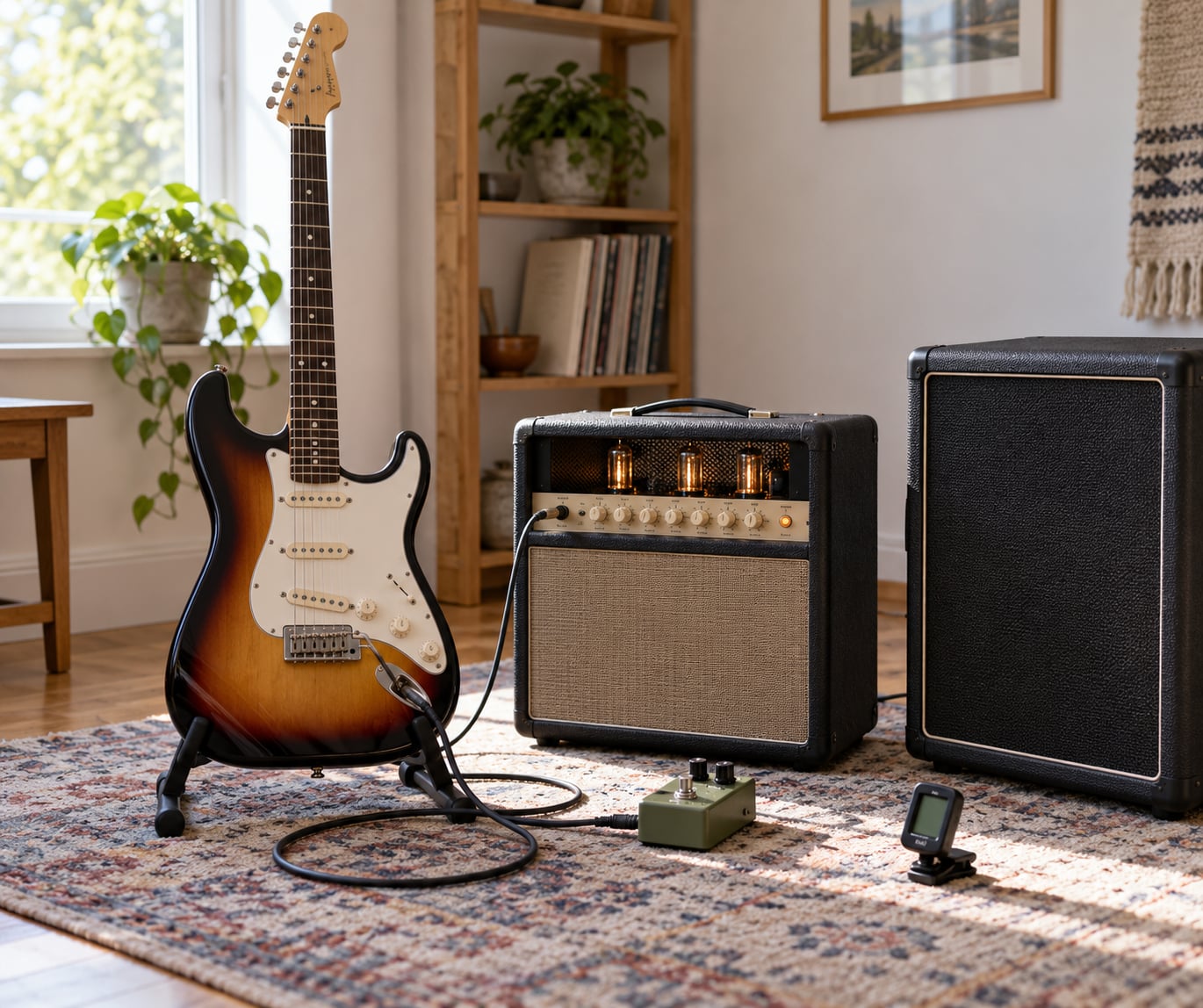
A heavy guitar tone is weight in the low end, bite through the midrange, notes that stay separate when you riff fast, and sustain that holds a note for a second after you let go. You get it from tuning, pickup choice, a sensible gain structure and an EQ window you set by ear, then reinforce with palm-muted playing. Turning the gain knob to ten gets you a noisy buzz, not that.
Learning how to get a heavy guitar tone at home is mostly a matter of order of operations. Fix the guitar and the signal chain first, set the amp to a known starting point, then adjust by ear. Nobody dials in a heavy tone in one move.
Table of Contents
- What You Need
- How to Get a Heavy Guitar Tone at Home: Step-by-Step
- Start with the guitar and signal chain
- Set the foundation for how to get a heavy guitar tone at home
- Choose the right amount of distortion
- Shape the tone with EQ and pedals
- Make the cabinet and room work together
- Refine the tone with playing technique
- Test and save your settings
- Fix the tone problems almost everybody hits
- Tips for Different Home Playing Situations
- Frequently Asked Questions
- Do I need a powerful amplifier to get a heavy guitar tone?
- What amp settings should I start with for a heavy tone?
- Is it better to use amp gain or a distortion pedal?
- Why does my heavy guitar tone sound better through headphones?
- How do I make distortion sound clear instead of muddy?
- Can a beginner get a heavy tone with a small practice amp?
- Conclusion
What You Need
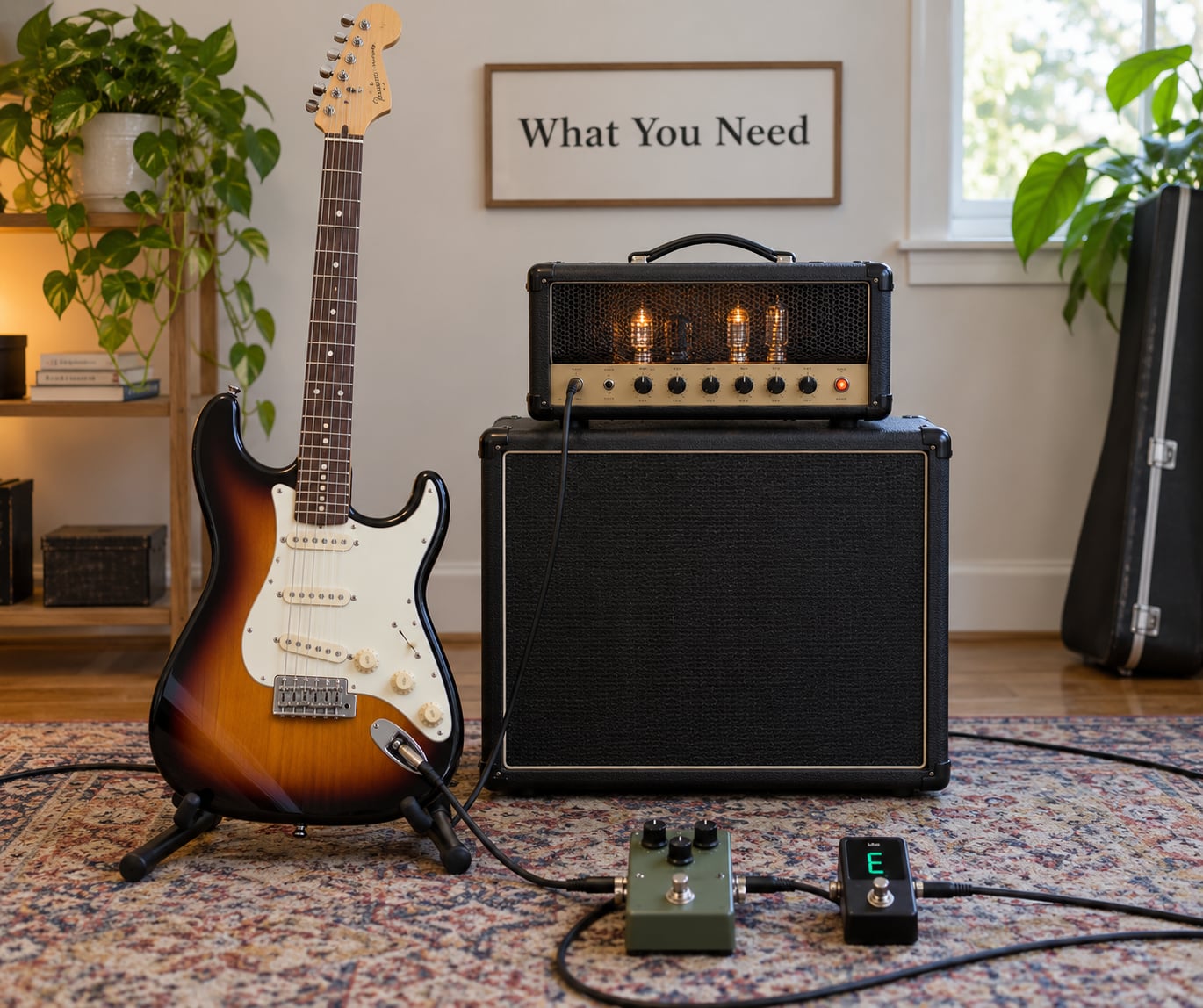
None of this needs to be expensive. It needs to be in the right order.
- An amp with a solid overdrive channel. Any tube or hybrid combo with a dirty channel works. A small practice amp is fine to start, and a modeller plus a cab gives you far more range than a cheap combo ever will.
- A guitar with humbuckers or a hot single coil. Humbuckers in the bridge position give you the midrange thickness most heavy tones are built on. Extended-range tunings and a bridge humbucker cover most of the ground.
- A distortion source. Either the amp’s own gain or a pedal. You need only one at a time, and the order matters more than the pedal.
- A clip-on tuner and fresh strings. Both take five minutes and change how the amp responds more than most players expect.
- A short, decent cable for the guitar to amp run, plus a longer one for the pedalboard. A faulty instrument cable adds noise and cuts highs.
- Optional but useful: a noise gate or noise reduction pedal, an EQ pedal for the moves your amp does not give you, and headphones or an interface with an amp sim for quiet practice.
How to Get a Heavy Guitar Tone at Home: Step-by-Step
The goal through all of this is a clear low end, harmonically rich distortion, controlled sustain, and a tone that fits your room. Not maximum gain. Maximum gain is the single most common reason a beginner’s tone sounds like a hairdryer.
Start with the guitar and signal chain
Before touching the amp, put fresh strings on, tune up, and check that the neck relief and action feel right in your playing position. Floppy low-action action buzzes against the frets and that buzz turns to fizz the moment you add gain.
Situate the pickups correctly too. A bridge humbucker sits around a few millimetres from the strings and gives the tight, cutting top end; a neck humbucker sits further back and adds girth and low-mid weight. Test both against your amp, because a bridge-only setting is the usual cause of a thin tone.
Set your instrument volume at 10 and your tone control around 7 to start. Rolling the guitar tone control back to 4 with the amp wide open is a reliable way to take the fizz off without touching the EQ.
Then order the pedals correctly: tuner first, noise gate second, overdrive or distortion third, EQ and boost last, time effects at the very end. A boost after distortion pushes the signal further into clipping, which is where the amp’s gain would have gone anyway.
Set the foundation for how to get a heavy guitar tone at home
Write these numbers down on a piece of tape and stick it to your amp. On a 0 to 10 scale, a solid heavy starting point is gain 7, bass 6, middle 5, treble 7, presence 6, master volume wherever your room allows.
That shape is not a guess. A database of 263 catalogued metal tones puts the median gain at 7.5, with bass at 6, middle at 5 and treble at 7. Guitarists on Reddit reach for the same intuition in words: bass a touch under halfway, mids and treble a touch over, roughly 5-7-5.
Treat those numbers as the first position on the dial, not the destination. Play a riff you know by heart, then move one knob at a time and listen to the note separation, not the overall volume.
Choose the right amount of distortion
There are three useful levels of dirt. Clean is the amp flat out. Crunch is a lightly broken-in overdrive, which is what most riffs on early thrash and groove metal records actually use. Saturated is preamp gain pushed until the waveform flattens, the notes get thick and round, and the sustain stretches out.
Most people at home skip straight to saturated because that is the sound in their head. Start at crunch, confirm the low string notes stay separate, and only then add gain.
Preamp gain and power amp gain do different things. Preamp gain adds compression and harmonic content, which is where the thickness comes from. Power amp gain gives louder, looser, springier distortion. In a practice room, preamp gain is almost always the more useful one, because you can reach it without the neighbours joining in.
Shape the tone with EQ and pedals
Scooped EQ is the signature of most heavy guitar sounds: less low end, less midrange, more top end, so the guitar carves a hole in the middle of the mix instead of fighting the bass and the kick.
Two pedals earn their place in most home setups. An overdrive, in the vein of a Tube Screamer, adds midrange punch when placed before a dirty amp channel and used as a boost; it tightens a tone the same way a tube amp does, which is why it works so well into a solid-state dirty channel. An EQ pedal with a sweepable midrange lets you carve space without the amp.
Compression sits after the gain stage to even out note volume on fast palm-muted passages. Noise reduction or a gate is the quiet fix for hiss at high gain: set it so it closes only between notes, not during sustain.
Pedals into an already-saturated channel is where a lot of home tones die. A distortion pedal into a channel that is at full gain gives you a compressed, lifeless sound. Put the amp’s gain at around 5, leave the pedal in front, and let the pedal do the clipping.
Make the cabinet and room work together
Cabinet choice does more to the character of a heavy tone than most players expect. A closed-back 4×12 gives the tight, punchy low end most modern metal relies on. A closed-back 2×12 sounds rounder and more old-school. A 1×12 cab is the most forgiving option in a small room because the low end has less surface to pile up on.
Never put a guitar cab on a desk, a bed, or anything soft. The cabinet needs to be coupled to something solid or the low end collapses, and that is a real reason some bedroom amps sound thin at any setting.
Position matters too. A cab pushed into a corner gets more low end bounce, which sounds exciting in the room and muddy on a recording. An inch or two off the wall and raised onto a stand gives a tighter result.
For recording at home, a Shure SM57 placed slightly off the cone centre, not dead centre, picks up more of the upper midrange and less of the honky centre. If you have an audio interface and no loud cab, capture a clean DI signal and re-amp it later through a different cabinet or an impulse response. Line 6 Helix, Boss Katana and Kemper units all load real cabs, and the Neural Amp Modeler does convincing work on a plain interface.
Refine the tone with playing technique
Here is the part that changes perceived heaviness more than any knob. Palm muting the low strings during a riff tightens the low end, because damped strings stop ringing and give the amp a cleaner, punchier transient. Rest the edge of your picking hand firmly on the strings by the bridge.
Pick angle sets the tone too. Strumming closer to the bridge produces a thinner, sharper, more aggressive note. Near the neck you get a warmer, thicker sound. Pick slightly flatter than you think you should, and use the downstroke for accents.
Guitar volume control is an effects pedal you already own. Rolling back to 5 for fast passages cleans up the low end. Let a note sustain fully for leads and solos, and the same patch sounds twice as thick.
Test and save your settings
Run three tests before you decide anything. Play a palm-muted riff at the speed you actually play it, and listen for note separation. Play a slow riff with your ring hand off the strings, and listen for whether the low notes blur together. Play a melody line and check that the sustain holds without fizzing out.
Then write the settings down. Amp, channel, all six knobs, guitar volume and tone, pickup position, tuning, and which pedals were in or out. Photograph the pedalboard with your phone if you cannot remember the order.
This is the step that pays off. Every serious player ends up with three or four named patches they trust, and none of them were found by accident.
Fix the tone problems almost everybody hits
Almost every bad heavy tone at home is one of five problems, and each has a specific fix.
Muddy. The low end is thick and the riffs disappear. Drop the bass from 6 to 4, raise the middle from 5 to 6, and check whether you are actually palm muting. If you downtuned, a heavier string set also helps, because thin strings in a low tuning give the amp a flabby fundamental to work with.
Fizzy at high gain. The top end crackles and turns harsh as you turn up. Turn the presence down, move the guitar tone control from 7 back to 5, and try the neck pickup instead of the bridge. Some fizz is preamp clipping; some of it is the guitar, and the fix is different for each.
Harsh and in-your-face. A tight scooped curve has swung too far. Bring the bass back from 4 to 5 and pull the middle down to 4, then check the amp is not also set to presence 10.
Thin. Often a single-coil pickup in a humbucker song, or the bridge pickup only with the guitar tone at 3. Try the neck pickup, raise the guitar tone to 8, and turn the bass to 7.
Noisy. Gate or noise reduction set too high is chopping sustain off every note. Back the threshold off so it closes in the gaps only, and confirm your instrument cable is sound.
For a starting point per style, thrash usually sits around gain 5, bass 6, middle 5, treble 7, which is closer to the JCM800 2203 sound; death metal runs gain 8 with bass 5, middle 5, treble 6; metalcore tends toward gain 8, bass 4, middle 6, treble 8 for a tighter, more scooped feel; groove metal sits near gain 5, bass 7, middle 5, treble 6; sludge is gain 7, bass 8, middle 4, treble 3, deliberately loose and slow. Those are starting positions on a 0 to 10 scale, not rules.
Tips for Different Home Playing Situations
In an apartment. Master volume around 4, a closed-back 1×12 or a small practice amp, and a heavier string gauge to compensate for the weight you cannot add with volume. Record or practise through headphones at low volume so you can hear detail the room hides.
In a bedroom. Put the cab on a stand off the wall and keep the room soft rather than hard. A duvet on the wall behind you absorbs some of the low-end buildup and makes the tone sound tighter as you play.
Through headphones. Heavy tone often sounds better in headphones because the low end is present without the room smearing it, which is why a tone that feels muddy in the room can sound huge on your ears. If it sounds too clean, a cab or IR with more midrange push brings back the weight.
With an interface and amp sim. This is the strongest home setup by a distance. Turn the amp sim’s gain up as high as it will go without clipping the input, and control volume in your monitoring software rather than in the sim.
Before a louder rehearsal. Pick two or three patches and learn to get between them with the guitar volume knob alone. Nobody in a rehearsal room can hear a subtle EQ change, but everybody can hear a dropped note.
One last thing worth knowing: heavy tone often sounds thin on phone speakers and earbuds, because those cannot reproduce the low end you spent an hour dialling in. Judge your tone on headphones, monitors or another guitar, not on a phone.
Frequently Asked Questions
Do I need a powerful amplifier to get a heavy guitar tone?
No. Tone is mostly a function of preamp gain and EQ, not power. A five-watt practice amp with a good overdrive channel can dial in a heavy tone using the settings in this guide, as long as the cabinet is coupled to something solid. Add power only when you want stage volume. If you have an audio interface, a modeller and a cab give you more usable range than any small combo.
What amp settings should I start with for a heavy tone?
On a 0 to 10 scale, start at gain 7, bass 6, middle 5, treble 7 and presence 6, with master volume wherever your room allows. That is close to the median of 263 catalogued metal tones, which sit around gain 7.5, bass 6, middle 5 and treble 7. Move one knob at a time and listen for note separation rather than overall loudness.
Is it better to use amp gain or a distortion pedal?
Each does a different job. Amp gain gives you harmonic density and sustain you can dial in slowly, and it never disappears when you turn up. A distortion pedal clips harder and reacts to how hard you pick, which makes it good for leads and accents. Running a pedal into a channel that is already saturated sounds flat, so drop the amp gain to around 5 when the pedal is on.
Why does my heavy guitar tone sound better through headphones?
Headphones remove the room’s low-end buildup, so the frequencies you spent time dialling are heard without smear. The same tone can sound thin on phone speakers because they cannot reproduce low frequencies at all. Judge your tone in headphones or on monitors, and treat phone playback as a worst-case test rather than a reference.
How do I make distortion sound clear instead of muddy?
Clarity comes from low gain, a scooped EQ and a tight picking hand. Lower the bass from 6 to around 4, raise the middle to 6, and palm mute the low strings so they stop ringing into each other. If it is fizz rather than mud, pull the presence back and move the guitar tone control from 7 to 5. Fizz and mud come from opposite fixes, so work out which one you actually have.
Can a beginner get a heavy tone with a small practice amp?
Yes, and it is a normal place to start. Set the overdrive channel to gain 5, add a distortion or overdrive pedal in front if the channel saturates too early, and keep the EQ in the 5-7-5 region. The limits of a small amp are volume and low-end headroom, not character. Plenty of players build a complete tone on a practice amp before they ever own a full-size cabinet.
Conclusion
Set the amp to gain 7, bass 6, middle 5, treble 7 and presence 6, drop the guitar volume to 5 to clean up the low end, and palm mute a riff you know. Then move one knob at a time and write down anything that works. Add pedals only after that baseline is solid, and remember this guide was updated for 2026 with settings you can try tonight on gear you already own.